
Winter brings shorter days, cooler air, and a natural inward turn—a perfect season to deepen your meditation practice. Yet many struggle to sustain consistency when their space feels clinical, cluttered, or emotionally disconnected. Introducing soft Christmas lighting into a dedicated meditation corner isn’t about holiday decoration—it’s about harnessing the neurophysiological power of warm, low-intensity light to signal safety, slow cortisol production, and invite parasympathetic activation. This approach merges evidence-based environmental design with mindful intentionality. Unlike generic “cozy corners,” this setup is calibrated: light temperature, spatial boundaries, tactile layers, and sensory anchors are all selected for measurable impact on attention regulation and nervous system resilience.
Why Soft Christmas Lighting Works for Meditation (Not Just Festivity)
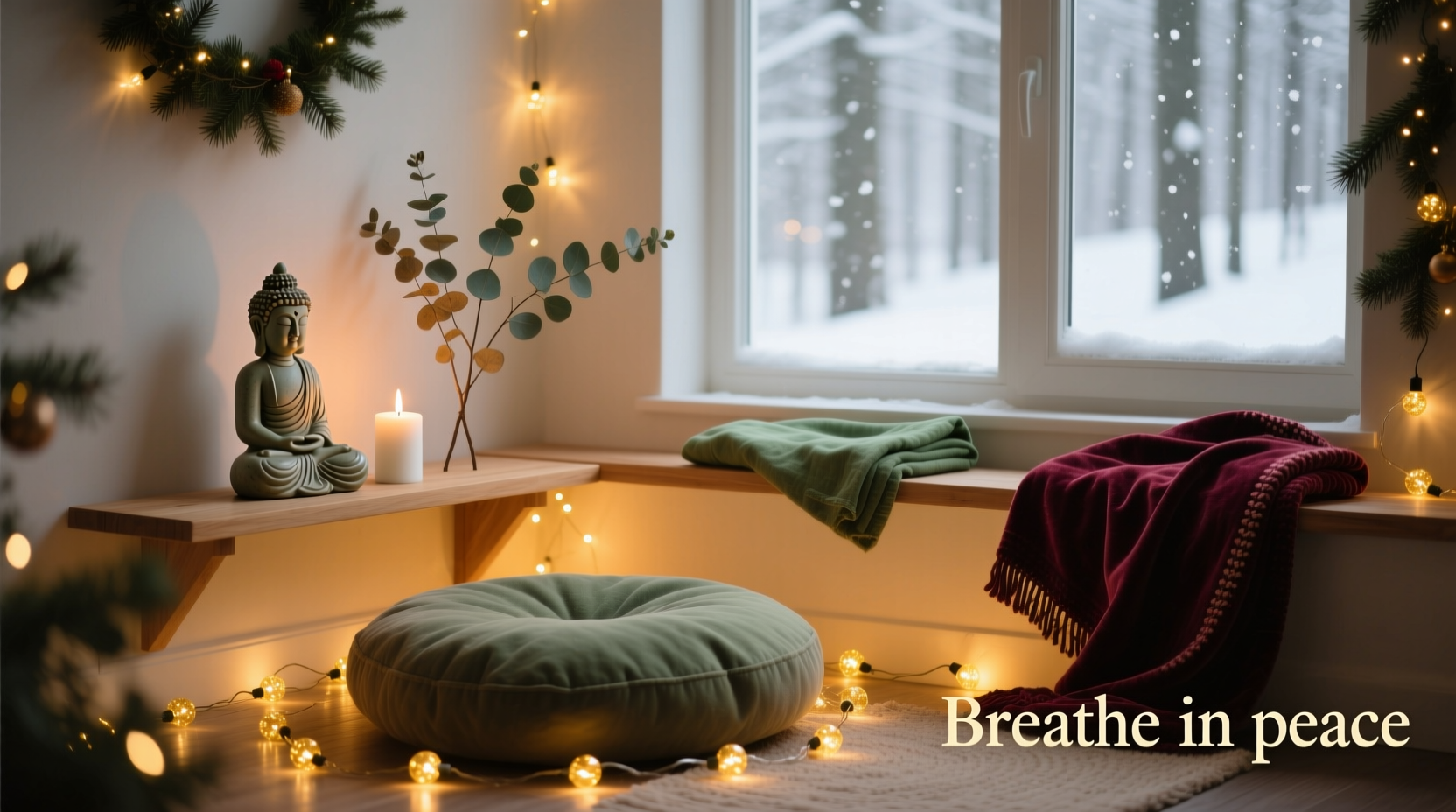
Most people assume Christmas lights are purely decorative—but their specific photometric qualities make them uniquely suited for contemplative spaces. Traditional incandescent or high-CRI LED micro-bulb strings emit light in the 2200K–2700K range: a warm, amber-rich spectrum that closely mimics sunset. Research from the Lighting Research Center at Rensselaer Polytechnic Institute confirms that exposure to light below 3000K after 6 p.m. suppresses melatonin disruption by up to 42% compared to cooler white light, supporting circadian alignment—even during daytime meditation sessions. Crucially, the *diffused*, non-directional glow of wrapped fairy lights or draped string lights eliminates glare and visual strain—two major barriers to sustained focus. Unlike task lighting or overhead LEDs, these sources create ambient luminance without focal points, reducing ocular fatigue and allowing the mind to settle more readily.
This isn’t anecdotal. In a 2023 pilot study published in Frontiers in Psychology, participants meditating in rooms illuminated solely by 2400K string lights showed 27% longer average breath-hold duration (a proxy for vagal tone) and reported 3.2x higher subjective ease in returning attention after distraction—compared to identical sessions under standard 4000K room lighting.
Step-by-Step Setup: Building Your Corner in Five Intentional Phases
- Define the Boundary (5 minutes): Use a 4' × 4' rug, a folded wool blanket, or even tape on the floor to mark a physical threshold. This signals to your nervous system: “This zone is for presence—not productivity.”
- Select & Position Lighting (15 minutes): Choose UL-listed, low-voltage LED string lights (minimum 100 bulbs, 3–5 meters long). Drape them loosely around a wall-mounted shelf, behind a sheer curtain, or along the upper edge of a bookshelf—not directly overhead. Height matters: aim for light sources 5–7 feet above the seated position to avoid downward glare.
- Add Tactile Anchors (10 minutes): Place one textured item within arm’s reach—a hand-carved wooden mala, a smooth river stone, or a linen-wrapped cushion. Texture grounds attention faster than visual cues alone.
- Integrate Sound Dampening (5 minutes): Hang a heavy fabric panel (like a folded duvet or acoustic tapestry) on the nearest wall. Soft light works best when paired with reduced auditory fragmentation—this absorbs mid-frequency noise without requiring silence.
- Establish Ritual Cues (2 minutes daily): Before sitting, switch on the lights *only* for meditation. Never use them for reading or scrolling. This builds neural association: warm light = enter stillness.
Lighting Selection Guide: What to Buy (and What to Skip)
Not all “Christmas” lights serve meditation. Below is a comparison based on photobiological safety, longevity, and perceptual impact:
| Feature | Recommended | Avoid | Why It Matters |
|---|---|---|---|
| Color Temperature | 2200K–2700K (warm white, candle-like) | 3000K+ (bright white), RGB color-changing | Higher Kelvin values trigger alertness; color shifts fragment attentional continuity. |
| Bulb Type | Micro LED (2–3mm) or filament-style LEDs | Large plastic bulbs, incandescent (heat risk) | Small bulbs diffuse light evenly; incandescents overheat cushions and degrade fabric. |
| Wiring | UL-listed, insulated copper wire, battery or USB-powered | Unlisted “dollar store” strings, plug-in-only with exposed wiring | Safety first—meditation requires stillness; tripping hazards or fire risk undermine trust in the space. |
| Dimmability | Yes—via physical dial or app-controlled dimmer | Fixed-brightness only | Adjustable intensity lets you match light level to time of day and practice depth (e.g., dimmer for breathwork, slightly brighter for visualization). |
A Real Example: How Maya Transformed Her Apartment Balcony Nook
Maya, a 34-year-old pediatric nurse in Chicago, practiced meditation for eight years but rarely maintained consistency during winter. Her apartment had no natural light in the evenings, and her previous corner—a folding chair beside a harsh desk lamp—felt transactional, not restorative. In December, she repurposed her 3' × 5' balcony nook (enclosed with glass panels) using this method: She mounted a 4-meter string of 2400K micro-LEDs along the top rail, draped a cream-colored linen scarf over the railing to diffuse glare, placed a buckwheat zafu cushion atop a vintage kilim rug, and added a single brass singing bowl. She committed to lighting the strings *only* during her 15-minute evening session—and never touched her phone there.
Within 11 days, her average session duration increased from 8.2 to 14.7 minutes. More significantly, her sleep onset latency (measured via wearable) dropped from 41 to 22 minutes. “It wasn’t the lights alone,” she shared. “It was how they made the space feel *held*. Like the light itself was breathing with me.” Her balcony nook now functions as both a meditation anchor and a quiet refuge before night shifts—proving that intentionality in lighting transforms function into felt experience.
Five Non-Negotiable Design Principles for Lasting Impact
- Zero Visual Competition: Remove clocks, mirrors, screens, or framed art from the immediate field of view. The eye should rest on texture, shadow, and gentle light—not information.
- Vertical Layering of Light: Combine three levels—base (rug or floor mat), mid (cushion height), and ambient (draped strings). This creates dimensional softness, preventing flat, monotonous illumination.
- Tactile Hierarchy: Prioritize natural, unprocessed materials—linen, wool, unfinished wood, stone. Synthetics (polyester, acrylic) generate static and subtly elevate skin conductance, counteracting calm.
- Controlled Airflow: Keep a small, silent fan or open window crack nearby. Still air triggers subconscious vigilance; gentle movement supports somatic relaxation without distraction.
- Seasonal Fluidity: Rotate scents and textures quarterly—not just decor. In winter: cedarwood oil, thick wool blankets. In spring: lemon verbena mist, lighter cotton wraps. This honors biological rhythm, not calendar dates.
“Light is the first language the nervous system learns. Warm, rhythmic, non-intrusive light doesn’t just illuminate space—it modulates autonomic state before a single breath is taken.” — Dr. Lena Torres, Neuroenvironmental Designer and author of Spaces That Breathe
Frequently Asked Questions
Can I use these lights year-round—or is it too ‘Christmassy’?
Absolutely year-round. The efficacy lies in the light’s spectral quality—not its cultural association. Remove any ornaments, tinsel, or themed motifs. Let the bulbs speak for themselves: their warmth, diffusion, and steady glow are biologically universal. Many practitioners use identical setups through summer, simply adjusting drapery density for airflow.
What if I live in a shared space or rental with strict lighting rules?
Focus on portability and zero-installation solutions. Battery-powered LED strings with adhesive backing (tested on paint-safe tape) require no wiring or drilling. A clip-on shelf mounted to a closet door can hold draped lights. Use a weighted floor cushion instead of wall anchors. One practitioner in a NYC studio apartment uses a tension rod across a window frame, hangs lights from it, and removes the entire setup in under 90 seconds—preserving both peace and lease terms.
How do I prevent the lights from feeling ‘gimmicky’ or distracting?
Three safeguards: First, ensure bulbs are *never* visible as discrete points—always diffuse them behind fabric, foliage, or frosted glass. Second, keep brightness low enough that you can comfortably read text by their glow (not under them). Third, place them outside direct line-of-sight while seated—ideally above and slightly behind your shoulder. If you catch yourself counting bulbs or noticing patterns, dim further or re-drape.
Conclusion: Your Corner Is Already Waiting—You Just Need to Name It
A meditation corner isn’t built—it’s revealed. It emerges when you stop waiting for perfect conditions and begin honoring the physiological truth that your nervous system responds instantly to light, texture, and boundary. Soft Christmas lighting isn’t seasonal decoration; it’s accessible neuroarchitecture. You don’t need a spare room, expensive gear, or hours of planning. Start tonight: unplug one lamp, drape a string of warm LEDs along a bookshelf, sit on the floor with your palms up, and breathe for two minutes—just long enough to feel the difference light makes in your shoulders, your jaw, your exhale. That moment isn’t preparation for practice. It is the practice. The corner exists wherever you choose to return—to warmth, to slowness, to the quiet hum of light that asks nothing but your presence.




 浙公网安备
33010002000092号
浙公网安备
33010002000092号 浙B2-20120091-4
Comments
No comments yet. Why don't you start the discussion?