
In a season often defined by excess—layers of tinsel, blinking lights, and ornaments from every era—a growing number of homeowners are choosing restraint. The minimalist Christmas tree has emerged not as a compromise, but as a deliberate design statement: refined, intentional, and deeply calming. At the heart of this trend is a single powerful idea—using only monochrome ornaments to create visual harmony, depth, and elegance.
A monochrome scheme doesn’t mean dull or lifeless. On the contrary, when executed with care, a black-and-white (or grayscale, or even all-silver) tree can radiate sophistication, texture, and quiet drama. This approach strips away visual noise, allowing form, light, and material to take center stage. Whether your style leans mid-century modern, Scandinavian, industrial, or contemporary, a monochrome ornament palette offers unmatched versatility.
The key lies in understanding that minimalism isn't about subtraction alone—it's about curation. Every ornament must earn its place. With thoughtful selection and strategic placement, you can craft a holiday centerpiece that feels both festive and serene.
Why Choose Monochrome for a Minimalist Tree?
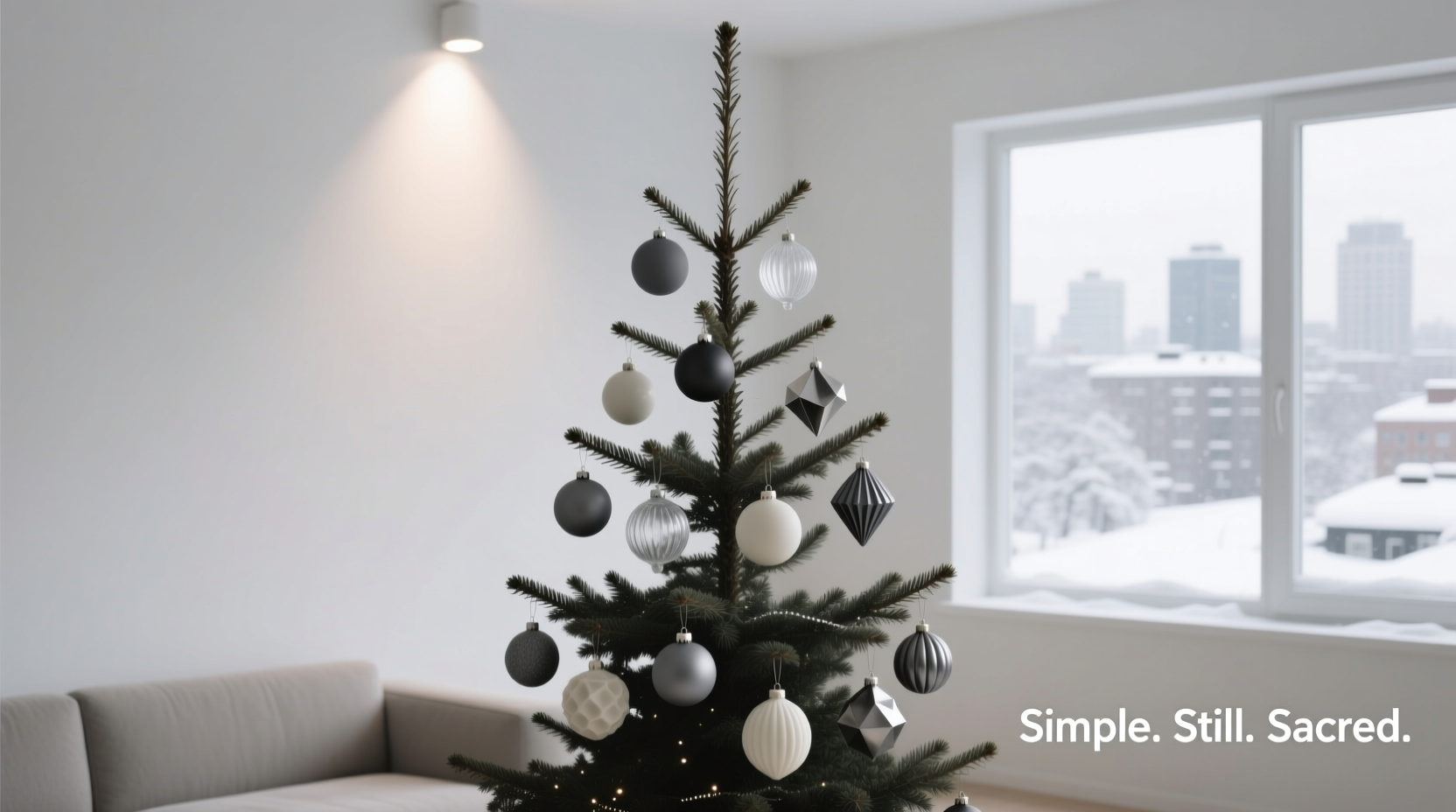
Color psychology plays a significant role in holiday decor. Traditional reds and greens evoke warmth and nostalgia, but they also increase visual stimulation. For those seeking a calmer, more contemplative atmosphere, monochrome provides a compelling alternative.
Monochromatic design uses variations in tone, shade, and texture within a single color family. In the context of Christmas trees, this typically means black, white, gray, silver, or gold-only schemes. These palettes reduce cognitive load, creating a sense of order and balance. According to interior designer Clara Nguyen, “A monochrome tree acts like a blank canvas—it lets architecture, lighting, and surrounding decor speak louder.”
Beyond aesthetics, there’s a practical benefit: longevity. A monochrome tree transcends trends. Unlike themed trees (think snowmen or Santa villages), a minimalist setup won’t feel dated in five years. It integrates seamlessly into any room year after year, regardless of evolving tastes.
“Minimalism in holiday decor isn’t about having less. It’s about making what you have matter more.” — Clara Nguyen, Interior Designer & Author of *Calm Spaces*
Step-by-Step Guide to Building Your Monochrome Tree
Creating a cohesive monochrome tree requires planning and precision. Follow these steps to achieve a polished, professional result.
- Choose your base color palette. Decide whether you’re going full black-and-white, grayscale, all-metallic, or another variation. Each creates a different mood:
- Black & White: Bold, graphic, modern.
- Grayscale: Subtle, layered, sophisticated.
- All Silver: Icy, reflective, elegant.
- All Gold: Warm, luxurious, opulent (still counts as monochrome if no other colors appear).
- Select a tree that complements the theme. A frosted or lightly flocked tree enhances a wintry monochrome look. Alternatively, a lush green tree provides contrast against stark ornaments. Artificial trees with slim profiles work especially well for tight spaces and clean lines.
- Limit light choices. Use warm white or cool white LED string lights only—no colored bulbs. For maximum minimalism, consider clear wire lights or even fairy lights tucked deep within branches to create a soft internal glow.
- Curate your ornaments. Stick strictly to one color family. Include a mix of finishes—matte, glossy, metallic, textured—to add dimension without introducing new hues.
- Arrange with intention. Distribute ornaments evenly but not symmetrically. Cluster similar shapes together for impact, then vary size and texture throughout. Avoid overcrowding; leave space between pieces to let each one breathe.
- Add a simple topper. Skip elaborate stars or angels. Opt for a geometric shape, a twisted ribbon bow in your color scheme, or a single large metallic orb.
- Complete the base. Use a solid-colored tree skirt—black velvet, white linen, or silver lamé. Avoid patterns or trims with contrasting colors.
Ornament Selection: Quality Over Quantity
In a monochrome scheme, every ornament becomes a focal point. There’s nowhere to hide weak pieces. Prioritize craftsmanship, material diversity, and tactile interest.
Focus on at least three types of textures to prevent flatness:
- Glass: Reflective, classic, available in matte or shiny finishes.
- Metal: Polished silver, brushed nickel, or blackened steel for industrial flair.
- Felt or Wool: Matte, soft spheres in charcoal or cream add warmth.
- Paper or Cardstock: Geometric origami stars or folded cubes introduce structure.
- Wood: Natural grain adds organic contrast, especially when stained black or painted white.
Shape variety is equally important. Combine spheres, cubes, cylinders, stars, and abstract forms. But maintain consistency in finish—don’t mix high-gloss red-tinted glass with matte black ceramic, for example.
| Ornament Type | Best Finish for Monochrome | Placement Tip |
|---|---|---|
| Large Sphere (4”) | Mirror silver or matte black | Anchor lower branches for weight |
| Mini Cones | White felt with black stitching | Nest near inner branches for depth |
| Geometric Wire Frame | Brushed brass (if gold monochrome) | Hung mid-canopy for light play |
| Photo Ornament | Black frame with white photo | Use sparingly—one per major branch |
| Starburst Design | Silver chrome | Place near top third for visual lift |
Real Example: A Brooklyn Brownstone’s Holiday Transformation
Jessica L., a graphic designer in Brooklyn, wanted a tree that reflected her love of editorial design and clean spaces. Her living room features white walls, black furniture, and brass accents. Last year, she replaced her cluttered multicolored tree with a strict black, white, and silver scheme.
She began with a 7-foot pre-lit artificial tree in \"snow-frosted pine,\" which added subtle sparkle without overwhelming. She used 45 ornaments total—fewer than half her previous count. These included 12 matte black glass balls, 15 white frosted orbs, 8 silver mercury-glass teardrops, and 10 handmade paper snowflakes in varying sizes.
Rather than random placement, Jessica mapped the tree in quadrants. She grouped three black spheres near the base on one side, balanced by three white ones opposite. Silver teardrops were hung vertically along the backplane to catch ambient light. The paper snowflakes were staggered toward the outer tips for movement.
The result was a tree that felt dynamic yet controlled. Guests described it as “like something from a design magazine.” More importantly, Jessica reported feeling less stress during the holidays—her decor no longer clashed with her everyday aesthetic.
Checklist: Building Your Monochrome Tree
Follow this checklist to ensure every element aligns with your minimalist vision.
- ☐ Choose a dominant monochrome palette (e.g., black/white, grayscale, silver)
- ☐ Select a tree type that supports the mood (frosted, slim-profile, or natural green)
- ☐ Use only white or neutral-toned lights (no colored bulbs)
- ☐ Limit ornament count to 30–50 max for a standard 6–7 ft tree
- ☐ Include at least 3 different textures (glass, metal, fabric, etc.)
- ☐ Mix 3–5 shapes (sphere, cube, star, cone, abstract)
- ☐ Avoid patterned ornaments unless in strict monochrome
- ☐ Use a solid-color tree skirt in a matching tone
- ☐ Place larger ornaments lower, smaller ones higher
- ☐ Step back frequently to assess balance and negative space
Frequently Asked Questions
Can I include a pop of green from the tree itself?
Yes—and it’s often encouraged. A natural or artificial green tree serves as a neutral backdrop in a monochrome scheme. The key is ensuring no other colors appear in the ornaments, ribbons, or lights. The green foliage doesn’t break the monochrome rule because it’s structural, not decorative.
Is gold considered monochrome?
Yes, if used exclusively. An all-gold tree—with ornaments, lights, and décor in varying gold tones (rose, antique, bright)—is monochromatic. The same applies to an all-silver or all-black scheme. The principle is unity of hue, not neutrality of color.
How do I keep the tree from looking too cold or sterile?
Introduce warmth through texture and lighting. Use soft materials like wool, felt, or linen in your ornaments or skirt. Opt for warm-white lights instead of cool blue-white. Consider adding a faintly scented diffuser nearby—notes of sandalwood, vanilla, or pine—to enhance coziness without visual clutter.
Final Thoughts: Less Is More, Especially at Christmas
The holiday season often pressures us to do more, buy more, and display more. Yet true celebration lies not in abundance, but in presence. A minimalist Christmas tree adorned with monochrome ornaments invites stillness. It asks the eye to slow down, to appreciate the curve of a glass ball catching the light, the soft shadow of a felt cone, the quiet symmetry of thoughtfully placed design.
This approach isn’t about deprivation. It’s about elevation. By removing the distractions, you amplify what remains. Each ornament becomes meaningful. Each light feels intentional. The tree stops being background noise and becomes a focal point of calm and beauty.
As you prepare your home this year, consider what kind of energy you want to cultivate. If peace, clarity, and timeless style resonate with you, then a monochrome minimalist tree isn’t just a decor choice—it’s a philosophy made visible.




 浙公网安备
33010002000092号
浙公网安备
33010002000092号 浙B2-20120091-4
Comments
No comments yet. Why don't you start the discussion?