
Minimalism during the holidays isn’t about scarcity—it’s about intentionality. When every ornament carries visual weight and every light filament contributes to atmosphere, the Christmas tree transforms from festive backdrop to quiet centerpiece. A minimalist tree built exclusively with white lights and clear ornaments achieves something rare in seasonal decor: serenity with presence. It doesn’t shout joy; it breathes it. This approach works especially well in modern apartments, Scandinavian-inspired homes, monochrome studios, or spaces where visual noise competes with daily calm. More than aesthetic preference, it reflects a deliberate choice—to celebrate tradition through restraint, light through clarity, and abundance through absence.
The Philosophy Behind the White-and-Clear Palette
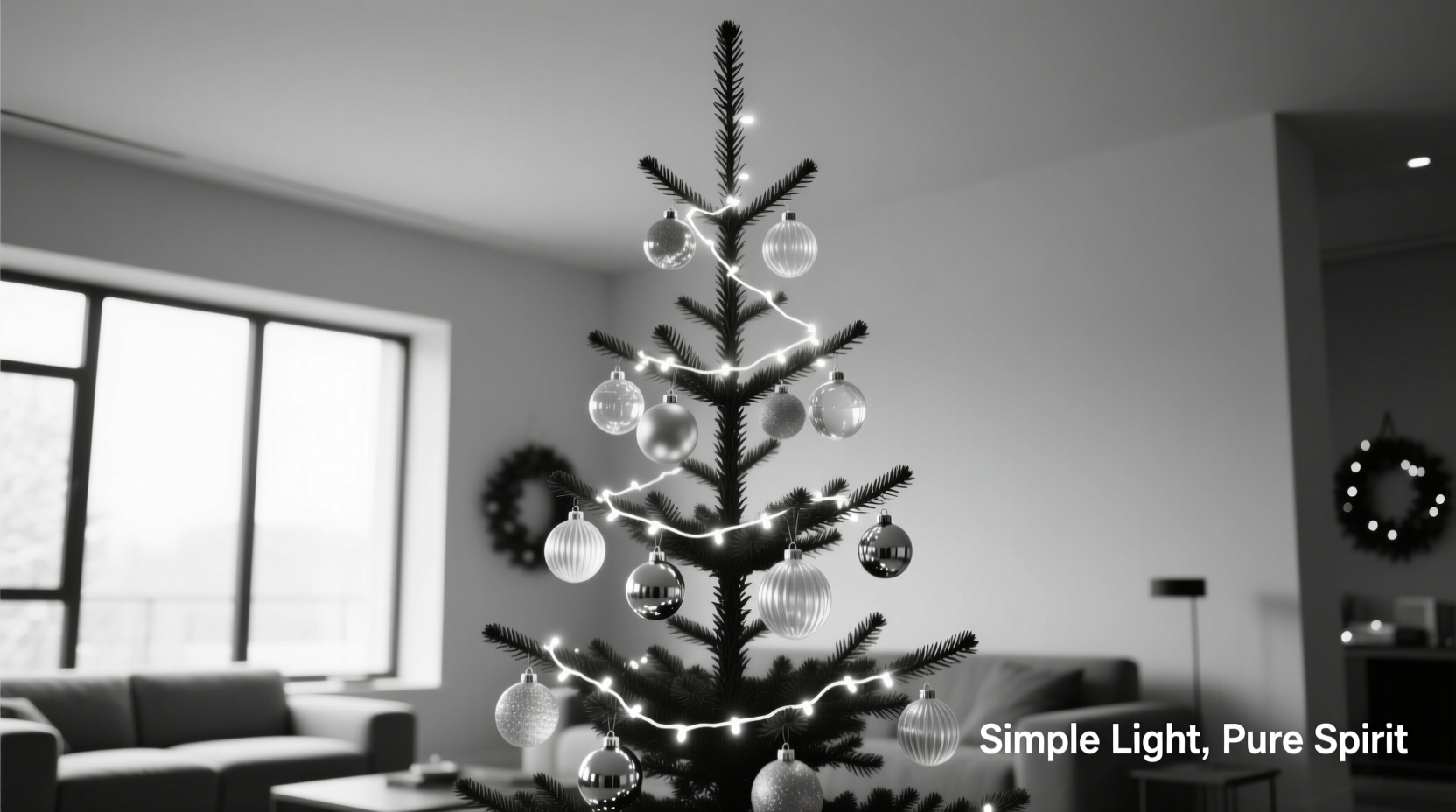
White light—particularly warm-white LED string lights at 2700K–3000K—mimics candle glow without the heat or hazard. Unlike cool-white bulbs that can feel clinical, warm-white emits a soft, enveloping luminescence that enhances texture rather than flattening it. Clear ornaments, meanwhile, are not “empty” or “neutral.” They’re optical instruments: prisms, lenses, and reflectors that capture, bend, and scatter light based on cut, thickness, and placement. A hand-blown glass ball refracts ambient light differently than a faceted acrylic teardrop or a smooth acrylic sphere. Their transparency allows the tree’s natural form—the silhouette of branches, the variation in pine needle density, the subtle green gradient—to remain visible and respected. In this context, the tree isn’t dressed; it’s illuminated and honored.
This palette also sidesteps seasonal fatigue. Red-and-green schemes, while beloved, can feel visually dense after weeks of exposure—especially in small or low-ceilinged rooms. White and clear eliminate chromatic competition, allowing other elements—architectural lines, furniture finishes, even winter daylight—to coexist harmoniously with the tree. As interior designer Lena Voss observes in her book Quiet Spaces: Designing for Emotional Resonance: “The most powerful holiday statements aren’t made with more, but with precision. A single strand of warm-white lights, thoughtfully wrapped, can evoke deeper nostalgia than a dozen competing colors.”
Essential Materials: Quality Over Quantity
Because every component is visible—and there are so few of them—material integrity is non-negotiable. Subpar lights flicker, yellow, or cast uneven pools. Low-grade ornaments cloud, scratch, or distort light. Below is a curated specification table for what to source—and why each detail matters.
| Component | Recommended Specification | Why It Matters |
|---|---|---|
| LED String Lights | Warm-white (2700K), 50–100 bulbs per strand, UL-listed, memory wire or flexible copper-core wiring | Memory wire holds shape without twisting; warm-white prevents sterility; UL listing ensures safety for extended use. |
| Ornaments | Mix of hand-blown glass (2–4\"), faceted acrylic (1.5–3\"), and smooth acrylic spheres (0.75–2.5\") — all lead-free, scratch-resistant | Glass adds depth and refraction; faceted acrylic multiplies light points; smooth spheres offer clean reflection. Avoid plastic film coatings—they degrade and haze. |
| Tree | Fresh-cut Nordmann fir or Balsam fir (for dense, horizontal branching) OR high-end artificial tree with PVC tips and realistic needle texture | Branch structure determines light distribution. Horizontal boughs catch light evenly; vertical pines create dramatic shadow play. Avoid sparse or overly symmetrical artificial trees—they flatten dimensionality. |
| Tree Topper | Clear crystal star (3–5\"), unadorned brass or brushed nickel ring, or a single oversized clear orb on a slender stem | Must continue the theme—not contrast with it. No ribbons, no glitter, no colored accents. |
A Step-by-Step Hanging Methodology
Minimalism fails when execution feels arbitrary. The placement of lights and ornaments must follow rhythm—not randomness. This method prioritizes three-dimensional balance, not flat symmetry. Follow these stages precisely, allowing 2–3 hours for a standard 6.5-foot tree.
- Prep the Tree: Fluff branches outward and upward—not downward. Focus on creating open negative space between tiers. Remove any pre-attached ornaments or garlands. Wipe dust from artificial needles with a microfiber cloth dampened lightly with distilled water.
- Wrap Lights First—From Bottom Up: Begin at the trunk base. Wrap strands loosely around the central leader, then spiral upward with 6–8 inches between loops. Do not wrap tightly or double-loop. Let lights drape naturally over branch tips. Use 100 lights per foot of tree height (e.g., 650 lights for a 6.5-footer). Prioritize inner branches: 40% of lights should nestle deep within the tree to create luminous volume—not just surface sparkle.
- Place Ornaments by Weight & Refraction: Start with heaviest pieces (glass balls) on lower, sturdier branches. Hang faceted acrylic mid-tree where light hits strongest. Reserve smallest smooth orbs for upper third and branch tips—these catch ambient ceiling light. Space ornaments asymmetrically: cluster 2–3 of varying sizes on one branch, leave adjacent branches bare. Never hang more than five ornaments on a single branch.
- Introduce Negative Space Strategically: For every three ornaments hung, deliberately leave one visually significant zone empty—a full branch section, a triangular gap near the trunk, or the entire top quarter beneath the topper. These voids let light breathe and reinforce minimalism as active design, not omission.
- Final Light Check at Dusk: Turn off all room lights. Observe the tree in near-darkness. Adjust any bulb that appears isolated or dim. Rotate ornaments slightly to catch new angles of light. Ensure no strand ends are visible—tuck plugs and connectors into branch junctions using black floral tape.
Real-World Application: The Brooklyn Loft Transformation
In late November 2023, architect Maya Chen faced a challenge common to urban dwellers: her 700-square-foot loft featured floor-to-ceiling windows, concrete floors, and a muted gray sofa—but also a narrow 48-inch-wide entry alcove where a traditional tree felt overwhelming. She chose a 5.5-foot artificial Nordmann fir with individually hinged branches. Her materials: 550 warm-white LED lights (strung across five strands), 38 ornaments (12 glass, 16 faceted acrylic, 10 smooth orbs), and a 4-inch clear crystal star.
What made her result exceptional wasn’t the selection—it was discipline. She spent 90 minutes wrapping lights, pausing every 15 minutes to step back and assess light density. She hung only 22 ornaments total—deliberately under-ornamenting to preserve airiness. She positioned the tree 18 inches from the window so dawn light would pass through ornaments onto the concrete floor, casting slow-moving rainbows. Neighbors began stopping in the hallway just to see the “glowing sculpture.” As Maya noted in her design journal: “People kept saying, ‘It doesn’t look like Christmas.’ I’d reply, ‘No—it looks like December, remembered gently.’”
Maintenance, Troubleshooting & Longevity
A minimalist tree demands ongoing attention—not because it’s fragile, but because its power lies in consistency. Dust dulls clarity. Heat degrades LEDs. Neglect invites visual entropy.
- Dusting Protocol: Every 7–10 days, use a static-free microfiber duster (never feather dusters or cloths that shed lint). Start at the top, working downward in gentle strokes. For glass ornaments, lightly mist the duster with 1:4 vinegar-water solution—never spray directly onto ornaments or lights.
- Light Monitoring: Check strands weekly for dark sections. Replace entire strands—not individual bulbs—when >3% of LEDs fail. Mixing old and new strands creates visible temperature variance (some warmer, some cooler).
- Ornament Care: Store each ornament separately in acid-free tissue inside rigid boxes—not plastic bins where static attracts dust. Never stack clear ornaments; place dividers between layers.
- Common Pitfalls & Fixes:
- “The tree looks flat, not dimensional.” → Add 20% more lights to inner branches. Use a mirror behind the tree to check rear illumination.
- “Ornaments look cloudy or greasy.” → Clean with isopropyl alcohol (70%) on cotton swab—alcohol evaporates without residue, unlike water or cleaners.
- “Lights appear too bright or harsh.” → Install a dimmer switch rated for LED loads. Reduce output to 70–80%. Warm-white at lower intensity reads as candlelight, not spotlight.
Frequently Asked Questions
Can I add a ribbon or tree skirt without breaking minimalism?
Yes—if rigorously edited. A single 3-inch-wide satin ribbon in matte ivory or natural linen, wrapped once around the base and tied with a loose, asymmetrical bow, maintains cohesion. For skirts: choose undyed wool felt or heavyweight unbleached cotton canvas in a circular cut—no lace, no fringe, no patterns. Its purpose is textural grounding, not decoration.
Won’t clear ornaments get lost against a green tree?
They won’t—if light is layered correctly. The goal isn’t visibility through contrast, but revelation through refraction. When warm-white light passes through a clear ornament suspended mid-branch, it projects tiny highlights onto nearby needles and the wall behind. Those highlights *are* the ornament’s presence. If you’re seeing “nothing,” the issue is insufficient internal lighting—not the ornament itself.
Is this approach suitable for families with young children?
With thoughtful adaptation, yes. Swap delicate glass for thicker-walled acrylic ornaments (minimum 2mm wall thickness). Use shatterproof LED lights with insulated wiring. Anchor the tree securely to the wall with a museum-grade bracket—not just a stand. Most importantly: involve children in the *lighting ritual*. Let them help place the largest smooth orbs on lower branches while explaining how light travels through glass. The calm focus becomes part of their holiday experience—not just the visual result.
Conclusion: Embracing Restraint as Celebration
A minimalist Christmas tree built with white lights and clear ornaments isn’t a compromise. It’s a distillation. It asks us to reconsider what we truly need to feel the season: not more objects, but better light; not louder symbols, but quieter resonance. It rewards patience—wrapping lights slowly, stepping back often, trusting emptiness as composition. It honors the tree not as a scaffold for decoration, but as a living architecture worthy of reverence. And it offers something increasingly rare in our hyper-stimulated world: permission to pause, to observe how light moves through stillness, and to find richness in what’s left unsaid.
Your home doesn’t need to shout “Christmas!” to hold meaning. Sometimes, the deepest warmth comes from a single strand of warm-white light catching the curve of a clear sphere—and the quiet certainty that less, when chosen with care, is infinitely more.




 浙公网安备
33010002000092号
浙公网安备
33010002000092号 浙B2-20120091-4
Comments
No comments yet. Why don't you start the discussion?