
Minimalism at Christmas isn’t about stripping away joy—it’s about distilling it. A minimalist Christmas tree with high-end decor reflects a conscious departure from seasonal clutter: no tinsel avalanches, no overcrowded branches, no competing motifs. Instead, it embraces restraint, texture, proportion, and craftsmanship. This approach appeals to those who value longevity over trend-chasing, substance over spectacle, and serenity over saturation. High-end minimalism doesn’t mean expensive for expense’s sake; it means investing in fewer, better-made pieces that harmonize with your home year after year—not just until New Year’s Eve.
The Philosophy Behind Minimalist Holiday Elegance
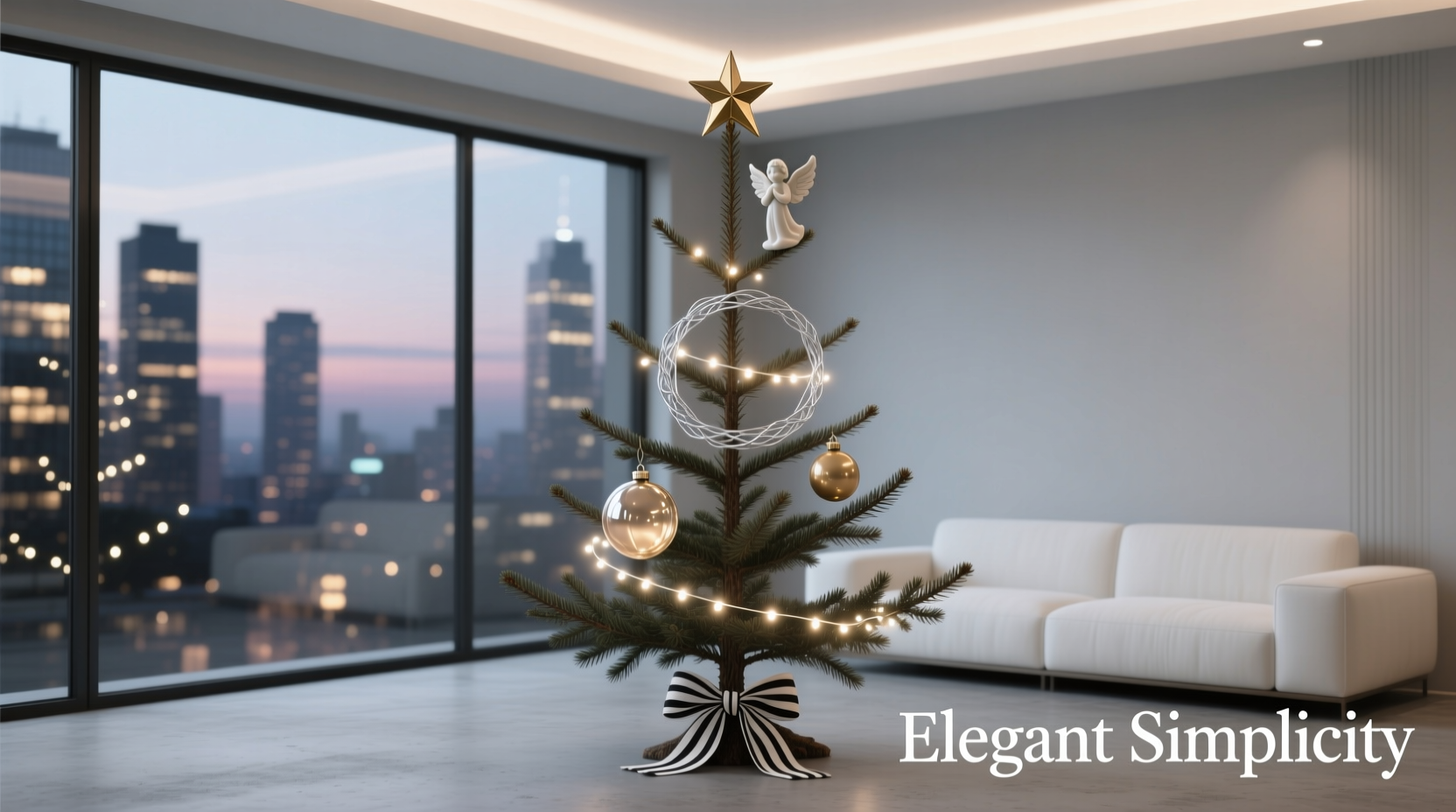
At its core, minimalist holiday design is rooted in Japanese concepts like *ma* (intentional negative space) and *wabi-sabi* (the beauty of imperfection and transience). It treats the tree not as a billboard for festivity, but as a sculptural focal point—a living column of quiet intention. High-end execution elevates this further: think hand-blown glass ornaments from Murano, matte ceramic baubles crafted by studio potters, or brass wire stars forged in small London ateliers. These aren’t mass-produced novelties. They’re heirloom-adjacent objects chosen for their weight, finish, and resonance with your interior architecture.
This aesthetic rejects the “more is merrier” ethos—not out of austerity, but precision. Every ornament, ribbon, and light serves a compositional purpose: balancing asymmetry, echoing existing metal finishes in your kitchen or lighting, or mirroring the grain of your oak flooring. The result feels curated, calm, and deeply personal—like your home breathing a sigh of relief during the holidays.
Step-by-Step: Building Your Minimalist Tree (5-Phase Process)
- Select the right tree species and form: Opt for a Nordmann fir or Serbian spruce—both hold needles longer and have naturally symmetrical, slender profiles. Avoid overly bushy varieties like Douglas fir. Height should be proportional: for standard 8’ ceilings, 6.5–7’ is ideal. Trim lower branches slightly to emphasize verticality.
- Choose a refined tree stand: Ditch the plastic bucket. Use a powder-coated steel or solid walnut stand with clean lines and a low profile. Ensure it’s weighted and stable—no wobbling compromises the entire composition.
- Layer lighting with discipline: Use only warm-white (2700K), dimmable LED micro-lights—no blinking, no color shifts. Wind them *sparsely*: 100 lights per foot of height max. Start at the trunk and spiral outward, leaving visible branch structure between strands.
- Curate ornaments by category—not quantity: Limit to three material families (e.g., matte ceramic, raw brass, frosted glass) and no more than 12–18 total pieces for a 7’ tree. Hang them asymmetrically but with deliberate rhythm: cluster two at eye level on one side, leave a gap, then place one higher on the opposite branch.
- Define the top and base intentionally: Skip the traditional star or angel. Instead, use a single sculptural element—a brushed brass crescent, a hand-thrown stoneware orb, or a dried white eucalyptus wreath suspended above the apex. For the base, drape a single, wide band of undyed Belgian linen or heavyweight wool felt—not a skirt, but a grounded plane.
Material Intelligence: What to Choose—and Why It Matters
High-end minimalism hinges on material integrity. Cheap imitations undermine the entire concept. Below is a comparative framework for selecting authentic, lasting elements:
| Element | High-End Choice | Why It Works | Avoid |
|---|---|---|---|
| Ornaments | Hand-blown mouth-formed glass (e.g., Skruf, Orrefors); unglazed stoneware; solid brass with satin finish | Each piece has subtle variation—no two are identical—adding quiet depth. Weight and temperature retention (cool to touch, warm in hand) signal authenticity. | Metallic plastic, mirrored acrylic, glitter-coated resin |
| Tree Lights | Dimmable, low-voltage LED strings with copper wiring and cloth-covered cord (e.g., Luminara, Philips Hue White Ambiance) | Soft diffusion, zero flicker, seamless integration into smart home systems. Cloth cord disappears against natural branches. | Standard plastic-wrapped mini-lights, battery-operated twinkle strings |
| Ribbon & Binding | 100% silk habotai (22mm width), undyed organic cotton tape, or vegetable-tanned leather cord | Subtle sheen, gentle drape, natural aging. Silk catches light without glare; leather develops patina over years. | Polyester satin, wired ribbon, metallic foil wraps |
| Tree Topper | One-of-a-kind ceramic sculpture, forged bronze shape, or preserved botanical sphere (e.g., white pampas + dried lotus pods) | Serves as a signature anchor—unique, tactile, and conversation-starting without shouting. | Mass-produced glitter stars, plastic angels, battery-powered rotating toppers |
Real-World Application: The West London Apartment Case Study
In a 1930s brick flat in Notting Hill, interior architect Lena Rossi faced a challenge: her clients wanted “Christmas energy” without compromising their Scandi-Japanese living room—featuring pale oak floors, custom concrete shelving, and a muted palette of oat, charcoal, and ash. Their 6.5’ Nordmann fir stood in a blackened steel stand beside a floor-to-ceiling window.
Lena began by removing all existing decor—then reinstalled with surgical precision. She used 120 warm-white LEDs wound with 8-inch spacing, allowing ample negative space. Ornaments were limited to nine: three matte white ceramic spheres (hand-thrown in Kyoto), three raw brass teardrops (forged in Sheffield), and three frosted glass cylinders (blown in Venice). Each hung at varying heights but aligned along an invisible diagonal axis. At the apex, she placed a single, palm-sized ceramic moon—unglazed, with faint finger marks visible in raking light. The base was wrapped in a 120cm-wide strip of unbleached Belgian linen, tucked neatly beneath the lowest boughs.
The result? A tree that didn’t dominate the room—but deepened it. Visitors commented not on “how Christmassy it looked,” but on how “calm and resolved” the entire space felt. One guest described it as “a pause button made visible.” The couple kept the same ornaments for four consecutive years—replacing only the tree and lights—proving that minimalism, when executed with material intelligence, is inherently sustainable.
Expert Insight: Craftsmanship Over Clutter
“True luxury in holiday decor lies in the courage to omit—not in the volume of what you add. A single perfect brass ornament carries more emotional weight than fifty forgettable ones. That’s where memory lives: in the object you choose, not the ones you discard.” — Marcus Thorne, Co-Founder of Studio Thorne & Co., London-based design studio specializing in residential ritual spaces
Essential Checklist: Before You Begin Hanging
- ✅ Test all lights for continuity and warmth before unwinding from spool
- ✅ Dust and lightly vacuum tree branches (use soft brush attachment) to remove debris and improve ornament adhesion
- ✅ Lay out all ornaments on a neutral surface—edit ruthlessly until only 3–5 shapes remain
- ✅ Measure vertical and horizontal sightlines from key vantage points (sofa, entryway, dining table)
- ✅ Confirm your tree stand is level and stable—add sandbag weight if needed
- ✅ Pre-cut ribbon lengths: three 1.2m strips for mid-tree accents, one 2.5m strip for base wrap
- ✅ Charge or install batteries for any dimmer switches or smart controls
FAQ: Clarifying Common Misconceptions
Can I use real candles on a minimalist tree?
No—safety and aesthetics both argue against it. Real flames contradict the controlled, serene intent of high-end minimalism. Instead, opt for flameless LED taper candles in matte black ceramic holders placed *near* the tree (not on it), or integrate flicker-free warm-white LEDs directly into your lighting string for the same atmospheric glow—without risk.
Is a white or silver tree acceptable for minimalism?
Artificial trees—even premium ones—undermine the philosophy unless they serve a specific, non-decorative purpose (e.g., allergy management). A real Nordmann or Fraser fir, properly cared for, offers irreplaceable texture, scent, and organic asymmetry. If you must use artificial, select a high-fidelity model with individually crafted PVC tips, no visible wire, and a natural green (not blue-green or silver) tone. But know this: minimalism gains power from authenticity. A real tree, even imperfectly shaped, always reads as more intentional.
How do I store high-end ornaments so they last decades?
Each ornament belongs in its own acid-free tissue-lined box—never stacked or loose. Store in a climate-controlled space (ideally 18–21°C, 40–50% humidity), away from direct sunlight and heating vents. Brass pieces benefit from occasional buffing with a microfiber cloth; ceramics should never be cleaned with abrasives—dust only with a soft goat-hair brush. Record provenance: note maker, year, and material on the box interior. This transforms storage into legacy-building.
Conclusion: Your Tree Is a Statement of Values
A minimalist Christmas tree with high-end decor isn’t a stylistic shortcut—it’s a declaration. It says you value time over trend, quality over quantity, silence over noise. It acknowledges that the holidays don’t need to shout to be meaningful. Every brass teardrop, every hand-blown orb, every precisely spaced light filament is a vote for intentionality in a world that defaults to excess.
You don’t need a designer or a six-figure budget to begin. You need clarity: about your space, your values, and what brings you genuine stillness during this season. Start small—this year, commit to just three exceptional ornaments and lights that breathe rather than blaze. Next year, add one more ceramic piece. In five years, you’ll have a collection that tells a story far richer than any department store display ever could.




 浙公网安备
33010002000092号
浙公网安备
33010002000092号 浙B2-20120091-4
Comments
No comments yet. Why don't you start the discussion?