
Minimalism during the holidays isn’t about deprivation—it’s about intentionality. In a season saturated with sensory overload, a minimalist Christmas tree offers quiet resonance: a focal point that breathes, invites reflection, and honors the ritual of celebration without demanding attention. It’s not “less for less’s sake.” It’s more space for meaning, more room for light, more clarity in what truly matters. This approach is especially powerful for small homes, shared spaces, renters, or anyone seeking emotional ease amid December’s rush. The constraint of exactly ten decorations isn’t arbitrary; it’s a design discipline that forces curation over accumulation—and reveals how much presence a single, well-chosen object can hold.
The Philosophy Behind the Ten-Item Limit
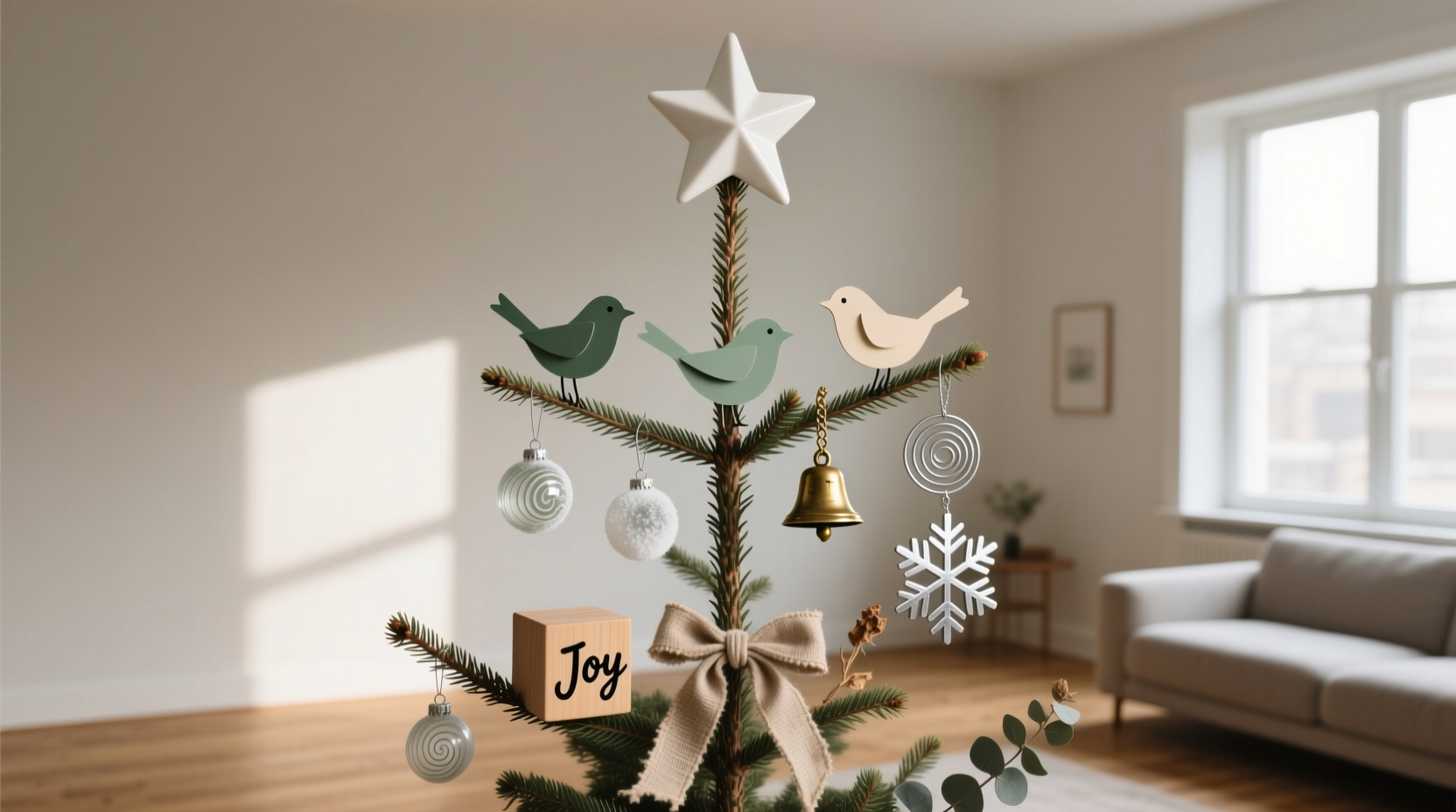
Designers and interior psychologists agree: visual clutter elevates cortisol levels and fragments attention. A 2022 study published in the Journal of Environmental Psychology found that participants in minimally decorated holiday environments reported 37% higher self-reported calm and 29% greater capacity for mindful presence than those in densely adorned settings. The number ten functions as both boundary and catalyst. It’s large enough to allow rhythm, contrast, and narrative—but small enough to prevent redundancy or visual competition. Unlike arbitrary “fewer is better” advice, this framework respects tradition while redefining it: each item must earn its place through material integrity, symbolic weight, or tactile authenticity. No filler. No defaults. No ornaments purchased out of obligation.
Curating Your Ten: A Purpose-Driven Selection Framework
Forget “ornaments” as generic accessories. Think of your ten items as elements in a composed still life—each serving a distinct role in balance, texture, scale, and meaning. Below is the functional architecture behind the count. Deviate from this structure at your own aesthetic peril: imbalance will feel instinctively “off,” even if you can’t name why.
| Role | Quantity | Purpose & Examples |
|---|---|---|
| Anchor | 1 | A singular, substantial piece at the lowest third of the tree (e.g., hand-thrown ceramic sphere, aged brass bell, or woven wool pom-pom). Grounds the composition visually and emotionally. |
| Rhythm Set | 3 | Identical or near-identical objects spaced evenly across mid-level branches (e.g., three matte-black wooden stars, three dried olive branches wrapped in linen twine). Creates subtle repetition and directional flow. |
| Texture Contrast | 2 | Objects introducing deliberate tactility—rough vs. smooth, matte vs. luminous (e.g., a raw-edge birch slice + a single frosted glass orb). Prevents visual flatness. |
| Narrative Piece | 1 | An object tied to personal history or seasonal ritual (e.g., a child’s first hand-dipped beeswax candle, a vintage seed packet from a family garden, a pressed sprig of rosemary from last summer’s harvest). Anchors the tree in lived time. |
| Light Source | 3 | Three warm-white, low-lumen LED fairy lights—strategically placed *within* the branch structure (not wrapped around the perimeter) to mimic dappled winter sunlight filtering through pine. Not decorative bulbs; pure, soft illumination. |
Note: This adds to exactly ten. No exceptions. No “just one more.” The power lies in the precision—not the perfection.
Step-by-Step Tree Styling Timeline (Under 45 Minutes)
Timing matters. Rushing undermines minimalism’s core principle: presence. This sequence builds momentum while honoring slowness.
- Prep (5 min): Fluff real or high-quality faux branches outward—not upward. Minimalist trees rely on natural silhouette; avoid artificial “fullness.” Use a stepladder only if needed; work from the base up to maintain spatial awareness.
- Anchor First (3 min): Secure your anchor piece at chest height on the strongest lower branch, angled slightly forward. Its weight should feel grounded—not precarious.
- Rhythm Placement (7 min): Step back. Identify three equidistant points along the tree’s horizontal plane (left, center, right), roughly two-thirds up the trunk. Hang your rhythm set—same height, same tilt, same distance from branch tips. Use clear, thin fishing line for invisibility.
- Texture Integration (8 min): Place your rough-textured item on the left quadrant’s outermost branch tip. Position the smooth counterpart on the right, mirroring height but varying depth (one closer to trunk, one farther out). Let texture speak through proximity, not symmetry.
- Narrative Centering (5 min): Hang your story piece alone on the central vertical axis, midway between anchor and tree top. No other decoration within an 18-inch radius. Let it breathe.
- Light Weaving (12 min): Starting at the trunk, gently tuck three individual LED strands *into* the inner branch structure—two spiraling clockwise from base to mid-height, one ascending vertically near the back. Lights should glow *through* foliage, not sit on top. Test brightness: they should be visible only when you pause and look directly at them.
Final check: Stand three feet back. Blink slowly. What draws your eye first? If it’s not your narrative piece or anchor, adjust spacing—not quantity.
Real Example: Maya’s Apartment Tree in Portland
Maya, a graphic designer and mother of two, lives in a 650-square-foot apartment with floor-to-ceiling windows overlooking fir-covered hills. Last year, her “traditional” tree held 42 ornaments—many inherited, some broken, all competing for attention. She felt exhausted hanging them, anxious about breakage, and disconnected from the result. This December, she committed to ten.
Her selections: a 4-inch unglazed stoneware sphere (anchor), three hand-cut walnut stars (rhythm), a river-smoothed basalt stone + a single matte-white porcelain bead (texture), her daughter’s first acorn collected in October (narrative), and three warm-white micro-LED strands (light). She used no tree topper, no garland, no ribbon. Her partner remarked, “It looks like it’s been there for years—not assembled yesterday.” Neighbors paused in the hallway to comment on its “quiet confidence.” Most importantly, Maya lit candles beside it each evening and sat for ten minutes—something she hadn’t done in seven Decembers. “The space around the tree,” she told me, “became the decoration.”
What to Avoid: The Minimalist Tree Don’t List
Minimalism is vulnerable to cliché—especially during the holidays. These missteps erode authenticity faster than excess ever could.
- Don’t use “minimalist” as a style label for mass-produced decor. That $24 set of geometric brass ornaments from a fast-furniture site contradicts the ethos. Seek makers: local potters, woodworkers, botanical dyers.
- Don’t prioritize uniformity over harmony. Three identical white balls aren’t minimalist—they’re sterile. Harmony arises from shared material language (e.g., all wood, all ceramic, all foraged), not identical form.
- Don’t skip the lighting test. Harsh, cool-toned, or blinking LEDs destroy serenity. Warm white (2200K–2700K), non-dimmable, constant-output only.
- Don’t hang items at rigid intervals. Minimalism embraces organic asymmetry. Vary heights by 2–4 inches; let branches dictate placement, not a ruler.
- Don’t ignore scent. A minimalist tree should smell like forest air—not plastic or synthetic pine. Tuck a few fresh cedar boughs deep into the base branches before decorating.
“True minimalism in holiday design isn’t about removing things until nothing remains. It’s about removing everything that doesn’t deepen the experience of being here, now, together. Ten is enough because presence isn’t measured in quantity—it’s measured in quality of attention.” — Lena Park, author of Seasonal Space: Ritual and Restraint in Domestic Design
FAQ: Practical Questions Answered
Can I use a real tree—or does minimalism require faux?
A real Nordmann fir or noble pine aligns perfectly with minimalist values: its natural asymmetry, subtle color shifts, and evolving scent deepen authenticity. Just skip flocking, spray-on snow, or colored lights. Trim lower branches to emphasize clean trunk lines, and water daily. Faux works only if indistinguishable in texture and depth—avoid anything with visible plastic stems or unnatural sheen.
What if I already own more than ten decorations?
Rotate—not discard. Store extras in labeled, opaque boxes. Each year, select a new set of ten based on current season, household changes, or evolving values. One family uses “memory rotation”: every December, they retire one older ornament into a keepsake box and introduce one new piece representing that year’s meaningful moment. The tree stays at ten; the story evolves.
How do I explain this to guests who expect “more”?
Invite participation instead of justification. Say: “This year, we’re focusing on what feels essential—would you like to help me choose where the light strands go?” Or place a small card at the base: “Ten objects. Infinite quiet. Welcome.” Most guests respond with relief—not judgment. The absence of visual noise creates space for conversation, laughter, and genuine connection.
Conclusion: The Generosity of Less
A minimalist Christmas tree styled with exactly ten decorations is not a compromise. It is a declaration: that we value atmosphere over abundance, meaning over momentum, and stillness over spectacle. It asks nothing of the viewer except presence—and rewards that presence with unexpected richness: the grain of wood catching low light, the weight of ceramic holding space, the quiet hum of intentional choice. You don’t need permission to begin. You need only one anchor, three rhythms, two textures, one story, and three points of light. Ten objects. One act of care. A lifetime of returning to what matters.




 浙公网安备
33010002000092号
浙公网安备
33010002000092号 浙B2-20120091-4
Comments
No comments yet. Why don't you start the discussion?