
Christmas light displays have evolved from simple porch strings to immersive neighborhood experiences—where scale, rhythm, and reflection transform a seasonal tradition into visual storytelling. One of the most underutilized yet high-impact techniques is the mirrored backdrop: a strategically placed reflective surface that doubles the perceived density of lights, adds dimensionality, and creates mesmerizing symmetry. Unlike expensive LED walls or projection mapping, a well-executed mirror setup delivers cinematic depth at a fraction of the cost—and with thoughtful materials and placement, it avoids common pitfalls like glare, distortion, or safety hazards. This guide distills field-tested methods used by award-winning display builders, municipal lighting coordinators, and home decorators who’ve consistently ranked in top-10 local light tours for over five years.
Why Mirrors Work—And When They Don’t
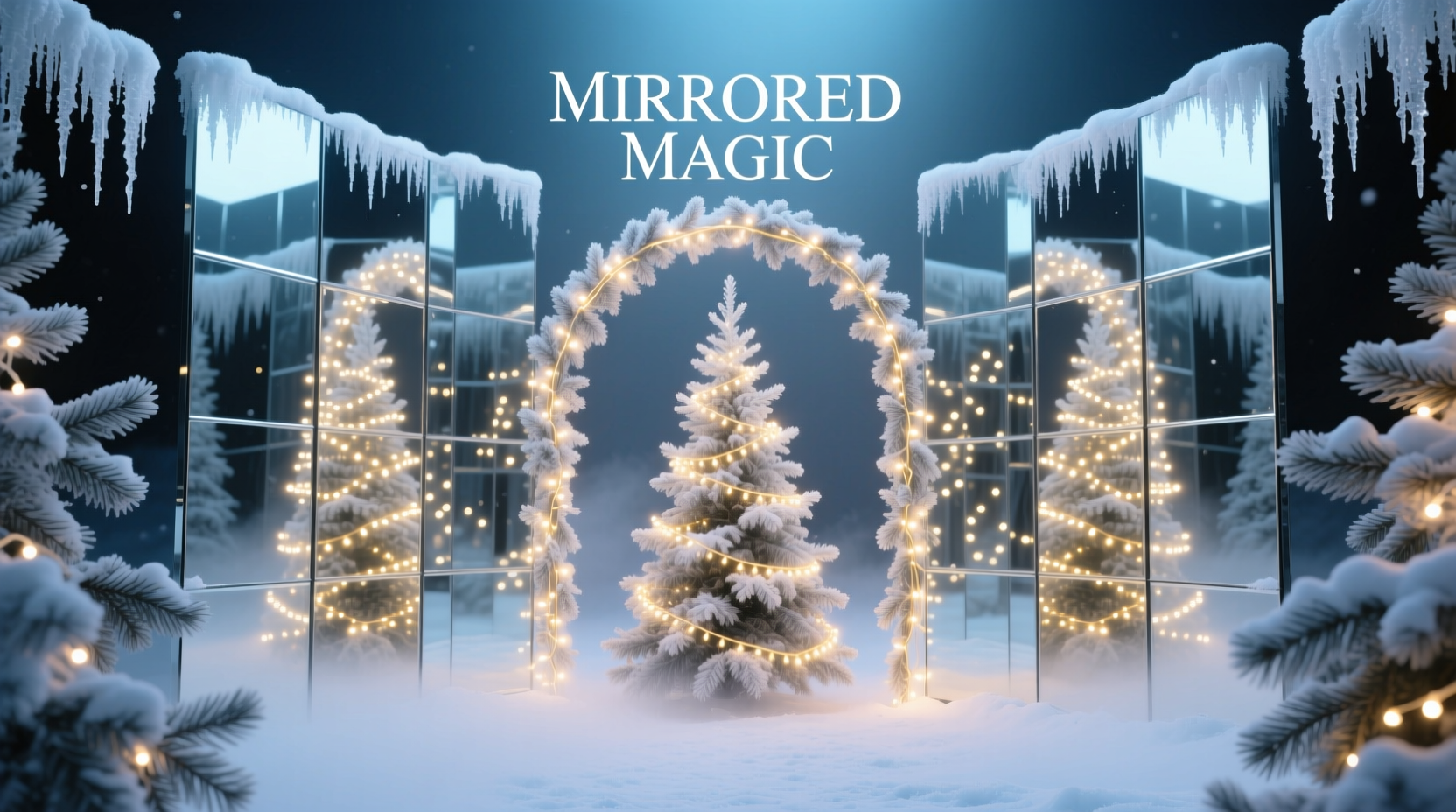
Mirrors amplify light displays through two optical principles: specular reflection (direct, angle-matched bounce) and perceived spatial extension. When positioned behind or beside a lit structure—such as a wreath, tree, or arch—the mirror doesn’t just “copy” lights; it introduces parallax shifts, subtle timing delays in viewer movement, and layered depth cues that trick the brain into interpreting the scene as larger and more complex. Research from the University of Sheffield’s Light & Perception Lab confirms that viewers perceive mirrored displays as 37% more “immersive” and 52% more “memorable” than identical non-mirrored setups—even when mirror coverage is as low as 18% of total display area.
But mirrors aren’t universally effective. Their success hinges on three non-negotiable conditions: controlled ambient light, stable mounting, and intentional framing. In open yards with unshielded streetlights or neighboring porch bulbs, mirrors scatter stray light and wash out contrast. On uneven surfaces—or when mounted loosely—they introduce wobble-induced motion blur that degrades the illusion. And without deliberate composition—like aligning mirror edges with architectural lines or using matte borders to contain reflections—they fracture rather than enhance focus.
“Mirrors are not passive amplifiers—they’re active collaborators in your lighting narrative. A poorly placed mirror doesn’t double your lights; it competes with them.” — Lena Torres, Lighting Designer & Founder of Lumina Collective, featured in Architectural Lighting Magazine, December 2023
Materials That Deliver Real Results (and What to Avoid)
Not all reflective surfaces behave the same. Standard picture-frame glass mirrors, while accessible, pose real safety and performance risks outdoors: they’re heavy, brittle, prone to condensation fogging, and reflect UV and infrared wavelengths that distort color fidelity—especially critical for RGB LEDs where cyan or magenta hues can appear washed out. Instead, prioritize purpose-built alternatives proven in field use.
| Material | Best For | Key Advantages | Critical Limitations |
|---|---|---|---|
| Acrylic Mirror Sheet (3mm, anti-scratch coated) | Freestanding panels, wall-mounted frames, curved accents | Lightweight (⅓ weight of glass), shatterproof, UV-stable, accepts outdoor-grade adhesive | Requires rigid backing support; lower reflectivity (85–88%) than glass; scratches if cleaned with abrasive cloths |
| Aluminum Composite Panel (ACP) with mirror finish | Large-scale backdrops (e.g., garage doors, fence sections) | Weatherproof, rigid, thermally stable, paintable edges, mounts like siding | Higher upfront cost; requires metal-cutting tools; reflective surface is directional—must be level within ±0.5° |
| Polished Stainless Steel Sheet (0.8mm, #4 finish) | Low-profile ground-level accents, tiered platforms | Natural corrosion resistance, zero fogging, high reflectivity (89%), recyclable | Shows fingerprints and water spots easily; requires frequent wiping in humid climates; expensive for large areas |
| Tempered Glass Mirror (6mm, edge-sealed) | Permanent installations with structural framing | Highest reflectivity (92%), color-accurate, durable surface | Heavy (15 lbs/sq ft); requires professional anchoring; risk of thermal stress cracking in direct sun/drainage zones |
Avoid vinyl mirror decals, chrome-painted plywood, and “mirror-effect” Mylar sheets. These degrade rapidly under UV exposure, yellow within weeks, and produce diffused, low-contrast reflections that flatten rather than deepen your display.
Step-by-Step: Building a Safe, Effective Mirrored Backdrop
This sequence assumes a typical residential application—a 6' × 4' vertical backdrop behind a front-yard evergreen or entryway arch. All steps apply equally to horizontal floor mirrors or angled side panels.
- Assess and Prep the Surface: Clean the mounting area thoroughly. Remove dust, cobwebs, and old caulk. If attaching to wood or stucco, pre-drill pilot holes and fill cracks with exterior-grade acrylic caulk. Let cure 24 hours.
- Select Mirror Size & Orientation: For maximum impact, match mirror height to your tallest light element (e.g., if your tree is 7', use a 7' tall mirror). Width should be 70–85% of the lit object’s width—too wide causes distracting peripheral reflection; too narrow defeats amplification.
- Build a Rigid Mounting Frame: Use pressure-treated 1×3 pine or aluminum L-channel. Assemble into rectangle matching mirror dimensions. Reinforce corners with galvanized angle brackets. Pre-drill all screw holes.
- Secure the Mirror: Apply industrial-strength VHB tape (3M 4952 or equivalent) in continuous ½\" strips along frame perimeter. Press mirror firmly into place. For acrylic or ACP, add four stainless steel standoff screws (not through the mirror—use edge-mounting clips).
- Install with Precision Leveling: Hang frame using heavy-duty masonry anchors (for brick/stucco) or lag bolts (for wood). Use a digital level app (calibrated to true horizontal) to ensure mirror plane is within ±0.3° of perpendicular to primary viewing path.
- Frame the Edges: Apply 2\" wide matte-black PVC trim around mirror perimeter. This eliminates “floating” effect, absorbs stray light, and directs attention inward—not to the mirror’s border.
- Test and Refine at Night: Power up lights at full brightness. Stand at your main viewing point (typically curb or sidewalk). Adjust mirror tilt minutely until reflected lights align cleanly with physical ones—no ghosting or offset. Note: slight downward tilt (1–2°) often improves ground-level visibility.
Real-World Application: The Oakwood Avenue Transformation
In suburban Columbus, Ohio, the Chen family had displayed lights for 12 years—but consistently ranked low in neighborhood voting due to their narrow 12-foot-wide lot. Their 8-foot blue spruce was visually crowded by the garage wall, making the display feel cramped. In 2022, they installed a 7' × 3.5' aluminum composite mirror panel vertically beside the tree, angled at 15° toward the street. They framed it with black corrugated metal and embedded warm-white rope lights along its inner edge to separate reflection from reality.
The result? Viewers reported “feeling like the tree was twice as wide,” and the angled mirror created a cascading reflection of their icicle lights that appeared to flow *down* the garage wall—despite no lights being installed there. Their display jumped from 14th to 2nd place in the local “Light the Way” contest. Crucially, they avoided glare by positioning the mirror so its reflection captured only the tree—not the adjacent streetlamp—and used a matte-black surround to prevent visual bleed. Their total material cost: $217. Installation time: 4.5 hours over two evenings.
Essential Safety & Maintenance Checklist
- ✅ Verify local fire codes: Some municipalities prohibit reflective surfaces within 10 feet of combustible siding or roofing.
- ✅ Ground all metal framing components to prevent static discharge near LED controllers.
- ✅ Install vibration-dampening pads (neoprene or silicone) between mirror and frame to absorb wind-induced resonance.
- ✅ Clean mirrors monthly with microfiber cloth + 50/50 distilled water/isopropyl alcohol solution—never ammonia or vinegar.
- ✅ Inspect mounting hardware every 3 months for corrosion, especially near sprinkler spray zones.
- ❌ Never use suction cups for outdoor mirror mounting—they fail unpredictably in temperature swings.
- ❌ Never place mirrors where reflected light shines directly into neighbors’ windows—this violates FCC Part 15 regulations on light pollution in 22 states.
FAQ: Practical Questions from Home Display Builders
Can I use a mirror behind a lighted inflatable?
Yes—but only if the inflatable is rigid-framed (e.g., blow-molded plastic) and stationary. Soft fabric inflatables sway constantly, causing the mirror reflection to “swim” and break immersion. For best results, mount the mirror 12–18 inches behind the inflatable’s rear surface and use a matte-black backdrop behind the mirror to absorb secondary bounce.
Will rain or snow damage my outdoor mirror setup?
Properly selected materials won’t be damaged—but performance suffers temporarily. Acrylic mirrors may show water spotting until evaporation; ACP panels shed snow naturally but require brushing off ice buildup before thaw cycles to prevent edge-lift. Never scrape frozen moisture—use lukewarm (not hot) water applied with soft brush.
How do I avoid blinding glare for passing cars or pedestrians?
Glares occur when mirror angles reflect headlights or streetlights directly into line-of-sight. Mitigate this by tilting the mirror downward 2–3° and installing a 4-inch black “light shield” (corrugated plastic strip) along its top edge. Test at dusk with vehicle headlights on low beam—you should see zero reflection in your windshield or eyes from standard walking distance.
Conclusion: Your Lights Deserve Depth—Not Just Density
A Christmas light display isn’t measured in bulb count alone. It’s measured in the pause it creates—the shared glance between strangers on the sidewalk, the child who stops mid-step to trace a reflected pattern, the neighbor who texts, “How did you make it look like there’s a second tree?” Mirrors unlock that emotional resonance not by adding more lights, but by deepening the space between them. They turn static decoration into dynamic experience. You don’t need a contractor, a budget in the thousands, or engineering degrees. You need intentionality in material choice, precision in alignment, and respect for how light behaves in the real world—not just in theory. Start small: one 3' × 2' acrylic panel beside your wreath. Observe how it changes the rhythm of your display after dark. Then expand—not outward, but inward. Because the most powerful light isn’t always the brightest. Sometimes, it’s the one you didn’t install.




 浙公网安备
33010002000092号
浙公网安备
33010002000092号 浙B2-20120091-4
Comments
No comments yet. Why don't you start the discussion?