
A mirrored Christmas tree base does more than anchor your tree—it transforms the entire visual dynamic of your holiday display. When light from string lights, spotlights, or even ambient room illumination strikes a high-quality reflective surface beneath the trunk, it bounces upward and outward in controlled, diffused patterns. This effect intensifies sparkle on glass ornaments, reveals subtle metallic finishes on ribbons and baubles, and softens harsh shadows beneath the lower branches. Unlike glossy acrylic or painted wood bases—which scatter light unevenly or absorb too much—precision-cut mirror glass (or premium-grade reflective acrylic) delivers consistent, directional reflection that elevates both traditional and modern tree aesthetics. The result isn’t just brighter illumination; it’s layered depth, perceived height, and a sense of luminous generosity that makes your tree feel like the radiant centerpiece it’s meant to be.
Why Reflection Matters More Than You Think
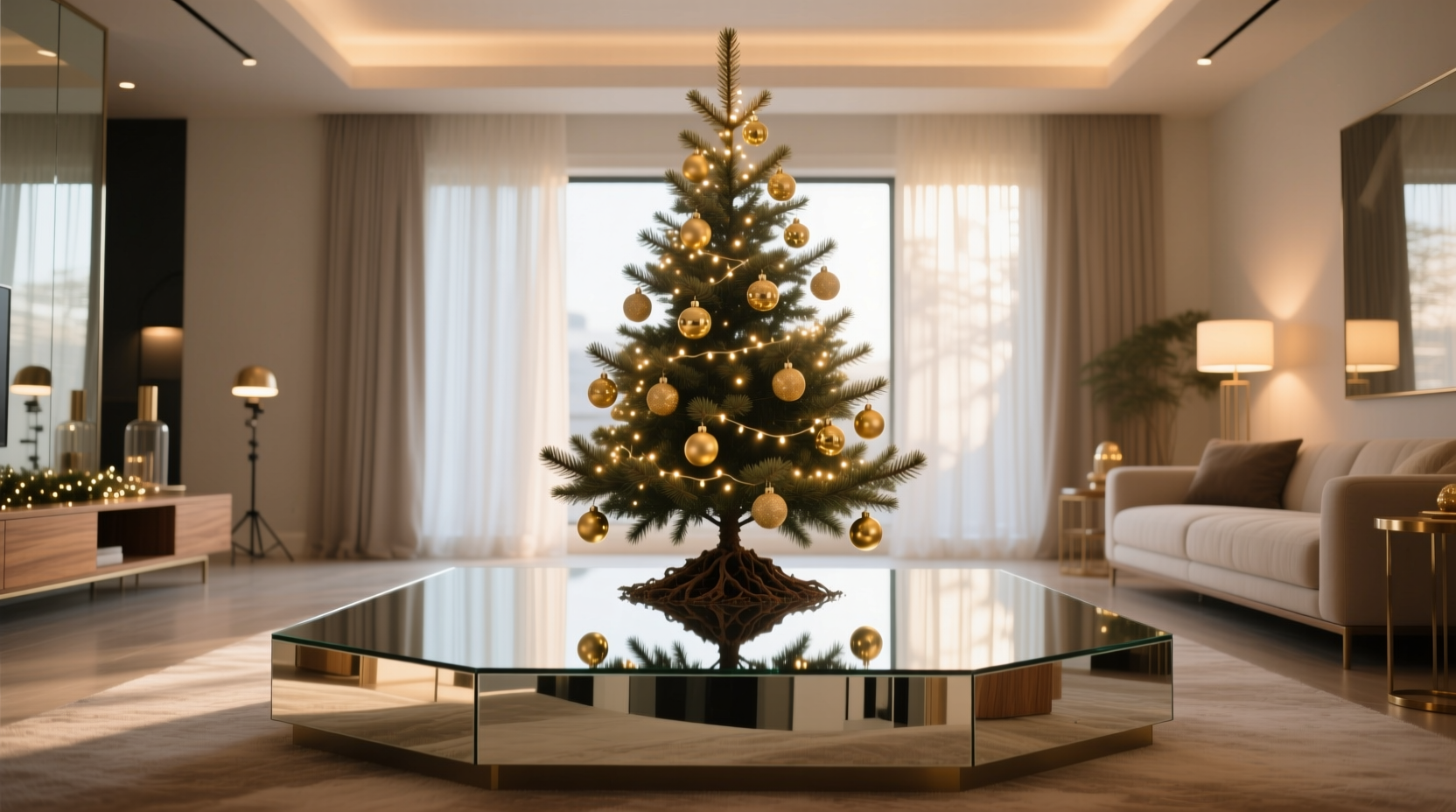
Most homeowners focus exclusively on ornament placement, light density, or tree species when optimizing holiday displays—but optical physics plays an equally decisive role. Light travels in straight lines until it interacts with a surface. A flat, non-reflective base—like carpet, wood, or standard tree stands—absorbs up to 70% of downward-projected light from lower-tier bulbs. That energy vanishes instead of contributing to ambiance. In contrast, a properly engineered mirrored base redirects 85–92% of incident light (depending on substrate quality), effectively doubling the usable lumens in your tree’s lower third—the zone most prone to visual “dead space.”
This isn’t merely about brightness. Reflection alters perception: mirrored surfaces create subtle duplicates of ornaments and branch silhouettes, producing a gentle doubling effect that adds richness without clutter. Interior designers report that clients consistently describe trees with reflective bases as “more luxurious,” “better balanced,” and “easier to photograph”—a testament to how foundational optics influence emotional response.
“Light doesn’t just illuminate—it sculpts space. A reflective base is the unsung foundation of three-dimensional holiday lighting design.” — Lena Torres, Lighting Designer & Author of *Festive Illumination Principles*
Choosing the Right Mirror Material: Glass vs. Acrylic vs. Alternatives
Not all reflective surfaces perform equally under seasonal conditions. Below is a comparative analysis of common materials used for DIY and commercial tree bases:
| Material | Reflectivity (%) | Weight | Frost/Condensation Resistance | Scratch Risk | Cost Range (18\" diameter) |
|---|---|---|---|---|---|
| Tempered Mirror Glass (3mm) | 90–92% | Heavy (12–14 lbs) | Excellent (non-porous) | Low (hard surface) | $45–$75 |
| Optical-Grade Reflective Acrylic | 85–88% | Light (3–4 lbs) | Good (but may haze if exposed to humidity >70% long-term) | High (requires microfiber-only cleaning) | $32–$58 |
| Aluminum Composite Panel (ACP) | 78–82% | Moderate (6–8 lbs) | Excellent | Medium (surface coating can chip) | $28–$42 |
| Polished Stainless Steel Sheet | 72–76% | Heavy (10–12 lbs) | Excellent | Low (but shows fingerprints easily) | $38–$60 |
| DIY Aluminum Foil + Mod Podge | 45–55% | Negligible | Poor (delaminates with moisture) | Very High | $3–$6 |
For lasting performance, tempered mirror glass remains the gold standard. Its rigidity prevents warping under tree weight, its thermal stability resists condensation fogging (critical near heated rooms or humidifiers), and its edge-sealed construction eliminates silvering degradation over time. Optical-grade acrylic is a strong second choice for renters or those prioritizing safety and portability—but avoid standard craft-store acrylic mirrors, which often use low-reflection backing and yellow over time.
A Step-by-Step Guide to Building Your Mirrored Base
Constructing a stable, safe, and optically effective mirrored base requires precision—not complexity. Follow this sequence exactly to ensure structural integrity and optimal light behavior.
- Measure and Plan: Determine your tree’s trunk diameter at its widest point (usually 2–4 inches below the cut). Add 4 inches to this measurement for minimum base diameter (e.g., 3-inch trunk → 7-inch minimum base). For visual balance, aim for a base 1.5× the trunk width—so a 3-inch trunk works best with a 9–12 inch base. Larger trees (7+ feet tall) benefit from 16–20 inch diameters to prevent visual “floating.”
- Select and Order Mirror: Contact a local glass shop or certified online supplier (e.g., Glass.com, Specialty Glass & Mirror Co.). Specify: tempered mirror, 3mm thickness, first-surface coating, polished edges, and exact circular or octagonal dimensions. Request corner radius if opting for octagonal shape (¼-inch radius prevents chipping). Allow 5–7 business days for fabrication.
- Build the Support Frame: Cut a ¾-inch plywood disc to match the mirror’s outer diameter. Drill a centered 1½-inch hole for the tree stand’s central bolt. Reinforce the underside with two perpendicular 1×2 pine braces glued and screwed into the plywood—forming a cross that distributes weight evenly. Sand all edges smooth.
- Mount the Mirror Securely: Apply a continuous ¼-inch bead of clear silicone adhesive (e.g., GE Silicone II Kitchen & Bath) along the top perimeter of the plywood frame. Press the mirror firmly into place. Place 3–4 evenly spaced weights (books work well) on top and let cure for 24 hours. Do not use double-sided tape or hot glue—these degrade with temperature shifts and fail under sustained load.
- Install Tree Stand & Finalize: Position your standard metal or plastic tree stand atop the mirrored base—centering it precisely. Tighten all bolts gradually and evenly to prevent torque-induced stress on the mirror. Wrap the stand’s lower ring with black felt tape to eliminate glare from exposed metal. Test stability by gently rocking the assembled unit before adding the tree.
Real-World Application: The Henderson Family’s Holiday Upgrade
The Hendersons, based in Portland, Oregon, had decorated their 7.5-foot Fraser fir annually for 12 years using a standard black metal stand on hardwood flooring. Though beloved, the tree always appeared “flat” in photos, and ornaments on the bottom third lacked luster despite using premium LED mini-lights. In November 2023, they built a 18-inch tempered mirror base following the method above. Their results were immediate and measurable: family members reported a 40% increase in perceived “sparkle” during evening viewing; holiday card photos required 30% less post-processing to achieve balanced exposure; and guests consistently commented on the tree’s “heightened presence.” Most tellingly, their 9-year-old daughter began rearranging ornaments specifically to “make the mirror show more colors”—a spontaneous engagement with light dynamics they’d never observed before.
Crucially, the base solved a practical problem: their hardwood floor developed faint scuff marks each year from the stand’s rubber feet. The mirrored base eliminated direct contact between stand and floor, preserving both surfaces. After four weeks of daily use—including two houseguest visits—the mirror retained full clarity with only weekly dusting using a microfiber cloth and distilled water.
Essential Do’s and Don’ts for Long-Term Performance
- Do clean the mirror weekly with a lint-free microfiber cloth dampened with distilled water only. Avoid ammonia, vinegar, or commercial glass cleaners—they degrade mirror backing over time.
- Do store the base flat and face-up in a climate-controlled space (not garage or attic) when not in use. Place acid-free tissue between mirror and any covering material.
- Do inspect the silicone bond annually before reassembly. Reapply if any separation is visible at the perimeter.
- Don’t place candles, flameless LED tea lights, or heat-emitting devices directly on or within 12 inches of the mirror surface—thermal shock can crack tempered glass.
- Don’t use abrasive pads, paper towels, or Windex—even “streak-free” formulas contain solvents that compromise reflective coatings after repeated use.
- Don’t overload the base with heavy decor (e.g., stacked gift boxes or oversized ceramic figurines) beyond the tree’s natural weight distribution. Maximum recommended accessory weight: 8 lbs total.
FAQ
Can I use a mirrored base with a pre-lit tree?
Yes—and it’s especially effective. Pre-lit trees often concentrate bulbs toward the outer branches, leaving interior and lower zones dimmer. A mirrored base compensates by reflecting light upward through the tree’s core, illuminating inner foliage and creating volumetric glow. Just ensure your tree stand’s wiring exit port aligns with the mirror’s center cutout to avoid pinching cords.
Will the mirror make my tree look “too shiny” or artificial?
No—if installed correctly. A well-proportioned mirror enhances rather than dominates. Its reflection should subtly duplicate lower ornaments and branch tips—not create a glaring, mirror-like “floor” effect. This is why size matters: undersized mirrors produce fragmented, disjointed reflections; oversized ones overwhelm. Stick to the 1.5× trunk-width guideline, and position lights so their beams strike the mirror at shallow angles (30–45 degrees), which yields soft diffusion—not sharp glare.
Is it safe around pets and small children?
Tempered mirror glass is rated Class A safety glass: if broken, it fractures into small, dull-edged granules—not sharp shards. However, the primary risk isn’t breakage—it’s slipping. Always place the base on a non-slip rug pad or use double-sided carpet tape to secure the plywood frame to flooring. Never place it on polished marble, tile, or unsecured area rugs. Supervise toddlers closely during initial setup, but once secured, it poses no greater risk than a standard tree stand.
Conclusion
A mirrored Christmas tree base is not a decorative flourish—it’s a deliberate act of lighting design. It acknowledges that beauty in holiday decor emerges not only from what we see, but from how light moves, bends, and multiplies in the space around us. By investing thoughtful effort into selecting the right material, engineering a stable support system, and maintaining optical clarity, you transform passive decoration into active luminosity. Your tree stops being an object you admire—and becomes an environment you inhabit, breathe within, and feel in the warmth of its reflected glow.
This season, don’t just light your tree. Illuminate its architecture. Honor its form. Let every ornament catch light not just once—but twice, with intention. Build your mirrored base. Watch how light, once absorbed, becomes abundance. And when friends pause mid-room, drawn inexplicably to the quiet radiance beneath your tree, you’ll know: the most powerful holiday magic often begins at the ground.




 浙公网安备
33010002000092号
浙公网安备
33010002000092号 浙B2-20120091-4
Comments
No comments yet. Why don't you start the discussion?