
Every year, millions of households welcome the festive glow of a Christmas tree—only to face an unwelcome seasonal challenge: curious paws, eager noses, and instinct-driven exploration. Cats scale trunks like miniature mountaineers; dogs nudge ornaments off branches with gentle nudges that become toppling hazards; rabbits and ferrets investigate tinsel as if it’s edible confetti. Traditional solutions—fencing, baby gates, or cordoning off entire rooms—disrupt flow, aesthetics, and family joy. But there’s a more elegant, effective, and increasingly science-backed approach: the invisible barrier. Not magic, not punishment—but behavioral psychology, environmental design, and sensory intelligence working in concert. This method respects your pet’s autonomy while safeguarding both life and tradition.
Why “Invisible” Barriers Work Better Than Physical Fences
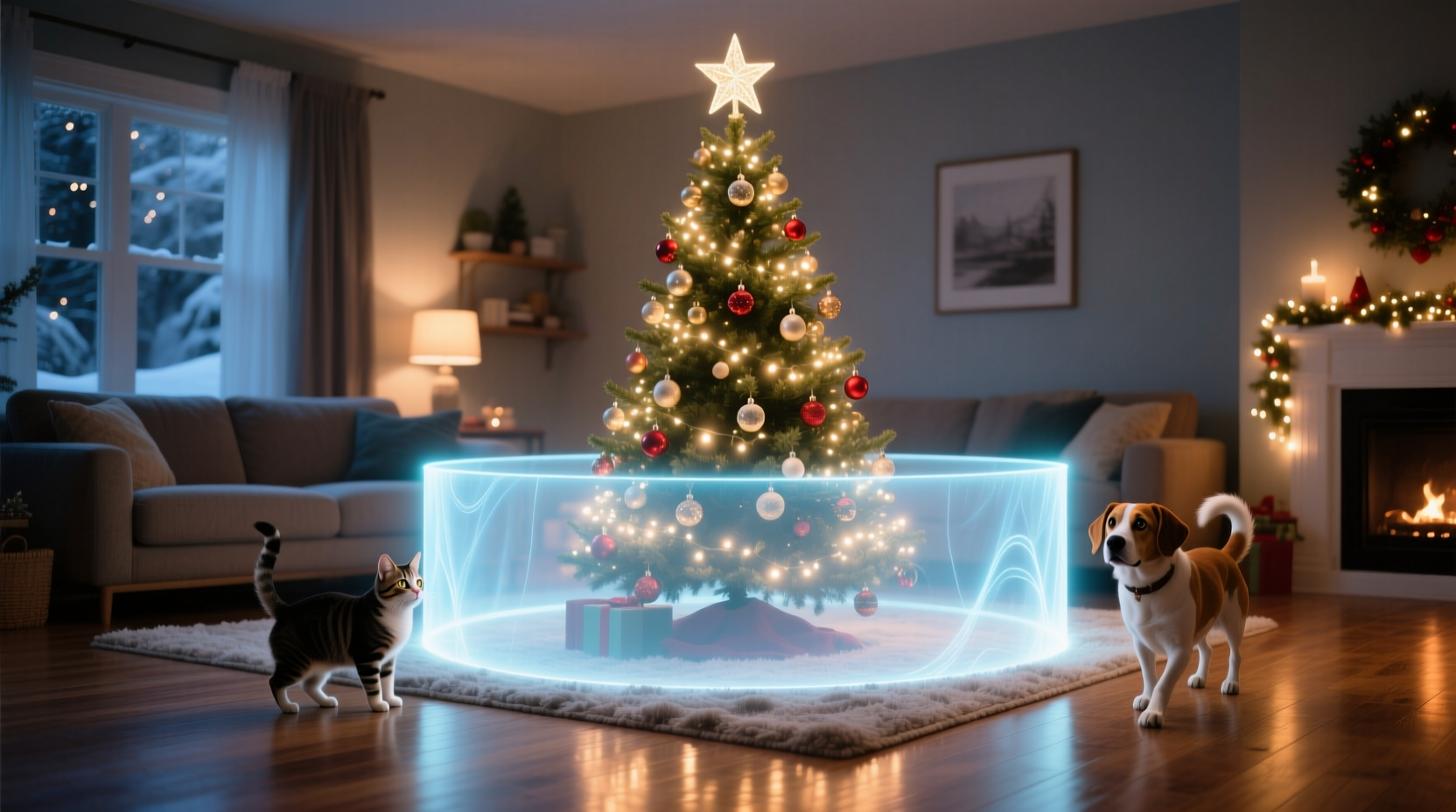
Physical barriers—like playpens, mesh enclosures, or taped-off perimeters—often backfire. They create visual cues that *invite* investigation (“What’s behind the line?”), trigger territorial guarding behaviors (especially in dogs), or induce frustration-based reactivity. Worse, they isolate pets from family activity, increasing anxiety during a high-stimulus season. Invisible barriers avoid these pitfalls by leveraging how animals actually perceive and navigate space.
Animals don’t rely on arbitrary human-imposed boundaries. Instead, they read environmental signals: scent gradients, air movement, surface texture changes, auditory thresholds, and subtle shifts in light reflection. An invisible barrier system works *with* those instincts—not against them—by introducing consistent, low-intensity deterrents at the perimeter of the tree zone. These cues are imperceptible—or barely perceptible—to humans but register clearly to pets as “transition zones,” prompting natural pause-and-assess behavior rather than impulsive entry.
The Four-Pillar Framework for an Effective Invisible Barrier
A successful invisible barrier isn’t one tool—it’s a layered, redundant system built on four interlocking pillars: olfactory, tactile, auditory, and spatial. Each pillar reinforces the others, creating a cohesive “zone boundary” your pet learns to recognize and respect.
- Olfactory Boundary: A scent gradient that signals “this area requires caution.” Use pet-safe, non-toxic essential oil blends (e.g., diluted citronella + eucalyptus) applied to cotton strips placed *just outside* the 3-foot radius around the tree base—not on the tree itself. Reapply every 48 hours. Avoid peppermint or tea tree oils, which are toxic to cats.
- Tactile Boundary: Subtle floor-level cues that interrupt forward momentum. Lay down two parallel rows of smooth, matte-finish vinyl floor tape (not duct tape or double-sided carpet tape) spaced 8 inches apart, forming a 12-inch-wide “threshold band.” Its slight tackiness and cooler surface temperature underfoot provide gentle, non-punitive feedback without sticking to fur or paws.
- Auditory Boundary: A quiet, intermittent sound cue triggered only when a pet crosses the tactile threshold. Use a motion-activated ultrasonic device emitting frequencies between 22–25 kHz—inaudible to most humans but clearly detectable by dogs and cats. Set volume to minimum effective level (test first with your pet present). Devices should emit for ≤1 second, then pause for ≥15 seconds—never continuous.
- Spatial Boundary: Strategic furniture placement that creates natural “dead space” around the tree. Position a low-profile ottoman or wide, shallow storage bench 36 inches directly in front of the tree stand. This breaks line-of-sight access, reduces the visual draw of lower-hanging ornaments, and physically occupies the most common approach path without blocking sightlines for people.
Step-by-Step Installation Timeline (72-Hour Prep Window)
Timing matters. Rushing installation invites confusion and undermines learning. Follow this precise sequence:
- Day 0 (Pre-Tree Day): Measure and mark a perfect 36-inch radius circle around your intended tree location using chalk or painter’s tape. Place tactile tape bands along the north/south and east/west axes of the circle. Install olfactory strips at the four cardinal points—outside the circle, 2 inches beyond the tape.
- Day 1 (Morning): Introduce the ultrasonic device. Place it at waist height on a nearby shelf, aimed downward toward the center of the tactile band. Power it on—but disable motion activation. Let your pet hear the faint, intermittent “tick” sound (most devices emit a soft audible pulse during standby) for 4 hours while offering treats nearby. This builds positive association.
- Day 1 (Evening): Activate motion sensing. Observe quietly for 30 minutes. Note where your pet pauses, turns, or sniffs near the tape. Adjust olfactory strip placement if avoidance is inconsistent.
- Day 2: Add the spatial element: position ottoman or bench. Continue observation. If your pet circumnavigates it easily, add a second tactile band 12 inches farther out—creating a dual-threshold system.
- Day 3 (Tree Arrival Day): Bring the tree in. Do *not* decorate yet. Let pets explore the room with all barriers active for 2 full hours. Only then begin decorating—keeping fragile or dangling items above 30 inches and avoiding glass or small detachable parts below 24 inches.
Do’s and Don’ts: Critical Safety & Effectiveness Guidelines
| Action | Do | Don’t |
|---|---|---|
| Olfactory Cues | Use food-grade, water-diluted citrus or rosemary oil on cotton swabs pinned to baseboards | Apply oils directly to flooring, carpets, or tree stands—residue attracts licking and causes skin irritation |
| Ultrasonic Devices | Choose models with adjustable frequency range and motion sensitivity (e.g., PetSafe Stay+Play) | Use untested “repellent” apps or DIY speakers—these often emit harmful harmonics or excessive decibel levels |
| Tactile Markers | Use matte-finish vinyl tape (e.g., Gorilla Clear Mounting Tape) cut into 4-inch strips | Use aluminum foil, plastic mats, or crinkly surfaces—these cause fear-based avoidance or overgeneralization to other floor types |
| Reinforcement | Reward calm, redirected behavior *away* from the zone with high-value treats (e.g., freeze-dried liver) | Punish or scold near the barrier—this creates negative association with the *entire room*, not just the zone |
| Maintenance | Replace olfactory strips every 48 hrs; clean tape weekly with vinegar-water solution | Ignore fading scent or dusty tape—diminished cues erode boundary reliability within 72 hours |
Mini Case Study: The Anderson Family’s Dual-Pet Household
The Andersons live in a 1,200-square-foot apartment with a 4-year-old rescue terrier mix named Jasper and a 2-year-old Bengal cat named Luna. Both had previously knocked over trees twice—Jasper pulling the stand with his nose, Luna batting at lights until strands came loose. In 2023, they implemented the invisible barrier system with strict adherence to the 72-hour timeline. Key adaptations: They used *two* ultrasonic units—one angled at the front approach, one at the side corridor—and substituted lavender hydrosol (pet-safe, calming) for the olfactory cue after Luna showed mild agitation to citrus. By Day 3, Jasper paused consistently at the tactile tape, sat, and looked expectantly for a treat. Luna approached the olfactory strip, sniffed intently, then pivoted to her perch across the room—never crossing the boundary. Their tree remained fully accessible to guests, undecorated sections were visible, and both pets slept peacefully 6 feet from the base each night. “It wasn’t about stopping them,” says Sarah Anderson. “It was about giving them clear, respectful rules they could understand without feeling trapped.”
Expert Insight: What Veterinary Behaviorists Say
“Invisible barriers succeed because they align with ethology—the science of natural animal behavior. You’re not suppressing instinct; you’re redirecting it using species-specific sensory input. A well-designed olfactory-tactile-auditory boundary mimics how wild canids and felids assess risk at territory edges: scent markers, substrate changes, and subtle acoustic shifts. Punishment-free, predictable, and physiologically safe—this is modern, evidence-informed cohabitation.” — Dr. Lena Torres, DACVB, Veterinary Behaviorist and Co-Director, Urban Pet Wellness Institute
FAQ
Can invisible barriers work for puppies or kittens still in training?
Yes—with critical modifications. For puppies under 5 months, omit ultrasonic cues entirely (their hearing is still developing sensitivity) and double the width of the tactile band to 16 inches. Rely heavily on olfactory cues and spatial blockers, paired with frequent, brief redirection sessions (2–3 minutes, 6x/day) where you guide them away from the zone and reward calm settling on a designated mat 4 feet away. Kittens under 4 months respond best to vertical spatial cues—add a low, stable shelf 24 inches high *beside* the tree, lined with soft bedding and toys, making it a more appealing alternative destination.
Will my pet become desensitized to the barriers over time?
Not if maintained correctly. Desensitization occurs only when cues fade (e.g., stale scent, dusty tape, dead batteries) or when reinforcement is inconsistent. The system relies on *reliability*: if the ultrasonic cue sounds *every single time* the tactile band is crossed, and the olfactory cue is fresh, the association remains strong. Monitor weekly—test the ultrasonic unit yourself with a smartphone app that detects >20 kHz frequencies, and replace tapes if they lose subtle tackiness. Consistency, not intensity, sustains effectiveness.
What if I rent and can’t install anything permanent?
All components are renter-friendly. Vinyl floor tape lifts cleanly with gentle heat (a hairdryer on low) and leaves zero residue. Olfactory strips attach with removable adhesive dots (e.g., Command Poster Strips). Ultrasonic units sit on shelves or clip to curtain rods. Spatial blockers—ottomans, benches, baskets—are fully portable. No nails, screws, or wall alterations required. Document your setup with photos before move-in; most landlords consider this standard pet safety practice, not modification.
Conclusion: Reclaim the Magic—Without Compromise
The Christmas tree shouldn’t be a battleground. It shouldn’t demand isolation, constant vigilance, or guilt-ridden trade-offs between festivity and safety. An invisible barrier system restores balance—not through restriction, but through clarity. It honors your pet’s intelligence, respects their sensory world, and preserves the warmth and openness of your shared space. This isn’t about building walls; it’s about drawing thoughtful, compassionate lines that everyone in the household can understand and honor. When Jasper sits calmly at the edge of the tape, tail thumping softly, or Luna watches twinkling lights from her perch without tension—you’ve achieved something deeper than safety. You’ve cultivated mutual trust, rooted in consistency and empathy. That’s the quiet magic no ornament can replicate.




 浙公网安备
33010002000092号
浙公网安备
33010002000092号 浙B2-20120091-4
Comments
No comments yet. Why don't you start the discussion?