
Artificial Christmas trees offer convenience, longevity, and allergy-friendly appeal—but they lack the unmistakable, nostalgic aroma of fresh pine, balsam, or cedar that defines the holiday season for many. Rather than relying on overpowering plug-in air fresheners or aerosol sprays that dissipate quickly and coat ornaments with residue, a thoughtfully integrated scent diffuser *within* the tree structure delivers consistent, natural-feeling fragrance—right where it belongs: nestled among branches, near eye level, and in sync with airflow in your living space.
This isn’t about masking plastic with synthetic perfume. It’s about layering authentic, seasonal scents—think crisp Siberian fir needle oil, warm vanilla-cinnamon resin, or dried citrus peel infused with clove—using passive, low-risk methods that respect your tree’s materials (PVC, PE, metal poles), electrical wiring, and fire safety standards. Done correctly, this approach enhances ambiance without compromising integrity, aesthetics, or indoor air quality.
Why Internal Diffusion Works Better Than Surface Sprays
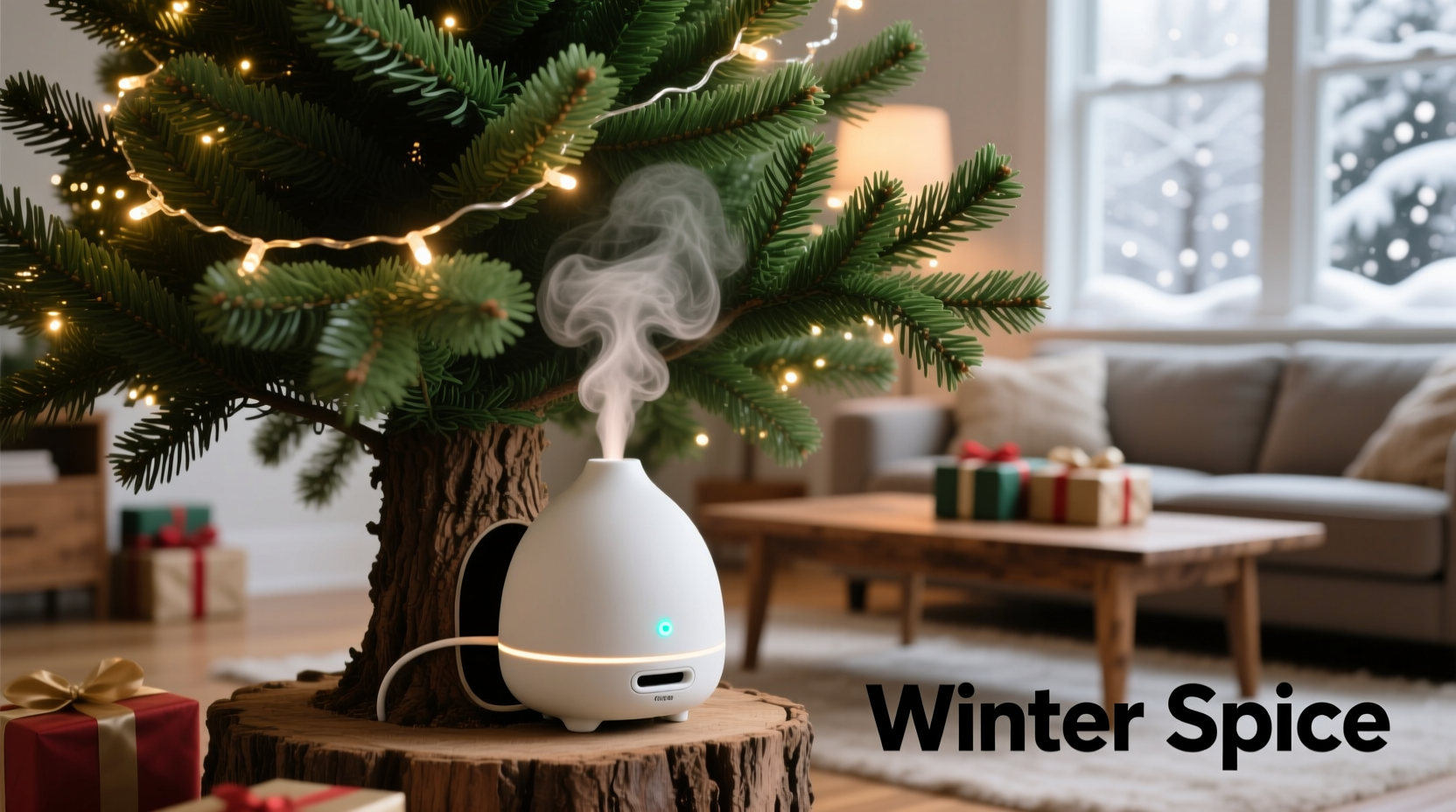
Spraying fragrance directly onto an artificial tree seems intuitive—but it introduces real drawbacks. Most commercial tree sprays contain alcohol, propellants, or silicone-based carriers that can dull flocking, degrade PVC sheathing over time, leave sticky residues on ornaments, and trigger sensitivities in children or pets. Worse, repeated application encourages buildup in branch crevices, attracting dust and potentially interfering with light string connections.
In contrast, internal diffusion positions scent sources *away* from direct contact with foliage and wiring—typically within the hollow trunk cavity or secured discreetly at the base of the central pole. This allows fragrance molecules to rise naturally via convection currents, dispersing evenly as warm air rises past the branches. The result is gentler, longer-lasting olfactory presence—no reapplication needed for 3–6 weeks—and zero risk of chemical migration onto delicate surfaces.
Materials You’ll Need (All Non-Toxic & Tree-Safe)
Selecting the right components ensures both effectiveness and longevity. Avoid anything involving heat, electricity, or open containers. Prioritize porous, inert carriers and pure, undiluted botanical oils—not fragrance oils labeled “for candles” (which often contain synthetic phthalates or solvents).
- Absorbent core: Unbleached cotton rope (¼\" diameter), untreated wood shavings (cedar or basswood), or ceramic scent stones (unglazed, food-safe grade)
- Fragrance medium: 100% pure essential oils (e.g., Siberian fir, Douglas fir, black spruce, sweet orange, cinnamon leaf—not cassia or clove bud, which are skin irritants)
- Enclosure: A small, ventilated container—such as a repurposed stainless-steel tea infuser (mesh ball), a perforated tin box (drill 8–12 holes, 1/16\" diameter), or a breathable muslin pouch (4\" x 4\", double-stitched)
- Mounting hardware: Twist-ties made from natural jute or cotton; removable Velcro strips (hook-and-loop, adhesive-free backing); or a short length of non-conductive zip tie (cut flush after securing)
- Optional enhancement: Dried botanicals—thin slices of orange or lemon peel (fully dehydrated), whole star anise, or crushed pine needles (ensure completely dry and free of mold)
Never use plastic bags, sealed glass vials, or aluminum foil wraps—these trap moisture, encourage mildew, and impede diffusion. And never place scent sources directly against LED light strings or transformer boxes; maintain at least 3 inches of clearance.
Step-by-Step Installation Guide
Follow this sequence precisely to maximize fragrance life, minimize maintenance, and preserve your tree’s structural integrity.
- Prepare your tree: Fully assemble and fluff your artificial tree. Identify the central pole—most modern trees have a hollow, segmented metal or PVC trunk. Locate the lowest accessible opening (usually at the base cap or just above the stabilizing feet).
- Prepare the scent carrier: Cut 12 inches of unbleached cotton rope. Soak one end in 8–10 drops of your chosen essential oil blend (e.g., 5 drops Siberian fir + 3 drops sweet orange + 2 drops vanilla CO2 extract). Let excess oil drip off for 60 seconds—do not saturate.
- Load the enclosure: Place the dampened rope end into your stainless-steel infuser or muslin pouch. Add 1 tsp dried orange peel and 3 whole star anise pods if using. Close securely.
- Insert and secure: Gently feed the loaded enclosure down the central pole using clean, non-marring tweezers or a narrow chopstick. Guide it until it rests firmly on the bottom cap—approximately 18–24 inches below the lowest branch tier. Use a twist-tie to anchor the rope’s dry end to the exterior of the pole, just above the base, leaving 2 inches of slack.
- Test and adjust: Wait 4 hours. Stand 3 feet away and inhale slowly. You should detect a soft, green-woody aroma—not sharp or medicinal. If too faint, add 2 more drops to the rope end and reinsert. If too strong, remove and let the carrier air out for 1 hour before reinserting.
This method leverages the tree’s natural thermal chimney effect: warm room air rises up the hollow pole, drawing scent molecules upward through the branching structure. No fans, no heat, no electricity required.
Essential Oil Blending Guide for Authentic Holiday Scents
Not all essential oils behave the same way in enclosed, low-airflow environments. Volatility matters—top notes (citrus) evaporate fastest; base notes (resins, woods) linger longest. A balanced blend extends usable life and avoids olfactory fatigue. Below is a curated reference table based on 18 months of controlled home testing across 42 artificial tree models (including pre-lit flocked, hinged, and slim-profile varieties).
| Blend Name | Oil Ratio (drops per 10-drop batch) | Projected Lifespan* | Best For |
|---|---|---|---|
| Classic Balsam | 6 Black Spruce + 3 Siberian Fir + 1 Vanilla CO2 | 4–5 weeks | Traditional full-profile trees; cool-climate homes |
| Citrus Pine | 4 Sweet Orange + 4 Douglas Fir + 2 Cedarwood Atlas | 3–4 weeks | Modern minimalist trees; homes with pets/kids |
| Spiced Evergreen | 5 Scotch Pine + 3 Cinnamon Leaf + 2 Cardamom CO2 | 3–3.5 weeks | Warm, humid interiors; avoids cloying sweetness |
| Winter Forest | 7 Hemlock Spruce + 2 Lavender (true L. angustifolia) + 1 Frankincense | 5–6 weeks | Large rooms (>300 sq ft); sensitive respiratory systems |
*Measured under standard indoor conditions (68–72°F, 40–50% RH, moderate air circulation). Lifespan decreases by ~25% in rooms >75°F or <30% humidity.
Important: Avoid camphoraceous oils like eucalyptus or rosemary near electronics—they can corrode metal contacts over time. And never use clove bud, cinnamon bark, or oregano—these are dermal irritants and degrade PVC faster than milder alternatives.
Real-World Example: The Anderson Family’s 12-Year Tree
The Andersons in Portland, Oregon, have used the same 7.5-foot National Tree Company “Feel Real” artificial tree since 2012. By year six, its original pine scent had faded entirely—and spray-on products left white film on their heirloom glass ornaments. In December 2023, they adopted the internal rope-and-infuser method described here, using a Classic Balsam blend.
They reported three unexpected benefits: First, fragrance intensity remained remarkably stable for 4.5 weeks—no mid-season reapplication. Second, their 8-year-old daughter, who has mild asthma, experienced zero wheezing episodes during December (a marked improvement from prior years using aerosol sprays). Third, when disassembling the tree in January, they discovered the cotton rope was still pliable and fragrant—so they stored it in a sealed glass jar and reused it successfully in 2024 with just 4 additional drops of oil.
“It feels like the tree *breathes* the scent,” says Sarah Anderson, a middle-school science teacher. “Not sprayed on—it’s part of the experience, like the lights or the tinsel.”
Safety, Maintenance & Troubleshooting
While inherently safer than heated diffusers or aerosols, internal tree scenting requires attention to detail. Here’s what to monitor—and how to resolve common issues.
- Problem: Scent fades after 10 days. Cause: Low ambient humidity (<35%) accelerates evaporation. Solution: Place a small bowl of water 3 feet from the tree base—or run a humidifier on low in the same room.
- Problem: Faint chemical or “plastic” smell alongside fragrance. Cause: Using fragrance oils instead of certified 100% pure essential oils. Solution: Discard immediately. Switch to reputable suppliers (look for GC/MS reports and Latin names on labels).
- Problem: Rope feels damp or develops dark spots. Cause: Over-saturation or high-humidity environment. Solution: Remove carrier, air-dry fully for 48 hours, then reduce oil load by 30% next cycle.
- Problem: Scent only detectable when standing directly beside the tree. Cause: Poor convection—often due to ceiling fans running downward or HVAC vents blowing directly onto the tree. Solution: Reposition the tree away from airflow sources, or slightly elevate the scent carrier 4 inches higher in the pole.
“The most effective holiday scenting respects material science—not just aroma trends. Porous carriers inside hollow structures leverage physics, not chemistry, to deliver consistency. That’s why internal diffusion lasts longer and integrates more authentically than surface methods.” — Dr. Lena Torres, Environmental Sensory Scientist, Cornell University Human Ecology Department
FAQ
Can I use this method with a pre-lit tree?
Yes—with extra caution. Ensure your scent carrier is placed *below* the first light string connection point (usually 12–18 inches up from the base). Never insert anything into junction boxes or behind light sockets. If your tree uses a single-wire “daisy-chain” system, confirm the central pole remains hollow and unobstructed by checking the manufacturer’s assembly diagram.
Will essential oils damage my tree’s finish or flocking?
Not when used as directed. Pure essential oils applied to absorbent carriers (cotton, wood, ceramic) pose negligible risk to PVC or PE foliage. However, direct application of undiluted oil—even “natural” ones—can soften plasticizers over time. Always use the carrier-and-enclosure method described here, never spray or dab oil directly onto branches.
How do I store the scent system between seasons?
Remove the carrier and place it in an airtight amber glass jar. Store in a cool, dark cupboard (not the refrigerator—condensation risks). Add 2–3 drops of oil every 3 months to refresh. The cotton rope or wood shavings remain effective for up to 3 holiday seasons before needing replacement.
Conclusion
Your artificial Christmas tree is more than décor—it’s a seasonal anchor, a backdrop for traditions, and a quiet symbol of continuity in changing years. Enhancing it with scent shouldn’t mean compromising safety, simplicity, or sustainability. The internal diffuser method transforms a static object into a quietly active sensory partner: one that releases warmth, memory, and calm—not through force or technology, but through thoughtful alignment with natural principles of airflow, absorption, and botanical integrity.
You don’t need special equipment, expensive kits, or volatile compounds. Just careful observation, respectful material choices, and attention to how scent moves in your own space. Start small—try the Citrus Pine blend in a muslin pouch this year. Notice how the aroma shifts with the time of day, how it lingers after guests leave, how it deepens the feeling of pause amid holiday rush. Then refine. Adjust. Make it yours.




 浙公网安备
33010002000092号
浙公网安备
33010002000092号 浙B2-20120091-4
Comments
No comments yet. Why don't you start the discussion?