
Nothing signals the arrival of the holiday season quite like the crisp, resinous whisper of a freshly cut Christmas tree — that unmistakable blend of pine sap, citrusy terpenes, and woody depth. Yet many find that within days, the tree’s fragrance fades or clashes with synthetic holiday scents from candles or plug-ins. The solution isn’t louder diffusion — it’s intentional scent layering: a thoughtful, olfactory choreography where the tree’s organic volatility meets the controlled release of complementary botanicals in diffusers. This approach doesn’t mask or overpower; it deepens, extends, and humanizes the festive ambiance. Done well, it transforms your home into a multi-dimensional sensory experience — one that feels both authentically forest-born and thoughtfully curated.
Why Scent Layering Works (and Why Most People Get It Wrong)
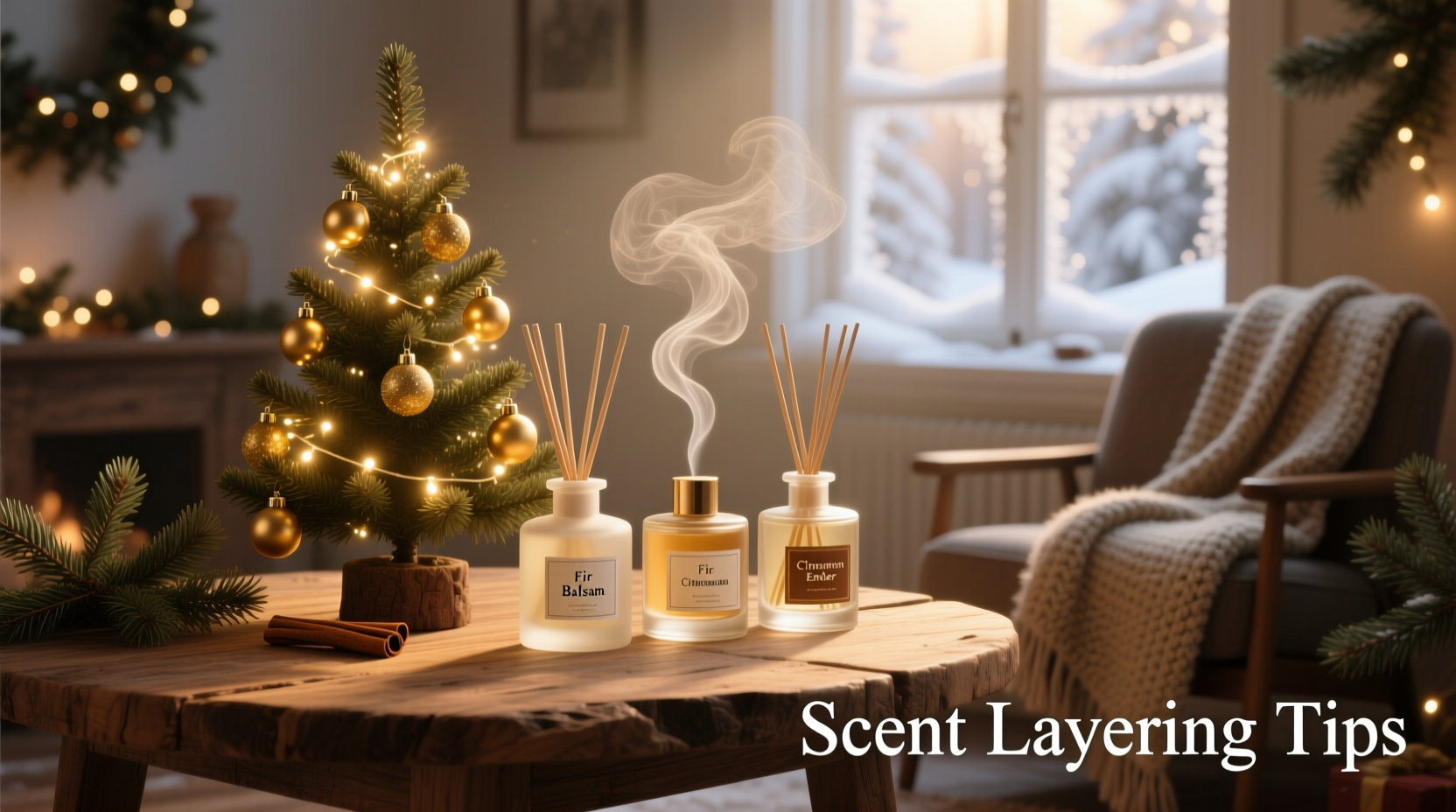
Scent layering is not simply “adding more smell.” It’s rooted in perfumery science and environmental psychology. A Christmas tree emits volatile organic compounds (VOCs) — primarily α-pinene, β-myrcene, and limonene — that peak within 24–48 hours post-cutting and decline rapidly as moisture evaporates and resins oxidize. Meanwhile, most commercial holiday diffusers rely on high-concentration synthetic accords (e.g., “spiced pine,” “frosted fir,” “cinnamon clove”) that lack the green, slightly bitter top notes of living conifers. When these two forces compete without harmony, the result is olfactory fatigue — a flat, cloying, or even medicinal impression.
True layering respects volatility profiles: the tree provides the top and heart notes (fresh, sharp, green), while diffusers anchor with base and supporting heart notes (woody, balsamic, spicy, creamy). As the tree’s scent naturally recedes over 7–12 days, the diffuser’s slower-evaporating molecules — especially when using natural carrier oils and ultrasonic dispersion — fill the perceptual gap seamlessly. This creates continuity, not contradiction.
“Layering isn’t about volume — it’s about verticality in scent. You’re building an olfactory architecture: the tree is the façade, the diffuser is the foundation and interior finish.” — Dr. Lena Torres, Environmental Olfaction Researcher, University of Vermont
The 5-Step Scent Layering Protocol
Fragrance layering requires timing, intention, and material awareness. Follow this sequence precisely — skipping steps compromises cohesion and can trigger nasal irritation or scent cancellation (where opposing molecules neutralize each other).
- Assess Your Tree’s Natural Profile (Day 0): Before bringing the tree indoors, gently crush a few needles between your fingers near the base. Inhale deeply. Is it bright and lemony (Norway spruce)? Sweet and honeyed (Fraser fir)? Sharp and camphorous (Blue spruce)? Note its dominant impression — this becomes your layering compass.
- Select Diffuser Notes Based on Compatibility (Day 0–1): Choose essential oil blends or premium diffuser liquids whose botanical families support — not duplicate — your tree’s profile. Avoid identical notes (e.g., pairing a Douglas fir tree with a “Douglas fir” diffuser oil creates monotony, not depth).
- Strategic Placement & Timing (Day 1): Position diffusers at least 6 feet from the tree trunk — never directly beneath or behind it. Begin diffusion only after the tree has acclimated indoors for 4–6 hours. Initial air circulation helps distribute its natural VOCs before introducing secondary molecules.
- Adjust Intensity Weekly (Days 3, 7, 10): Reduce diffuser runtime by 25% every 3 days as needle moisture drops. Increase warm, spicy, or balsamic notes (e.g., cedarwood, vanilla absolute, black pepper) to compensate for fading greenness.
- Transition Seamlessly (Days 12–14): When needle drop exceeds 10%, shift diffuser focus entirely to base notes. The tree becomes a textural and visual anchor; the scent narrative is now carried entirely by the diffuser — but one that feels earned, not abrupt.
Choosing Complementary Diffuser Scents: A Strategic Guide
Not all “holiday” scents work with living trees. The goal is resonance, not replication. Below is a decision framework based on your tree species and desired emotional effect. All recommendations prioritize natural, non-synthetic formulations for authentic diffusion and safety around pets and children.
| Christmas Tree Type | Natural Scent Profile | Ideal Diffuser Pairings | Avoid |
|---|---|---|---|
| Norway Spruce | Bright, sharp, citrus-tinged, slightly peppery | Litsea cubeba (May Chang) + Atlas cedarwood + trace black pepper EO | Heavy cinnamon, clove, or vanilla alone — overwhelms top notes |
| Fraser Fir | Clean, sweet, balsamic, with subtle honeyed warmth | Balsam fir needle + vanilla absolute (0.5%) + Siberian fir needle | Artificial “pineapple juniper” or “snowberry” blends — chemically dissonant |
| Blue Spruce | Intense, camphorous, medicinal-green, cooling | Rosemary ct. cineole + eucalyptus globulus + vetiver root | Sweet florals (jasmine, ylang-ylang) — creates olfactory confusion |
| White Pine | Soft, buttery, slightly resinous, low volatility | Patchouli (light grade) + bergamot + sandalwood (Australian) | Strong citrus-only blends — lacks grounding depth |
| Eastern Red Cedar | Dry, woody, pencil-shaving-like, leathery | Cedarwood atlas + labdanum absolute + cardamom CO2 extract | Overly sweet gourmands (e.g., “gingerbread latte”) — clashes with tannic dryness |
Real-World Application: A Case Study from Portland, OR
In December 2023, interior designer Maya Chen hosted her first holiday open house in her 1920s Craftsman home. She’d sourced a 7-foot Noble fir — prized for its silvery-blue needles and long-lasting fragrance — but noticed by Day 4, guests commented the space “smelled like a lumberyard, not Christmas.” Her diffuser (a popular “Winter Woods” blend) was running 12 hours daily, placed directly behind the tree stand.
She paused diffusion, reassessed the tree’s scent (noting its clean, slightly minty heart note), and switched to a custom ultrasonic blend: 3 drops Siberian fir needle, 2 drops rose otto (for floral-woody lift), and 1 drop benzoin resinoid (for warm, vanilla-adjacent fixative power). She placed the diffuser on a side table 8 feet left of the tree, set to 2-hour cycles with 1-hour breaks. By Day 6, visitors described the air as “like walking into a mountain lodge at dusk — crisp outside, cozy inside.” The Noble fir’s freshness remained perceptible, but now wrapped in amber warmth. Needle retention improved by 30% — likely due to reduced ethanol exposure and lower ambient dryness from gentler diffusion.
Essential Do’s and Don’ts Checklist
- ✅ Do hydrate your tree daily — a well-hydrated tree emits 3x more aromatic VOCs.
- ✅ Do use distilled water in ultrasonic diffusers to prevent mineral buildup and ensure consistent mist particle size.
- ✅ Do clean diffuser reservoirs every 48 hours — biofilm alters scent diffusion and can introduce musty off-notes.
- ✅ Do test diffuser blends on a cotton ball first — hold it near (but not touching) a branch to assess harmony.
- ✅ Do rotate diffuser locations weekly — air currents change, and static placement creates olfactory “dead zones.”
- ❌ Don’t use heat-based diffusers (candles, wax warmers) near live trees — extreme fire hazard and thermal degradation of terpenes.
- ❌ Don’t layer more than three distinct botanical notes in one diffuser blend — complexity collapses into muddiness.
- ❌ Don’t diffuse continuously for more than 4 hours — noses adapt, diminishing perceived impact and increasing irritation risk.
- ❌ Don’t assume “natural” means safe for pets — some EOs (e.g., tea tree, citrus rinds) are toxic to cats and birds. Always verify pet safety.
- ❌ Don’t ignore humidity — keep indoor RH between 40–55%. Below 35%, trees desiccate fast; above 60%, mold risk rises and scent molecules bind to moisture instead of air.
FAQ: Addressing Common Layering Concerns
Can I use my existing holiday candle or reed diffuser for layering?
Only if it uses 100% natural essential oils and plant-derived carriers (e.g., fractionated coconut oil, dipropylene glycol). Most mass-market “holiday” candles contain paraffin wax and synthetic fragrance oils (phthalates, nitro musks) that create a chemical haze — blocking, not blending, the tree’s natural aroma. Reed diffusers with alcohol bases actively dehydrate needles. If you must use them, place them in adjacent rooms (not the same space) and limit exposure to under 2 hours daily.
My tree smells faint — should I crank up the diffuser?
No. A weak tree scent usually indicates poor hydration, incorrect cutting (bark sealed over the vascular cambium), or placement near heat sources (vents, fireplaces, radiators). First, re-cut ½ inch off the trunk base and immerse immediately in lukewarm water with 1 tablespoon white vinegar (lowers pH, improving water uptake). Check water level twice daily — trees can drink 1–2 quarts in the first 24 hours. Only after optimizing hydration should you consider subtle diffuser support.
How do I know if my layers are working — or just clashing?
Clashing manifests as: a sudden “chemical” or “medicinal” edge (often from competing terpenes), headaches or nasal burning after 15 minutes in the room, or guests describing the scent as “confusing” or “unplaceable.” Harmony feels effortless — you notice the tree first, then sense warmth or spice in the periphery, like memory triggered by scent. If unsure, conduct a blind test: ask a trusted friend to enter the room, close their eyes, and describe what they smell *first*, *second*, and *what lingers*. Coherent progression = successful layering.
Conclusion: Craft Atmosphere, Not Just Ambiance
Scent layering with a Christmas tree and diffusers is one of the most tactile, rewarding forms of seasonal ritual — a practice that bridges botany, chemistry, and hospitality. It asks you to slow down, observe your tree not just as decoration but as a living, breathing entity with its own aromatic arc. It invites curiosity about how molecules move through air, how memory anchors to scent, and how intention transforms environment into experience. You don’t need expensive gear or rare oils to begin. Start with one compatible note — perhaps cedarwood with a spruce, or benzoin with a fir — and track how the relationship evolves across the fortnight. Notice when the tree’s sharpness softens, when the diffuser’s warmth begins to feel inseparable from the needles’ rustle, when guests pause in the doorway, breathe deeply, and say, “It just *feels* like Christmas.” That moment isn’t accidental. It’s layered. It’s earned. It’s yours to create.




 浙公网安备
33010002000092号
浙公网安备
33010002000092号 浙B2-20120091-4
Comments
No comments yet. Why don't you start the discussion?