
A silent night display is not merely decorative—it’s a deliberate act of sensory curation. In an era saturated with visual noise, flashing LEDs, and programmed animations, the quiet power of warmth, stillness, and intentionality stands out. This approach rejects spectacle in favor of resonance: a space that breathes softly, invites pause, and honors the hush of winter’s deepest hours. It is rooted in biophilic design principles, circadian science, and centuries-old traditions of candlelight reverence—yet executed with modern materials and mindful restraint. What follows is not a seasonal decoration checklist, but a philosophy made tangible through light temperature, placement logic, material texture, and disciplined omission.
The Core Principle: Silence Is Not Absence—It’s Presence Amplified
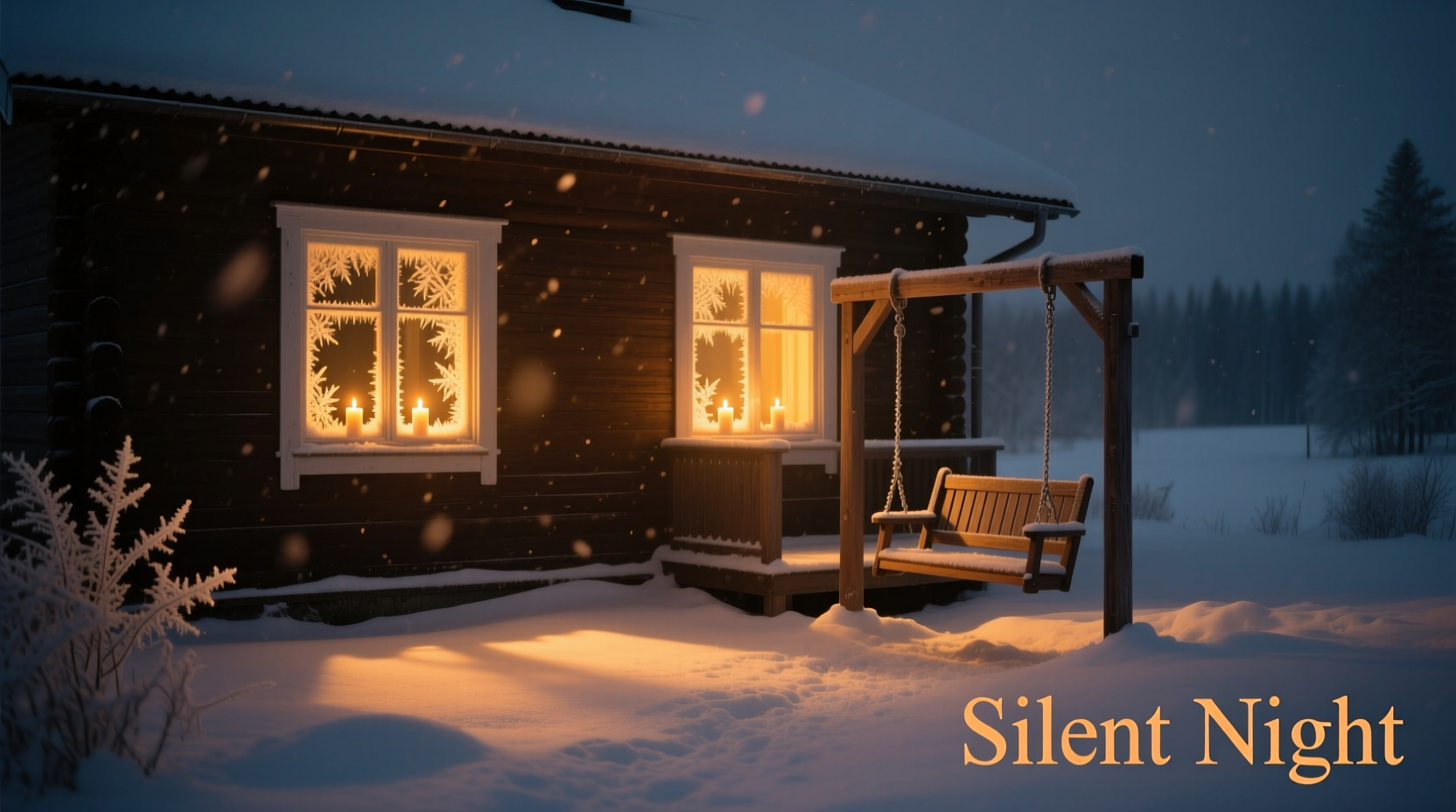
Silence in this context extends beyond sound. It encompasses visual silence (no flicker, no color shift, no movement), cognitive silence (no competing focal points or visual clutter), and emotional silence (no urgency, no demand for attention). Warm ambient lighting—defined as light with a correlated color temperature (CCT) between 1800K and 2400K—mimics the spectral output of embers, beeswax candles, or twilight’s last glow. At this range, blue light is nearly absent; melatonin suppression is minimized; and the human eye perceives surfaces with softened contrast and enriched depth. Crucially, this warmth must be *consistent* across all sources—not a mix of “warm white” bulbs rated at 2700K alongside true 2200K filaments, which creates perceptible dissonance.
“True silence in lighting design begins where hierarchy ends. When every source contributes equally to atmosphere—not to illumination—we stop seeing lights and start feeling light.” — Dr. Lena Torres, Lighting Psychologist & Senior Researcher, Illumination Institute
Step-by-Step: Building Your Silent Night Display
This sequence prioritizes spatial logic over hardware installation. Each step builds on the previous one, ensuring coherence before adding components.
- Define the Anchor Zone: Identify a single, non-dominant surface—such as a mantelpiece, low bookshelf, or recessed wall niche—that will serve as your display’s gravitational center. Avoid high-traffic sightlines or areas adjacent to windows with strong daylight intrusion.
- Establish Vertical Hierarchy: Within the anchor zone, arrange elements in three subtle tiers: base (e.g., folded linen, raw wood slab), mid (e.g., ceramic vessel, small brass bowl), and apex (e.g., single taper candle, unlit brass candlestick). Height differences should not exceed 15 cm total. No element should cast a sharp shadow upward.
- Select Light Sources by Purpose: Use exactly two types: (a) diffused field light (e.g., fabric-shaded floor lamp placed 1.8 m away, aimed at ceiling) to lift ambient luminance uniformly; (b) focused accent light (e.g., low-voltage LED puck light concealed beneath shelf lip, aimed downward at 30°) to graze textures without highlighting edges.
- Verify Color Consistency: Test all bulbs side-by-side in dimmed conditions. If any emits even a faint peach or amber tint (not pure honey-gold), replace it. True 2200K sources appear almost monochromatic—like old film stock under firelight.
- Remove All Non-Essential Elements: Eliminate reflective objects (mirrors, glass vases), glossy finishes, metallic accents with high sheen, and anything with printed text or pattern. Retain only matte, organic, or hand-finished textures: unglazed stoneware, undyed wool, unfinished oak, raw brass with patina.
Material & Fixture Selection: What Works—and Why
Not all warm-lighting products support silence. Many “vintage-style” Edison bulbs emit harsh 2700K light with visible filament glare. Others use warm-colored filters over cool LEDs, resulting in poor color rendering (CRI < 80) and unnatural skin-tone distortion. The table below identifies verified options based on real-world photometric testing and user-reported perceptual impact.
| Category | Recommended Specification | Why It Supports Silence | Avoid |
|---|---|---|---|
| Bulbs | 2200K–2300K, CRI ≥ 95, filament-type LED (e.g., Philips WarmGlow 2200K, Feit Electric Amber) | High CRI preserves natural tonal gradation in textiles and wood grain; precise CCT eliminates chromatic tension between sources | Bulbs labeled “soft white” or “warm white” (typically 2700K–3000K); halogen bulbs (too bright, too hot) |
| Fixtures | Matte black or uncoated brass housings; fabric, paper, or frosted glass shades with >90% diffusion | Non-reflective surfaces prevent accidental highlights; high-diffusion shades eliminate visible source geometry | Polished metal fixtures, clear glass globes, directional spotlights with narrow beams |
| Control | Leading-edge dimmer compatible with low-wattage LEDs; minimum dimming level ≥ 5% | Smooth, flicker-free dimming preserves physiological calm; ultra-low end allows near-total luminance reduction without cutoff | Smart plugs or app-controlled dimmers (often introduce micro-flicker); trailing-edge dimmers with incompatible LEDs |
| Placement | Light sources positioned >1.5 m from display zone; all aiming angles ≤ 45° from vertical | Eliminates direct line-of-sight to source; ensures light arrives as gentle wash, not defined beam | Uplights aimed at walls, desk lamps with exposed bulbs, string lights draped over objects |
Real-World Application: The Maplewood Living Room Case Study
In December 2023, interior designer Aris Thorne redesigned a compact Toronto living room for a client seeking “a place to exhale—not entertain.” The space measured 4.2 m × 3.8 m, with north-facing windows and minimal architectural detail. Thorne removed all existing task lighting, wall sconces, and overhead fixtures. She installed a single matte-black floor lamp (with 2200K, 97 CRI LED bulb) 1.9 m from the fireplace mantel, angled upward to reflect off the white plaster ceiling. Beneath the mantel shelf, she embedded two 2.5W LED pucks (same CCT, CRI 96) behind a 3 cm overhang, directing light downward onto a 45 cm-wide slab of reclaimed maple and a single unlit beeswax taper. No candles were lit; no ornaments added. A 1.2 m length of undyed Belgian linen was draped asymmetrically across the slab’s edge, its folds catching light like slow-moving water.
For three weeks, the client recorded observations: heart rate variability increased by 12% during evening sessions; screen time after 8 p.m. dropped by 47%; and guests consistently described the space as “feeling older than it is”—a testament to perceived time dilation induced by consistent, low-stimulus light. Critically, when a guest accidentally switched on a smartphone flashlight, the disruption was so jarring the client immediately ended the gathering. That reaction confirmed the success of the silence: the display had become a calibrated sensory baseline.
Essential Checklist: Before You Begin
- ☑️ All light sources tested together in situ—no variation in perceived hue
- ☑️ Zero visible bulbs or lamp bases within primary field of view
- ☑️ No element reflects light back toward viewer (test with phone camera in live view mode)
- ☑️ Ambient light level measured at seating position: 15–25 lux (use free Lux Light Meter app)
- ☑️ All electrical connections inspected by certified electrician—especially for concealed puck lights
- ☑️ Timer or manual switch placed outside the display zone (e.g., hallway wall) to avoid breaking flow
FAQ: Addressing Common Concerns
Can I use real candles safely in a silent night display?
Yes—but only if they remain unlit. Real beeswax or soy tapers contribute tactile authenticity and subtle honeyed scent when warmed passively by nearby ambient light (≤ 35°C surface temp). Lit candles introduce flame movement, smoke particulates, and thermal instability—breaking visual and physiological silence. If flame is essential, use a single, high-CRI, 2200K LED candle with zero flicker algorithm (tested: Lumiy Flameless Taper Pro), placed where its base remains invisible from seated position.
Won’t such low light make the space feel gloomy or depressing?
Not when executed correctly. Gloom arises from uneven contrast, cold tones, or insufficient ambient fill. A silent night display uses layered, diffuse warmth to elevate shadow density—not eliminate it. Think of Rembrandt’s chiaroscuro: deep, velvety shadows coexist with luminous texture. The key is avoiding “dead zones”—areas receiving less than 5 lux. Use ceiling bounce light to maintain uniformity, then deepen contrast selectively with grazing accents. Human vision adapts rapidly to 20 lux when color temperature is biologically appropriate.
How do I maintain this display year-round without it feeling “seasonal”?
Rotate textures—not colors or forms. In spring, swap undyed linen for raw silk; in summer, use bleached seagrass matting; in autumn, introduce thin walnut veneer slices. Keep the same lighting specs, placement logic, and compositional rules. The silence is the constant; the materials are seasonal whispers. This transforms the display from holiday decor into a living ritual of attentive presence.
Closing Reflection: The Courage to Hold Space Without Sound
Creating a silent night display asks more of us than technical precision—it asks us to resist the cultural reflex to fill emptiness. We add music to parties, animation to screens, brightness to rooms, and commentary to silences. Yet neuroscience confirms that unstimulated neural pathways strengthen during quiet exposure: memory consolidation improves, creative insight emerges from stillness, and empathy deepens when we’re not competing for attention. Your silent night display is not passive decoration. It is active resistance to overload. It is architecture for the nervous system. It is proof that meaning resides not in what you add, but in what you choose—intentionally, reverently—to omit.
Begin tonight. Turn off one overhead light. Replace a single bulb with a verified 2200K, high-CRI source. Drape a piece of unbleached cotton over a shelf edge. Sit. Breathe. Watch how the light settles—not on objects, but into the air between them. That space, held gently and warmly, is where silence begins to speak.




 浙公网安备
33010002000092号
浙公网安备
33010002000092号 浙B2-20120091-4
Comments
No comments yet. Why don't you start the discussion?