
Decorative LED string lights bring warmth and ambiance to any space, but many off-the-shelf sets lack advanced features like dimming or color transitions. If your LED strings aren’t “smart,” you might assume they’re limited to static on/off operation. However, it’s entirely possible—and surprisingly simple—to achieve a soft, slow fade effect without relying on Bluetooth, Wi-Fi, or proprietary apps. With basic electrical components and a bit of hands-on tinkering, you can transform ordinary LED strings into mood-enhancing lighting installations that gently pulse like candlelight or mimic a sunset.
This guide walks through practical, proven techniques to create a slow fade effect using analog electronics, mechanical solutions, and clever hacks. Whether you're decorating a bedroom, patio, or event space, these methods deliver professional-looking results while keeping costs low and complexity manageable—even for beginners.
Understanding Non-Smart LED Strings
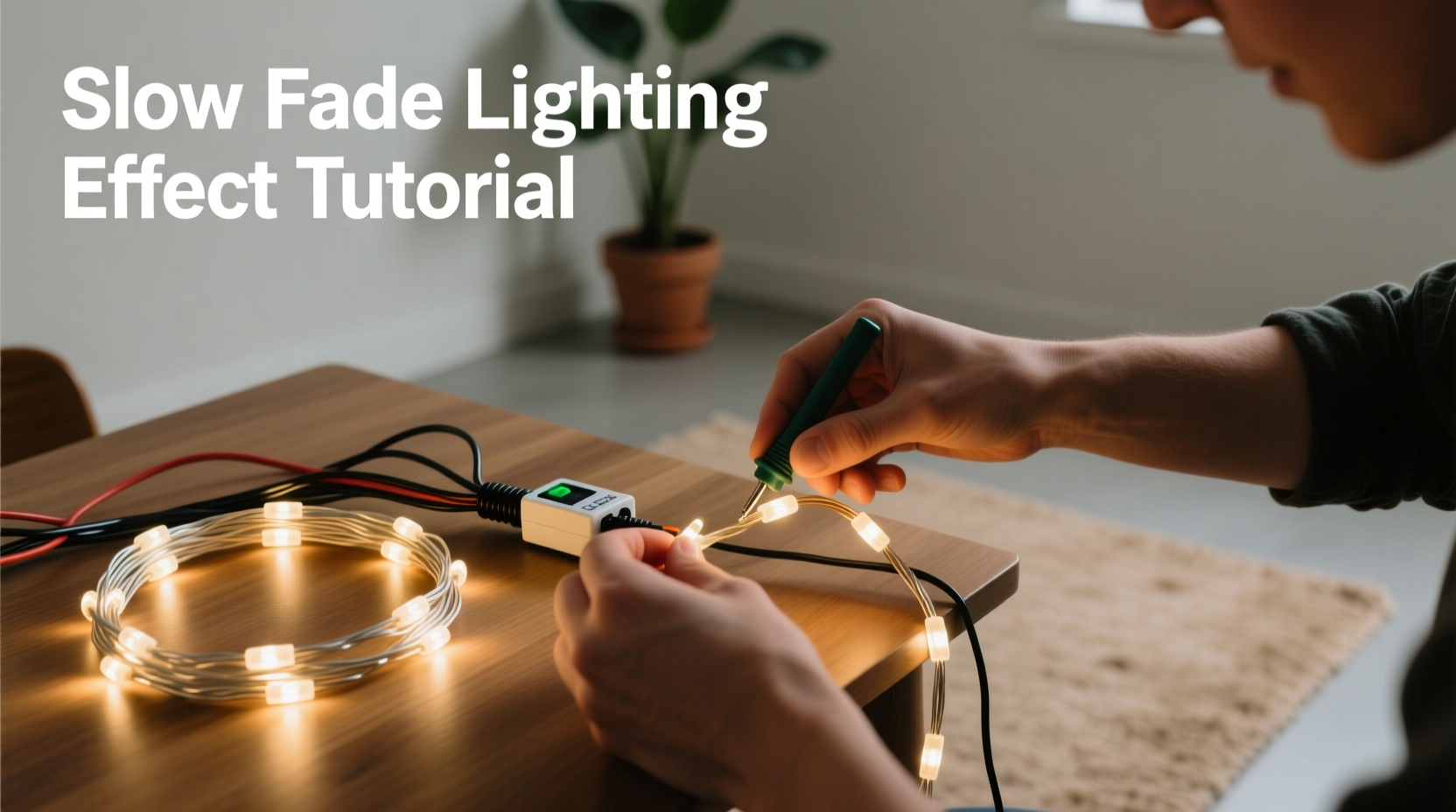
Most standard LED string lights operate on direct current (DC) or alternating current (AC), depending on their power source. Battery-powered sets typically run on 3V to 6V DC, while plug-in versions often use 120V AC in North America or 230V AC elsewhere. These lights are usually wired in parallel or series-parallel configurations to maintain brightness across all bulbs.
Unlike smart LEDs, which accept digital signals to change intensity or color, non-smart strings respond only to voltage changes. This means that to create a fade effect, you must gradually increase or decrease the voltage supplied to the entire string. The human eye perceives this as a smooth brightening or dimming—what we call a \"fade.\"
Because these lights don’t have built-in microcontrollers, achieving dynamic effects requires external control over power delivery. Fortunately, several analog and electromechanical approaches make this feasible without programming or specialized tools.
Using a Dimmer Circuit with Variable Voltage Control
The most reliable way to produce a slow fade is by regulating the input voltage using an analog dimmer circuit. For DC-powered LED strings (such as battery-operated fairy lights), a simple **PWM (Pulse Width Modulation) dimmer module** works exceptionally well. PWM rapidly switches the power on and off at varying duty cycles, effectively controlling average brightness without changing the actual voltage.
These small modules are inexpensive and widely available online. Most operate between 3V and 24V DC, making them compatible with common LED string voltages. To set up:
- Cut the power cord near the battery pack or adapter end.
- Connect the input wires from the power source to the dimmer's “+IN” and “–IN” terminals.
- Attach the LED string wires to the “+OUT” and “–OUT” terminals.
- Adjust the potentiometer (knob) slowly to test fading behavior.
To automate the fade instead of manual adjustment, replace the standard knob with a **rotary cam attached to a slow-moving motor**, or use a **555 timer IC circuit** configured in astable mode to generate a sweeping control signal. When paired with a MOSFET transistor, this setup can cycle the brightness up and down automatically, creating a continuous breathing effect.
Step-by-Step: Building a 555 Timer Fade Controller
A classic solution among hobbyists, the 555 timer IC can be wired to produce a triangle-wave output that drives a MOSFET, modulating LED brightness in a repeating cycle. Here’s how to assemble one:
Materials Needed:
- NE555 timer IC
- IRFZ44N MOSFET (or similar N-channel)
- 10kΩ resistor
- 10µF and 100µF electrolytic capacitors
- 100kΩ linear potentiometer
- Breadboard and jumper wires
- 9V battery or regulated DC supply (compatible with LED string)
Assembly Steps:
- Insert the 555 timer into the breadboard.
- Connect Pin 8 (VCC) and Pin 4 (RESET) to the positive rail.
- Connect Pin 1 (GND) to the negative rail.
- Wire Pin 7 (DISCHARGE) to the positive side of the 10µF capacitor; connect the other side to GND.
- Link Pin 6 (THRESHOLD) to the same capacitor node.
- Add the 100kΩ potentiometer between Pin 7 and Pin 6, with the wiper going to Pin 2 (TRIGGER).
- Place a 10kΩ resistor from Pin 2 to VCC.
- Add a 100µF capacitor from Pin 5 (CONTROL VOLTAGE) to GND for stability.
- Connect Pin 3 (OUTPUT) to the gate of the MOSFET via a 1kΩ resistor.
- Link the MOSFET source to GND; drain connects to the negative lead of the LED string.
- Power the LED string’s positive lead directly from the supply.
When powered, the 555 generates a slow oscillation. The output ramps up and down, turning the MOSFET on and off gradually. This causes the LEDs to fade in and out smoothly over several seconds. Adjusting the potentiometer changes the fade speed.
“Analog circuits like the 555 timer offer unmatched simplicity for lighting effects. You get precise control without writing a single line of code.” — Rafael Nguyen, Electronics Hobbyist & DIY Instructor
Mechanical Fading Using Motorized Dampers
For those who prefer mechanical solutions—or work with AC-powered strings where electronic dimming poses safety concerns—there’s an elegant workaround: physically modulate light output using movement.
One creative method involves placing the LED string behind a rotating disk with variable opacity. As the disk turns, different sections filter the light, creating the illusion of fading. For example:
- A semi-circular gradient film (dark to clear) mounted on a slow motor shaft.
- A cardboard cylinder painted with radial gradients, spun by a repurposed fan motor.
While not electrically altering the LEDs themselves, this technique produces a convincing visual fade. It’s particularly effective for indoor displays, art installations, or themed decor where the mechanism can be hidden.
Another variation uses a sliding baffle—a piece of frosted acrylic moved back and forth in front of the lights via a cam follower. Even a modified wall clock mechanism can provide the slow, rhythmic motion needed.
| Method | Voltage Compatibility | Fade Speed Control | Skill Level |
|---|---|---|---|
| PWM Dimmer Module | DC only (3–24V) | High (adjustable) | Beginner |
| 555 Timer Circuit | DC only | Medium to High | Intermediate |
| AC Triac Dimmer + Chaser | AC only (120V/230V) | Low to Medium | Advanced |
| Mechanical Shutter | Any | Low (fixed by motor speed) | Beginner/Intermediate |
| Transformer-Based Variac | AC only | Manual only | Intermediate |
Alternative: Repurpose Old Equipment for Analog Fading
You don’t always need to build something new. Many household devices already contain components capable of producing fade-like effects.
Old audio equipment, for instance, often includes **VU meters** driven by amplifier output. Some models feature auto-dimming backlighting that pulses gently. Harvesting the driver board from such units can yield a ready-made slow-fade controller suitable for low-voltage LED strings.
Similarly, vintage Christmas light controllers—especially those designed for “twinkle” or “chase” effects—sometimes include gradual transition circuits. Models labeled “soft glow” or “candle flicker” may use RC timing networks that ramp voltage slowly. Testing these with a multimeter can reveal usable fade outputs.
Mini Case Study: Cozy Café Ambiance on a Budget
Jessica runs a small coffee shop in Portland and wanted to enhance evening ambiance without investing in expensive smart lighting. She had several 24-foot warm-white LED strings but found them too harsh when fully lit.
Instead of buying new fixtures, she purchased four $8 PWM dimmer modules and connected each to a separate string. Using a 12V DC power supply, she adjusted the fade speed so each string cycled from 10% to 100% brightness over 8 seconds. She staggered the start times slightly so the overall effect resembled a gentle wave of light moving through the space.
The result transformed the back wall into a living canvas of soft illumination. Customers reported feeling more relaxed during evening hours, and Jessica achieved the look of high-end programmable lighting for under $50.
Checklist: Creating Your Own Slow Fade Effect
- Determine if your LED string uses AC or DC power
- Select a compatible dimming method (PWM, 555 timer, mechanical)
- Gather necessary components (dimmer, MOSFET, resistors, capacitors)
- Test the circuit on a breadboard before permanent wiring
- Ensure all connections are insulated and secure
- Mount the system safely away from moisture or foot traffic
- Adjust fade speed for desired visual rhythm (3–10 seconds per cycle)
FAQ
Can I use a regular household dimmer switch for LED string lights?
No, standard wall dimmers are designed for incandescent bulbs and often don’t work well with low-wattage LEDs. They can cause flickering, buzzing, or incomplete dimming. Use a dimmer specifically rated for LED loads, or better yet, an electronic PWM module for DC strings.
Will fading reduce the lifespan of my LED lights?
No—unlike older bulb types, LEDs benefit from reduced voltage operation. Running them at lower brightness extends their life by reducing heat and stress on the semiconductor junctions. A fade cycle does not harm the LEDs.
Is it safe to modify plug-in LED strings?
Working with AC-powered strings carries risks. If you’re not experienced with mains voltage, stick to battery-operated sets or use isolated, UL-listed dimmer modules. Always unplug before making modifications, and never bypass safety fuses or insulation.
Conclusion
Creating a slow fade lighting effect with non-smart LED strings is not only possible—it’s accessible to anyone willing to experiment with basic electronics or mechanical ingenuity. Whether you choose a precision-timed 555 circuit, a plug-and-play PWM module, or a kinetic shading device, the outcome is the same: atmospheric, dynamic lighting that elevates any environment.
Forget relying on apps and subscriptions for mood lighting. With a few dollars’ worth of parts and a few hours of effort, you can craft a personalized glow that breathes with your space. Start small, test thoroughly, and let your creativity shine—one fading pixel at a time.




 浙公网安备
33010002000092号
浙公网安备
33010002000092号 浙B2-20120091-4
Comments
No comments yet. Why don't you start the discussion?