
A starburst lighting effect radiating from the top of your Christmas tree transforms a traditional display into a luminous focal point—evoking the celestial drama of a supernova or the warm glow of a vintage holiday postcard. Unlike simple tree toppers that merely sit atop branches, a true starburst extends outward in symmetrical, dynamic rays, casting light across walls, ceilings, and adjacent surfaces. This isn’t about adding more bulbs; it’s about intentional light geometry, thoughtful layering, and subtle control over direction, intensity, and rhythm. Done well, it elevates your entire room’s ambiance without overwhelming the space. What makes this effect accessible—and often overlooked—is that it requires no custom fabrication, no electrician, and minimal investment. With common holiday supplies, basic tools, and precise placement logic, you can achieve results that rival professionally installed displays.
Understanding the Starburst Principle: Light as Architecture
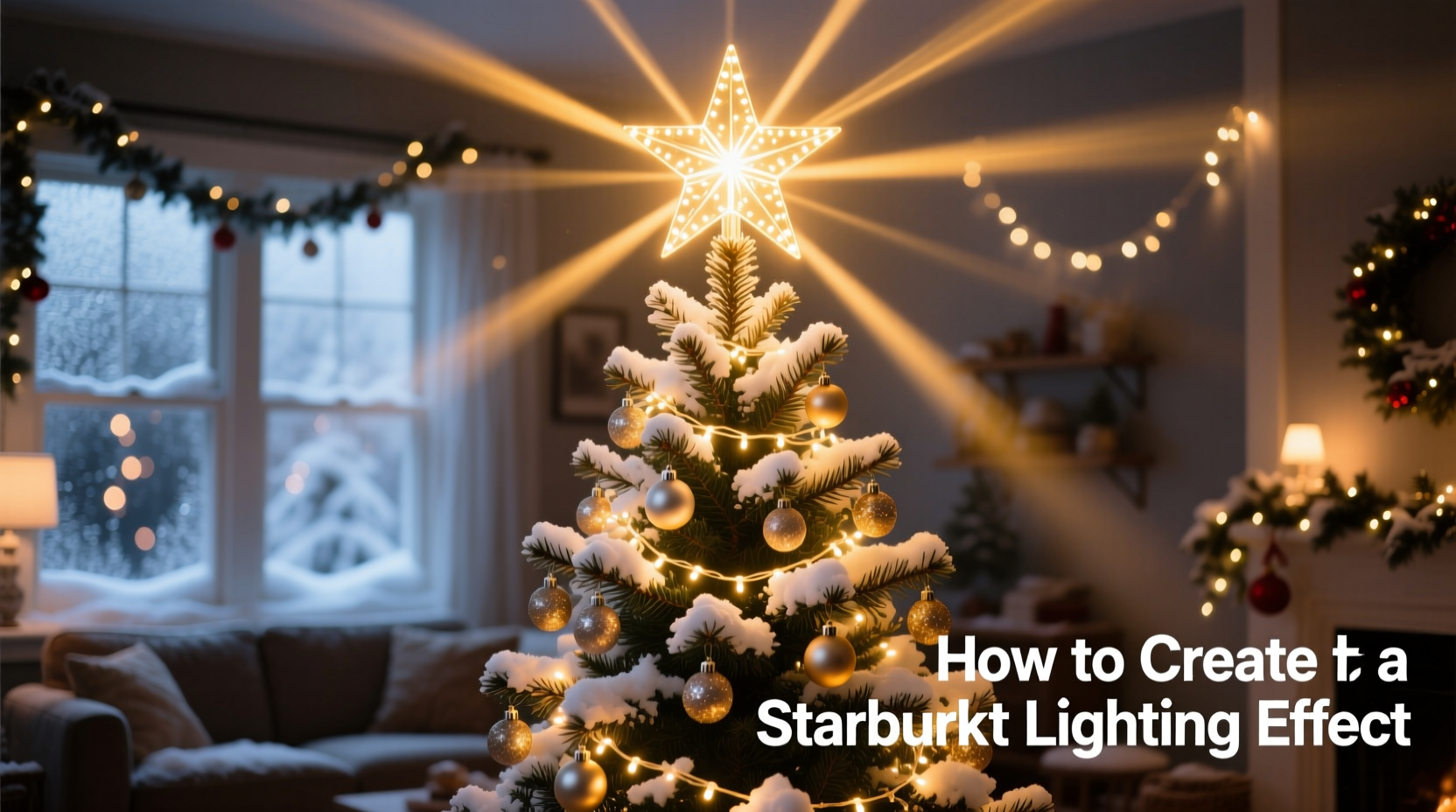
The starburst effect relies on three optical principles working in concert: directional projection, radial symmetry, and controlled diffusion. Directional projection ensures light travels outward—not downward—so rays appear to emanate from a single origin point. Radial symmetry creates visual balance: typically 6–12 evenly spaced arms, each angled between 25° and 45° from vertical. Controlled diffusion prevents harsh glare while preserving definition—think soft-edged beams rather than sharp laser lines. Traditional tree toppers (stars, angels, or finials) rarely satisfy these criteria because they’re decorative, not functional. A true starburst is engineered: it uses linear light sources mounted on rigid supports, positioned to fan out from the apex with consistent spacing and uniform elevation.
Crucially, this effect works best when the tree itself acts as a structural anchor—not just a backdrop. The trunk and central leader provide vertical stability; the upper third of the tree (roughly the top 24–36 inches) offers natural support points for securing arms without visible hardware. That means success hinges less on what you buy and more on how thoughtfully you integrate components into the tree’s existing architecture.
Essential Materials & Why Each One Matters
You don’t need specialty lighting gear—but substituting materials compromises both safety and aesthetics. Below is a vetted list of what actually delivers reliable, repeatable results. All items are widely available at hardware stores, craft suppliers, or major retailers during the holiday season.
| Item | Purpose | Why It’s Non-Negotiable |
|---|---|---|
| UL-listed mini LED string lights (warm white, 20–50 count) | Primary light source for each arm | Low heat output prevents needle drying and fire risk; UL certification guarantees safe voltage drop and insulation integrity. |
| 1/8\" flexible aluminum wire (12–18 gauge, pre-annealed) | Arm framework | Stiff enough to hold shape under light weight, yet bendable by hand for fine-tuning angles. Plastic-coated coat hangers warp; wooden dowels lack flexibility. |
| Small-gauge floral wire (24–26 gauge, green) | Securing lights to arms | Thin, strong, and nearly invisible against branches. Twists tightly without cutting through light cord insulation. |
| Tree-top stabilizer ring (3–4\" diameter, metal or heavy-duty plastic) | Central mounting hub | Distributes weight evenly across multiple attachment points. Prevents torque on the tree’s leader branch—a common cause of drooping or breakage. |
| Heavy-duty zip ties (4\", UV-resistant) | Secondary anchoring | Withstand temperature fluctuations better than standard ties; prevent slippage as tree dries over time. |
Avoid common pitfalls: never use incandescent lights (excessive heat), unlisted extension cords (fire hazard), or adhesive tapes (residue, poor grip, insulation damage). Also skip battery-operated lights for this application—they lack consistent output across all arms and dim unevenly.
Step-by-Step Assembly: From Concept to Illumination
This sequence prioritizes safety, adjustability, and repeatability. Complete each step fully before moving to the next. Total assembly time: 45–75 minutes.
- Prepare the tree apex: Trim any loose or brittle needles from the top 8 inches of the leader branch. Gently separate upper branches to expose the central stem. Insert the stabilizer ring snugly around the leader—about 2 inches below the very tip. Secure it with two small floral wire loops twisted firmly but not so tight they cut into bark.
- Cut and shape arms: Cut 8 equal lengths of aluminum wire (each 24–30 inches long, depending on desired spread). Bend each gently into a slight “S-curve”: 3 inches near the base (for anchoring), then a 30° outward angle, followed by a gentle upward curve at the tip to lift the light strand off the branch surface.
- Mount arms to stabilizer: Thread one end of each wire through a hole or slot in the stabilizer ring. Wrap the base 3 inches tightly around the ring using floral wire—two full wraps per arm. Ensure all arms emerge at identical angles and rotate freely before tightening.
- Attach lights: Starting 4 inches from the tip of each arm, secure lights every 4–5 inches using floral wire—loop once around the wire arm and the light cord, then twist twice. Do not wrap tightly enough to pinch the cord. Leave the last 3 inches of each strand free at the tip for optimal beam projection.
- Anchor and test: Use zip ties to connect each arm’s midsection to a sturdy upper branch. Pull gently to verify tension—arms should spring back slightly, not sag. Plug in lights and observe beam patterns. Adjust individual arm angles by loosening floral wire at the ring, repositioning, and retwisting.
Real-World Application: The Thompson Family’s Living Room Transformation
In Portland, Oregon, the Thompsons had struggled for years with a 7.5-foot Fraser fir in a high-ceilinged living room. Their previous attempts—a glittery star topper and a spiral-wrapped garland—vanished into visual noise. “It looked like every other tree,” says Sarah Thompson, an interior designer by trade. “We wanted drama, but also warmth—not brightness.”
Using the method outlined here, they built an 8-arm starburst with warm-white micro-LEDs and aluminum wire shaped to project light onto their pale blue ceiling and adjacent bookshelves. They added a subtle dimmer switch (a $12 plug-in model compatible with LED strings) to lower intensity after 9 p.m. The result? A soft, radiant halo that made the room feel cozier without sacrificing elegance. Neighbors began asking how they achieved “that gallery-lighting effect.” Most importantly, the tree remained stable for six weeks—no sagging, no burnt needles, no rewiring. “We realized the secret wasn’t more lights,” Sarah notes. “It was fewer lights, placed with intention.”
“The starburst isn’t decoration—it’s spatial storytelling. When light originates from a single, elevated point and moves outward with purpose, it changes how people move through and perceive a room.” — Marcus Bellweather, Lighting Designer & Author of *Ambient Narrative: Light in Domestic Space*
Optimization Techniques for Professional Results
Once the core structure is sound, refinement separates good from exceptional. These techniques require no extra cost—just attention to detail.
- Layer color temperature: Use 2700K warm-white lights on outer arms and 2400K amber-toned lights on inner arms (if using multi-string setups). This mimics natural light falloff and adds depth—outer rays feel bright and energetic; inner ones feel grounded and inviting.
- Introduce rhythm: Program lights on a 3-second fade cycle (many LED controllers offer this). Avoid strobing or rapid blinking—subtle pulsation reinforces the “radiating” illusion without distraction.
- Control spill: Fold a 2-inch strip of matte black craft paper into a cone and slide it over the base of each light strand where it meets the arm. This blocks upward light bleed that washes out the starburst’s clean edges.
- Balance weight distribution: If using longer arms (>28\"), add a tiny counterweight (e.g., a 1/4-ounce fishing sinker) wrapped in tape at the arm’s midpoint. Prevents torque-induced twisting over time.
Do’s and Don’ts: Safety, Longevity & Aesthetics
| Category | Do | Don’t |
|---|---|---|
| Safety | Use only UL-listed lights rated for indoor use; inspect cords for nicks or fraying before installation; unplug before adjusting arms. | Plug more than three light strings into a single outlet; use extension cords not rated for continuous load; install near flammable drapery or heating vents. |
| Longevity | Store arms coiled loosely in cardboard tubes; keep lights in original clamshell packaging or labeled bins; wipe aluminum wires with dry cloth before storage. | Wrap arms tightly around tree trunks for storage (causes permanent bends); store lights knotted or compressed; leave lights plugged in overnight unattended. |
| Aesthetics | Match light cord color to arm wire (green cord + green wire = invisible); trim excess floral wire ends flush; use same bulb spacing across all arms. | Mix bulb sizes or shapes on one starburst; allow cords to drape visibly down branches; install arms at irregular intervals or angles. |
FAQ
Can I adapt this for an artificial tree?
Yes—and often more easily. Most premium artificial trees include a reinforced center pole with pre-drilled holes or threaded inserts near the top. Replace the stabilizer ring with a lightweight aluminum disc bolted to those inserts. Use shorter arms (20–24\") since artificial branches are stiffer and less forgiving. Confirm your tree’s weight limit: many support up to 5 lbs at the apex, which comfortably accommodates 8 arms plus lights.
What if my tree is shorter than 6 feet?
Scale proportionally. Reduce arm length to 18–22 inches and use 6 arms instead of 8. Prioritize tighter angles (25°–30°) to avoid light hitting the floor too soon. You may also omit the stabilizer ring and anchor arms directly to the topmost branch junction using double-wrapped floral wire—just ensure at least three arms share one robust anchor point to distribute load.
How do I prevent flickering or partial outages?
Flickering almost always stems from poor connections or overloaded circuits. First, check each light’s male/female plug interface: wiggle gently—if lights blink, replace the connector or use a higher-grade plug adapter. Second, calculate total wattage: most mini-LED strings draw 2–4 watts. Eight strings = ~24 watts—well within a standard 15-amp circuit’s capacity (1800 watts). If flickering persists, try a different outlet or use a dedicated circuit. Never daisy-chain more than three strings unless the manufacturer explicitly permits it.
Conclusion
A starburst lighting effect isn’t about spectacle for spectacle’s sake. It’s about reclaiming intention in holiday decoration—replacing passive consumption with active creation, and transforming a seasonal ritual into a moment of quiet craftsmanship. You don’t need a workshop, a budget, or prior experience. You need only aluminum wire, a handful of certified lights, and the willingness to see your tree not as static ornament, but as living architecture waiting for light to give it voice. When you stand back and watch those rays reach across your ceiling—soft, steady, and unmistakably yours—you’re not just illuminating a room. You’re practicing patience, precision, and presence. That’s the real magic.




 浙公网安备
33010002000092号
浙公网安备
33010002000092号 浙B2-20120091-4
Comments
No comments yet. Why don't you start the discussion?