
For anime fans, the holiday season isn’t just about tradition—it’s an opportunity for joyful self-expression. A themed Christmas tree rooted in anime isn’t novelty decor; it’s narrative curation. It transforms your living room into a seasonal shrine honoring characters, worlds, and emotional milestones that shaped your fandom journey. Done thoughtfully, it balances reverence with festivity—avoiding cluttered kitsch while delivering visual cohesion, storytelling depth, and genuine warmth. This guide distills years of community practice—from Tokyo’s Otaku Christmas pop-ups to North American fan conventions—into actionable, aesthetically grounded steps. No prior crafting expertise is required, but attention to palette, proportion, and thematic resonance is essential.
1. Choose Your Anime Theme with Intention (Not Just Popularity)
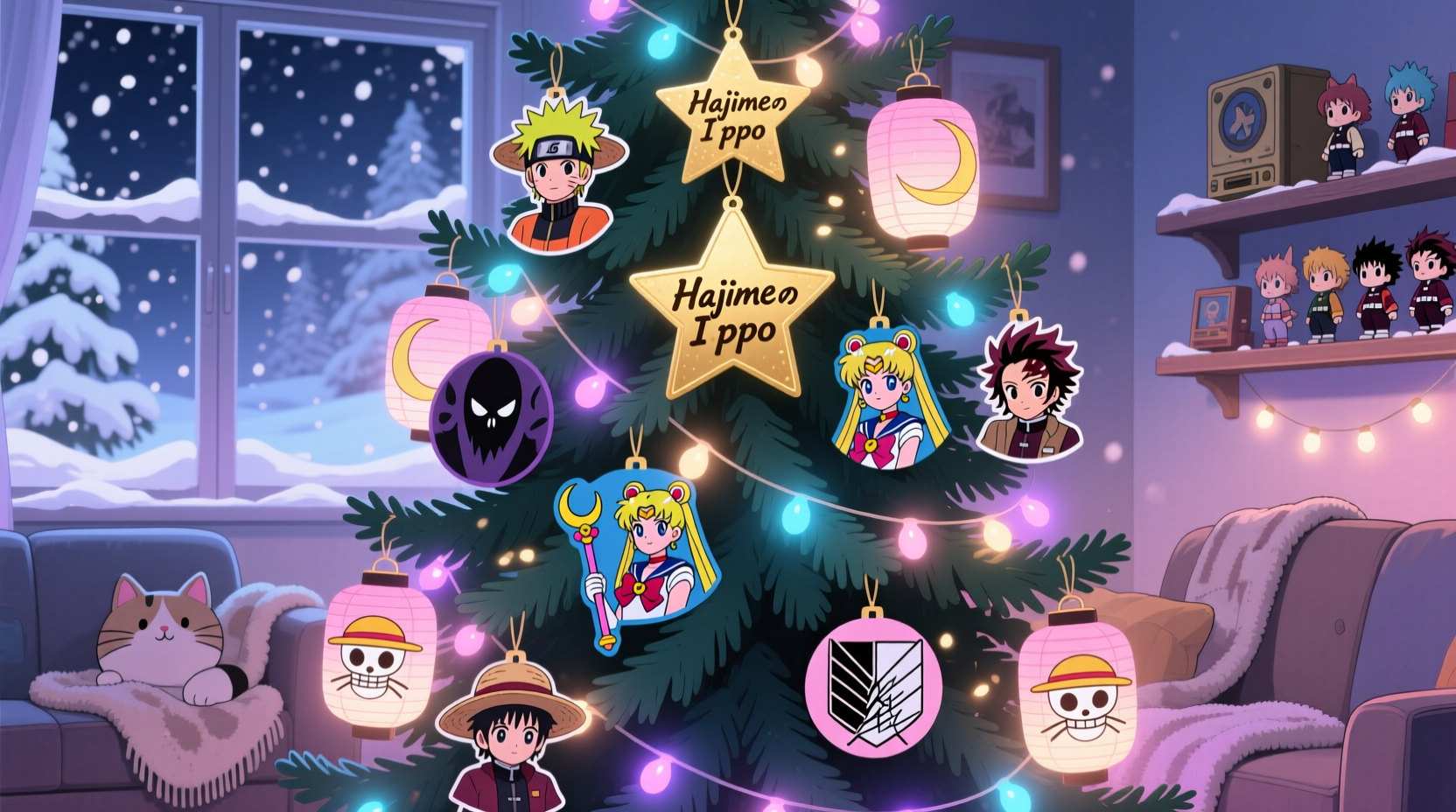
Selecting the right anime isn’t about picking the most streamed title—it’s about identifying which series carries the strongest emotional or aesthetic resonance for *you* this year. Consider tone, visual language, and seasonal alignment. A high-energy shonen like My Hero Academia lends itself to bold primaries and dynamic ornament shapes, while a melancholic, snow-draped story like Your Name invites soft gradients, subtle metallics, and minimalist silhouettes. Avoid mixing franchises unless you’re deliberately building a “crossover universe” concept (e.g., “Studio Ghibli Winter Solstice” or “Shonen Battle Royale Tree”). Even then, limit yourself to two tightly related titles—say, Fullmetal Alchemist: Brotherhood and Attack on Titan, both grounded in wartime gravity and alchemical symbolism—not Naruto and Sailor Moon, whose visual vocabularies clash tonally.
Ask yourself three questions before committing: • Does this series have strong, recognizable iconography (e.g., Naruto’s headband, Luffy’s straw hat, Asuka’s Eva-02 horn)? • Are its dominant colors harmonious enough to build a full palette around (e.g., Haikyu!!’s navy-and-white vs. Jujutsu Kaisen’s deep indigo and blood crimson)? • Does it evoke a feeling compatible with the holidays—nostalgia, hope, quiet resilience, or communal celebration?
2. Build a Cohesive Color & Texture Palette
A successful anime tree avoids “rainbow overload.” Instead, anchor it in a 3–4-color foundation derived directly from the source material. Use the anime’s official logo, key art, or even its opening sequence as reference. For example, Kimetsu no Yaiba offers a rich, layered palette: charcoal black (Demon Slayer Corps uniform), deep burgundy (Tanjiro’s haori), muted gold (sunlight motifs), and off-white (snowy mountain backdrops). That becomes your core: 60% black, 25% burgundy, 10% gold, 5% white.
Texture reinforces theme without relying on literal imagery. Instead of plastering every ornament with character faces, use tactile cues: • Felt or wool for Princess Mononoke’s forest textures • Frosted glass or matte ceramic for Weathering With You’s rain-slicked cityscapes • Woven rattan or jute for Grave of the Fireflies’s mid-century Japanese domesticity • Smooth acrylic or mirrored surfaces for Steins;Gate’s tech-infused futurism
| Anime Title | Core Colors | Recommended Ornament Materials | Thematic Texture Notes |
|---|---|---|---|
| My Neighbor Totoro | Forest green, sky blue, warm beige, soft white | Felt, hand-painted wood, matte ceramic | Organic grain, gentle curves, matte finishes—no sharp edges or glossy plastics |
| Death Note | Black, stark white, deep red, gunmetal gray | Matte acrylic, brushed steel, embossed leather | Crisp lines, high contrast, industrial minimalism—avoid anything whimsical or rounded |
| Clannad | Muted plum, dusty rose, cream, slate gray | Chalk-painted wood, linen-wrapped spheres, frosted glass | Soft focus, weathered authenticity, gentle translucence—evokes autumn light and memory |
| Demon Slayer | Charcoal black, oxblood, antique gold, parchment white | Waxed cotton, hammered brass, unglazed stoneware | Tactile weight, artisanal imperfection, time-worn elegance |
3. Curate Ornaments with Narrative Purpose
Every ornament should serve one of three functions: icon, symbol, or atmosphere. Icon ornaments are instantly recognizable character or object representations—e.g., a tiny replica of Spike Spiegel’s cigarette case or Sailor Moon’s brooch. Symbol ornaments abstract core ideas: a crescent moon for transformation, a broken chain for freedom (Attack on Titan), or interlocking gears for fate (Steins;Gate). Atmosphere ornaments evoke mood without literal reference—a cluster of frosted pinecones for Winter Sonata’s quiet solitude, or iridescent resin drops for Macross Frontier’s cosmic scale.
Resist overcrowding. A 6-foot tree needs no more than 45–55 ornaments total. Distribute them intentionally: • 6–8 large (3–4 inch) statement pieces at eye level (e.g., a hand-painted One Piece Thousand Sunny ship) • 20–25 medium (1.5–2.5 inch) icons and symbols (e.g., Naruto Rasengan swirls, Fullmetal Alchemist transmutation circles) • 15–20 small (0.75–1.25 inch) atmospheric accents (e.g., tiny origami cranes for Battery, miniature lanterns for Yuri!!! on Ice)
“Themed trees succeed when every element feels inevitable—not decorative. If an ornament doesn’t deepen the story or reinforce the mood, it dilutes the whole. Restraint is fandom respect.” — Kenji Tanaka, curator of the Tokyo Anime Art Archive and designer of the annual Shibuya Station Holiday Installation
4. Step-by-Step Assembly Timeline (4 Hours Total)
Build your tree over a single focused afternoon—not scattered sessions. Follow this timed sequence to maintain flow and prevent decision fatigue:
- Hour 1: Foundation & Structure (60 min)
Fluff and shape your tree. Hang neutral base lights first—warm white LED string lights (not multicolor) for Ghibli or Clannad; cool white for Ghost in the Shell or Serial Experiments Lain. Wrap lights evenly, spacing bulbs 3–4 inches apart. Then add your tree skirt: a custom fabric piece (e.g., indigo-dyed cotton for Blue Exorcist) or a vintage kimono obi for Rurouni Kenshin. - Hour 2: Anchor Layers (60 min)
Hang all large statement ornaments first—at branch junctions, not tips. Space them 8–10 inches apart vertically. Prioritize balance: if you place a heavy My Hero Academia hero emblem on the left, counter with a similarly weighted Villains’ Association insignia on the right at the same height. - Hour 3: Narrative Weaving (60 min)
Add medium ornaments in thematic clusters: group three Haikyu!! volleyball motifs together on one bough; arrange four Yuri!!! on Ice skate blades in ascending size on another. Vary orientation—some upright, some tilted—to imply motion and life. - Hour 4: Atmosphere & Finishing (60 min)
Weave in small atmospheric ornaments last. Tuck them deep into branches—not just on the surface—for dimension. Add ribbon or garland only if it serves the theme: braided black-and-red satin for Death Note, hand-dyed silk strips for Little Witch Academia. Top with a custom topper: a miniature Studio Ghibli soot sprite, a folded paper crane, or a stylized Neon Genesis Evangelion entry plug.
5. Real Example: The “Spirited Away” Winter Bathhouse Tree
In Portland, Oregon, fan and textile artist Mei Lin Chen transformed her 7-foot Fraser fir into a breathtaking homage to Spirited Away—not as cartoonish decoration, but as immersive environmental storytelling. She began with a base of warm white fairy lights, then draped hand-dyed, undulating silk ribbons in gradient ochre-to-moss-green to mimic bathhouse steam. All ornaments were handmade: ceramic soot sprites with movable arms, rice-paper lanterns lit by micro-LEDs, and delicate wire-wrapped river stones inscribed with kanji for “purification.” She avoided Chihiro’s face entirely—instead using her red hair ribbon as a subtle motif repeated in narrow velvet ties securing ornaments. The tree skirt was a vintage furoshiki cloth printed with koi swimming upstream. Guests didn’t just see a decorated tree; they felt the hush of the spirit world, the warmth of the boiler room, and the quiet courage of crossing thresholds. Local anime magazine *Otaku Season* featured it as “the definitive example of thematic restraint meeting emotional fidelity.”
FAQ
Can I mix anime from different studios or eras?
Yes—if you unify them under a conceptual umbrella. For example, “Anime About Found Family” could include My Hero Academia, Cardcaptor Sakura, and Barakamon, all rendered in a shared soft-watercolor aesthetic and warm, earthy palette. Avoid stylistic whiplash: don’t pair Akira’s hyper-detailed cyberpunk with Puella Magi Madoka Magica’s flat, graphic pop-art unless you’re executing a deliberate deconstruction project.
How do I make ornaments safely if I’m not craft-inclined?
Start with modification, not creation. Buy plain wooden, ceramic, or acrylic ornaments and apply vinyl decals (use high-quality, weather-resistant ones). Print official art on sticker paper and seal with matte Mod Podge. Or commission artisans via platforms like Etsy using precise references—specify “no facial features, focus on silhouette and color blocking” to ensure tasteful results.
What if my chosen anime has dark or mature themes?
Lean into symbolic abstraction. For Parasyte, use smooth, pearlescent orbs (representing the parasites’ fluid forms) and matte black branches wrapped in silver thread (suggesting neural networks). For Berserk, opt for heavy, forged-iron ornaments in oxidized copper and charcoal gray—evoking the Berserker Armor’s weight and endurance, not its violence. The tree becomes a meditation on resilience, not a depiction of trauma.
Conclusion
Your anime-themed Christmas tree is more than seasonal decor—it’s a quiet act of devotion. It honors the stories that gave you comfort during lonely winters, the characters who modeled courage when you needed it most, and the communities that made you feel seen across continents and time zones. This isn’t about perfection or viral appeal. It’s about intentionality: choosing colors that breathe like a Ghibli sky, placing ornaments with the care of a frame-perfect storyboard, and stepping back to feel the quiet hum of recognition when you see your world reflected in tinsel and tradition. Don’t wait for next December. Gather your references tonight. Sketch a palette. Order one meaningful ornament. Let your tree grow—not just upward, but inward, toward what matters most.




 浙公网安备
33010002000092号
浙公网安备
33010002000092号 浙B2-20120091-4
Comments
No comments yet. Why don't you start the discussion?