
For anime fans, the holiday season isn’t just about tradition—it’s an opportunity for joyful self-expression. A themed Christmas tree rooted in a beloved anime series transforms a seasonal decoration into a narrative centerpiece: one that reflects fandom depth, aesthetic sensibility, and creative craftsmanship. Unlike generic holiday decor, an anime-themed tree tells a story—whether it’s the melancholy warmth of *Your Name*, the vibrant chaos of *My Hero Academia*, or the serene minimalism of *Mushishi*. Done thoughtfully, it honors both the spirit of the source material and the intentionality of the holidays. This guide walks through every phase—not as a craft tutorial alone, but as a curatorial process grounded in visual storytelling, color psychology, material ethics, and fan authenticity.
1. Choose Your Series with Narrative Intention
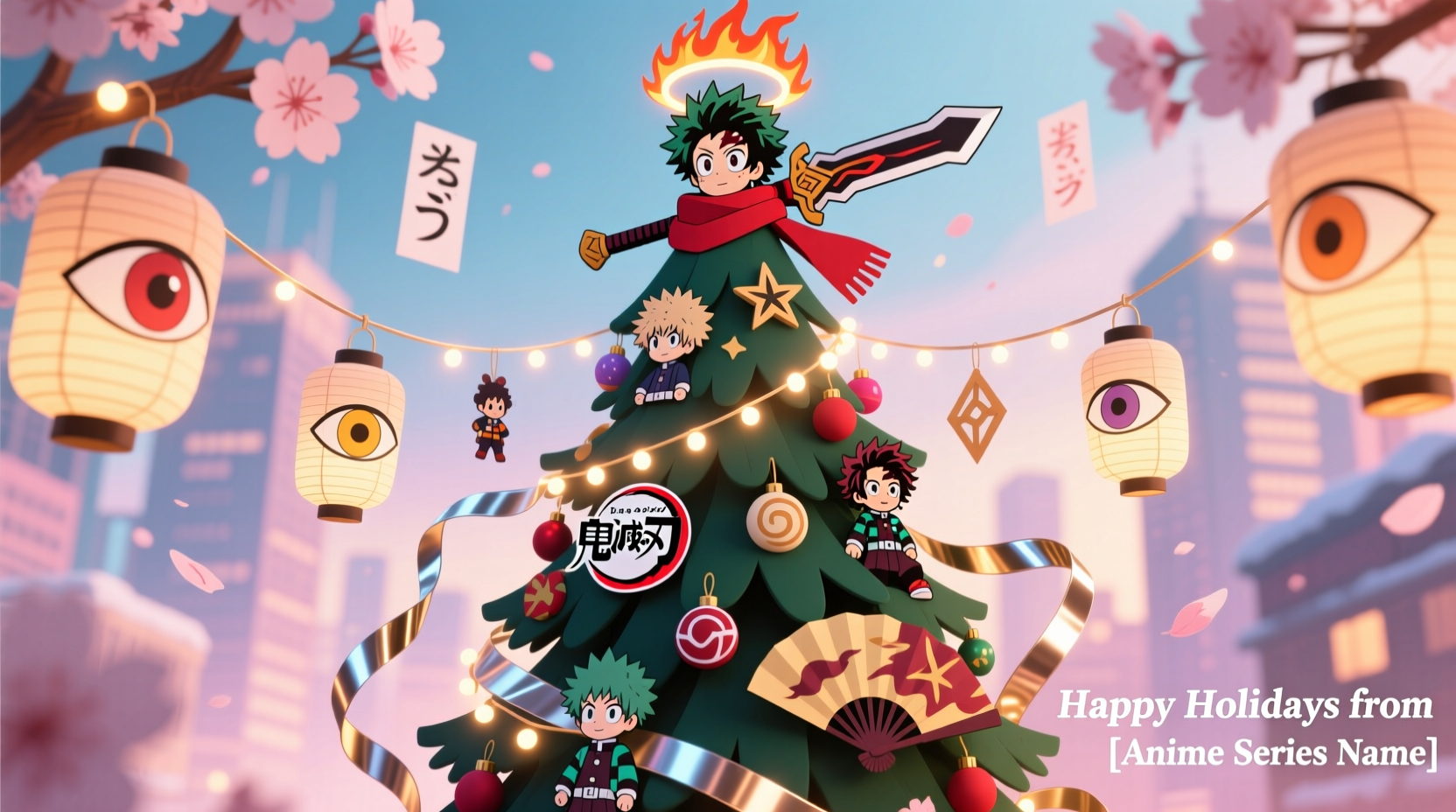
Selecting the right anime isn’t about popularity or personal attachment alone—it’s about thematic resonance with the season. Consider how the series’ core motifs align with winter, reflection, renewal, or communal celebration. A high-energy shonen like *Jujutsu Kaisen* may translate well into bold, dynamic ornament placement, while a contemplative slice-of-life series like *Barakamon* invites softer textures, handmade paper elements, and earth-toned lighting.
Ask yourself three questions before committing:
- What is the dominant emotional tone? (e.g., nostalgic hope in *Clannad*, stoic resilience in *Demon Slayer*, playful whimsy in *K-On!*)
- Which visual motifs recur meaningfully? (e.g., cherry blossoms in *Fruits Basket*, infinity mirrors in *Made in Abyss*, school uniforms in *Hyouka*)
- Are there canonical seasonal references? (e.g., the snowbound festival in *A Silent Voice*, the winter solstice ritual in *Natsume’s Book of Friends*, the New Year’s shrine visit in *Kimi no Na wa*)
2. Build a Cohesive Color Palette Using Canon-Driven Theory
Anime series rarely use color arbitrarily. Palettes are deliberate tools for emotional signaling and worldbuilding. To maintain authenticity, extract your tree’s primary and accent colors directly from official art—opening title sequences, Blu-ray menus, or licensed artbooks—not fan wikis or unofficial renders. For example:
| Anime Series | Primary Colors (Canon-Sourced) | Seasonal Translation | Ornament Material Suggestions |
|---|---|---|---|
| My Hero Academia | Midnight blue (#0a1a2f), hero-red (#d32f2f), electric yellow (#ffeb3b) | Blue evokes night patrols; red symbolizes courage; yellow mimics Quirk energy bursts | Acrylic geometric shapes, metallic foil stars, LED-lit “Quirk” symbols |
| Kiki’s Delivery Service | Soft cobalt (#2c5f8c), warm cream (#f8f3e6), muted rose (#d9a7c7) | Reflects coastal twilight, bakery warmth, and Kiki’s gentle growth | Hand-painted wooden birds, linen-wrapped baubles, dried lavender bundles |
| Demon Slayer | Deep indigo (#2a1b3d), blood crimson (#9e1b34), charcoal gray (#333) | Indigo = moonlit battles; crimson = life force & sacrifice; gray = breath control discipline | Blackened steel charms, hand-stitched fabric blades, matte ceramic crescents |
Resist the urge to add “Christmas red and green” unless canonically justified. In *Fruits Basket*, for instance, the Sohma family’s signature orange and black appear in every major arc—so incorporating burnt orange glass balls and matte black ribbons honors continuity far more than forced seasonal hues.
3. Curate Ornaments with Character Integrity
Authenticity hinges on how ornaments reflect characters—not as caricatures, but as distilled essences. A Naruto ornament shouldn’t just say “Naruto”—it should evoke his orange jumpsuit texture, the swirl motif from his headband, or the tactile weight of ramen bowls. Likewise, a *Spy x Family* tree thrives on layered subtlety: Loid’s briefcase charm (not his face), Anya’s thought bubble with a tiny “Waku Waku!” inside, and Yor’s hairpin-shaped ornament in brushed steel.
Three-tiered ornament strategy ensures balance:
- Anchor pieces (3–5): Larger, structurally significant items representing core themes—e.g., a miniature *Spirited Away* bathhouse made from birch plywood, or a rotating *Steins;Gate* time-leap device with engraved coordinates.
- Narrative connectors (12–18): Medium-sized items referencing pivotal moments—e.g., a tiny umbrella for *Your Name*’s rain scene, a folded paper crane for *5 Centimeters Per Second*, or a miniature notebook for *Death Note* (with blank pages, not written text, to avoid copyright issues).
- Tactile accents (20+): Small, repeatable elements that unify the tree visually—e.g., 24 identical origami foxes for *Kitsune no Yomeiri*, matte black beads shaped like *Tokyo Ghoul* kagune hooks, or frosted glass snowflakes etched with *Mushishi* glyphs.
“Fan-made decor succeeds when it prioritizes emotional fidelity over literal representation. A single perfectly textured scarf fragment from *March Comes in Like a Lion* communicates more than ten generic ‘Lion’ faces.” — Kenji Tanaka, Prop Designer & Anime Archivist, Tokyo Animation Museum
4. Real-World Execution: A Step-by-Step Tree Assembly Timeline
This 7-day timeline balances realism and reverence—designed for working adults who want meaningful results without burnout. Each step builds on the last, with built-in flexibility for sourcing delays or creative pivots.
- Day 1 — Canon Audit: Watch the series’ opening credits, ending sequence, and one key winter-adjacent episode. Screenshot 15–20 frames showing recurring colors, patterns, and objects. Organize by palette, texture, and scale.
- Day 2 — Supply Mapping: List materials needed (wood, felt, resin, etc.) and cross-reference with local craft stores and ethical suppliers. Prioritize FSC-certified wood, recycled glass, and vegan leather alternatives. Note lead times—custom laser-cutting often requires 5–7 business days.
- Day 3 — Core Structure Prep: Select tree type (real fir holds ornaments best; PVC offers fire safety and shape consistency). Wrap trunk in burlap dyed with natural indigo if emulating *Demon Slayer*; leave bare for *Mushishi*’s forest purity. String lights first—warm white LEDs for nostalgia (*Clannad*), cool white for clinical precision (*Psycho-Pass*), or programmable RGB for dynamic shifts (*Kill la Kill*).
- Day 4 — Anchor Piece Creation: Build or commission 1–2 anchor ornaments. Use templates from official artbooks—not traced fan art—to avoid derivative design. Sand edges, seal with matte varnish, and attach secure metal loops.
- Day 5 — Narrative Connector Assembly: Assemble medium ornaments. If hand-painting, use acrylic inks for opacity and archival permanence. For fabric pieces, stitch linings to prevent fraying. Label each with a tiny numbered tag matching your storyboard notes.
- Day 6 — Tactile Accent Production: Mass-produce small elements using jigs or molds. For *My Hero Academia*, cut 30 identical “Plus Ultra” banners from fire-retardant polyester. For *K-On!*, roll 40 miniature rolled sheet music scrolls from recycled paper.
- Day 7 — Layered Hanging & Final Calibration: Hang ornaments in order of size and weight—anchors first at branch junctions, then connectors along mid-canopy, finally tactile accents at tips. Step back every 15 minutes. Adjust density: no branch should feel barren or overcrowded. Test lighting angles—shadows should enhance, not obscure, details.
5. Mini Case Study: The “Natsume’s Book of Friends” Winter Solstice Tree
In Kyoto, 32-year-old librarian Aiko Sato transformed her 6.5-foot Nordmann fir into a living homage to *Natsume’s Book of Friends*. She began not with ornaments, but with scent: she infused pinecones with yuzu essential oil (referencing Natsume’s grandmother’s citrus orchard) and tucked them deep into branches. Her palette drew exclusively from the manga’s winter chapter covers—muted greys, parchment beige, and the faintest wash of cerulean for the sky where spirits gather.
Her anchor piece was a hand-carved wooden book (14 cm tall) with removable cedar “pages” inscribed with 12 yokai names—not from the anime, but from the original folklore sources Natsume Yuu refers to. Narrative connectors included origami kitsune curled around branch forks, miniature lanterns with rice-paper shades painted with *kanji* for “gratitude,” and brass bells inscribed with “Thank you for watching over me.” Tactile accents were 48 dried persimmons strung with hemp cord—the fruit Natsume shares with Nyanko-sensei in Chapter 47.
The result wasn’t “anime decor.” It was a quiet, respectful ritual object—recognized by fellow fans not by logos, but by its hushed reverence, its attention to textual detail, and its refusal to reduce spiritual themes to novelty. Visitors didn’t ask, “Where can I buy that?” They whispered, “This feels like standing in the shrine gate.”
FAQ
Can I use copyrighted character images on ornaments?
No—commercially printed character faces, logos, or direct screenshots violate Japanese copyright law (Article 23 of the Copyright Act) and most licensing agreements. Instead, use symbolic abstraction: silhouette profiles, signature accessories (e.g., Levi’s vertical maneuvering gear, not his face), or environment-based motifs (e.g., the *Ghibli* studio logo’s cat bus ears, not the full vehicle). For personal, non-distributed use, transformative reinterpretation (e.g., watercolor impressionism, embroidery with visible stitch texture) falls under fair use in most jurisdictions—but never sell or publicly exhibit such pieces.
How do I make ornaments safe for real trees?
Avoid anything flammable, heavy, or sharp. Skip plastic glitter (melts near heat), glass ornaments without protective wire cages, and metal charms with exposed edges. Opt for lightweight basswood, cork, felt, or resin cured at room temperature. All hanging wires must be stainless steel or nickel-free brass—aluminum corrodes in sap and humidity. Test weight distribution: no single branch should hold more than 1.2 kg total.
What if my favorite anime has no winter scenes?
Look deeper. Even summer-centric series contain seasonal metaphors: *Haikyuu!!*’s “first serve” mirrors New Year’s resolutions; *Toradora!*’s fireworks echo celebratory light; *Erased*’s time-loop structure parallels cyclical renewal. Translate conceptually—not chronologically. A *Bocchi the Rock!* tree could feature soundwave-patterned ornaments, guitar-pick-shaped baubles, and stage-light blue LEDs, honoring its emotional winter: isolation, quiet courage, and the warmth of found community.
Conclusion
Your anime-themed Christmas tree is more than decoration. It’s a declaration of what moves you—not just as a fan, but as a person who finds meaning in stories, beauty in detail, and connection in shared symbolism. It resists mass-produced uniformity and instead affirms that joy lives in specificity: the exact shade of Luffy’s straw hat, the grain of the wood in the *Mushishi* traveler’s staff, the quiet weight of a *Clannad* snow globe holding one perfect, unmelted flake. You don’t need perfection. You need presence—presence in selecting materials with care, presence in assembling each ornament with intention, presence in stepping back to see not just a tree, but a testament.
Start small this year. Choose one series. Pull three colors. Make five ornaments—not to impress, but to remember why you love these worlds in the first place. Then share your process—not just the final photo, but the story behind the yuzu-scented pinecone, the reason you chose matte black over glossy, the moment you realized the *Your Name* comet motif aligned perfectly with a vintage star map. Because fandom, at its best, isn’t consumption—it’s conversation. And every ornament you hang is a sentence in that ongoing, luminous dialogue.




 浙公网安备
33010002000092号
浙公网安备
33010002000092号 浙B2-20120091-4
Comments
No comments yet. Why don't you start the discussion?