
Themed Christmas trees have evolved far beyond traditional red-and-gold elegance or rustic farmhouse charm. Today’s most memorable trees tell stories—narratives rooted in fandom, nostalgia, and personal identity. A tree inspired by anime and pop culture isn’t just decorative; it’s a curated expression of who you are: the late-night rewatcher of *My Hero Academia*, the lifelong *Star Wars* collector, the *Stranger Things* enthusiast who still owns a Demogorgon action figure. But building one that feels intentional—not like a garage sale of merch dumped onto branches—requires strategy, restraint, and narrative discipline. This guide walks through the full creative process: from selecting a unifying theme and sourcing meaningful ornaments to balancing scale, color theory, and visual hierarchy—all without sacrificing holiday warmth or craftsmanship.
1. Choose a Single, Cohesive Theme (Not a Mashup)
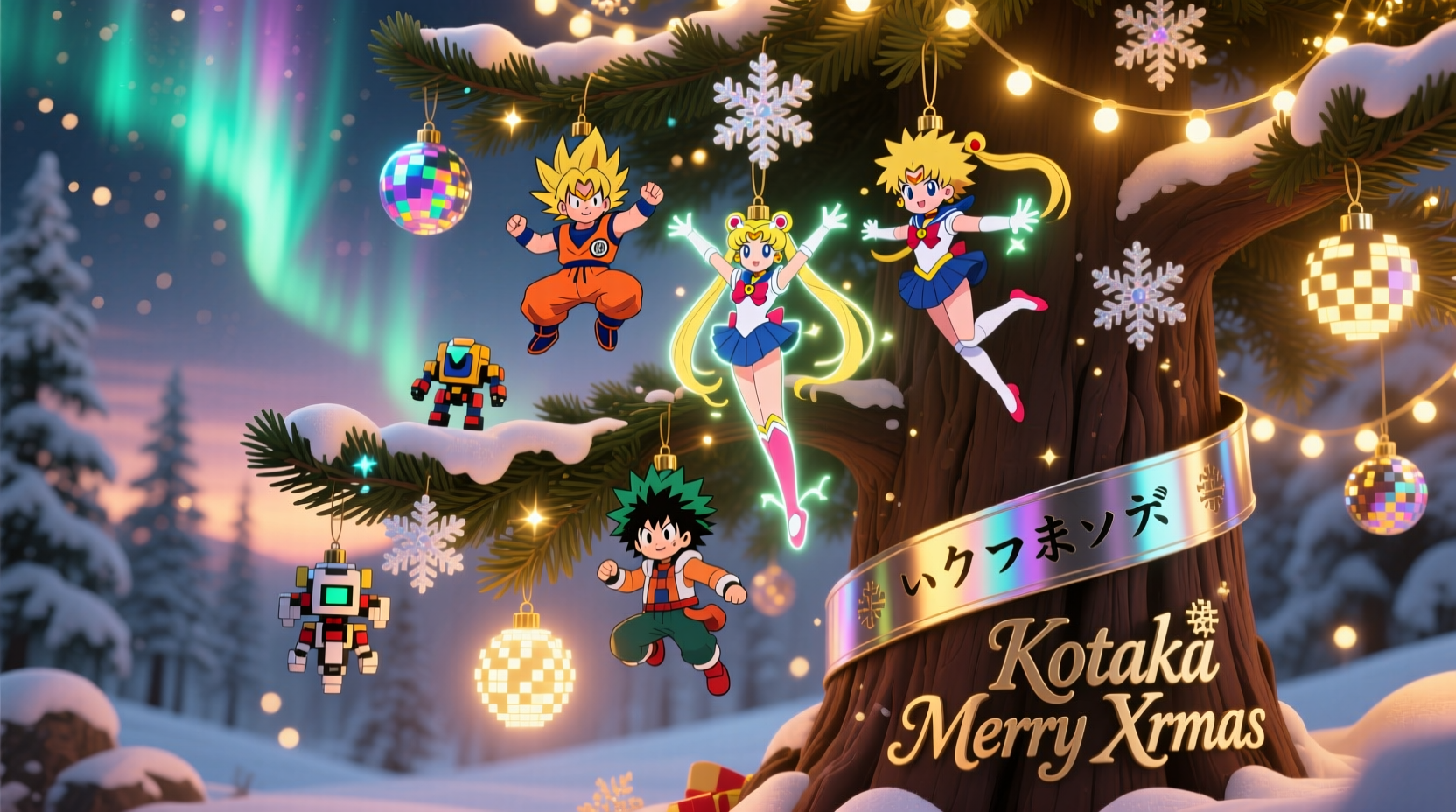
Many enthusiasts begin with enthusiasm—and end with visual chaos. A tree featuring Naruto headbands next to *Game of Thrones* direwolves, *Pokémon* Pokéballs, and *Marvel* Infinity Stones may feel fun in concept, but lacks narrative cohesion. The strongest themed trees commit to one world, one aesthetic, or one emotional tone. Think of it as curating a museum exhibit, not a thrift-store shelf.
Three proven thematic approaches:
- World-Bound: Focus on one fictional universe (*Studio Ghibli*, *Attack on Titan*, *The Mandalorian*). This allows deep exploration of its iconography, color palette, and symbolic motifs.
- Character-Driven: Center the tree on a single beloved protagonist or ensemble (*Sailor Moon* senshi, *Avatar: The Last Airbender* team, *Rick and Morty* core cast). Their traits, weapons, and signature items become structural anchors.
- Aesthetic-First: Prioritize mood and visual language over canon—e.g., “cyberpunk Tokyo winter” (neon-lit micro-LEDs, chrome ornaments, origami Shiba Inus), or “90s anime VHS nostalgia” (distressed tape-textured baubles, CRT-screen-shaped ornaments with static-printed frames).
2. Build Your Ornament Hierarchy: Scale, Texture, and Placement Logic
A successful themed tree relies on deliberate spatial layering—not random hanging. Treat your tree like a three-dimensional canvas with foreground, midground, and background planes. Each ornament type serves a distinct visual function:
| Ornament Type | Function | Quantity Guideline | Placement Zone |
|---|---|---|---|
| Signature Statement Pieces | Large, iconic, instantly recognizable (e.g., a 5-inch *Naruto* headband, a *Star Wars* Death Star globe) | 3–5 total | Lower third of tree—visible at eye level |
| Character Miniatures | Small figurines or sculpted baubles (e.g., *My Hero Academia* quirks rendered as glowing resin orbs) | 8–12 | Middle third—nestled among branches, facing outward |
| Symbolic Motifs | Abstract or stylized icons (e.g., *One Piece* jolly roger, *Tokyo Ghoul* mask silhouettes, *Stranger Things* upside-down swirl) | 15–20 | Upper third & tips—creating rhythm and repetition |
| Textural Fillers | Non-character elements that reinforce theme (e.g., tiny origami cranes for *Sadako*, matte-black “void” beads for *JoJo’s Bizarre Adventure*, iridescent dragon-scale ribbons) | As needed | Woven throughout—filling gaps, adding depth |
This hierarchy prevents visual fatigue. Without it, even high-quality collectibles compete for attention and flatten into noise. A *Demon Slayer* tree, for example, uses crimson glass baubles (symbolizing blood and flame) as fillers, while Tanjiro’s hanafuda earrings appear only as two precise, hand-painted miniatures near the trunk—making them feel earned, not ubiquitous.
3. Lighting Strategy: Color Theory Meets Canon Accuracy
Lighting is the emotional engine of your tree—and where many pop-culture trees fail. White lights read as generic. Multicolor LEDs often clash with franchise palettes. Instead, select lights that deepen the theme’s mood and align with canonical color symbolism.
Consider these real-world examples:
- My Hero Academia: Warm amber LEDs mimic Quirk energy glows; avoid cool blue unless highlighting ice-based heroes like Fuyumi.
- Sailor Moon: Soft pink + silver LED strings replicate the Moon Kingdom’s ethereal glow—never neon pink or glittery purple.
- Neon Genesis Evangelion: Deep indigo base lights with intermittent, slow-pulse red accents (for LCL fluid and activation sequences).
- The Legend of Zelda: Forest-green + golden filament bulbs evoke Hyrule’s twilight woods and Triforce light.
“Color isn’t decoration—it’s subtext. When fans see your tree, they should *feel* the world before they recognize the characters.” — Lena Torres, Exhibit Designer at Anime Expo Museum & Themed Environment Consultant
Pro tip: Use dimmable LED string lights. Set brightness at 70% for ambient warmth, then add 2–3 focused spotlights (battery-powered, directional) on key statement pieces—like illuminating a miniature *Gundam* model perched atop the tree as a topper.
4. Step-by-Step Tree Assembly Timeline
Building a themed tree in one evening leads to rushed decisions and imbalance. Follow this five-day framework for precision and calm:
- Day 1 – Theme Lock & Inventory Audit: Finalize your theme. Photograph every relevant item you own (figures, pins, prints, fabric scraps). Note condition, size, and color. Discard or set aside anything off-palette or low-resolution.
- Day 2 – Sourcing & Crafting: Order missing key pieces (e.g., custom-printed baubles, 3D-printed props). Make 2–3 handmade ornaments: embroidered *Attack on Titan* vertical maneuvering gear straps, air-dry clay *Pokémon* Pokéballs painted with metallic glaze.
- Day 3 – Branch Prep & Structure: Fluff artificial tree branches outward and upward. Wrap trunk with thematic fabric—e.g., black silk for *Death Note*, navy wool with gold thread for *One Piece*. Secure with discreet floral wire.
- Day 4 – Strategic Hanging (Bottom → Top): Start with statement pieces at eye level. Then place character miniatures. Finish with motifs and fillers—always stepping back every 5 minutes to assess balance.
- Day 5 – Lighting & Final Polish: Install lights last. Drape ribbons *after* lights are tested. Add final touches: a small framed quote under the tree (“Believe it!”), a scent diffuser with cedar + yuzu oil for *Ghibli* trees, or a vintage cassette player softly looping an OST.
5. Real Example: “The Studio Ghibli Winter Solstice Tree”
In Portland, Oregon, graphic designer Maya Chen spent six weeks preparing her 6.5-foot Nordmann fir for a Studio Ghibli–themed display. She rejected obvious choices—no Totoro plushes dangling from branches, no mass-produced catbus ornaments. Instead, she built the tree around *Howl’s Moving Castle*’s central metaphor: transformation, warmth, and quiet resilience.
Her execution:
- Base: A woven willow basket filled with dried lavender, moss, and miniature ceramic soot sprites (hand-thrown, glazed in matte charcoal).
- Trunk wrap: Hand-dyed indigo linen, stitched with subtle gold thread resembling Howl’s moving castle gears.
- Ornaments: 12 custom wooden baubles laser-engraved with Ghibli film titles in Japanese calligraphy; 8 glass globes containing pressed edible flowers (chamomile, rose, calendula) referencing *Ponyo*’s ocean garden; 5 hand-blown glass “fire spirits” filled with amber liquid and suspended on copper wire.
- Lighting: Warm white fairy lights wrapped in sheer ivory organza to diffuse glare—evoking candlelight in Calcifer’s hearth.
- Sound & Scent: A Bluetooth speaker playing Joe Hisaishi’s piano arrangements at low volume; a diffuser releasing hinoki cypress and honey notes.
Guests didn’t just see a “Ghibli tree”—they paused, breathed deeper, and commented on how “calm” and “safe” it felt. That was Maya’s goal: not fan service, but emotional fidelity.
FAQ
Can I mix anime and Western pop culture legally?
Yes—for personal, non-commercial display. Copyright law permits transformative, non-derivative use in private settings. Avoid reproducing logos or exact character likenesses for sale—but hand-painting a *Dragon Ball* orb inspired by the Dragon Balls’ shape and texture? That’s fair use. When in doubt, lean into abstraction: use symbols, colors, and textures instead of direct portraiture.
What if my collection is mostly low-budget or DIY?
That’s often an advantage. High-end collectibles can look sterile. A tree adorned with hand-stitched *Your Name* constellation maps, origami *Demon Slayer* breathing technique symbols, or upcycled bottle-cap *Pokémon* badges reads as more authentic and heartfelt. Prioritize craftsmanship over cost—glue a single perfect *Spirited Away* No-Face face onto a plain bauble rather than buying ten glossy knockoffs.
How do I keep the tree from looking “too geeky” for non-fans?
Design for universal aesthetics first. Use refined materials (matte ceramics, brushed brass, natural wood), limit text-heavy ornaments, and anchor everything in classic holiday structure: symmetry, layered lighting, organic textures. A *Star Wars* tree using only monochrome schematics, weathered metal finishes, and deep-navy velvet ribbons reads as sophisticated sci-fi minimalism—not a toy aisle explosion.
Conclusion
Your Christmas tree doesn’t need to be a neutral backdrop. It can be a quiet manifesto—a celebration of the stories that shaped your empathy, your humor, your sense of wonder. Creating a themed tree using anime and pop culture isn’t about proving fandom; it’s about honoring the worlds that helped you feel seen when real life felt overwhelming. It’s in the careful placement of a *My Hero Academia* symbol beside a sprig of holly—not because they “go together,” but because both represent resilience. It’s in the warmth of amber lights echoing Quirk energy or the stillness of a Ghibli-inspired branch wrapped in indigo linen—not as decoration, but as intention.
Start small. Pick one character, one world, one feeling. Sketch your vision. Source thoughtfully. Hang deliberately. Let the tree breathe between layers. And when December arrives, stand back—not to judge perfection, but to witness what you’ve made: a living archive of joy, rendered in tinsel, light, and love.




 浙公网安备
33010002000092号
浙公网安备
33010002000092号 浙B2-20120091-4
Comments
No comments yet. Why don't you start the discussion?