
Themed Christmas trees have evolved far beyond traditional red-and-gold motifs. Today’s most memorable holiday displays tell stories—of beloved worlds, cherished characters, and personal identity. Anime-themed trees sit at the intersection of fandom devotion and seasonal creativity: they’re expressive, emotionally resonant, and surprisingly sophisticated when executed with intention. But jumping straight from “I love My Hero Academia” to “I’ll hang all my figurines on a tree” rarely yields cohesion. Without narrative framing, color discipline, or spatial awareness, even the most passionate fan risks creating visual noise rather than a curated celebration. This guide walks through the deliberate, design-forward process used by professional prop stylists and award-winning convention decorators—not just to *add* anime elements to a tree, but to let the fandom *become* the tree’s architecture.
1. Choose One Fandom—and Commit to Its Visual Language
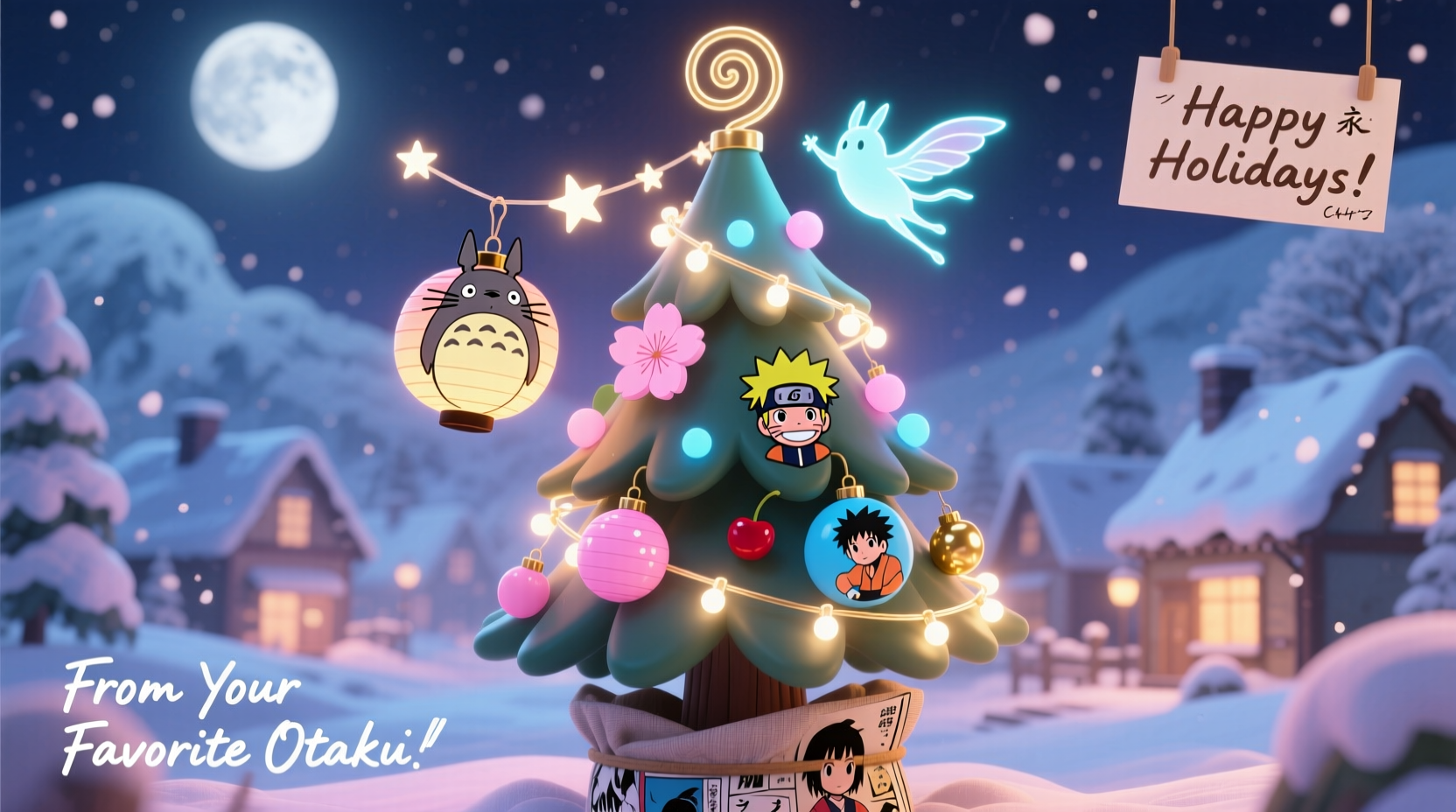
Selecting a single anime series—or, at most, two tightly related ones—is the foundational decision. Cross-fandom trees (e.g., Naruto + Demon Slayer + Jujutsu Kaisen) often collapse under competing palettes, iconography, and emotional tones. A successful themed tree functions like a film set: every element supports a unified world. Consider how Studio Ghibli’s soft watercolor aesthetic demands different treatment than Attack on Titan’s stark monochrome and militaristic geometry—or how the neon-drenched cyberpunk of Ghost in the Shell contrasts sharply with the warm, rustic palette of Laid-Back Camp.
When choosing, ask three questions:
- Narrative resonance: Does this series evoke the feeling you want your tree to convey? (e.g., hope and renewal for Haikyuu!!, quiet introspection for March Comes in Like a Lion)
- Visual richness: Does it offer distinct, scalable motifs? (e.g., Demon Slayer’s breathing style kanji, My Hero Academia’s hero emblems, Sailor Moon’s crescent moons and hearts)
- Merchandise accessibility: Are official ornaments, plushes, or art prints available—or are you prepared to craft key pieces yourself?
2. Build Your Palette Around Canon Colors—Not Just Character Outfits
Fans often default to character-specific colors: “Sasuke wears blue, so I’ll use navy.” But canon palettes go deeper. Examine official key visuals, Blu-ray menus, and background art. Notice how One Piece uses sun-bleached ochres, seafoam greens, and coral pinks—not just Luffy’s red vest. How Steins;Gate leans into CRT monitor blues, lab-coat whites, and circuit-board greys. These are your tree’s base tones.
Adopt a 60-30-10 rule:
- 60% Dominant: The background tone—usually drawn from skies, settings, or dominant environmental hues (e.g., the deep indigo of Tokyo Ghoul’s nightscapes)
- 30% Secondary: Supporting tones from key props or locations (e.g., the rust-orange of Attack on Titan’s walls, or the warm amber of Violet Evergarden’s letter paper)
- 10% Accent: High-contrast, character-driven pops (e.g., Goku’s orange gi, Sailor Moon’s pink hair ribbon, or Levi’s black vertical stripes)
| Fandom | Dominant Tone | Secondary Tone | Accent Tone | Why It Works |
|---|---|---|---|---|
| My Hero Academia | Deep cobalt (U.A. Academy sky) | Concrete grey (training grounds) | Bright orange (Deku’s gloves) | Grounds heroics in realism; avoids cartoonish overload |
| Spirited Away | Muted sage green (bathhouse gardens) | Weathered cedar (wood architecture) | Gold leaf (No-Face coins) | Evokes aged magic—not fairy-tale glitter |
| JoJo’s Bizarre Adventure | Charcoal black (stand energy shadows) | Warm sepia (vintage photo filters) | Vibrant magenta (Stardust Crusaders logo) | Channels the series’ retro-futurist tension |
3. Curate Ornaments by Type—Not Just by Likability
A common mistake is hanging every favorite character without hierarchy. Instead, treat ornaments as architectural elements: each serves a functional role in the tree’s composition. Use this taxonomy to assign purpose:
- Structural Anchors (3–5 large pieces): 4–6 inch ornaments that define zones—e.g., a ceramic U.A. crest, a hand-painted Spirited Away bathhouse, or a resin JoJo Stand symbol. Hang these at branch junctions, spaced evenly.
- Textural Layers (8–12 medium pieces): Items that add depth: fabric kimonos (folded into tiny bows), felt chibi characters, origami paper cranes with character faces, or miniature ramen bowls (for Jujutsu Kaisen fans).
- Light & Movement (4–6 dynamic pieces): Elements that catch light or shift subtly: acrylic stand-effect ornaments with embedded LED micro-lights, dangling kanji charms that sway, or transparent resin “spirit orbs” filled with iridescent powder.
- Narrative Details (5–8 subtle pieces): Story-driven miniatures: a tiny notebook for Death Note, a folded “hero license” for MHA, or a steampunk gear for Fullmetal Alchemist. Place these near eye level—not hidden, but discovered.
“Themed trees succeed not by how many characters they display, but by how clearly they communicate a world. A single, perfectly placed ‘Naruto headband’ ornament tells more than ten generic ramen-themed baubles.” — Kenji Tanaka, Prop Designer for Crunchyroll Expo Main Stage
4. Step-by-Step Tree Assembly Timeline (90 Minutes Total)
Do not rush assembly. A thoughtful tree takes time—but the sequence matters more than duration. Follow this timed workflow:
- Prep (15 min): Fluff artificial tree branches outward and upward. Remove all existing ornaments. Wipe branches with a dry microfiber cloth to remove dust. Lay down a neutral-toned tree skirt (charcoal, heather grey, or unbleached linen—no patterns).
- Lighting (20 min): String lights *before* any ornaments. Use warm-white LEDs (2700K–3000K) for warmth. Weave them deeply into the interior—not just wrapped around the perimeter—to create dimensional glow. For fandom effect: add 3–5 colored bulbs matching your accent tone (e.g., orange for MHA, pink for Sailor Moon), placed asymmetrically near structural anchors.
- Structural Anchors (15 min): Hang largest ornaments first—at trunk-level branch forks. Space them at least 8 inches apart vertically and 10 inches horizontally. Step back after each to assess balance.
- Textural Layers (25 min): Work from bottom to top, alternating sides. Attach fabric/felt pieces with clear ornament hooks (not wire—prevents snagging). Vary heights: some hang low, some nestle into branch forks.
- Final Details (15 min): Add narrative details and light/movement pieces last. Tuck small LED tea lights into hollow ornaments or behind translucent resin pieces. Finish with a custom topper: a hand-carved wooden Byakuya Kuchiki mask, a minimalist Studio Ghibli Totoro silhouette, or a brass “Hero License” plaque.
5. Real Example: The “Quiet Strength” Attack on Titan Tree
Maya R., a Tokyo-based graphic designer and long-time AoT fan, created a tree centered not on action, but on the series’ quieter themes: memory, resilience, and the weight of history. She rejected typical titan motifs entirely. Instead, she sourced:
- Hand-blown glass orbs in muted slate grey and weathered copper (representing the Walls and Survey Corps insignia)
- Miniature folded paper letters sealed with wax stamped with the Survey Corps emblem (each containing a typed quote about duty from Mikasa or Hange)
- Branch-wrapped twine dyed with walnut ink (evoking rope ladders and ancient scrolls)
- A topper made from reclaimed oak, laser-engraved with the phrase “The truth is out there”—in the exact font used in the manga’s chapter headings
The result was a tree that felt solemn, grounded, and deeply respectful—not a merch dump. Visitors didn’t say “Look at all the Titans!” They said, “This feels like standing in the basement of the Survey Corps HQ.” That’s thematic success: emotion before iconography.
FAQ
Can I mix official merchandise with handmade items without looking mismatched?
Absolutely—if you unify them through finish and scale. Spray-paint mass-produced plastic ornaments with matte acrylic to match handmade wood or ceramic pieces. Resize printed character art to fit standard 2.5-inch ornament blanks. Always prioritize texture over brand: a glossy Aniplex ornament next to a matte clay one will clash, but both finished in satin sealant harmonize instantly.
How do I handle fragile collectibles safely on a tree?
Never hang delicate figures by their limbs or accessories. Instead, mount them on rigid acrylic stands (cut to 1.5 inches tall) with adhesive-backed felt pads. Then attach the stand to the branch using a thin, clear fishing line looped around the trunk and knotted beneath the branch. This keeps weight off the figure while allowing subtle movement.
What if my fandom doesn’t have obvious “holiday” symbols?
Lean into metaphor. For Parasyte, use silver mercury-like orbs and mirrored shards. For Erased, incorporate vintage clock gears and faded blue notebook paper. For Clannad, use dried cherry blossoms sealed in resin and soft-focus photo ornaments of empty school hallways. Holiday spirit lives in mood—not tinsel.
Conclusion
Your anime-themed Christmas tree isn’t decoration. It’s curation. It’s storytelling. It’s the physical manifestation of what these worlds mean to you—not as consumer, but as participant. When you commit to one fandom’s visual grammar, build a disciplined palette, and place each ornament with narrative intent, you transform seasonal tradition into personal legacy. You’re not just celebrating Christmas—you’re honoring the hours spent immersed in those stories, the friendships forged in fandom spaces, and the quiet moments when a particular scene changed how you saw the world. So choose deliberately. Edit ruthlessly. And when your tree glows softly in the December dark, know that every element reflects something true about you. That’s the real magic—not tinsel, but meaning.




 浙公网安备
33010002000092号
浙公网安备
33010002000092号 浙B2-20120091-4
Comments
No comments yet. Why don't you start the discussion?