
A Zen Christmas corner isn’t about rejecting tradition—it’s about reclaiming it. In a season saturated with sensory overload—blinking LEDs, stacked gift boxes, synthetic scents, and relentless cheer—the quiet power of restraint becomes radical self-care. This approach honors the spirit of the season not through abundance, but through presence: a space where light breathes, silence holds weight, and every object earns its place. It’s designed for reflection, not reaction; for stillness, not spectacle. Rooted in Japanese aesthetics like *wabi-sabi* (the beauty of imperfection and transience) and *ma* (the intentional use of negative space), a Zen Christmas corner invites slowness, authenticity, and tactile warmth. It doesn’t require expensive materials or perfect symmetry—it asks only for intentionality, consistency in tone, and deep respect for how light, texture, and emptiness shape mood.
The Philosophy Behind the Minimalist Holiday Space
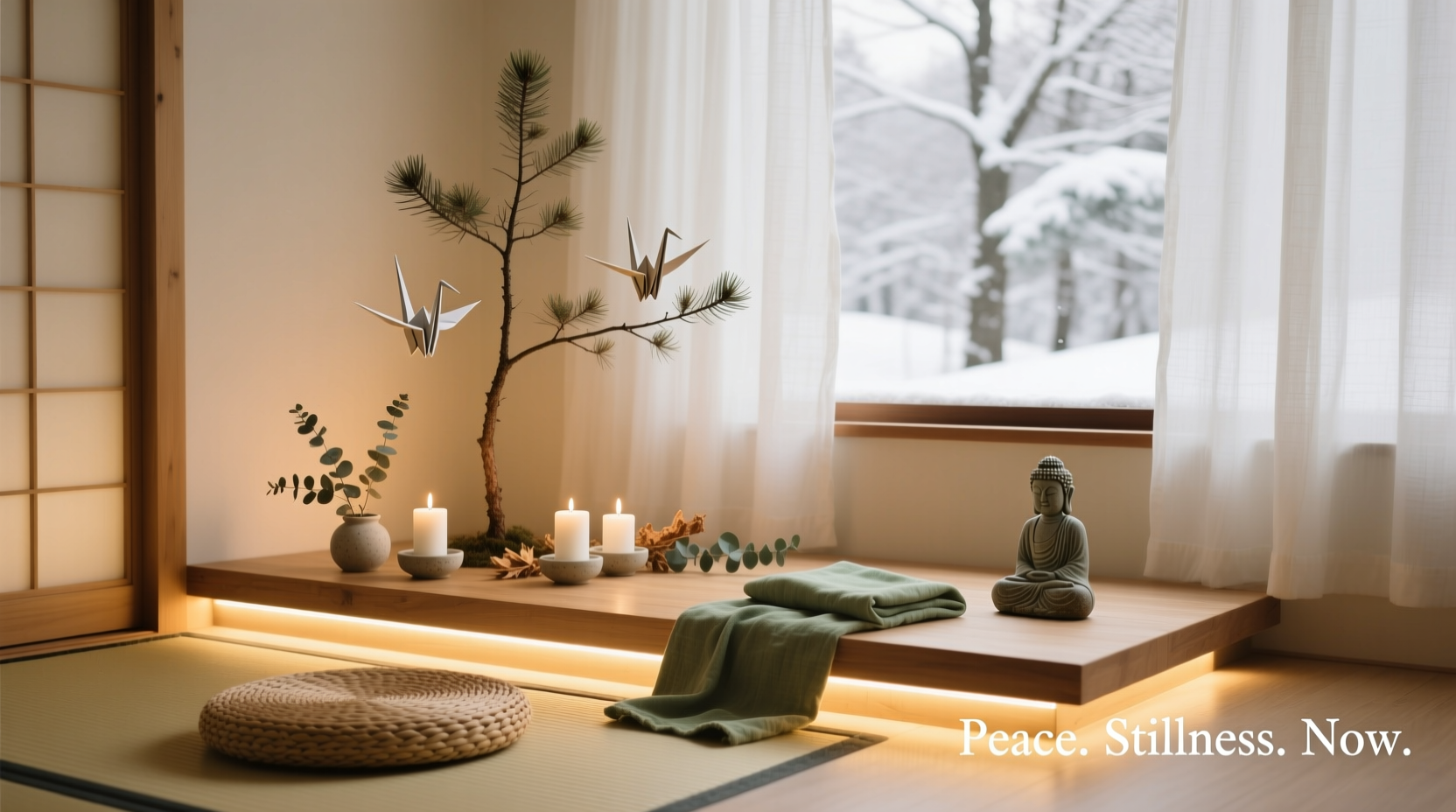
Minimalism in holiday design is often misunderstood as austerity. In practice, it’s generosity—giving yourself permission to omit what drains rather than delights. A Zen Christmas corner emerges from three core principles: intention, harmony, and temporality. Intention means choosing each element deliberately—not because it’s “expected,” but because it evokes quiet joy or meaningful resonance. Harmony refers to cohesion in material, tone, and scale: wood grain echoing the grain of a ceramic vase; the warm amber of candlelight mirroring the honeyed glow of a linen runner. Temporality acknowledges that this space is sacred *because* it’s temporary—designed to be assembled with reverence and released without regret after the season ends.
This mindset directly counters modern holiday fatigue. Research from the University of Sussex shows that visual clutter increases cognitive load and elevates cortisol levels by up to 37%—a physiological response our nervous systems register even when we’re “just decorating.” A Zen corner reverses that effect. Its empty surfaces aren’t vacant—they’re charged with potential. Its subdued palette doesn’t lack color; it prioritizes chromatic rest. As interior architect Naomi Sato observes, “A holiday space should feel like an exhale—not a shout. When you remove the visual noise, what remains is emotional clarity.”
Lighting as the Soul of Your Zen Corner
In Zen design, light isn’t illumination—it’s atmosphere. Soft, layered, and directional lighting transforms a corner into a sanctuary. Harsh overheads or cool-white LEDs shatter the illusion of calm. Instead, build light in three gentle tiers:
- Base layer: Warm ambient glow (2200K–2400K) from floor-level sources—think low-wattage LED string lights tucked beneath a woven basket or wrapped around a single branch laid horizontally on a shelf.
- Middle layer: Focused, diffused task light—such as a paper-shade floor lamp casting a soft pool on a meditation cushion or a small brass reading lamp angled over a journal.
- Accent layer: Flickering organic light—real beeswax or soy candles in matte ceramic holders, placed at staggered heights (e.g., one on a low stool, one on a stone plinth, one nestled in moss).
Crucially, avoid plug-in fairy lights with blinking modes, timers, or remote controls. Their artificial rhythm disrupts circadian harmony. Opt instead for battery-operated warm-white LEDs with a simple on/off switch—no flashing, no fading, no programmed sequences. The light should feel steady, like breath.
Curating Decor: Less Is Not Empty—It’s Essential
Minimal decor isn’t about absence—it’s about curation so precise that each item feels inevitable. Start with a strict 5-item limit for your entire corner (excluding lighting and structural elements like furniture). Choose objects that meet at least two of these criteria: natural origin, tactile texture, personal significance, functional utility, or seasonal symbolism (e.g., dried orange slices, pinecones, unbleached cotton, raw-edge linen).
Avoid anything mass-produced, glossy, or overly thematic (no Santa figurines, glittery snowmen, or plastic reindeer). Instead, lean into quiet archetypes: a single evergreen bough draped over a wooden beam; a hand-thrown mug holding dried eucalyptus; a smooth river stone placed beside a folded wool blanket. Scale matters deeply—choose one dominant natural form (e.g., a 24-inch fallen birch branch) and let smaller items relate to it proportionally.
| Element | Zen-Appropriate Choice | Why It Works | Avoid |
|---|---|---|---|
| Tree/Centerpiece | Single potted dwarf spruce in unglazed stoneware pot | Lives beyond the season; grows slowly; scent is subtle, not overwhelming | Plastic tabletop trees, tinsel-wrapped branches |
| Textiles | Unbleached linen runner + undyed merino wool throw | Natural fibers breathe; neutral tones recede visually; texture invites touch | Velvet pillows with gold embroidery, sequined tablecloths |
| Ornaments | Hand-blown glass baubles in smoke gray & amber | Reflect light softly; no glare; irregular shapes honor wabi-sabi | Shiny metallic balls, cartoon-shaped ornaments |
| Scent | Dried cedar + crushed cardamom pods in a shallow ceramic dish | Warm, grounding, non-cloying; changes subtly over days | Synthetic “Christmas cookie” diffusers, overpowering pine-scented candles |
| Sound | Wind chime made of bamboo and river stones | Irregular, gentle tones; connects to nature; no electricity required | Bluetooth speakers playing carols, digital nativity soundscapes |
A Real-World Example: Maya’s Apartment Nook
Maya, a 38-year-old pediatric occupational therapist in Portland, transformed a 4’x5’ alcove beside her living room window into her Zen Christmas corner after two consecutive seasons of post-holiday exhaustion. Her previous setup included a 5-foot artificial tree, 42 ornaments, electric garlands, and a rotating Santa display. She kept dismantling it by January 3rd—not out of dislike, but because the energy required to maintain it left her emotionally depleted.
This year, she began with a 30-minute walk in Forest Park, collecting one fallen Douglas fir branch, three smooth basalt stones, and a handful of dried fern fronds. Back home, she cleared the alcove completely—removing even the existing shelf. She installed a low-profile wall-mounted sconce (2200K, dimmable), placed a reclaimed oak stool beneath it, and draped an undyed alpaca blanket over its seat. On the stool sat a hand-thrown stoneware bowl holding the stones and ferns. Above, she suspended the fir branch horizontally using thin, nearly invisible hemp cord. Along its length, she hung three mouth-blown glass orbs—smoke gray, amber, and frosted white—each tied with raw silk ribbon. No music played. No scented candle burned. Just natural light by day, and the sconce’s warm halo by night.
“I didn’t expect how much quieter my thoughts became,” Maya shared. “My daughter, who’s seven, started sitting there every morning with her sketchbook—not because I asked her to, but because she said it ‘felt like listening to the air.’ That’s the shift: from decoration as performance to space as invitation.”
Your Step-by-Step Assembly Guide
Build your Zen Christmas corner in four deliberate phases—allowing time between steps for reflection and adjustment. Do not rush.
- Phase 1: Clear & Contain (Day 1)
Remove everything from your chosen corner—including furniture if possible. Wipe surfaces. Place a single neutral rug (jute or undyed wool) to define the zone. This isn’t prep—it’s ritual. Acknowledge what you’re releasing. - Phase 2: Anchor with Light (Day 2)
Select and install your base-layer lighting first. Position it so light falls gently on the floor or a central surface—not upward, not glaring. Test at dusk. Adjust until shadows are soft, not sharp. - Phase 3: Introduce Natural Form (Day 3)
Add your largest organic element—a branch, a potted plant, or a stone arrangement. Place it off-center, following the rule of thirds. Step back. Does it feel grounded? If it seems “loud,” reduce its scale or add negative space around it. - Phase 4: Layer Meaning (Day 4)
Add exactly two more items: one tactile (a woven basket, a knitted pouch), one symbolic (a single candle, a handwritten note in calligraphy on rice paper). No more. Sit with the space for 10 minutes. If something feels unnecessary, remove it—even if it’s beautiful. - Phase 5: Live & Observe (Ongoing)
For three days, spend 5 minutes daily in the corner—no phone, no agenda. Notice how light shifts, how textures change with humidity, how your breathing settles. Let the space teach you what it needs.
FAQ: Addressing Common Concerns
Won’t a Zen Christmas corner feel too “cold” or “sad” during the holidays?
Not if warmth is built intentionally—not through color saturation, but through materiality and light quality. Unbleached linen, raw wood, beeswax candles, and wool throws radiate thermal comfort. The perceived “coldness” usually comes from over-reliance on white or gray alone. Introduce warmth via undertones: oatmeal instead of stark white; charcoal instead of black; amber glass instead of clear. Texture is temperature—rough bark, nubby wool, and pebbled ceramics hold heat differently than smooth plastic or polished metal.
How do I explain this aesthetic to family members expecting traditional decor?
Frame it as inclusion, not exclusion. Say: “This corner is where we’ll light our first candle together, write gratitude notes, or sit quietly before opening gifts. It’s not less festive—it’s more focused on what matters to us.” Invite them to contribute one meaningful natural item (a pinecone they found, a seashell from vacation) rather than mass-produced decor. Ownership builds connection faster than explanation.
Can I incorporate religious symbols respectfully within a Zen framework?
Absolutely—if they carry personal resonance. A simple wooden cross, a brass Star of Bethlehem, or a hand-painted Nativity figure in muted earth tones aligns with Zen principles when treated as sacred objects—not decorative props. Place them with space, light them softly, and avoid clustering with unrelated motifs. As Zen Buddhist teacher Roshi Joan Halifax reminds us: “Sacred space is not defined by doctrine, but by attention. When you bow to a candle flame, you bow to presence—not dogma.”
Conclusion: The Quiet Power of Enough
Your Zen Christmas corner is not a compromise. It’s a declaration: that peace is not the absence of celebration, but the presence of choice. That light need not shout to be seen. That stillness can hold more meaning than a hundred blinking bulbs. This approach doesn’t ask you to diminish joy—it asks you to deepen it, to slow it down, to let it settle into your bones like winter light through bare branches. You don’t need perfection to begin. Start with one candle. One branch. One breath taken in front of a softly lit space you’ve claimed as yours.
When the season ends, dismantle your corner with the same care you used to build it. Store each piece mindfully—wrap the branch in breathable cloth, label the candle holder with the year, fold the linen runner by hand. These rituals embed the intention into memory. And next December, you won’t start from scratch. You’ll return—not to replicate, but to renew.




 浙公网安备
33010002000092号
浙公网安备
33010002000092号 浙B2-20120091-4
Comments
No comments yet. Why don't you start the discussion?