
A Zen Christmas tree is not defined by abundance—but by presence. It rejects visual noise, commercial saturation, and seasonal overload in favor of quiet elegance, tactile authenticity, and mindful intention. Rooted in Japanese wabi-sabi principles—where imperfection, transience, and simplicity are celebrated—this approach transforms the traditional Christmas tree into a contemplative centerpiece: grounded, unhurried, and deeply restorative. In an era of sensory fatigue, a Zen tree offers something rare: holiday joy that doesn’t exhaust. It’s not about removing festivity—it’s about refining it until only what resonates remains.
The Philosophy Behind the Zen Tree
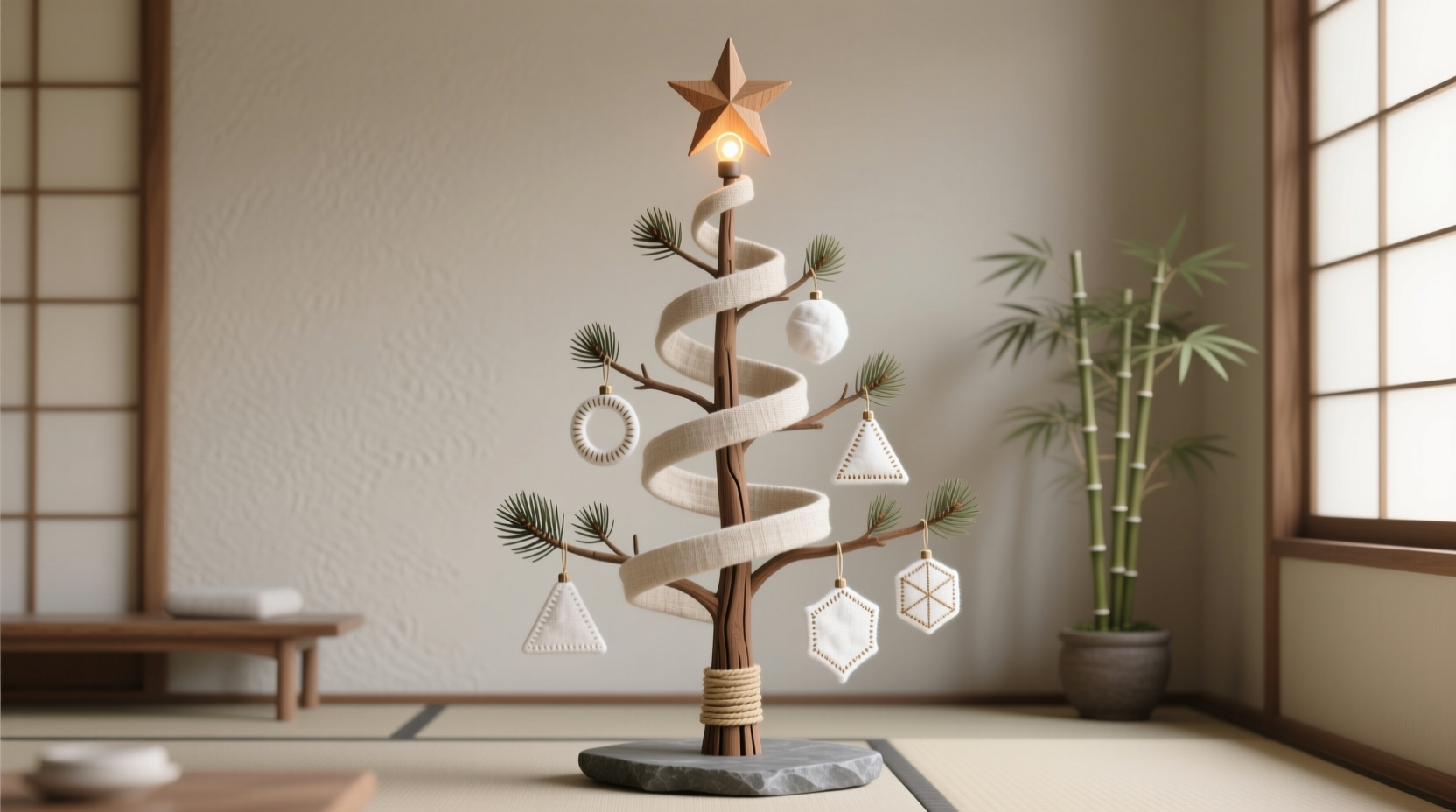
Before selecting ornaments or choosing a tree species, understanding the underlying philosophy prevents aesthetic mimicry without meaning. A Zen tree isn’t “white-only” or “bare-looking” by accident—it emerges from three core tenets:
- Ma (Negative Space): Intentional emptiness. Gaps between branches aren’t flaws; they’re breathing room for the eye and the spirit.
- Shibui (Subtle Beauty): Understated refinement—think matte finishes over gloss, raw linen over polyester, unbleached cotton over metallic foil.
- Fukinsei (Asymmetry & Imperfection): A slightly off-center branch, a hand-thrown ceramic ornament with subtle glaze variation, or a pinecone with one missing scale—all honored, not corrected.
This isn’t decor as decoration. It’s decor as practice—slowing down to choose each element with awareness, honoring materials for their inherent qualities rather than forcing them into uniformity.
“Minimalism in holiday design isn’t austerity—it’s generosity toward attention. When you remove the unnecessary, you make space for what truly moves you.” — Hiroshi Tanaka, Tokyo-based interior designer and author of *Seasonal Stillness*
Selecting the Right Tree: Form, Texture, and Presence
The foundation of any Zen tree is the tree itself—not its height or fullness, but its structural honesty. Avoid artificially dense, perfectly symmetrical specimens. Instead, seek trees that express organic rhythm.
| Tree Species | Why It Works | What to Look For | What to Avoid |
|---|---|---|---|
| Nordmann Fir | Soft, dark green needles with gentle upward sweep; naturally open branching pattern | Branches with visible spacing, slight taper in silhouette, matte needle finish | Overly compact lower branches or excessive shearing |
| White Spruce | Sturdy, horizontal boughs that hold weight gracefully; subtle blue-green hue reads as warm gray in low light | Needles with silvery undersides, clean trunk line, moderate density | Dry, brittle tips or resin-heavy sap spots (indicates stress) |
| Eastern Hemlock | Feathery, delicate foliage; soft drape creates layered depth without visual weight | Even needle distribution, supple branch flexibility, earthy forest scent | Yellowing needles at base or stiff, brittle twigs |
Height matters less than proportion. A 6.5-foot tree works powerfully in a standard living room—not because it fills the space, but because its vertical line anchors the room while leaving generous air above and around it. Always opt for a real tree when possible: its subtle scent, evolving texture (needle drop becomes part of the ritual), and biodegradable nature align with Zen values of impermanence and material honesty.
Curating a Neutral Palette: Beyond “Beige”
Neutral tones in Zen design are not monochromatic—they’re chromatic whispers. The palette is built on temperature, texture, and light interaction—not pigment alone. Think of it as a spectrum anchored by three tonal families:
- Earthy Neutrals: Unbleached linen, oat straw, raw clay, dried pampas grass, sandstone gray
- Cool Neutrals: Fog blue, stone-washed concrete, misted slate, oyster shell, ash wood
- Warm Neutrals: Toasted almond, parchment, roasted chestnut, fossilized bone, sun-baked terracotta
Avoid pure white—it reads sterile, not serene. Instead, use ivory, eggshell, or rice paper white: colors with warmth and depth. Likewise, “black” is replaced by charcoal, basalt, or deep indigo—tones that absorb light softly rather than cutting it abruptly.
Texture is your primary vehicle for visual interest. A single matte ceramic orb reflects light differently than a woven raffia sphere of the same size—and that variation creates quiet complexity. Layer surfaces deliberately: rough-hewn wood against smooth porcelain, nubby wool against silky silk ribbon, porous stone beside burnished brass.
The Zen Ornament System: Less Than Ten Elements
A Zen tree uses restraint as a compositional tool. Rather than covering branches, ornaments punctuate them—like punctuation in poetry. The goal is not symmetry, but intentional placement. Follow this principle: every ornament must earn its place by contributing to balance, contrast, or narrative.
- Anchor Ornaments (3–4 pieces): Larger pieces (3–5 inches) placed at key structural points—near the trunk base, mid-level on strong horizontal limbs, and one near the crown’s apex. Use weighted materials: river-smoothed stones wrapped in undyed hemp, hand-thrown stoneware orbs, or aged brass bells with muted chime.
- Line Ornaments (2–3 pieces): Elongated forms that echo branch direction—driftwood fragments suspended on linen cord, tapered beeswax candles in natural tapers, or slender ceramic cylinders hung vertically.
- Textural Ornaments (2–3 pieces): Pieces valued for surface, not shape—dried lotus pods, bundled cinnamon sticks bound with jute, or tightly coiled seagrass spheres.
- One Living Element: A single fresh botanical—such as a sprig of rosemary (for clarity), dried lavender (for calm), or a single white camellia bloom (for transient beauty). Replace weekly.
No two ornaments should be identical. Even if using multiples of the same form—say, three ceramic eggs—vary their glaze, size, or orientation. This honors fukinsei: asymmetry as harmony.
Step-by-Step Assembly: A Mindful Ritual
Building the tree is not a task—it’s a meditative sequence. Allow 90 minutes. Silence your phone. Brew tea. Work slowly, pausing between placements.
- Prepare the Base (10 min): Line the tree stand with unbleached muslin. Fill with lukewarm water mixed with 1 tsp apple cider vinegar (slows bacterial growth in sap). Place the tree upright—do not force. Let gravity settle it.
- First Pass – Structure Mapping (15 min): Walk slowly around the tree. Identify 3–5 primary branches that define its silhouette. Note where negative space feels most generous. Do not hang anything yet—just observe.
- Second Pass – Anchor Placement (25 min): Hang anchor ornaments first. Use undyed cotton twine knotted with a surgeon’s knot (secure but removable). Position so each piece relates visually to at least one other—e.g., a stone orb at the base aligns vertically with a ceramic egg mid-canopy.
- Third Pass – Line & Texture Integration (25 min): Add line ornaments along dominant branch directions. Then nestle textural pieces into natural cradles—where two branches meet, or within a loose cluster of needles. Press gently—never force.
- Final Pass – Breath & Balance (15 min): Step back. Wait two minutes. Ask: Where does my eye linger? Where does it rush? Adjust one piece only—if needed. Then add the living element. Finally, mist the entire tree lightly with water infused with 2 drops of petitgrain essential oil (calming, woody, non-sweet).
Real Example: The Kyoto Apartment Tree
In a 42-square-meter apartment overlooking the Kamo River in Kyoto, architect Aiko Sato created a Zen tree for her family’s winter solstice gathering. With no fireplace and limited floor space, she chose a 5.5-foot Eastern Hemlock in a blackened oak planter. She used only seven ornaments: three hand-thrown porcelain eggs (glazed in ash, iron, and shino), two river stones wrapped in hand-spun ramie fiber, one suspended bundle of dried mugwort tied with washi paper cord, and a single white camellia bloom. No lights. No tree skirt—just the planter’s raw grain exposed. Guests didn’t comment on its “beauty.” They sat longer. Spoke more softly. One remarked, “It feels like the room exhaled.” That, Aiko says, is the measure of success—not visual impact, but atmospheric resonance.
Do’s and Don’ts of Zen Tree Design
| Do | Don’t |
|---|---|
| Use natural fibers exclusively: linen, hemp, wool, cotton, raffia, seagrass | Use plastic, acrylic, foil, or synthetic glitter—even if “eco-friendly” labeled |
| Choose ornaments with tactile integrity: weight, grain, temperature variation | Select ornaments based solely on visual match or online photos |
| Embrace seasonal evolution: let pine needles fall naturally; replace botanicals weekly | Apply spray-on “anti-drop” sealants or artificial preservatives |
| Light selectively: one string of warm-white LED fairy lights (50 bulbs max), draped loosely on 2–3 main branches only | Wrap lights densely or use multicolor, blinking, or remote-controlled strings |
| Keep the base bare or use a single natural element: a circle of river stones, a woven seagrass mat, or nothing at all | Use a tree skirt, tinsel ring, or fabric drape—even in neutral fabric |
FAQ
Can I use battery-operated candles instead of real ones?
Yes—if they emit steady, warm-white light with zero flicker or digital pulse. Avoid any candle that simulates flame movement. The Zen principle here is stillness: light should feel like held breath, not performance. Test before hanging: if the glow feels “alive” in a distracting way, omit it.
What if my family expects traditional decorations?
Invite participation—not compromise. Offer a small side table with a curated selection of neutral-toned ornaments (e.g., wooden stars, felt balls, ceramic bells) and invite guests to contribute one piece that feels meaningful to them. Their contribution becomes part of the tree’s story—honoring connection without sacrificing cohesion.
How do I store Zen ornaments year after year?
Store each piece individually in acid-free tissue inside a cedar-lined box. Cedar repels moths, regulates humidity, and imparts a subtle, clean aroma—aligning with Zen values of natural preservation. Never stack ceramics or wrap in plastic. Label the box simply: “Winter Stillness.”
Conclusion
A Zen Christmas tree asks nothing of you except presence. It doesn’t demand perfection—it invites you to notice the curve of a branch, the weight of a stone in your palm, the quiet hush that follows a deep breath. In creating it, you’re not assembling decor—you’re practicing discernment, honoring material truth, and making space for what endures: slowness, sincerity, and shared stillness. This season, resist the pull of more. Choose fewer pieces, deeper meaning, and longer pauses. Let your tree be less a symbol of celebration and more a vessel for calm—one deliberate choice at a time.




 浙公网安备
33010002000092号
浙公网安备
33010002000092号 浙B2-20120091-4
Comments
No comments yet. Why don't you start the discussion?