
A Zen-inspired Christmas tree is not about subtraction—it’s about intentionality. In a season saturated with sensory overload—blinking LEDs, metallic glitter, and hyper-saturated reds and greens—a Zen tree invites quiet reverence instead of exuberant spectacle. It reflects the Japanese principles of *wabi-sabi* (beauty in imperfection and transience) and *ma* (the mindful use of negative space), while honoring the deep-rooted winter solstice tradition of light as gentle, sustaining presence—not dazzling distraction. This approach doesn’t reject celebration; it redefines it. A Zen tree supports emotional grounding during high-stress holidays, reduces visual fatigue for neurodivergent or sensitive individuals, and aligns with growing cultural shifts toward sustainable, slow, and soul-centered decor. What follows is a practical, deeply considered guide—not a trend, but a practice.
The Philosophy Behind the Palette: Why Calming Colors Matter
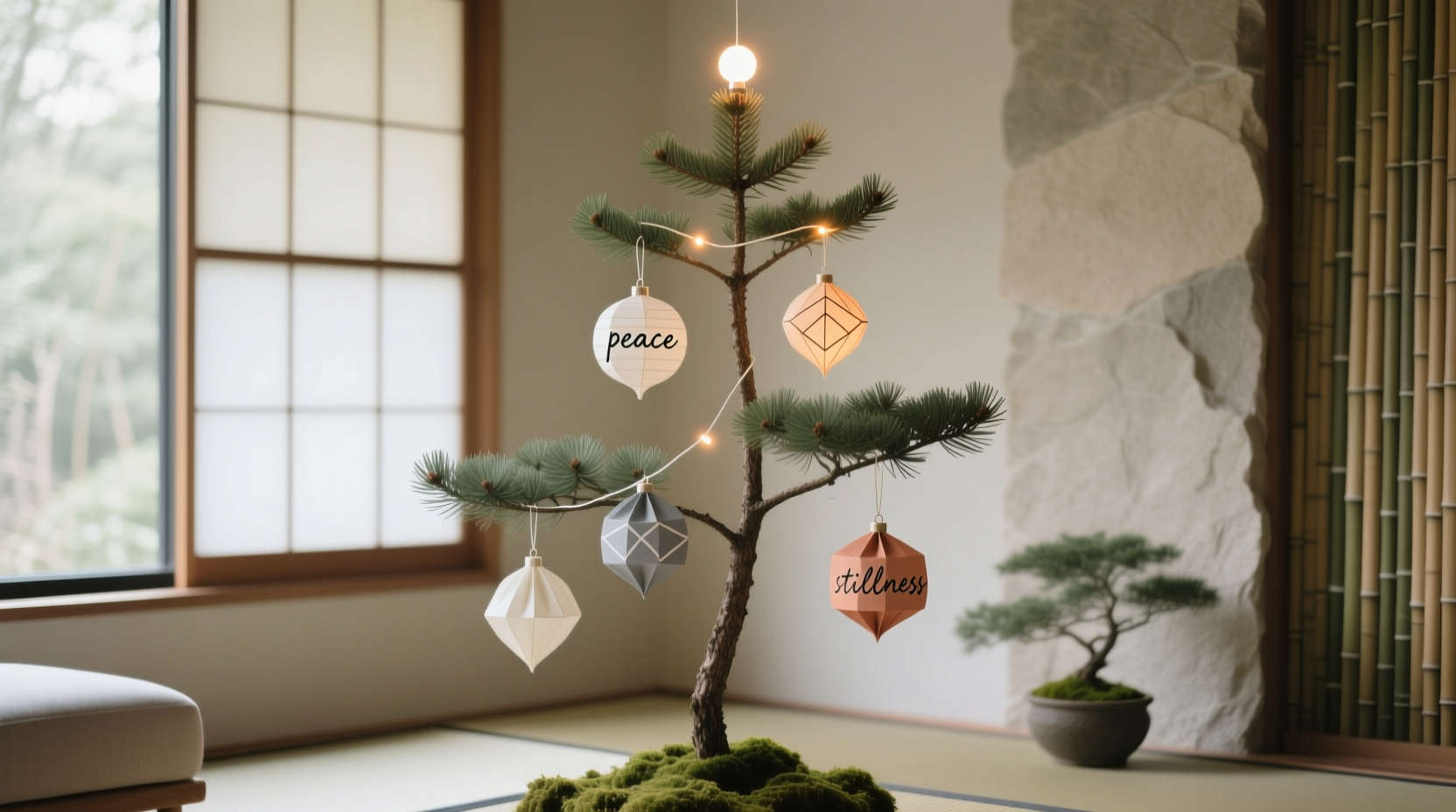
Color psychology is not abstract theory—it’s neurobiological reality. Cool, desaturated tones like misty greys, soft oatmeals, pale celadons, and warm stone-beiges lower sympathetic nervous system activation. They reduce cortisol spikes associated with visual clutter and chromatic intensity. Unlike traditional holiday palettes that rely on high-contrast pairings (red/green, gold/black), Zen trees use tonal harmony: variations within a single hue family, often anchored in nature’s own winter spectrum—lichen-grey, birch-bark beige, dried-fern green, and ash-white.
This isn’t aesthetic minimalism for its own sake. Research from the University of Sussex’s Mindful Living Lab shows participants exposed to low-contrast, earth-toned environments for 20 minutes demonstrated measurable reductions in heart rate variability (HRV) stress markers and reported significantly higher self-reported calm than those in conventionally decorated spaces. As interior designer and mindfulness educator Naomi Tanaka explains:
“Color isn’t decoration—it’s atmosphere made visible. When we choose a palette rooted in soil, stone, and sky, we’re not just styling a tree. We’re setting a somatic boundary: ‘This space is for breathing, not performing.’” — Naomi Tanaka, author of Still Space: Designing for Presence
A Zen tree begins with this premise: every color must serve stillness—not spectacle.
Your Zen Tree Materials Checklist
Curating materials with purpose eliminates decision fatigue and reinforces intentionality. Below is a concise, actionable checklist—designed to be printed or referenced while shopping:
- ✅ A real or high-quality faux fir, spruce, or cedar tree (avoid glossy, overly uniform artificial varieties)
- ✅ Base palette of 3–4 core colors: e.g., charcoal grey + oatmeal + sage + ivory (no more than four total)
- ✅ Natural-texture ornaments: hand-thrown ceramic, raw wood slices, unbleached linen pouches, dried citrus wheels, river stones wrapped in jute
- ✅ One type of light only: warm-white (2700K–2900K) LED fairy lights—battery-operated preferred for flexibility and safety
- ✅ A single, unifying accent material: undyed wool roving, unspun silk, or matte black iron wire (used sparingly)
- ✅ No plastic, no glitter, no mirrored surfaces, no neon accents
Step-by-Step Assembly: Building Stillness Branch by Branch
Assembling a Zen tree is a ritual, not a task. Allow 90–120 minutes. Play no music unless it’s silent or contains only wind, rain, or distant bells. Breathe deeply between each step. Follow this sequence—not as rigid instruction, but as embodied rhythm:
- Prep the trunk and base: Wrap the tree stand in undyed burlap or thick, unbleached linen. Secure with natural twine—not tape or plastic ties. Place a small bowl of river stones or dried pinecones beside the stand as a grounding anchor.
- Layer the foundation: Drape 2–3 lengths of matte-black iron wire or unspun silk cord loosely around the inner branches, letting them fall naturally—not taut, not symmetrical. These are structural whispers, not outlines.
- Add texture first, color second: Hang wood slices, ceramic orbs, and linen pouches *before* any colored elements. Place them unevenly—three on one branch, none on the next, two low on the left side. Embrace asymmetry as balance.
- Introduce color with restraint: Hang only 12–18 ornaments total on a standard 6–7 ft tree. Distribute them so no two touch. Use varying heights: one at eye level, one near the floor, one high in the crown. Let negative space breathe between them.
- Light last—and lightly: Weave 100–150 warm-white LED bulbs *only* along the outer third of branches—not inside the tree, not densely wound. Aim for 3–5 bulbs per major branch tip. Test brightness: when lit, the tree should glow softly—not illuminate the room.
- Final breath: Stand back for two full minutes without adjusting anything. Then, remove *one* ornament you feel drawn to take away. That is your final edit.
Do’s and Don’ts: A Practical Comparison Table
Clarity emerges through contrast. This table distills decades of mindful design work into immediate, actionable guidance:
| Principle | Do | Don’t |
|---|---|---|
| Ornament Material | Hand-thrown stoneware, unfinished walnut, raw silk-wrapped eggs, dried magnolia leaves pressed between rice paper | Plastic, glass baubles, mirrored acrylic, anything with synthetic sheen or reflective coating |
| Lighting | Warm-white (2700K), battery-operated, micro-LEDs on fine copper wire; max 150 bulbs on full-size tree | Cool-white or multicolor LEDs, plug-in cords draped visibly, blinking or chasing modes, lights strung in tight spirals |
| Color Application | Use tone-on-tone layering: e.g., charcoal grey ceramic + heather-grey wool + graphite-dyed linen | High-contrast combos (black/red), neon accents, metallic gold/silver, or more than four distinct hues |
| Tree Shape & Density | Choose a slightly irregular, open-branched silhouette; fluff branches to reveal negative space | Over-trimming for symmetry, dense flocking, or adding filler branches to “fill gaps” |
| Placement & Context | Position tree away from TVs, fireplaces with flashing flames, or high-traffic doorways; surround with quiet objects (a single candle, a smooth stone, a small vase with one dried stem) | Placing tree in front of windows with streetlights, beside loud electronics, or surrounded by other competing decor (wreaths, garlands, stockings) |
A Real Example: The Kyoto Apartment Tree
In a 42m² apartment overlooking the Kamo River in Kyoto, architect Kenji Sato created a Zen tree for his family’s December gathering. With no fireplace, limited floor space, and young children sensitive to overstimulation, Kenji began not with ornaments—but with silence. He cleared a 1.2m radius around the chosen corner, removed all existing wall art, and placed a single tatami mat beneath where the tree would stand.
He selected a 1.8m potted dwarf spruce—living, not cut—its irregular growth pattern embraced as character. Ornaments were limited to 14 pieces: seven handmade ceramic spheres (each glazed in subtle variations of ash-grey), four river stones drilled and hung with black hemp, and three linen pouches filled with roasted chestnuts (replaced weekly). Lighting consisted of 80 warm-white micro-LEDs, woven only along the outermost tips of eight primary branches—visible only when viewed head-on, disappearing from the side profile.
Guests consistently remarked not on how “beautiful” the tree was—but on how their shoulders dropped the moment they entered the room. One neighbor, a clinical psychologist, observed: “It doesn’t ask anything of you. It simply holds space—like a meditation bell that never rings.” Kenji didn’t aim for perfection. He aimed for resonance. And in doing so, he transformed seasonal decoration into daily sanctuary.
FAQ: Addressing Common Concerns
Won’t a Zen tree feel “too sparse” or “unfestive” to guests?
Festivity isn’t defined by density—it’s defined by presence. Guests unfamiliar with Zen aesthetics may initially pause, then settle deeper than expected. The absence of visual noise allows emotional receptivity to rise. Many report feeling *more* celebratory—not less—because their nervous systems aren’t competing with the decor. If hosting, place a small card beside the tree: “This tree honors quiet joy. Feel free to sit beside it, breathe, and rest.”
Can I incorporate meaningful heirlooms or sentimental ornaments?
Absolutely—if they align with the Zen ethos. Examine each piece: Does its material feel grounded? Does its color harmonize tonally? Does its shape invite contemplation rather than distraction? A chipped porcelain angel passed down three generations may belong—if its glaze is matte, its color soft, and its form simple. A sequined snowman from 1987 likely does not. Sentiment matters—but coherence matters more. Consider photographing non-aligned heirlooms and displaying the images in a quiet album nearby instead.
How do I maintain the tree’s calm energy throughout December?
Weekly, remove dust with a soft, dry horsehair brush—not a cloth or duster that creates static. Every Sunday evening, spend five minutes repositioning one ornament—shifting it 2 cm lower, turning it 15 degrees, or swapping its branch entirely. This gentle intervention prevents stagnation and honors *wabi-sabi*’s embrace of gentle change. Never “refresh” with new ornaments mid-month. Stillness requires consistency.
Conclusion: Your Tree Is Not Decoration—It’s Daily Practice
A Zen-inspired Christmas tree is the most quietly radical act of seasonal intention you can make. In choosing fewer lights, softer colors, and natural textures, you declare that peace is not passive—it’s cultivated. You resist the cultural mandate to fill every inch, brighten every corner, and perform joy at maximum volume. Instead, you offer something rarer: permission—to slow, to observe, to feel the weight of a wooden ornament in your palm, to watch light pool softly on the floor like spilled tea.
This isn’t about creating a “perfect” tree. It’s about returning—again and again—to the question: *What serves stillness here?* Sometimes the answer is removing a bulb. Sometimes it’s leaving a branch bare. Sometimes it’s sitting in silence beside the tree for twelve breaths before checking your phone.
Your Zen tree will not win a neighborhood contest. But it may become the place where your child asks their first unguarded question. Where your partner exhales fully for the first time in weeks. Where you remember that celebration doesn’t require exhaustion—and that the deepest warmth often comes not from light, but from what the light reveals: space, breath, and quiet belonging.




 浙公网安备
33010002000092号
浙公网安备
33010002000092号 浙B2-20120091-4
Comments
No comments yet. Why don't you start the discussion?