
A Zen-inspired Christmas tree is not an absence of tradition—it’s a distillation of it. It honors the season’s essence: stillness, gratitude, warmth, and cyclical renewal—without ornamentation that competes for attention or overwhelms the senses. In a world saturated with maximalist decor, this approach offers visual calm and emotional resonance. It invites presence over performance, breath over busyness. This isn’t about austerity; it’s about intentionality. Every element serves a purpose—structural, textural, or atmospheric—and nothing remains merely decorative. Below is a complete, field-tested methodology rooted in Japanese aesthetic principles (wabi-sabi, shibui, ma), sustainable material choices, and human-centered lighting science.
The Philosophy Behind the Design
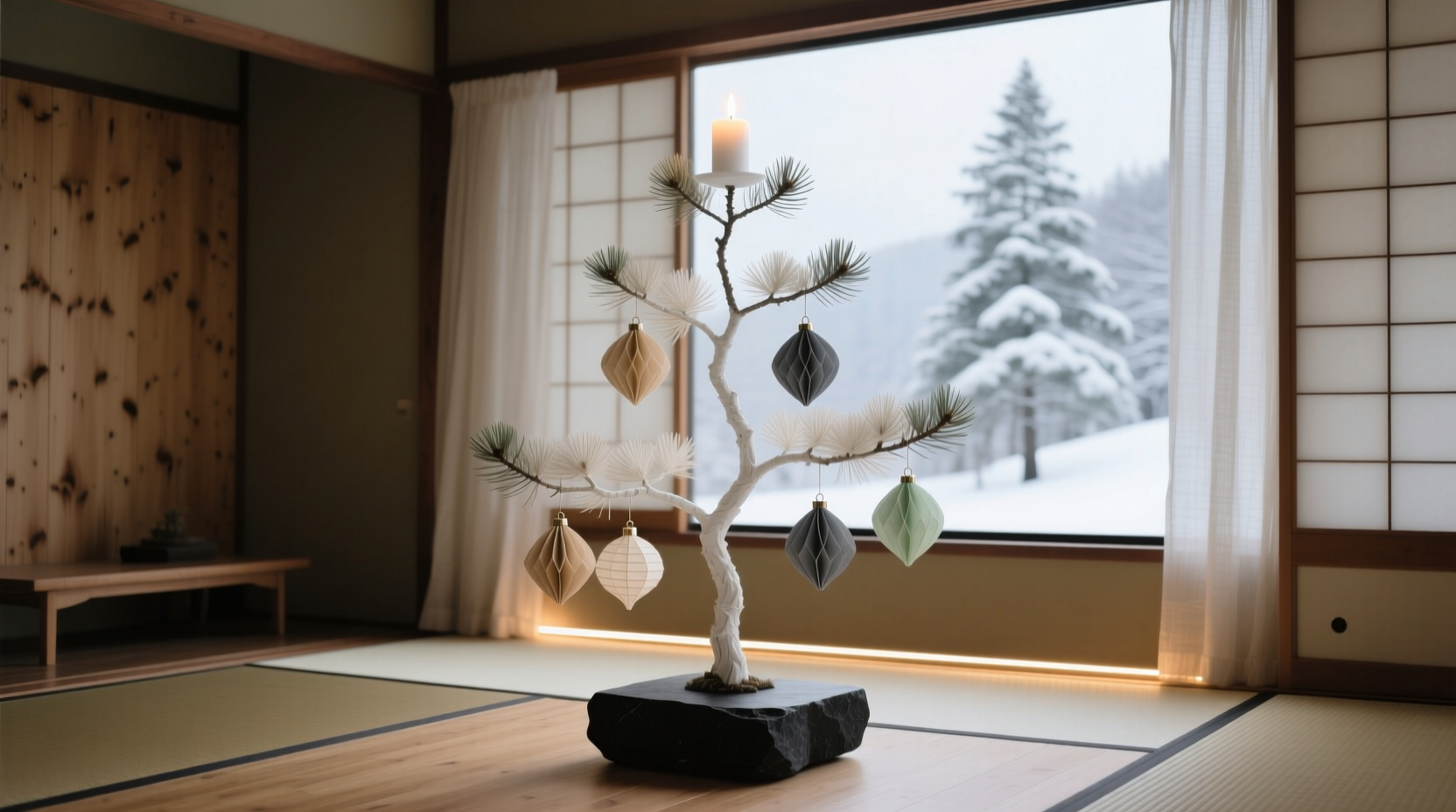
Zen aesthetics reject excess not as a stylistic preference but as a practice of discernment. In the context of holiday decor, this means asking: What evokes quiet joy? What supports rest rather than stimulation? A Zen tree prioritizes negative space (“ma”)—the deliberate pauses between branches, ornaments, and light sources—as much as the objects themselves. It embraces imperfection: asymmetrical branch placement, slight variations in twig thickness, the gentle irregularity of hand-dipped beeswax candles. Unlike conventional trees that aim for symmetry and density, a Zen tree leans into organic rhythm—like a carefully pruned pine in a Kyoto temple garden.
This philosophy directly informs material selection. Synthetic tinsel, plastic baubles, and blinking LED strings contradict the ethos. Instead, emphasis falls on natural, tactile, and locally sourced elements: dried citrus slices, foraged pinecones, unbleached linen ribbons, hand-thrown ceramic ornaments, and sustainably harvested wood. Even the tree itself—ideally a real, potted Nordmann fir or Japanese yew—serves dual purposes: seasonal beauty followed by re-planting or composting.
“Minimalism in ritual isn’t about subtraction—it’s about amplifying meaning through restraint. When every object on the tree has been chosen with care and placed with awareness, the space around it becomes sacred.” — Hiroshi Tanaka, Kyoto-based ikebana and interior harmony consultant
Essential Materials & Sourcing Guidelines
Selecting materials is the first act of intention. Avoid mass-produced kits or generic craft store items. Prioritize durability, biodegradability, and sensory authenticity. Below is a curated list of non-negotiable components, with sourcing rationale:
| Element | Recommended Material | Why It Aligns With Zen Principles | Sourcing Tip |
|---|---|---|---|
| Tree Base | Unstained ash or walnut wood stand, circular or low-profile rectangular | Warm grain texture reinforces natural harmony; no paint or finish preserves material honesty | Commission from local woodworker or source from reclaimed timber suppliers like Urban Lumber Co. |
| Ornaments | Hand-blown glass orbs (matte white, soft grey, pale celadon), ceramic discs with carved kanji for “peace” or “stillness”, dried magnolia leaves pressed in rice paper | Imperfections in handcrafted pieces embody wabi-sabi; muted tones reflect shibui’s understated elegance | Support small studios via platforms like Etsy (filter for “handmade,” “non-toxic glaze,” “local clay”) |
| Lighting | Incandescent fairy lights (2700K color temperature), copper-wire string lights, or battery-operated beeswax taper candles in ceramic holders | Low-color-temperature light mimics candle glow—calming to circadian rhythm; copper wire ages gracefully, gaining patina over time | Avoid LEDs labeled “cool white” or “daylight”; look for UL-listed incandescents rated for indoor use and dimmable compatibility |
| Binding/Texture | Unbleached hemp twine, undyed silk ribbon (3mm width), or strips of repurposed linen napkin | Fibers retain natural variation—slight slubs, tonal shifts—emphasizing process over perfection | Buy by the spool from textile recyclers like FabScrap or natural fiber specialists like The Hemp Trading Co. |
| Scent Element (Optional) | Fresh-cut cedar boughs tucked beneath lower branches, or a single small ceramic oil diffuser with 100% pure hinoki cypress oil | Hinoki is used in Japanese shrines for its grounding, meditative aroma; avoids synthetic fragrance chemicals | Source essential oil from certified organic suppliers like Mountain Rose Herbs; avoid pre-mixed “holiday blend” oils |
A Five-Step Assembly Process
Building the tree is a mindful ritual—not a race against the clock. Allow 90–120 minutes. Work slowly. Pause between steps. Breathe. This sequence follows traditional Japanese “kata” (formalized practice) to embed intention into each action.
- Prepare the space and tree: Clear a 3m x 3m area. Place the wooden base on a neutral rug or bare floor. Gently shake the real tree to release loose needles. Trim only dead or crossing lower branches—preserve natural asymmetry. Insert trunk into base, ensuring stability without overtightening.
- Establish vertical rhythm with lighting: Begin at the trunk. Wrap incandescent string lights *spiral-wise*, moving upward every 15–20 cm—not tightly wound, but with 3–4 cm of gentle slack between loops. Let wires nestle into branch junctions, not hang freely. End at the topmost tip, leaving 30 cm of cord to drape downward along one side. No lights on the very top branch—this preserves the sense of open sky (“ma”).
- Add structural anchors: Select 5–7 primary branches (3 per tier: bottom, middle, top). Tie a single dried orange slice (pierced and air-dried for 10 days) or ceramic disc to each using hemp twine. Knot loosely—allow slight sway. These are not ornaments; they’re “breathing points”—places where the eye rests and releases.
- Introduce texture and depth: Tuck 3–5 small cedar boughs (15–20 cm long) into the inner structure near the trunk, pointing outward. Their deep green adds tonal contrast without brightness. Then, weave 2–3 lengths of undyed silk ribbon vertically through mid-level branches—let ends fall naturally, no cutting or securing at the tip.
- Final calibration and stillness: Step back. Observe for 60 seconds without adjusting anything. Note where light pools, where shadow gathers, where the eye lingers. Only then, make micro-adjustments: loosen one knot, rotate a ceramic disc 15 degrees, lift a ribbon end 2 cm. Turn off all other room lights. Sit beside the tree for 5 minutes in silence. If the space feels expansive—not empty, but full of quiet—you’re finished.
Real-World Example: The Kyoto Apartment Tree
In late November 2023, architect Mika Sato transformed her 42m² Kyoto apartment’s compact living area with this approach. Her space featured shōji screens, tatami flooring, and a north-facing window—low natural light, high sensitivity to visual noise. She chose a 1.4m potted Japanese yew (Taxus cuspidata), known for its dense, slow-growing habit and deep green, almost black foliage.
Mika sourced hand-thrown ceramic ornaments from a potter in Shigaraki, each glazed in matte iron oxide—varying subtly from charcoal to rust. She strung 100 incandescent micro-bulbs (2700K, 0.5W each) along a single copper wire, wrapping only the lower two-thirds of the tree. No ribbon, no scent—just the natural resinous aroma of yew and the soft amber pulse of light reflecting off her rice-paper lamps.
Her neighbors, initially skeptical of “a Christmas tree with no sparkle,” began gathering quietly in her entryway each evening. “They don’t talk,” Mika observed. “They sit on the zabuton cushion, watch the light move with the setting sun, and leave after ten minutes—calmer. That was the point. Not celebration as spectacle—but celebration as sanctuary.”
Maintenance, Safety & Seasonal Transition
A Zen tree requires different care than conventional ones. Its longevity depends on environmental harmony, not just hydration.
- Watering: Use a base with integrated reservoir (not a spike). Fill daily with room-temperature water mixed with 1 tsp apple cider vinegar (lowers pH, slows needle drop). Check soil moisture for potted trees—keep consistently damp, never soggy.
- Light management: Run lights only 4–6 hours daily, ideally during twilight or early evening. Use a mechanical timer—not smart plugs—to avoid digital interference. Never leave unattended overnight.
- Dust & air quality: Wipe branches weekly with a dry, soft-bristle brush (not cloth—static attracts dust). Avoid sprays or polishes. If indoor air feels dry, place a shallow ceramic dish of water near (not under) the tree.
- Post-holiday transition: On January 5th (traditional Japanese “Koshōgatsu” date), remove ornaments mindfully—place each on a clean cloth, wipe gently, store in breathable cotton bags. Compost the tree or arrange for municipal green-waste pickup. Repurpose the wooden base as a plant stand; reuse ceramic ornaments year-round on bookshelves or windowsills.
FAQ
Can I use a fake tree and still achieve Zen minimalism?
Yes—but only if it meets strict criteria: real-branch texture (not smooth PVC), matte finish (no shine), neutral tone (charcoal grey or deep forest green—not bright green), and zero built-in lights. You must add your own incandescent strings manually. Most artificial trees fail the “material honesty” test—plastic contradicts wabi-sabi’s reverence for natural aging. A high-quality faux tree can last 10+ years if treated as a permanent sculptural object, not disposable decor.
How many ornaments are too many?
There is no fixed number—only a principle: if you can count them without looking away, there are too many. A true Zen tree uses 5–12 total ornaments, spaced so each occupies its own visual “room.” Clustered groupings trigger cognitive load. Test it: stand 2 meters away. Blink rapidly. The elements you register in the first 0.5 seconds are the only ones needed.
Is it safe to use real candles near a live tree?
No—never. Even beeswax tapers pose unacceptable fire risk near dry conifer needles. Use only UL-listed electric candles designed for indoor trees, or better yet, rely solely on incandescent fairy lights. Their filament glow replicates candle warmth without combustion. If flame is non-negotiable for ritual, place a single real candle in a heavy ceramic holder *on the floor beside* the tree—not on or in it—and extinguish after 20 minutes.
Conclusion
A Zen-inspired minimalist Christmas tree is more than decor—it’s a daily invitation to return to yourself. In the quiet glow of warm light against natural wood and muted ceramic, something settles: the frantic pace of December softens, the pressure to perform joy eases, and space opens for what matters most—presence, connection, stillness. This tree doesn’t shout “Merry Christmas!” It whispers “Breathe. You are here. This moment is enough.”
You don’t need special skills, expensive tools, or perfect taste to begin. Start with one element: swap cool-white lights for 2700K incandescents. Replace three plastic balls with hand-dipped beeswax ornaments. Sit beside your tree for five minutes tonight—not to adjust, not to photograph, but to witness. That small act is the heart of the practice.




 浙公网安备
33010002000092号
浙公网安备
33010002000092号 浙B2-20120091-4
Comments
No comments yet. Why don't you start the discussion?