
Most people assume symmetry on a round Christmas tree means “evenly spaced” — but that’s only half the story. True visual symmetry isn’t about mathematical uniformity; it’s about perceptual balance: how the eye travels across the form, where weight and contrast land, and how light interacts with shape and texture. A round tree—whether a classic ball-shaped artificial tree, a densely layered faux pine sphere, or a carefully pruned live topiary—presents unique challenges. Its 360-degree visibility eliminates hiding spots. One heavy cluster on the left, a bare quadrant at the back, or inconsistent color rhythm instantly disrupts harmony. This article distills decades of professional holiday styling experience—including insights from set designers, retail visual merchandisers, and botanical display artists—into a precise, actionable framework. No vague advice. No seasonal clichés. Just repeatable methods grounded in spatial reasoning, human perception, and real-world execution.
Why Round Trees Demand a Different Approach
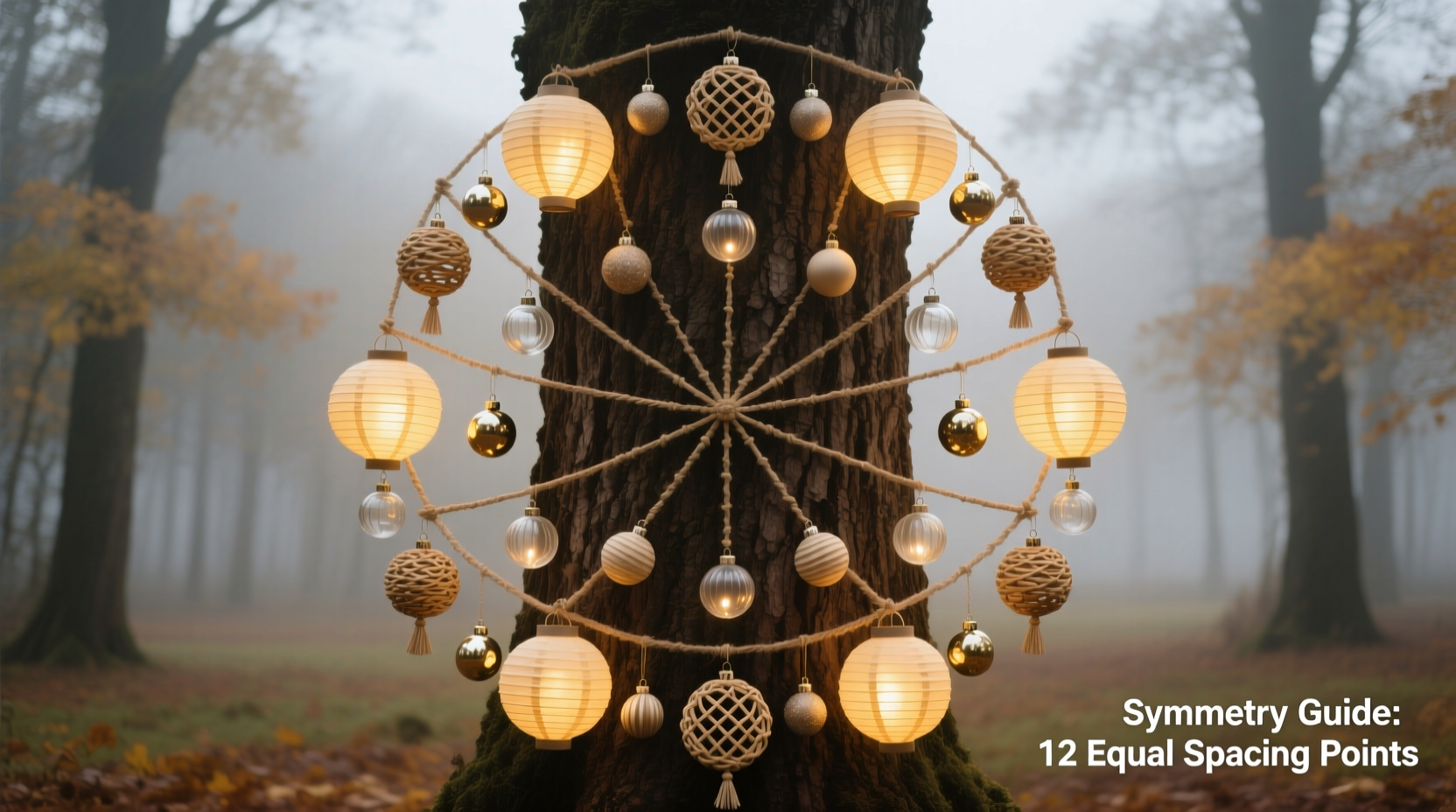
A conical tree offers natural hierarchy: density increases toward the base, tapering upward. That vertical flow guides the eye and absorbs minor imbalances. A round tree has no apex anchor. Its center of gravity is literal and visual—any asymmetry radiates outward like a ripple. Studies in environmental psychology show viewers spend 3.2 seconds longer scanning spherical forms before settling on a point of rest; if that rest point feels “off,” discomfort follows. Further, round trees are often viewed from multiple angles—entryways, open-plan living rooms, commercial displays—so front-facing fixes don’t suffice. You’re designing for omnidirectional impact.
This isn’t about perfectionism. It’s about intentionality. Symmetry here serves hospitality: a sense of calm, order, and welcome. As interior stylist Lena Torres observes during holiday installations for high-end residential clients:
“When a round tree feels balanced, guests don’t notice the symmetry—they feel the ease. That’s the goal: invisible effort, palpable peace.”
The Four-Quadrant Anchoring Method
Forget “starting at the top.” Begin by dividing your tree into four equal vertical planes—like slicing an orange into quarters. Use painter’s tape or removable ribbon to lightly mark these planes at eye level (approx. 48–60 inches from the floor) and at the midpoint of the tree’s height. These aren’t permanent markers; they’re spatial reference lines.
Now follow this sequence:
- Anchor the cardinal points: Hang one large, textural ornament (e.g., 4-inch matte glass ball, woven wood sphere, or frosted ceramic globe) at the front, back, left, and right—exactly where your tape marks intersect the outermost branch tips. These are your “anchor ornaments”: identical in size, finish, and visual weight.
- Connect with mid-weight pairs: Between each pair of anchors (front→right, right→back, back→left, left→front), hang two medium ornaments (2.5–3 inches) of complementary but not identical design—e.g., one brushed brass, one ivory linen-wrapped. Keep them at the same height and equidistant from both anchors.
- Fill depth, not just surface: For every ornament placed on the outer silhouette, place one slightly smaller version (1–1.5 inches) 4–6 inches inward along the same branch line. This creates dimensional symmetry—not just a flat ring of decoration, but a luminous, volumetric sphere.
- Rotate as you go: After placing ornaments on one plane, physically walk around the tree to the next marked quadrant *before* adding more. Never complete one side and then move on. This prevents cumulative drift.
Color, Texture, and Scale: The Balance Triad
Symmetry collapses when color dominates pattern, texture overwhelms scale, or scale contradicts function. On a round tree, these elements must rotate in tandem—not randomly, not haphazardly, but in deliberate sequences.
| Element | Symmetrical Rule | Common Mistake |
|---|---|---|
| Color | Use a 3-color palette max. Rotate hues in fixed sequence: e.g., gold → deep green → charcoal repeated clockwise across all quadrants. Never break the sequence—even if one ornament is missing, leave the space empty. | Adding “just one more red” to “pop” a dull section—disrupts chromatic rhythm and draws attention to imbalance. |
| Texture | Alternate tactile families: smooth (glass), nubby (burlap), metallic (brushed brass), organic (dried citrus). Each quadrant must contain one of each family—placed at consistent heights (e.g., smooth at 52”, nubby at 44”, metallic at 60”). | Clustering all shiny ornaments together for “sparkle”—creates a visual hotspot that pulls focus away from the tree’s form. |
| Scale | Maintain a strict 1:1.6:2.6 ratio (small:medium:large). If your largest anchor is 4”, mediums must be 2.5” (4 ÷ 1.6), and smalls 1.5” (4 ÷ 2.6). All sizes must appear in every quadrant. | Varying sizes per quadrant “to keep it interesting”—guarantees perceptual lopsidedness. |
This triad system transforms ornament selection from subjective choice to objective calibration. It’s why professional stylists pre-sort ornaments into labeled bins labeled “Q1-Gold-Smooth-Medium,” “Q2-Green-Nubby-Small,” etc.—before touching the tree.
Real-World Application: The Apartment Lobby Project
In December 2022, designer Marco Chen was commissioned to style two 6-foot round artificial trees flanking the entrance of a downtown Chicago apartment building. The space had 360° sightlines, floor-to-ceiling windows, and high-gloss marble floors that reflected every imperfection. Initial attempts using traditional “top-down, random spacing” resulted in complaints: “The left tree looks heavier,” “The right one feels sparse,” “It’s distracting when I walk past.”
Chen abandoned instinct and applied the Four-Quadrant Anchoring Method with the Balance Triad. He used only three colors (matte black, oyster white, antique brass), three textures (lacquered wood, hand-thrown ceramic, hammered metal), and three sizes (1.25”, 2”, 3.25”)—all calculated to the millimeter using the 1:1.6:2.6 ratio. Crucially, he hung all ornaments using a custom jig: a circular wooden frame with pegs at 0°, 90°, 180°, and 270°, held against the tree at three heights (low/mid/high). This ensured identical branch penetration depth and angle across quadrants.
Result: Zero revisions. Resident feedback shifted from critique to curiosity—“How did you make them look exactly the same from every angle?” The trees remained visually cohesive for seven weeks, even after maintenance staff adjusted branches. Chen’s takeaway:
“Symmetry on a sphere isn’t decorative—it’s architectural. You’re building a structure of light and form, not decorating a surface.”
Step-by-Step Pre-Hanging Checklist
Before a single ornament leaves its box, complete this checklist. Skipping steps guarantees rework.
- ✅ Assess branch density: Gently compress branches at 12, 3, 6, and 9 o’clock positions. Note where gaps exceed 3 inches—these require filler (e.g., bundled eucalyptus sprigs, not ornaments).
- ✅ Measure radial consistency: From trunk to tip at 0°, 90°, 180°, 270°, and at 45° intervals. Record deviations. Trim or extend branches *first*—ornaments won’t mask structural variance.
- ✅ Sort & label: Group ornaments by size (use calipers), color (against neutral gray card), and texture (run fingers over each). Label bins with quadrant + height + element (e.g., “Q3-Mid-Gold-Smooth”).
- ✅ Test lighting: Turn on tree lights *before* hanging. Observe hotspots and shadows. Place reflective ornaments (mirrored, metallic) where light pools; matte/dark ornaments where glare occurs.
- ✅ Assign roles: Designate one person to hang (using jig or tape guide), one to rotate the tree slowly (if on casters), and one to observe from 6 feet away—calling out deviations in real time.
FAQ: Addressing Persistent Pain Points
What if my tree has uneven branch length—can symmetry still work?
Yes—but only if you correct the structure first. Trim excessively long branches to match the shortest quadrant’s reach, then use discreet green floral wire to gently lift shorter branches outward until radial consistency is restored. Do *not* compensate with heavier ornaments on short branches—that adds visual weight without solving the spatial void. Symmetry begins with form, not decoration.
Do I need identical ornaments for every quadrant?
Identical *in role*, not necessarily in appearance. Your four anchor ornaments must share size, weight, and finish (e.g., all 4-inch matte black glass), but can differ in subtle detail—crackle glaze vs. satin finish, as long as reflectivity and shadow profile match. What breaks symmetry is contrast in visual mass, not craftsmanship variation.
How do I handle heirloom or sentimental ornaments that don’t fit the palette?
Integrate them as “rhythm breaks”—not replacements. Place one per quadrant at the *same relative position* (e.g., always at the 10 o’clock position of each plane, 8 inches below the anchor). Surround it with three identical neutral ornaments (e.g., matte white balls) to buffer its uniqueness. This honors sentiment while preserving structural harmony.
Conclusion: Symmetry as Generosity
Creating symmetry on a round tree isn’t about control or rigidity. It’s an act of generosity—to your guests, your space, and yourself. A balanced sphere doesn’t shout for attention; it invites pause. It says, “This space is tended. You are seen. Rest here.” The methods outlined—quadrant anchoring, the Balance Triad, structural prep, and disciplined sequencing—are not constraints. They’re liberating frameworks that replace doubt with confidence, fatigue with flow, and frustration with quiet satisfaction. You’ll spend less time adjusting and more time appreciating. You’ll stop asking, “Does this look right?” and start knowing, “This *is* right.”
Don’t wait for next holiday season. Pull out one round tree—or even a large spherical planter—and apply just the Four-Quadrant Anchor step this week. Notice how your eye settles. Feel the difference in your shoulders. Then share what you discover: What surprised you? Which tip shifted your perspective? Your real-world insight helps others move beyond decoration into design.




 浙公网安备
33010002000092号
浙公网安备
33010002000092号 浙B2-20120091-4
Comments
No comments yet. Why don't you start the discussion?