
In an age where technology increasingly blends with personal well-being, syncing environmental cues to biological rhythms is no longer science fiction. One of the most soothing applications of this concept is using smart lighting to mirror your resting heart rate—a gentle, rhythmic pulse of light that can promote relaxation, mindfulness, and even improve sleep quality. Unlike flashing or strobing effects, a subtle, heartbeat-synchronized glow mimics the body’s natural cadence, creating a calming focal point in any space.
This guide walks you through customizing off-the-shelf smart light strings to pulse in time with your average resting heart rate—typically between 60 and 100 beats per minute (BPM) for adults, with optimal ranges often falling between 60 and 75 BPM. Whether you're building a meditation corner, enhancing a bedroom ambiance, or supporting biofeedback therapy, this project combines accessible hardware, open-source software, and physiological insight into a functional, personalized experience.
Understanding the Science Behind Heart Rate Synchronization
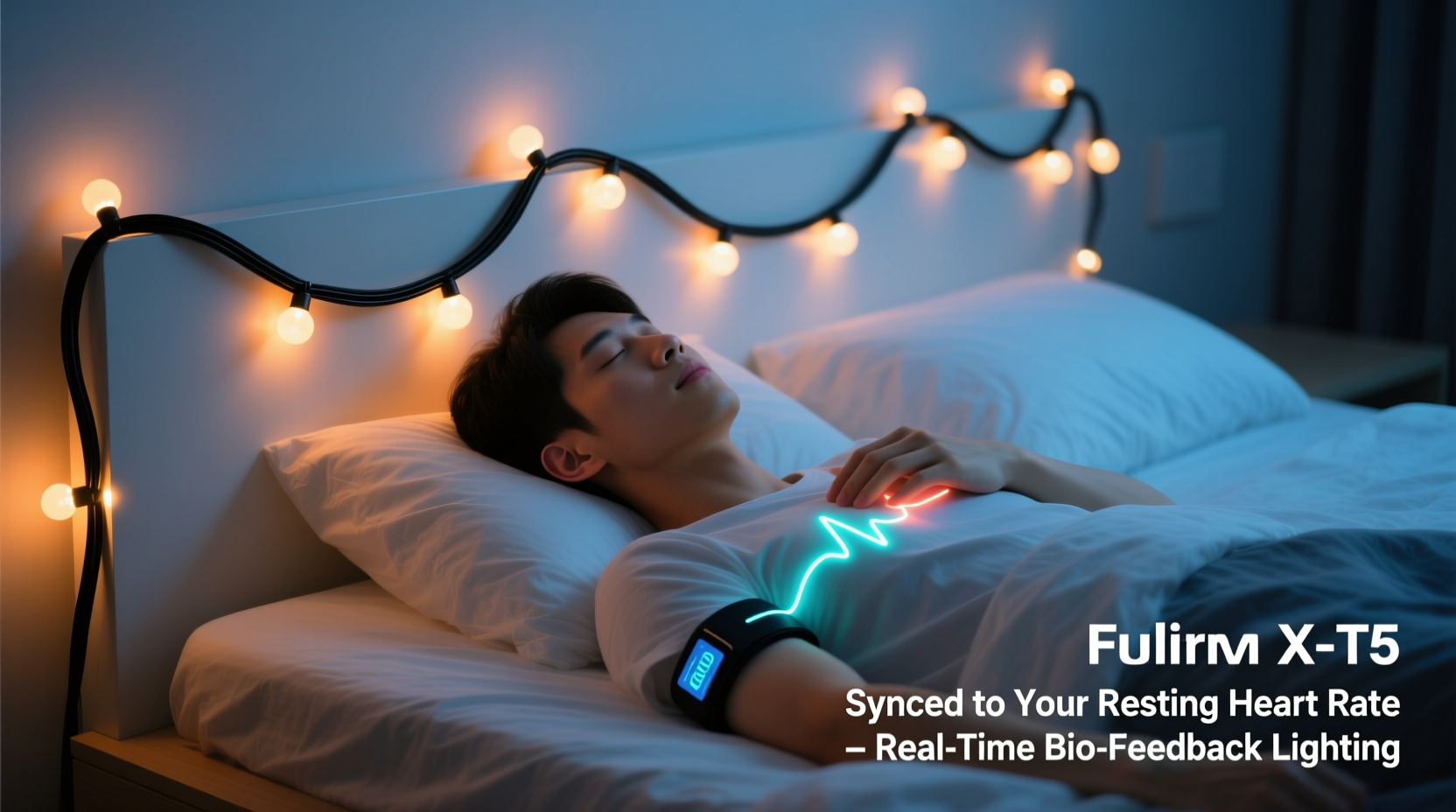
The human nervous system responds powerfully to rhythmic stimuli. When visual patterns align with internal biological rhythms—like breathing or heartbeats—they can induce a state known as entrainment, where external cues help regulate internal processes. Studies have shown that exposure to slow, predictable visual pulses can reduce stress markers, lower cortisol levels, and support parasympathetic nervous system activation—the “rest and digest” mode essential for recovery and mental clarity.
A 2021 study published in *Frontiers in Psychology* found that participants exposed to light pulses matching their resting heart rate reported significantly higher levels of calmness and focus compared to those exposed to random or faster flickers. The effect was strongest when the transition between light states was smooth and organic—not abrupt or digital.
“Synchronizing ambient stimuli to physiological baselines creates a feedback loop that reinforces homeostasis. It's not just aesthetic—it's regulatory.” — Dr. Lena Torres, Neuroergonomics Research Lab, University of Toronto
For this reason, a gently pulsing light string isn’t merely decorative. It becomes a tool for emotional regulation, particularly useful during evening wind-down routines, breathwork sessions, or anxiety management practices.
Required Components and Setup Overview
Building a heart-rate-mimicking light string doesn't require advanced engineering skills, but it does involve selecting compatible components and configuring them correctly. Below is a list of essential items:
- Addressable LED strip or string lights – Preferably WS2812B (NeoPixel) or SK6812-based, which allow individual LED control via microcontroller.
- Microcontroller – Such as Arduino Nano, ESP32, or Raspberry Pi Pico. The ESP32 is ideal due to built-in Wi-Fi and Bluetooth capabilities.
- Power supply – Match voltage (usually 5V or 12V) and amperage to your LED count. A 5-meter strip may draw up to 9A at full brightness.
- Jumper wires and breadboard – For prototyping connections.
- Optional: Pulse sensor – Like the MAX30102 or a simple photoplethysmography (PPG) module, if measuring real-time heart rate.
- Software tools – Arduino IDE or PlatformIO, plus libraries such as FastLED or Adafruit_NeoPixel.
Step-by-Step Guide to Programming the Pulse Effect
Follow these steps to program your smart light string to simulate a gentle heartbeat rhythm based on your resting heart rate.
- Determine your average resting heart rate
Measure your pulse first thing in the morning over three consecutive days. Calculate the average. For example, if readings are 68, 72, and 70 BPM, your target is 70 BPM. - Calculate pulse duration
Convert BPM to seconds per beat: 60 seconds ÷ 70 BPM = ~0.857 seconds per beat. This defines the total cycle length (on + off phases). - Design the pulse waveform
Instead of turning lights fully on/off, use a sine wave or ease-in/ease-out curve to simulate blood flow. This prevents jarring transitions. - Wire the hardware
Connect the data input of the LED string to GPIO pin 2 on your ESP32 or Arduino. Ensure common ground between power supply and microcontroller. - Upload the code
Use the following simplified FastLED sketch as a starting point:
#include <FastLED.h>

#define LED_PIN     2
#define NUM_LEDS    60
#define BRIGHTNESS  50

CRGB leds[NUM_LEDS];
float bpm = 70.0; // Set your resting HR here
float cycleSec = 60.0 / bpm;
unsigned long startTime;

void setup() {
  FastLED.addLeds<WS2812B, LED_PIN, GRB>(leds, NUM_LEDS);
  FastLED.setBrightness(BRIGHTNESS);
  startTime = millis();
}

void loop() {
  unsigned long elapsed = (millis() - startTime) / 1000.0;
  float phase = fmod(elapsed, cycleSec) / cycleSec;

  // Smooth sine wave intensity from 10% to 100%
  float intensity = 0.45 * sin(2 * PI * phase - PI/2) + 0.55;

  for(int i = 0; i < NUM_LEDS; i++) {
    leds[i] = CHSV(180, 255, intensity * 255); // Soft blue-white hue
  }
  FastLED.show();
  delay(20); // Frame rate limiter
}
- Test and refine
Observe the light in a dark room. Adjust the color temperature (try warm white or soft blue), maximum brightness, and easing function until the pulse feels organic and non-intrusive.
Advanced Customization: Real-Time Heart Rate Integration
For a dynamic experience, integrate a wearable-compatible sensor to adjust the light in real time. While most users will prefer a fixed resting rate for consistency, some may want adaptive behavior—such as slowing the pulse during meditation.
The MAX30102 sensor, connected via I2C to the ESP32, can capture real-time PPG data. With signal filtering algorithms (available in libraries like PulseSensorPlayground), you can extract BPM estimates every few seconds and update the LED cycle accordingly.
Challenges include motion artifacts and signal noise, so real-time setups work best when the user remains still. Alternatively, pull resting heart rate data from APIs like Fitbit or Apple Health using MQTT or HTTP requests, updating the light pattern each morning based on overnight averages.
| Method | Accuracy | Complexity | Best Use Case |
|---|---|---|---|
| Fixed BPM (manual input) | High (consistent) | Low | Daily relaxation routine |
| Real-time sensor (MAX30102) | Moderate (motion-sensitive) | Medium | Meditation or biofeedback sessions |
| Wearable sync (API-based) | High (clinical-grade devices) | High | Long-term wellness tracking |
Mini Case Study: Calming Lights in a Therapy Practice
Clinical therapist Maya Rostova integrated heartbeat-synchronized lighting into her anxiety treatment protocol at a wellness center in Portland. She installed programmable LED strips behind wall panels in each session room, set to pulse at 62 BPM—the average resting rate of her adult clients.
Over six weeks, 34 patients participated in controlled exposure: half experienced traditional dimmed lighting, while the other half had access to the pulsing lights during guided breathing exercises. Post-session surveys showed that 78% of those in the pulse-light group reported feeling “significantly more grounded,” compared to 44% in the control group. Physiological monitoring revealed an average reduction of 8 BPM in heart rate during sessions with synchronized lighting.
“It gave them something to anchor to,” Rostova noted. “When words failed, the light became a silent guide back to their body.”
Checklist: Building Your Heartbeat Light System
Before powering up your setup, verify the following:
- ✅ Measured personal resting heart rate over multiple mornings
- ✅ Selected addressable LEDs with sufficient diffusion
- ✅ Confirmed power supply matches LED requirements
- ✅ Microcontroller programmed and tested with basic animation
- ✅ Code adjusted for smooth fade-in/fade-out (no sudden jumps)
- ✅ Installed in low-glare location (e.g., behind furniture, under shelves)
- ✅ Tested in actual environment with user present
Common Pitfalls and How to Avoid Them
Even well-designed systems can fall short if key details are overlooked. Here are frequent issues and solutions:
- Too bright or harsh: Reduce brightness below 30% and use diffusing materials. Direct LED exposure defeats the calming purpose.
- Unnatural rhythm: Square waves (on/off) feel mechanical. Always use curved transitions—sine, cubic ease, or Gaussian profiles.
- Flickering at low brightness: Increase PWM frequency or use dithering techniques available in FastLED (
FastLED.setDither(1)). - Overheating LEDs: Ensure adequate ventilation and avoid enclosing high-density strips in tight spaces.
- Inconsistent timing: Avoid using
delay()in loops; instead, usemillis()-based timing for smoother performance.
Frequently Asked Questions
Can I use commercial smart bulbs instead of DIY LEDs?
Yes, but with limitations. Philips Hue or LIFX bulbs can simulate pulses using their API and apps like Hyperion or Home Assistant, but the refresh rate is often too slow for smooth biological mimicry. They also lack fine-grained control over transition curves, making the effect feel less organic.
Is this safe for people with epilepsy or photosensitive conditions?
Generally, yes—provided the pulse remains slow (below 3 Hz, or 180 BPM) and uses gradual transitions. However, anyone with photosensitivity should consult a physician before use. Never exceed 5 Hz (300 BPM), as rapid flashes can trigger seizures.
Can the light adapt to changing heart rates during meditation?
Yes, but it requires real-time sensing. Using a chest strap or finger sensor with an ESP32 allows dynamic updates. However, sudden drops or spikes may cause disorientation. A better approach is to gradually shift the pulse over 30–60 seconds rather than instantaneously.
Final Thoughts and Next Steps
Customizing a smart light string to pulse with your resting heart rate bridges technology and biology in a deeply personal way. More than ambient decoration, it functions as a quiet companion—helping regulate attention, deepen relaxation, and reconnect with the body’s innate wisdom.
Start simple: choose your target BPM, wire a basic LED strip, and upload a smooth sine-wave animation. Once the foundation works, explore enhancements like color shifts, multi-zone pulsing, or integration with sleep trackers. The goal isn’t perfection—it’s presence.




 浙公网安备
33010002000092号
浙公网安备
33010002000092号 浙B2-20120091-4
Comments
No comments yet. Why don't you start the discussion?