
Open bangles offer elegance and versatility, but their one-size-fits-all design often leads to slippage, rotation, or discomfort. Unlike closed bracelets, open bangles rely on precise curvature and spring tension to stay in place. When poorly fitted, they can pinch, slide off, or fail to complement your wrist naturally. The good news? With minor adjustments, you can tailor any open bangle to match your wrist shape, size, and wearing preference. This guide walks you through the process of customizing your bangle for a secure, snug, and comfortable fit—no special tools required.
Understanding Open Bangle Mechanics
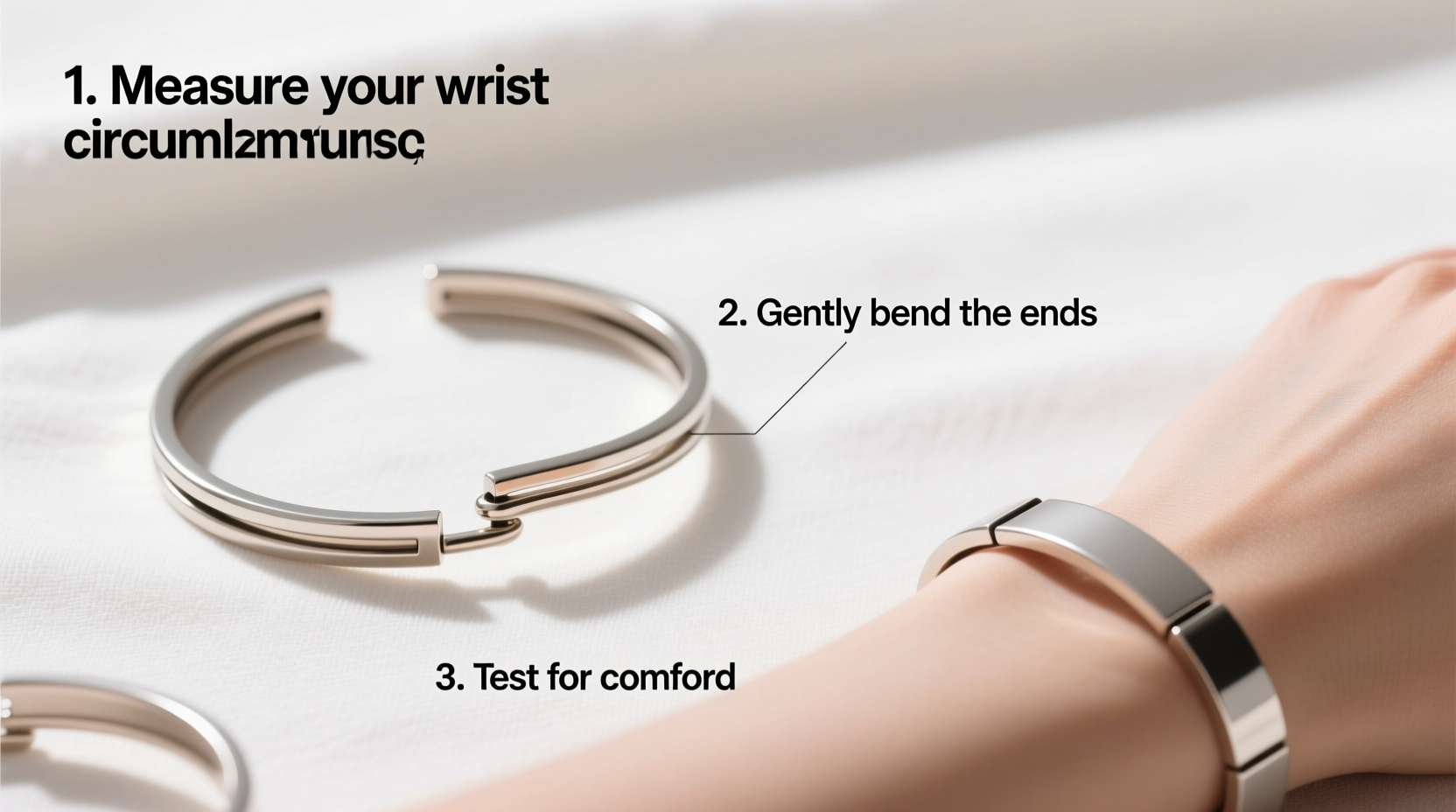
An open bangle is a rigid bracelet with a gap between its two ends, allowing it to be slipped over the hand. Its fit depends on three key factors: inner diameter, metal thickness, and arc curvature. The ideal bangle should rest comfortably around the wrist bone without pressing into soft tissue or rotating excessively. Because wrists vary in width, bone prominence, and flexibility, mass-produced bangles rarely achieve a perfect fit out of the box.
The gap in an open bangle provides room for adjustment. By gently bending the ends closer together or farther apart, you control how tightly the bangle grips the wrist. However, over-bending can weaken the metal or distort its shape. Understanding your bangle’s material—whether sterling silver, gold-filled, brass, or stainless steel—is essential before making changes.
“Most open bangles are designed with intentional flexibility, but each metal has a fatigue point. Customize with care to preserve both comfort and longevity.” — Lena Torres, Jewelry Artisan & Metalsmith
Step-by-Step Guide to Customizing Your Bangle Fit
Follow this five-step process to adjust your open bangle safely and effectively. This method works best for solid metal bangles with moderate thickness (1.5–3mm). Avoid attempting these steps on hollow, plated, or fragile pieces unless advised by a jeweler.
- Measure your wrist: Use a flexible tape measure to determine the circumference just above the wrist bone—the area where you typically wear a bangle. Note this measurement. Then, add 0.5 to 1 inch for ease of movement and comfort. This total helps estimate your ideal inner diameter.
- Test the current fit: Slide the bangle over your hand and onto your wrist. Observe how it sits:
- Does it rotate freely?
- Is there visible gap between the ends?
- Does it press uncomfortably on the wrist bone?
- Prepare your workspace: Lay down a soft cloth on a flat surface to prevent scratches. Have a pair of non-slip rubber gloves ready for better grip. If available, use nylon-jaw pliers to avoid marring the metal.
- Adjust the curve gradually: Hold the bangle firmly with one hand at the base (opposite the gap). With the other hand, grasp one end and apply gentle, even pressure inward to tighten or outward to loosen. Make small bends—no more than 5 degrees at a time—and retest the fit after each adjustment. Remember: metal work-hardens with repeated bending, so patience prevents breakage.
- Finalize and test wearability: Once the bangle fits snugly over the hand but stays stable on the wrist, wear it for 10–15 minutes. Check for pinching, slipping, or warmth buildup. If discomfort persists, slightly increase the gap. Allow 24 hours of regular wear to confirm long-term comfort.
Material-Specific Adjustment Guidelines
Different metals respond uniquely to bending. A misstep with soft silver may cause permanent deformation, while overly stiff steel might resist shaping altogether. Refer to the table below for safe customization practices by material.
| Material | Bendability | Recommended Tools | Caution |
|---|---|---|---|
| Sterling Silver | High | Nylon-jaw pliers, gloves | Prone to kinking; anneal if excessive reshaping needed |
| Gold-Filled | Moderate | Hands only or soft-grip tools | Avoid cracking the outer layer; limit adjustments to 10° total |
| Brass | Moderate-High | Gloves, padded pliers | Oxidizes over time; clean after handling to prevent tarnish |
| Stainless Steel | Low | Professional tools recommended | High tensile strength; home bending risks fracture |
Real-Life Example: Fitting a Heirloom Bangle
Sophia inherited a delicate sterling silver open bangle from her grandmother. While beautiful, it spun constantly and slipped toward her knuckles when she gestured. Her wrist measured 6.75 inches, but the bangle’s inner diameter was equivalent to a 7.5-inch fit. Using rubber gloves and a soft cloth, she applied inward pressure to both ends over three sessions, adjusting by 3 degrees each time. After narrowing the gap by approximately 1/8 inch, the bangle stayed securely in place without pinching. Now, it rests elegantly across her wrist bone and moves only slightly during activity—exactly as she wanted.
Checklist: Perfect Bangle Fit Verification
Before declaring your customization complete, verify the following:
- ✅ Slides over the hand with slight resistance (not too loose)
- ✅ Ends align nearly parallel when worn (not gapping widely)
- ✅ Rotates less than 45 degrees during normal movement
- ✅ No red marks or pressure points after 30 minutes of wear
- ✅ Maintains symmetrical curve with no visible kinks
- ✅ Feels balanced and natural, not top-heavy or tilted
Frequently Asked Questions
Can I resize an open bangle permanently?
Yes, but only through professional jewelry services. A skilled jeweler can solder the gap shut and add a hinge or clasp for a closed bracelet, or cold-work the metal for lasting shape retention. Home adjustments are typically semi-permanent and reversible.
Why does my bangle keep turning around my wrist?
Excessive rotation usually means the bangle is too large or lacks sufficient spring tension. Adjusting the curve to reduce the inner diameter will improve stability. Also, consider stacking with other bracelets to limit movement.
Is it safe to adjust a plated or hollow bangle?
No. Plated finishes can crack under stress, exposing base metal. Hollow bangles may crease or collapse. If you own such a piece, consult a jeweler for alternative fitting solutions like adding a silicone grip strip inside the band.
Conclusion: Wear Confidence, Not Just Jewelry
A well-fitted bangle doesn’t just look better—it feels like an extension of you. Taking the time to customize your open bangle ensures it stays secure, enhances your movements, and reflects your personal style without distraction. Whether you're wearing a modern minimalist band or a vintage heirloom, proper fit transforms jewelry from accessory to expression. Start with small adjustments, trust your comfort, and enjoy the quiet confidence that comes from knowing your bangle was made—just for you.




 浙公网安备
33010002000092号
浙公网安备
33010002000092号 浙B2-20120091-4
Comments
No comments yet. Why don't you start the discussion?