
Stringing up Christmas lights is one of the most joyful parts of holiday decorating. But nothing kills the festive mood faster than a sudden power outage caused by a tripped circuit breaker. This often happens when too many light strands are daisy chained together, exceeding the electrical capacity of the outlet or circuit. The good news? With proper planning, understanding of electrical limits, and smart setup practices, you can create a dazzling display while staying within safe operating parameters.
Daisy chaining—plugging one strand of lights into another—is common practice during the holidays. However, it’s not just about convenience; it’s about safety. Overloaded circuits pose fire hazards, damage appliances, and risk electrical shock. Knowing how to calculate your load, choose the right lights, and distribute connections across circuits ensures your decorations shine brightly—and safely—all season long.
Understanding Electrical Load and Circuit Capacity
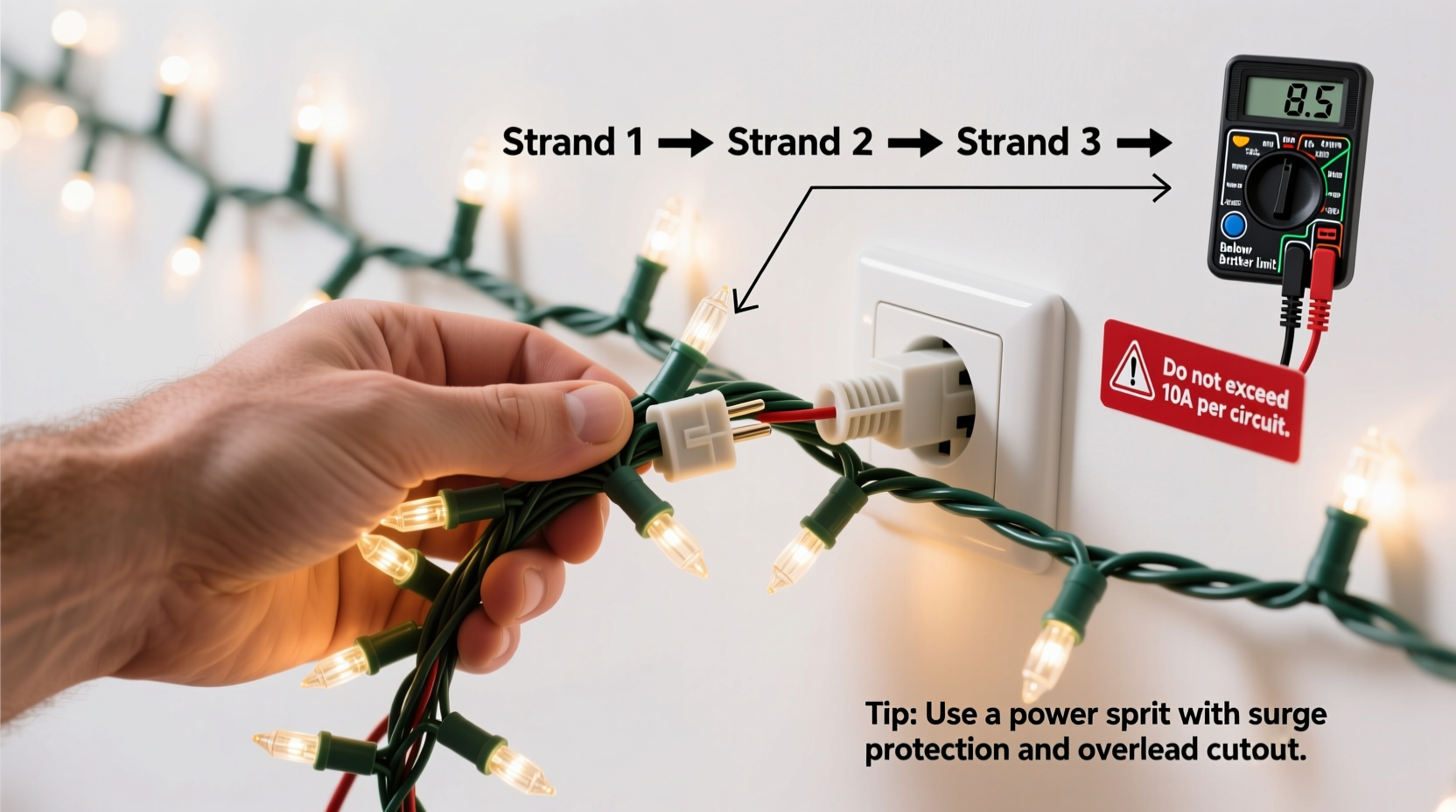
Every home electrical circuit has a maximum load it can handle, typically measured in amperes (amps). Most residential lighting circuits in modern homes are either 15 or 20 amps at 120 volts. To determine how much power your circuit can support, use this simple formula:
Watts = Volts × Amps
For a 15-amp circuit: 120V × 15A = 1,800 watts
For a 20-amp circuit: 120V × 20A = 2,400 watts
However, electrical codes recommend using only 80% of a circuit’s total capacity for continuous loads (those running three hours or more), which includes holiday lights. That means:
- Maximum safe load on a 15-amp circuit: 1,440 watts
- Maximum safe load on a 20-amp circuit: 1,920 watts
This 80% rule prevents overheating and reduces strain on wiring and outlets. When daisy chaining Christmas lights, every bulb adds to the cumulative wattage. Exceeding this threshold causes breakers to trip as a protective measure.
Choosing the Right Lights: LED vs. Incandescent
The type of lights you use dramatically affects how many strands you can safely connect. Traditional incandescent mini lights consume significantly more power than modern LED alternatives.
| Light Type | Average Watts per String | Bulbs per String | Max Daisy Chain (15A Circuit) |
|---|---|---|---|
| Incandescent Mini | 40–50 watts | 50 | ~28–36 strings |
| LED Mini | 4–7 watts | 50–100 | ~200+ strings |
| LED Icicle Lights (150 bulbs) | 10–12 watts | 150 | ~120 strings |
| Incandescent C9 (25 bulbs) | 175 watts | 25 | ~8 strings |
As shown above, switching from incandescent to LED lights increases the number of daisy-chained strands by an order of magnitude. A single string of LED lights may draw less than 5 watts—about the same as a nightlight—while a comparable incandescent set uses ten times that amount.
“LED technology has revolutionized holiday lighting. Not only do they use up to 90% less energy, but their lower heat output also reduces fire risk.” — David Reynolds, Residential Electrical Safety Consultant
Additionally, LEDs last longer—often rated for 25,000 to 50,000 hours—making them a cost-effective investment over time. While the upfront cost may be higher, the savings in energy and replacement frequency quickly offset the difference.
Step-by-Step Guide to Safe Daisy Chaining
Follow this practical sequence to design a safe and impressive light display without overloading circuits.
- Map Your Circuits: Identify which outlets are on the same circuit. You can do this by turning off breakers one at a time and checking which outlets lose power. Label each outlet accordingly.
- Calculate Total Wattage Needs: Add up the wattage of all light strands you plan to use. Multiply the number of strings by the wattage per string (found on packaging or base tag).
- Determine Maximum Strings Per Outlet: Check manufacturer instructions for the “maximum connectable” number. For example, many LED strings are rated for up to 43 sets connected end-to-end. Do not exceed this limit even if wattage calculations suggest otherwise—internal wire gauge and connectors have physical limits.
- Distribute Across Multiple Outlets: Plug groups of strings into different outlets on separate circuits. Avoid relying on a single wall outlet with multiple power strips.
- Use Heavy-Duty Extension Cords: Choose outdoor-rated, 16-gauge or thicker cords for longer runs. Thinner cords overheat under high loads, especially when buried under snow or pinched by doors.
- Test Before Finalizing: Turn on all lights for at least 30 minutes before securing them permanently. Watch for flickering, dimming, or warm cords—all signs of overload.
- Install GFCI Protection Outdoors: If connecting to exterior outlets, ensure they are GFCI-protected to prevent shock hazards in wet conditions.
Real Example: A Two-Story Home Display Done Right
Consider Sarah, who decorates her two-story suburban home every December. Her plan includes outlining eaves (120 ft), wrapping four porch columns (20 ft each), and draping front trees (3 large evergreens).
In the past, she used incandescent mini lights and frequently tripped breakers. After consulting an electrician, she upgraded to commercial-grade LED strings and restructured her setup:
- Replaced 180 feet of incandescent mini lights (45 strings × 45W = 2,025W) with LED equivalents (same length, 6W per string = 270W total).
- Split display into three zones: roofline (dedicated 15A circuit), porch/columns (second 15A circuit), and landscaping (third circuit via garage outlet).
- Used three power hubs near the foundation, each fed by its own interior circuit via weatherproof conduit.
- Labeled all extension cords and installed surge-protected power strips with individual switches.
The result? A brighter, safer display drawing less than half the original power. No breaker trips occurred during the entire season, and her electricity bill increased by only $12 compared to the previous year’s $48 spike.
Common Mistakes That Cause Breaker Trips
Even experienced decorators make errors that lead to electrical issues. Avoid these frequent pitfalls:
- Ignoring Manufacturer Limits: Just because two strands plug together doesn’t mean they’re meant to be chained indefinitely. Always follow the “max connectable” rating.
- Mixing Light Types: Combining LED and incandescent strings on the same run creates uneven loads and can confuse internal fuses.
- Overloading Power Strips: Plugging multiple high-wattage chains into a single strip—even a multi-outlet one—overheats the unit and may melt insulation.
- Using Indoor Cords Outdoors: Indoor-rated extension cords lack moisture resistance and degrade quickly outside, increasing resistance and heat buildup.
- Running Cords Through Windows or Doors: Closed doors pinch cords, damaging insulation and creating hot spots. Use designated exterior access points instead.
“I’ve responded to dozens of holiday-related service calls. Nearly all involved overloaded circuits due to daisy chaining beyond limits. One homeowner had 17 incandescent C9 strings plugged together—that’s nearly 3,000 watts on a 15-amp circuit!” — Mark Tran, Licensed Electrician, Metro Electric Services
Checklist: Pre-Lighting Setup Safety Review
Before plugging in your first strand, go through this essential checklist:
- ✅ Confirm all lights are rated for intended use (indoor/outdoor)
- ✅ Verify wattage per string and total projected load
- ✅ Ensure no single circuit exceeds 80% of its capacity
- ✅ Use only UL-listed extension cords and power strips
- ✅ Inspect all cords for fraying, exposed wires, or damaged plugs
- ✅ Test GFCI outlets monthly; press “Test” and “Reset” buttons
- ✅ Keep connections elevated off ground and away from water
- ✅ Install timers to limit daily runtime (e.g., 5 PM to 11 PM)
- ✅ Label each circuit’s purpose (e.g., “Front Roof Lights”)
- ✅ Have spare fuses or know how to reset breakers safely
Frequently Asked Questions
Can I daisy chain different brands of LED Christmas lights?
You can—if both brands are designed for connecting and share compatible voltage and connector types. However, always adhere to the lowest “maximum connectable” number among the chains. Mixing brands increases the risk of mismatched tolerances, so test thoroughly before final installation.
Why did my breaker trip even though I’m under the wattage limit?
Several factors could cause this. Inrush current—the brief surge when lights turn on—can momentarily exceed breaker thresholds, especially with older magnetic-trip models. Also, degraded wiring, loose connections, or shared appliances (like refrigerators) on the same circuit contribute to trips. Consider staggering startup times with timers or using arc-fault breakers designed for mixed loads.
Is it safe to leave Christmas lights on overnight?
If installed correctly with quality materials and within circuit limits, LED lights can be left on overnight. However, it's safest to use a timer to turn them off after midnight. Never leave incandescent lights unattended for long periods due to higher heat output. Always inspect cords periodically for warmth during operation.
Final Tips for a Sparkling, Safe Season
Daisy chaining Christmas lights doesn’t have to be a game of electrical Russian roulette. By understanding your home’s circuit capacity, choosing efficient LED lighting, and distributing loads wisely, you can achieve a professional-quality display without compromising safety.
Remember: More lights aren’t better if they come at the cost of reliability and risk. Prioritize quality connections, proper cords, and regular inspections. A well-planned layout not only prevents breaker trips but also makes storage and reassembly easier next year.
Take the time now to audit your setup. Replace worn cords, upgrade outdated lights, and map your circuits. Your future self—and your electric bill—will thank you when the neighborhood votes you “Best Lit Home” without a single outage.




 浙公网安备
33010002000092号
浙公网安备
33010002000092号 浙B2-20120091-4
Comments
No comments yet. Why don't you start the discussion?