
Selecting the right phone case goes beyond aesthetics—it’s about matching your lifestyle with the protection and usability your device needs. While plain cases offer simplicity and reliability, embossed designs bring texture, personality, and visual flair. Yet both come with trade-offs in grip, pocketability, durability, and cleaning ease. Understanding these differences helps you make an informed decision that aligns with how you use your phone every day.
Understanding Embossed vs. Plain Phone Cases
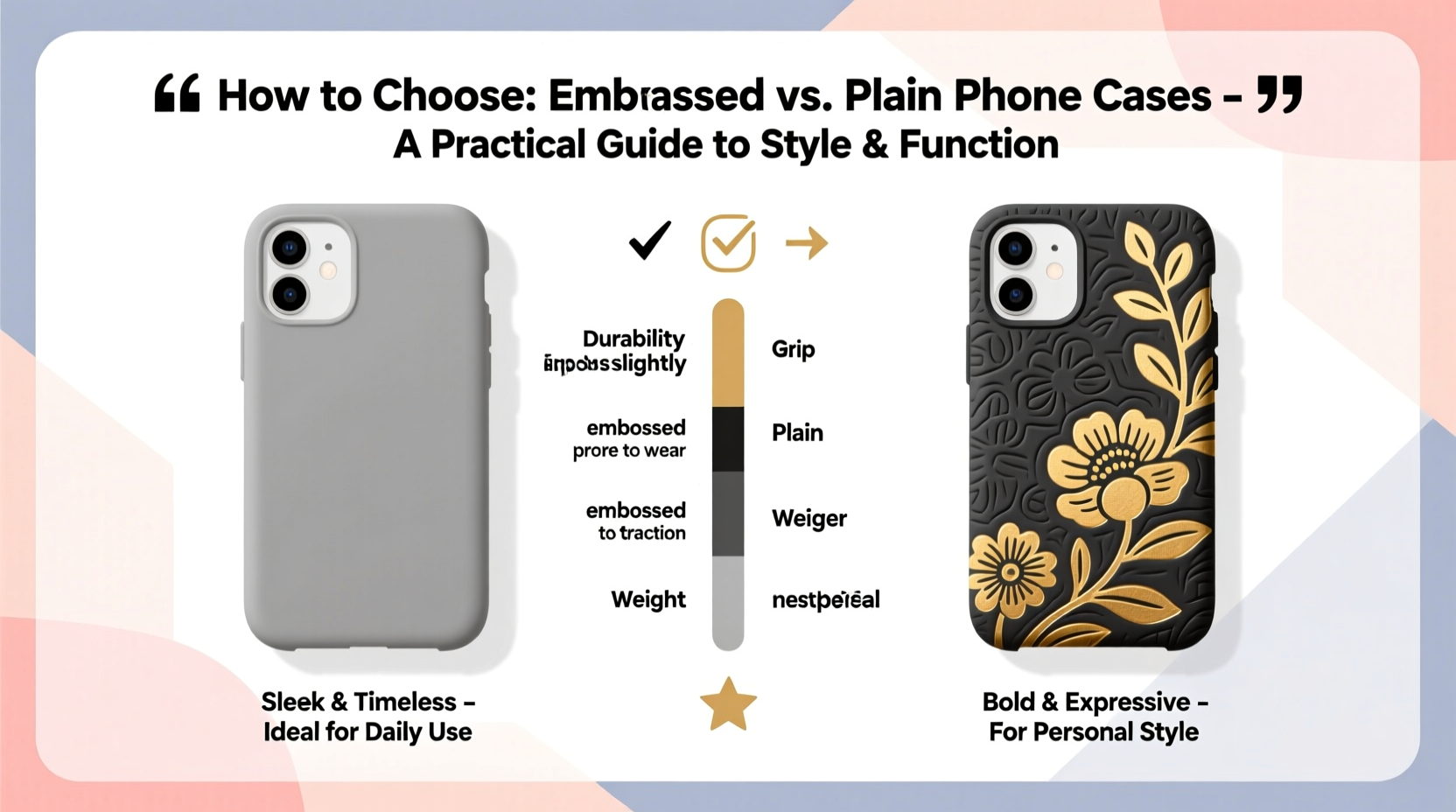
At first glance, the distinction seems simple: embossed cases feature raised patterns, logos, or textures on the surface, while plain cases maintain a smooth, uniform finish. But beneath this surface-level difference lies a spectrum of functional implications.
Embossed cases are often made using thermoplastic polyurethane (TPU) or silicone with molded-in designs. These can range from subtle geometric ridges to bold brand logos or artistic motifs. The texture adds tactile interest and may improve grip under certain conditions. However, the raised elements are also more prone to wear, collecting dirt, and snagging in pockets.
Plain cases, by contrast, prioritize minimalism and consistency. They’re typically smoother across the entire surface, making them easier to slide in and out of pockets or bags. Their lack of texture means fewer crevices for dust and oils to accumulate, which simplifies cleaning. Many users prefer plain cases when they want reliable protection without added bulk or sensory distraction.
Key Factors to Consider When Choosing
Your ideal case depends on how you interact with your phone daily. Below are critical considerations that should guide your choice.
Durability and Wear Resistance
Embossed surfaces, especially those with fine detailing, tend to degrade faster. Raised patterns can chip, crack, or flatten over time due to friction against surfaces like desks or countertops. In contrast, plain cases distribute impact evenly and resist abrasion more uniformly. For users who drop their phones regularly or place them face-down on rough surfaces, a plain case offers longer-lasting structural integrity.
Grip and Handling
The textured surface of embossed cases can enhance grip, reducing the chance of accidental slips—particularly helpful for larger smartphones. However, if the embossing is too aggressive or uneven, it may create pressure points during prolonged use, leading to hand fatigue. Some users report that heavily patterned backs feel “sticky” rather than secure.
Plain cases, especially those made from soft-touch TPU or matte-finish polycarbonate, provide consistent, predictable grip. While not as aggressively tacky as some embossed models, they strike a balance between comfort and control.
Cleaning and Maintenance
This is where plain cases clearly outperform their textured counterparts. Dirt, sweat, and oils easily become trapped in the grooves of embossed designs, requiring frequent scrubbing with cotton swabs or toothbrushes to keep clean. Over time, grime buildup can discolor intricate patterns, diminishing their appeal.
A plain case wipes down effortlessly with a damp cloth. No hidden crevices mean no surprise stains months later. For hygiene-conscious users or those with oily hands, this low-maintenance quality is a significant advantage.
“Textured cases look great initially, but after six months of daily use, most show visible wear around high-contact zones.” — Jordan Lee, Product Durability Analyst at MobileGear Labs
Comparative Overview: Embossed vs. Plain Cases
| Feature | Embossed Case | Plain Case |
|---|---|---|
| Aesthetic Appeal | High – unique design, stands out | Moderate – minimalist, blends in |
| Grip Level | Variable – depends on pattern depth | Consistent – even surface contact |
| Durability | Lower – raised areas wear faster | Higher – uniform material stress |
| Cleaning Ease | Low – traps dirt in textures | High – smooth wipe-down |
| Pocket Friendliness | Low – may catch on fabric | High – slides easily |
| Price Range | Often higher due to design complexity | Typically lower or standard |
Real-Life Scenario: Two Users, Two Choices
Consider Sarah, a graphic designer who values self-expression. She carries her phone in a tote bag and uses it primarily for creative apps and social media. She chooses an embossed case with a watercolor-inspired texture because it reflects her personal brand and doesn’t rub against fabric. She cleans it weekly and replaces it every eight months when the pattern starts fading.
Now consider Mark, a construction site supervisor. His phone is constantly exposed to dust, moisture, and drops. He opts for a rugged plain black case with military-grade drop protection. It fits snugly in his workwear pocket, wipes clean with a towel, and shows no signs of wear after a year of heavy use. Style takes a backseat to resilience.
Their choices reflect different priorities—one centered on identity, the other on endurance. Neither is wrong; each aligns with real-world demands.
Step-by-Step Guide to Making Your Decision
Follow this five-step process to determine whether an embossed or plain case suits you best:
- Evaluate your daily routine. Do you place your phone on gritty surfaces? Carry it in your pocket? Use it one-handed for long periods?
- Assess your grip confidence. Have you dropped your phone recently? Was it due to slipping? If so, test cases with moderate texture—not necessarily full embossing.
- Think about maintenance habits. Are you diligent about cleaning? If not, avoid intricate textures that trap debris.
- Define your style goals. Do you want your phone to express individuality, or do you prefer understated professionalism?
- Test before committing. Visit a store or order from retailers with return policies. Hold both types side by side. Notice weight, edge smoothness, and how they feel in your hand.
Frequently Asked Questions
Do embossed cases offer better protection?
No. Protection depends on material thickness, shock absorption, and corner reinforcement—not surface texture. An embossed case isn’t inherently safer than a plain one unless specifically designed for impact resistance.
Can I customize a plain case to add style?
Absolutely. Many users apply removable decals, skins, or even paint plain cases for a personalized touch without sacrificing smoothness. This allows flexibility—you can change the look without replacing the entire case.
Are there hybrid options available?
Yes. Some manufacturers offer cases with slight texturing (like micro-dots or faint lines) that aren’t fully embossed but still improve grip. These serve as middle-ground solutions for users seeking mild traction without excessive bulk or cleaning hassle.
Final Checklist Before You Buy
- ✅ Does the case fit your phone model precisely?
- ✅ Is the material resistant to yellowing (especially clear or white cases)?
- ✅ Can you comfortably reach all buttons and ports?
- ✅ Does it interfere with wireless charging?
- ✅ Is it easy to clean based on your lifestyle?
- ✅ Will the design still appeal to you in six months?
Conclusion: Choose Based on Lifestyle, Not Just Looks
The debate between embossed and plain phone cases isn’t about which looks better in a product photo—it’s about what works best in your hands, pockets, and daily routines. Embossed cases shine when personal expression matters and usage is gentle. Plain cases excel in durability, cleanliness, and universal compatibility. There’s no single “best” option, only the one that fits your life.
Take a moment to reflect on how you really use your phone. Then choose accordingly—not for trends, but for long-term satisfaction. Your next case should protect more than just your device; it should support your way of living.




 浙公网安备
33010002000092号
浙公网安备
33010002000092号 浙B2-20120091-4
Comments
No comments yet. Why don't you start the discussion?