
A cluttered digital workspace slows you down more than you realize. Files buried in nested folders, duplicate downloads, forgotten projects from years ago—these digital remnants consume space, increase stress, and make it harder to find what you need when you need it. The good news? You don’t need days or even hours of effort. With a focused strategy, you can streamline your entire file system in under 60 minutes. This guide walks you through a proven process that prioritizes speed, sustainability, and simplicity.
Why Digital Clutter Matters More Than You Think
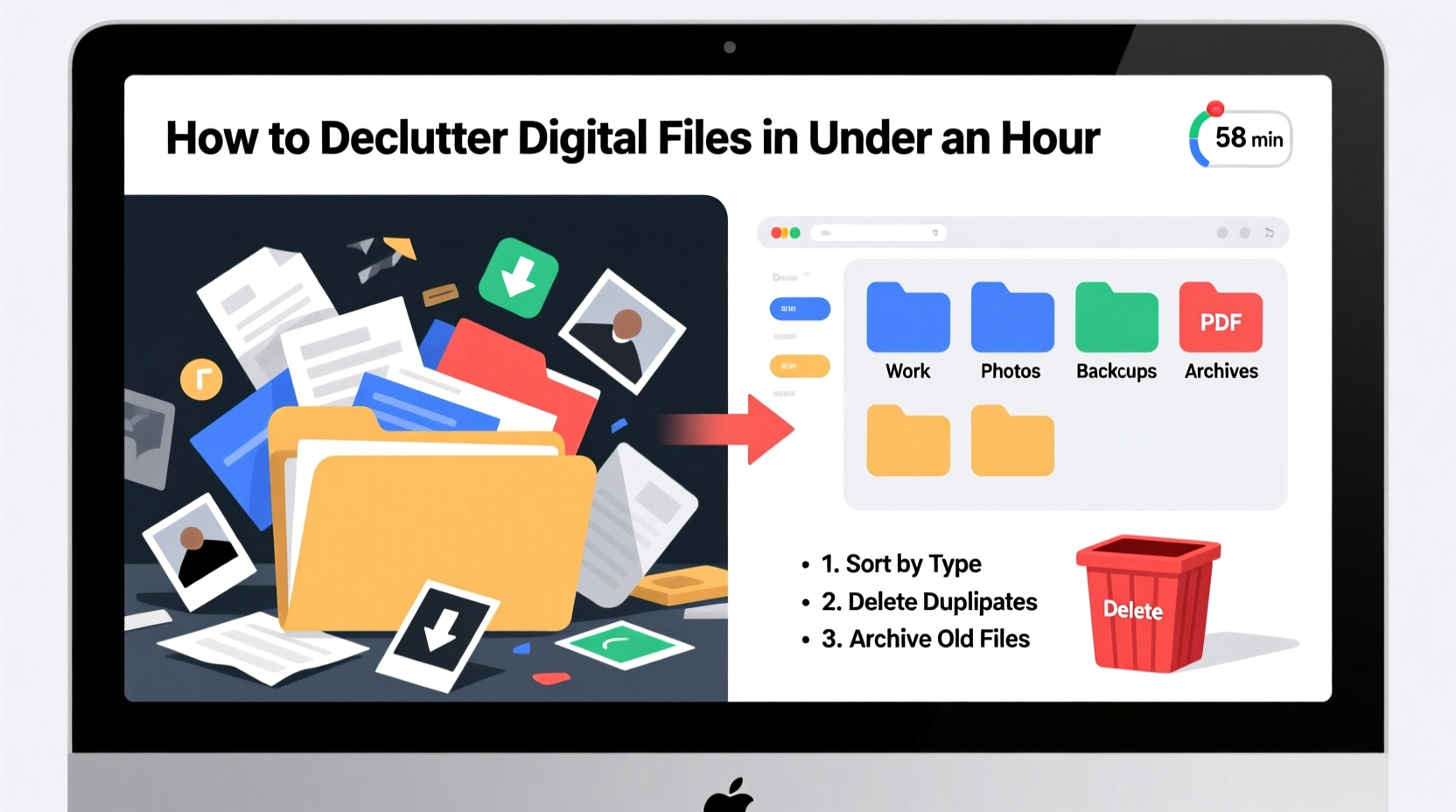
Digital clutter isn't just about storage—it's about mental clarity and productivity. A study by the National Association of Professional Organizers found that employees spend an average of 4.3 hours per week searching for misplaced digital files. That’s over 220 hours a year lost to disorganization. Beyond time waste, cluttered systems are more vulnerable to data loss, malware infiltration, and backup failures.
When your desktop is littered with random documents and your Downloads folder has grown into a black hole of forgotten installers and PDFs, decision fatigue sets in. Simple tasks like attaching a resume or finding last month’s invoice become frustrating hurdles. Cleaning up your digital environment reduces cognitive load, improves system performance, and creates a sense of control over your digital life.
“Digital organization isn’t about perfection—it’s about creating systems that work so well you forget they exist.” — Dr. Lena Torres, Digital Productivity Researcher, MIT Human Systems Lab
A 5-Step System to Declutter in Under 60 Minutes
The key to fast, effective digital cleanup is structure. Follow this five-phase approach to maximize impact with minimal effort.
Phase 1: Prepare Your Environment (5 Minutes)
Before diving into files, set yourself up for success:
- Close all unnecessary applications to reduce distractions.
- Plug in your laptop or ensure your battery is charged.
- Open a notepad window to jot down decisions (e.g., “Delete,” “Archive,” “Move”).
- Disable notifications for apps like Slack, email, or messaging tools.
Phase 2: Identify and Isolate Core Folders (10 Minutes)
Most people store files in just a few key locations. Target these first:
- Desktop – Often used as a temporary holding area but quickly becomes chaotic.
- Downloads – Accumulates installers, temporary files, and one-off documents.
- Documents – May contain outdated projects, drafts, or duplicates.
- Pictures/Videos – Screenshots, old memes, and low-quality images pile up silently.
- Email Attachments – Often saved redundantly across multiple folders.
Open each location and scan visually. Don’t dive deep yet—just get a sense of volume and chaos level. Note which folder looks most overwhelming; you’ll tackle it first in Phase 3.
Phase 3: Rapid Triage Using the 3-Second Rule (25 Minutes)
This is the core of your cleanup. Apply the 3-second rule: if you can’t decide what to do with a file in three seconds, either delete it or move it to a “Maybe Later” folder for review outside this session.
Use these quick decision criteria:
| File Type | Action | Reason |
|---|---|---|
| Duplicate files | Delete | Keep only the most recent version unless versions differ significantly. |
| Old installers (.exe, .dmg) | Delete | Re-download if needed; most are obsolete after updates. |
| Screenshots older than 30 days | Review & Delete | Rarely needed long-term unless part of documentation. |
| Temporary documents (drafts, notes) | Delete if incomplete or outdated | Only keep final versions or actively used drafts. |
| Archived projects (no activity >1 year) | Move to external drive or cloud archive | Free up local space while preserving access. |
Work folder by folder. Right-click and sort files by “Date Modified” to surface the oldest ones first. Ask yourself: “Have I opened this in the past six months?” If not, it likely doesn’t belong on your main drive.
Phase 4: Reorganize What Remains (10 Minutes)
Now that clutter is removed, build a simple, sustainable structure. Avoid over-engineering—start with broad categories:
- Work → Projects, Invoices, Meetings
- Personal → Taxes, Health, Travel
- Creative → Writing, Design, Photography
- Reference → Manuals, Certificates, Guides
Name folders clearly and consistently. Use dates only when necessary (e.g., “Taxes_2023”), but avoid excessive nesting. Two levels deep is usually sufficient (e.g., Documents > Work > Projects).
Phase 5: Automate Future Maintenance (5 Minutes)
Prevent backsliding with small automation steps:
- Set your browser to download files directly to a “To Sort” folder, not Downloads.
- Enable automatic photo syncing to cloud services like Google Photos or iCloud.
- Use built-in tools: Windows Storage Sense or Mac Optimize Storage auto-delete old files.
- Create a monthly calendar reminder: “Digital Cleanup – Last Sunday of Month.”
These tiny habits prevent clutter from rebuilding and preserve your hard work.
Checklist: Your 60-Minute Digital Declutter Plan
Follow this concise checklist to stay on track:
- ☐ Close distracting apps and disable notifications.
- ☐ Open Desktop, Downloads, Documents, Pictures, and Videos folders.
- ☐ Scan each folder for obvious junk (duplicates, old installers, screenshots).
- ☐ Apply the 3-second rule: delete, archive, or move to “Maybe Later.”
- ☐ Sort remaining files into 4–6 main categories.
- ☐ Rename and restructure folders for clarity.
- ☐ Move inactive archives to external/cloud storage.
- ☐ Enable one automated cleanup tool (e.g., Storage Sense).
- ☐ Schedule a 15-minute weekly file review.
- ☐ Celebrate completion—your system is now faster and calmer.
Real Example: How Sarah Regained Control in 52 Minutes
Sarah, a freelance graphic designer, felt overwhelmed every time she opened her laptop. Her desktop had 217 files, including client drafts, font installers, and personal photos. She spent 10–15 minutes daily just searching for active project files.
Using this method, she started by clearing her Downloads folder—deleting 89 obsolete files. Next, she moved old design assets to a cloud-based “Client Archive” folder. She renamed her main folders from vague names like “Stuff” and “New Stuff” to “Active Clients,” “Invoices,” and “Portfolio.”
In 52 minutes, she reduced her visible files from over 300 to fewer than 50. The next day, she found a client contract in seconds instead of minutes. “It felt like someone turned on a light,” she said. “I didn’t realize how much mental energy I was wasting.”
Dos and Don’ts of Digital Decluttering
Avoid common pitfalls with this quick-reference table:
| Do | Don’t |
|---|---|
| Create a “To Review” folder for uncertain files | Try to organize everything perfectly in one go |
| Delete duplicates using tools like Duplicate Cleaner (Windows) or Gemini (Mac) | Keep 10 copies of the same invoice “just in case” |
| Use consistent naming: “ProjectName_Draft_v2” | Name files “final_final_revised.docx” |
| Back up critical data before deletion | Empty trash immediately—wait 24 hours |
| Leverage search features (Ctrl+F or Spotlight) | Rely solely on folder browsing to find files |
“Speed matters more than perfection in digital cleanup. A ‘good enough’ system used consistently beats a perfect one abandoned out of frustration.” — Mark Ren, Tech Life Coach and Author of *Digital Minimalism Daily*
Frequently Asked Questions
What if I accidentally delete something important?
Always wait 24 hours before emptying your Recycle Bin or Trash. During that window, deleted files can be restored. For critical data, use version history (Google Drive, OneDrive) or Time Machine (Mac) to recover earlier states. When in doubt, move files to a “Review” folder instead of deleting outright.
Should I use cloud storage or an external hard drive for archiving?
Use cloud storage (Google Drive, Dropbox, iCloud) for files you might need to access remotely or share. Use an external hard drive for large media libraries (videos, photo backups) or sensitive personal data you prefer to keep offline. Ideally, use both: cloud for accessibility, external drives for redundancy.
How often should I repeat this process?
Perform a full sweep once every quarter. Between sessions, spend 10–15 minutes weekly reviewing your Downloads and Desktop. This prevents buildup and maintains momentum. Automation tools can handle routine tasks like removing old temporary files.
Take Back Your Digital Space—Starting Today
You don’t need special software or advanced skills to reclaim your digital life. In less time than a TV episode, you can transform a chaotic file system into a streamlined, intuitive workspace. The benefits go beyond speed and storage—they affect your focus, confidence, and daily efficiency.
Your computer should serve you, not slow you down. Every file you delete, every folder you rename, is a step toward a calmer, more productive digital experience. The best time to start was yesterday. The second-best time is right now.




 浙公网安备
33010002000092号
浙公网安备
33010002000092号 浙B2-20120091-4
Comments
No comments yet. Why don't you start the discussion?