
Decorating for the holidays in a studio apartment presents a unique design challenge: how to honor tradition and cultivate joy while respecting tight square footage, limited storage, sightlines, and functional flow. A towering 7-foot spruce with cascading tinsel and 200 bulbs may feel festive in theory—but in reality, it can dominate your sleeping zone, block your only window, or make your compact kitchenette feel like a backstage prop closet. The solution isn’t scaling back on celebration—it’s scaling *up* on intentionality. Thoughtful tree selection, strategic placement, minimalist yet meaningful ornamentation, and clever spatial awareness transform constraint into creative opportunity. This guide draws from interior stylists, small-space designers, and real studio dwellers who’ve mastered the art of festive minimalism—not by removing joy, but by refining where and how it lives.
Choose the Right Tree: Scale, Shape, and Sensibility
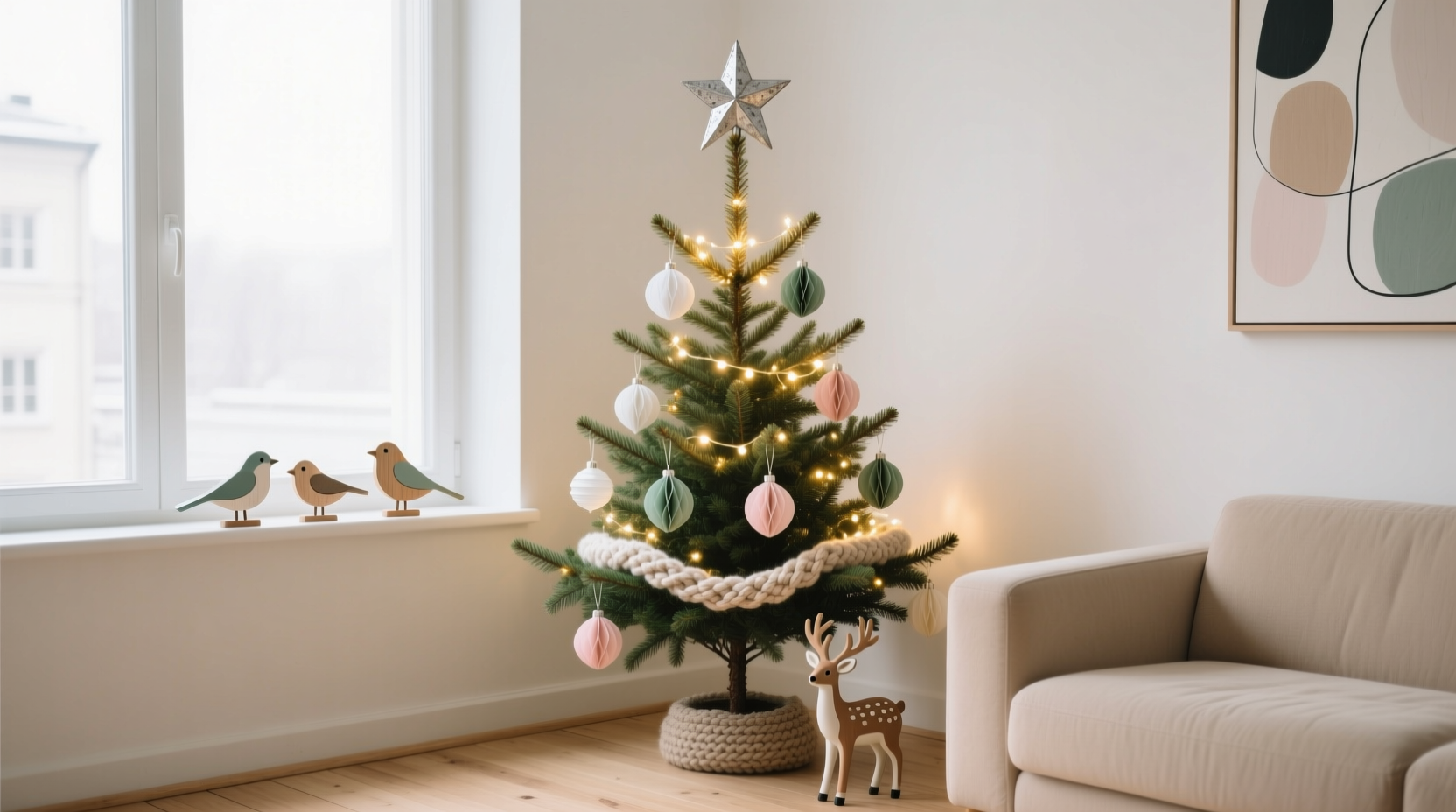
Start not with ornaments—but with architecture. In a studio, every vertical inch competes with daily living needs: your bed, desk, sofa, and cooking surface all occupy the same footprint. A traditional full-width evergreen consumes floor space, interrupts circulation paths, and visually fragments the room. Instead, prioritize trees designed for tight quarters.
Opt for narrow-profile silhouettes: pencil trees (typically 1.5–2 feet wide), slim firs (under 24 inches at the base), or even flat-panel “wall trees” that mount vertically and project only 6–12 inches from the wall. Height remains flexible—5 to 6.5 feet is often ideal—tall enough to feel ceremonial, short enough to avoid brushing against ceiling-mounted fixtures or interfering with lofted beds.
Real trees demand water, cleanup, and disposal logistics—challenging in buildings without curbside pickup or elevator access. High-quality artificial trees offer precision, reusability, and zero needle drop. Look for models with hinged branches (for faster setup) and segmented trunks (easier to store in under-bed bins or closet shelves). Avoid dense, bushy varieties; instead, choose trees with open branch structures that allow light to pass through—this preserves brightness and prevents the “wall effect” that makes studios feel cave-like.
Strategic Placement: Where the Tree Lives Matters More Than Its Size
In a studio, location is function. Don’t default to the center of the room—the most common mistake. Instead, anchor the tree to existing architecture: beside a window (to borrow natural light and reflect seasonal views), tucked into a corner behind your sofa (creating depth rather than obstruction), or mounted on a sturdy wall bracket above a low console or bookshelf (freeing floor space entirely).
Consider traffic flow. Your primary path—from entry to kitchen, or bed to bathroom—must remain unimpeded. Use painter’s tape to outline the tree’s footprint on the floor before committing. Walk the route. Sit on your sofa. Stand at your desk. Does the tree now block sightlines to your TV? Obscure your reading lamp? Force you to sidestep just to reach the fridge? If yes, relocate.
Vertical layering enhances perception of space. Place your tree on a low, shallow platform (like a 12-inch round riser or repurposed wooden crate) to lift it slightly off the floor—this creates visual separation from surrounding furniture and improves legibility. Pair it with a slender, monochrome tree skirt (charcoal wool, ivory linen, or black velvet) no wider than the tree’s base. Avoid oversized skirts that spill onto adjacent surfaces—they read as clutter, not cohesion.
Ornament Strategy: Less Is Anchored, More Is Meaningful
Studio apartments reward curation over accumulation. A tree overloaded with ornaments feels chaotic, not celebratory. Instead, adopt a “three-tier principle”: one dominant material, one accent color, and one personal motif.
- Dominant material: Glass, wood, matte ceramic, or handmade paper—choose one and stick to it for 70% of ornaments. Uniform texture creates rhythm and calm.
- Accent color: One hue used sparingly—deep forest green, burnished copper, or midnight blue—to add warmth without visual noise.
- Personal motif: Three to five handmade, heirloom, or travel-themed ornaments representing meaningful moments. Not more. These become focal points—not decorations.
Avoid reflective or mirrored ornaments in small spaces—they multiply visual stimuli and can cause glare near workspaces or beds. Skip large, heavy baubles that weigh down slender branches and obscure light. Instead, favor lightweight ornaments hung on fine-gauge wire or silk ribbon, spaced generously (every 6–8 inches along a branch) to emphasize negative space.
| Ornament Type | Studio-Safe? | Why / Why Not |
|---|---|---|
| Glass globes (3–4\" diameter) | ✅ Yes | Lightweight, refract ambient light, easy to store flat in dividers |
| Felt animal shapes (hand-sewn) | ✅ Yes | Soft texture, zero glare, stackable, non-reflective |
| Large glitter-covered spheres | ❌ No | Create visual vibration, shed micro-particles, difficult to store |
| Heavy metal stars or bells | ❌ No | Strain branches, risk falling, add unnecessary weight to slim trees |
| Photo ornaments (magnetic or clip-on) | ✅ Yes | Personal, lightweight, removable for rotation or storage |
Lighting & Finishing Touches: Glow Without Glare
Lighting is the soul of a studio tree—but also its greatest spatial risk. Warm-white LED string lights (2700K–3000K) are non-negotiable. Cool-white or daylight LEDs create clinical, uninviting contrast in warm-toned studios and exacerbate the feeling of crampedness. Use only one strand—no more than 100–150 bulbs—for a 5–6 foot tree. Wrap lights *sparsely*: begin at the trunk and spiral outward with 4–6 inches between loops. This ensures even illumination without density.
For added dimension, weave in three to five battery-operated fairy lights on thin, flexible wire—nestled deep within inner branches. Their soft, pinpoint glow adds depth without brightness competition. Never use incandescent mini-lights: they generate heat, pose fire risk near curtains or bedding, and consume disproportionate energy in small units.
The topper should be proportional and purposeful. A simple brass star, a single dried orange slice suspended on twine, or a miniature ceramic bird reads as intentional—not decorative excess. Avoid oversized angels or elaborate bows that draw the eye upward and disconnect the tree from its surroundings.
“Small-space holiday design isn’t about deprivation—it’s about editing with empathy. Every object must earn its place by serving both aesthetics and utility.” — Lena Ruiz, Interior Designer & Author of Compact Living: Designing Joy in Tight Spaces
Real-World Studio Tree: A Case Study from Brooklyn
Mira, a graphic designer in a 420-square-foot Williamsburg studio, faced this exact dilemma last December. Her unit features an open kitchen, Murphy bed, and large north-facing window. She’d previously tried a 6-foot pre-lit artificial tree in the center of the room—only to find it blocked her morning light, forced her to pivot awkwardly around it while cooking, and made video calls feel like she was filming inside a department store display.
This year, she chose a 5.5-foot pencil tree (22\" wide) with hinged branches and matte-black PVC tips. She mounted it in the window bay, centered between two floor-to-ceiling curtains, using a custom L-bracket screwed into wall studs. She wrapped it with one strand of warm-white micro-LEDs and hung 24 hand-blown glass orbs in varying shades of sage and smoke gray. Her personal motif? Four ceramic ornaments shaped like subway tokens—one for each year she’s lived in NYC. She added a single brass star topper and a narrow charcoal wool skirt.
The result: the tree became a quiet focal point visible from her desk, bed, and kitchen counter—without occupying floor space or disrupting movement. Natural light filtered *through* the sparse branches during the day; at night, the warm glow reflected softly in the window glass, doubling its presence without doubling its footprint. Mira reported feeling “more festive, not less”—and finally able to host friends without apologizing for the “tree situation.”
Step-by-Step Studio Tree Setup Timeline
- Week 3 before Christmas: Measure available floor/wall space. Identify mounting options (floor corner, wall bracket, shelf base). Order tree and confirm dimensions match.
- Week 2 before Christmas: Assemble tree frame *in place*. Test stability and sightlines. Adjust position until it complements—not competes with—existing furniture layout.
- Week 1 before Christmas: String lights evenly. Hang ornaments using the three-tier principle (dominant material first, then accent color, then personal motifs). Step back after each layer—pause for 60 seconds to assess visual weight.
- 3 days before Christmas: Add topper and skirt. Place a small woven basket nearby for stray gloves, scarves, or mail—keeping the zone functional *and* festive.
- Christmas Eve: Replace any burnt-out bulbs. Wipe glass ornaments with microfiber cloth. Turn on lights at dusk—observe how glow interacts with evening ambiance.
FAQ
Can I use a fake tree if my studio has low ceilings?
Absolutely—and often preferentially. Choose a 4.5- to 5-foot tree with a slim profile and adjustable height legs (some models let you remove bottom sections). Avoid “full-height” trees marketed as “5 feet” that include a bulky stand adding 8–10 inches. Measure from floor to ceiling *including* crown molding or light fixtures—then subtract 4 inches for safety margin.
What if I don’t have wall studs for mounting?
Use heavy-duty toggle bolts rated for drywall (minimum 50 lbs capacity) or invest in a freestanding corner tree stand with anti-tip straps anchored to a nearby bookshelf or radiator pipe (with landlord permission). Never rely solely on adhesive hooks or command strips for anything over 3 lbs.
How do I store everything efficiently after the holidays?
Disassemble immediately post-New Year’s. Store tree sections in original box or a flat-fold fabric storage bag (not plastic—traps moisture). Hang ornaments in compartmentalized jewelry organizers or stackable clear acrylic boxes labeled by theme or year. Wind lights around cardboard spools or use twist-ties in consistent 3-loop coils. All fit neatly in under-bed storage or a single closet shelf.
Conclusion
A studio apartment doesn’t dilute the meaning of the season—it invites deeper intention. Decorating a Christmas tree there isn’t about compromise; it’s about clarity. It asks you to consider what truly embodies warmth, memory, and light—not just what fills space. When your tree breathes *with* your room instead of against it—when its glow enhances your reading nook, its silhouette frames your favorite view, and its ornaments tell your story without shouting—you haven’t sacrificed festivity. You’ve elevated it.
Start small. Measure once. Choose deliberately. Light gently. And remember: the most memorable holiday spaces aren’t defined by abundance—but by resonance. Your studio isn’t too small for magic. It’s perfectly sized for meaning.




 浙公网安备
33010002000092号
浙公网安备
33010002000092号 浙B2-20120091-4
Comments
No comments yet. Why don't you start the discussion?