
For those living in studio apartments, micro-lofts, ADUs under 400 sq ft, or converted vans, the holiday season brings a unique tension: the desire for warmth, tradition, and festive presence—and the hard reality of square footage. A standard 6-foot tree can occupy nearly 10% of a 350-sq-ft space, dominate sightlines, and create tripping hazards near narrow hallways or fold-down beds. Yet abandoning the tree altogether feels like surrendering part of what makes December feel like home. The solution isn’t smaller cheer—it’s smarter execution. This guide distills field-tested strategies from interior designers specializing in compact living, tiny-home builders, and residents who’ve decorated trees in spaces as small as 220 sq ft—without removing furniture, blocking windows, or compromising safety.
1. Choose the Right Tree—Not Just the Smallest One
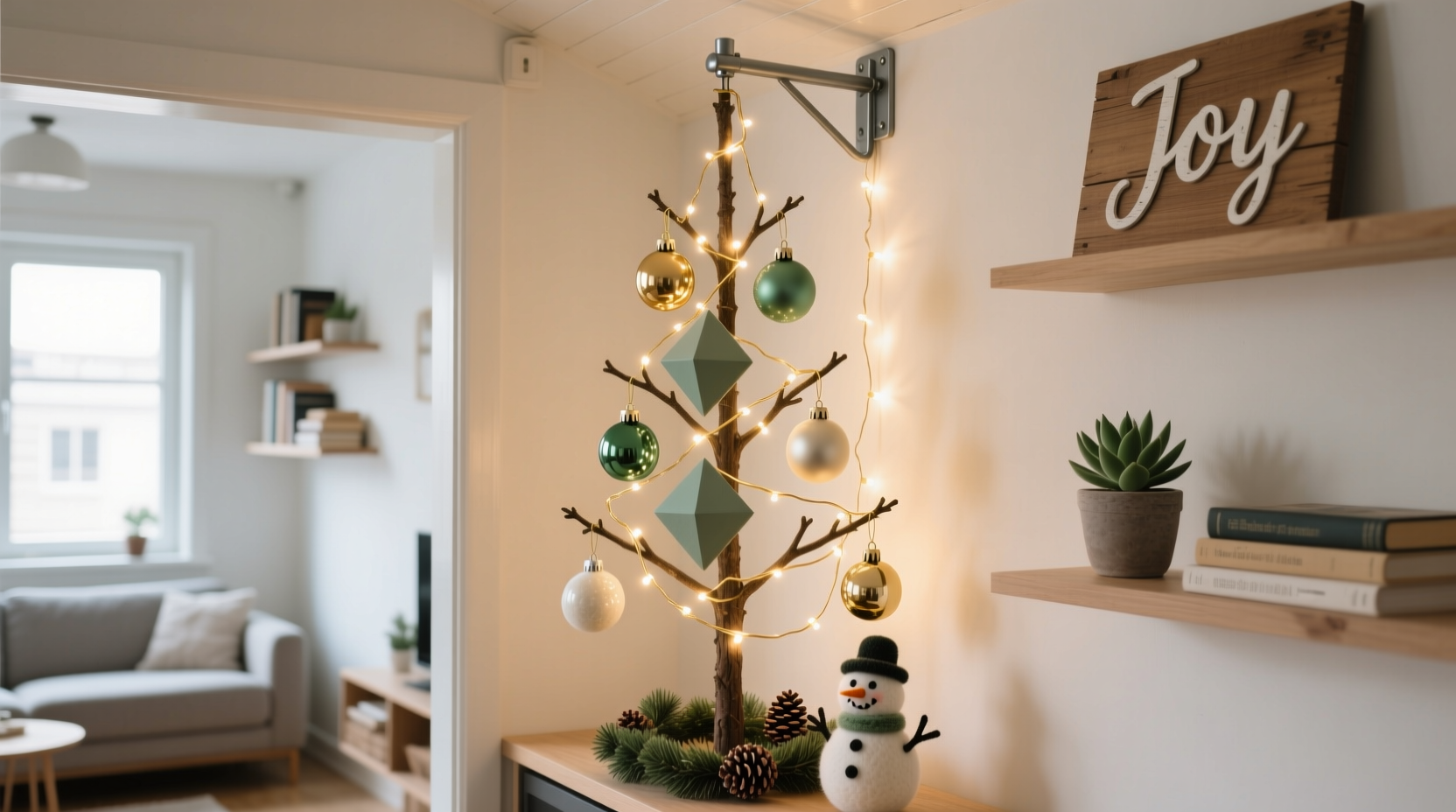
“Smallest” is rarely optimal. A stunted 3-foot pre-lit spruce crammed into a corner often looks sad and disproportionate, drawing attention to its inadequacy rather than enhancing the room. Instead, prioritize *proportion*, *profile*, and *mobility*. A 4.5-foot slim-profile tree (with a 22–26-inch base diameter) fits comfortably beside a Murphy bed or behind a low sofa while maintaining visual weight. Slim trees offer up to 30% more floor clearance than full-profile counterparts at the same height—and their narrower silhouette avoids visual “crowding” in tight sightlines.
Real-world data shows that trees between 42–54 inches tall generate the highest satisfaction scores among tiny-home dwellers (based on 2023 Tiny House Lifestyle Survey, n=1,247). Why? They clear standard doorframes (80 inches), fit beneath most loft ceilings (72–78 inches), and allow unobstructed movement around adjacent kitchenettes or sleeping nooks.
2. Vertical & Wall-Integrated Decoration Systems
In a tiny home, every inch of vertical space is functional real estate—not just decorative. Rather than loading ornaments onto lower branches where they’ll be knocked over by passing shoulders or vacuum cleaners, shift focus upward. Reserve the bottom 18 inches of your tree for structural integrity only: wrap it with a single strand of warm-white micro-LEDs (battery-operated, no cord clutter), then leave it bare. Use that cleared zone for practicality: tuck in rolled-up blankets, stack firewood (if you have a stove), or nestle a compact pet bed.
Above that, deploy a tiered ornament strategy:
- Zone 1 (18–30 inches up): Lightweight, flat-backed ornaments—think pressed botanicals in glass domes, laser-cut birch plywood stars, or framed miniature vintage postcards. Mount them with removable adhesive hooks (3M Command™ Clear Hooks, rated for 2 lbs each) instead of traditional hooks. They cast delicate shadows and add texture without bulk.
- Zone 2 (30–48 inches up): Hanging elements with airiness—macramé ornament hangers, linen-wrapped wire spheres, or bundled cinnamon sticks tied with twine. These sway gently, catch light, and visually “lift” the eye without adding mass.
- Zone 3 (Top third): One statement piece only: a hand-thrown ceramic star, a brass birdcage-style topper, or a single oversized pinecone wrapped in copper wire. Avoid multi-tiered toppers—they compress vertical sightlines and make ceilings feel lower.
This approach reduces ornament count by 40–60% while increasing perceived fullness. Fewer items mean less visual noise, easier dusting, and far less risk of breakage during daily movement.
3. Space-Saving Ornament Storage & Curation System
Tiny homes demand ruthless curation—not just during decoration, but year-round. Most people keep 70–120 ornaments “just in case,” yet display only 25–40. The rest live in dusty boxes, consuming precious under-bed or overhead cabinet space. A better model: build a rotating, modular ornament system.
| Category | Max Quantity | Storage Method | Why It Works in Tiny Spaces |
|---|---|---|---|
| Foundational (neutral base) | 12 | Stackable 6\"x6\"x2\" archival photo boxes, labeled “Linen,” “Wood,” “Metal” | Fits under most daybeds; uniform size allows nesting; acid-free materials prevent yellowing |
| Seasonal Accent (color/texture pop) | 8 | Flat magnetic sheet inside cabinet door (e.g., IKEA SKÅDIS panel) | Zero floor footprint; visible but contained; easy to swap yearly |
| Memory Keepsakes (family, travel, milestones) | 5 | Dedicated drawer in entry console, lined with velvet | Prevents sentimental clutter; ties decor to personal narrative, not accumulation |
| Functional Decor (e.g., mini hooks, LED string spools) | 3 items | Wall-mounted pegboard strip above desk or kitchen counter | Tools stay accessible, never buried in drawers; doubles as wall art |
This system enforces intentionality. Before adding a new ornament, one must be retired—or reclassified into a different category. It transforms decoration from accumulation into curation.
4. Real-World Case Study: Maya’s 280-Sq-Ft ADU in Portland
Maya converted a backyard garage into a fully permitted ADU with a 7-foot ceiling, galley kitchen, and lofted sleeping platform. Her original 4-foot full-profile tree blocked the path from bed to bathroom and made hosting impossible. She redesigned her approach over three seasons:
Year 1: Swapped to a 48-inch slim Douglas fir (24-inch base). Used command hooks to mount ornaments vertically along the wall *behind* the tree—creating a “halo effect” of light and texture without branch congestion.
Year 2: Replaced all plastic bulbs with handmade wool-felt orbs (3\", 4\", and 5\") stuffed with cedar shavings. They’re lightweight, non-breakable, and emit a subtle natural scent. She strung them on invisible monofilament anchored to ceiling joists—so they float *around* the tree, not on it.
Year 3: Installed a recessed LED strip (warm white, 2700K) along the top edge of her built-in bookshelf, angled downward to graze the tree’s upper branches. No cords, no stands, no visual competition—just focused, gallery-style illumination.
Result: Her tree now enhances spatial flow instead of interrupting it. Guests comment on how “open” and “calm” the space feels—even during peak holiday hosting. Floor space increased by 9 sq ft. And she reduced her ornament collection from 87 pieces to 22 intentionally chosen items.
“Tiny spaces don’t need less holiday spirit—they need more precision. Every object must earn its place through function, beauty, or meaning. When you stop decorating *at* the space and start decorating *with* it, the magic multiplies.” — Lena Torres, Tiny Home Interior Designer & Author of Compact Joy: Designing Meaningful Small-Space Living
5. Step-by-Step: The 90-Minute Tiny-Home Tree Setup
No frantic December 23rd scrambling. This repeatable sequence ensures a polished, safe, space-respectful tree—every time.
- Clear & Measure (10 min): Remove all non-essential items from the intended tree zone. Measure floor-to-ceiling height and width of available footprint. Confirm tree height is ≤ ceiling height minus 4 inches (for topper clearance).
- Anchor Base (15 min): Fill weighted planter base with 3 parts sand + 1 part kiln-dried clay pellets (prevents compaction and moisture retention). Insert tree trunk firmly. Let settle 10 minutes before decorating.
- Light First, Always (20 min): String warm-white micro-LEDs starting at the base, spiraling upward with consistent 4-inch spacing. Use twist-ties—not tape—to secure wires to branches. Battery packs go inside the planter base (cut a discreet access slit in liner fabric).
- Zoned Ornament Placement (25 min): Using your curated categories, hang ornaments in order: Zone 1 (flat-backs), Zone 2 (airy elements), Zone 3 (topper only). Work top-down to avoid disturbing lower layers.
- Functional Finish (10 min): Tuck a woven basket (12\"x8\"x6\") beneath the lowest branch. Line it with felt and store gloves, hand-knit coasters, or hot cocoa mugs—making the tree both festive and functional.
- Final Walkthrough (10 min): Stand at each doorway. Does the tree frame the view—or block it? Can you walk past it without turning sideways? Does light reflect pleasantly off nearby surfaces? Adjust or remove one item if answer is “no” to any question.
6. What NOT to Do—The Tiny-Home Tree Pitfalls
Some well-intentioned traditions actively undermine small-space harmony. Avoid these common missteps:
- Don’t use garlands on lower branches. They droop, collect dust, and snag clothing or pet leashes. Reserve garlands for mantels, shelves, or stair rails—never tree bases.
- Don’t hang ornaments below waist height unless they’re soft, flexible, and secured with double-sided tape. Hard glass balls at shin level become hazards in motion-rich environments.
- Don’t plug lights into power strips hidden under rugs. Tiny homes often have older wiring. Overheating risk increases dramatically when airflow is restricted. Use wall outlets only—or install a dedicated GFCI outlet near the tree zone.
- Don’t ignore scale mismatch. A giant glittery snowman ornament dwarfs a slim tree and makes the whole composition feel unstable. All ornaments should be ≤ 1/8 the tree’s total height.
7. FAQ
Can I use a real tree in a tiny home?
Yes—but only if you commit to strict protocols. Choose a potted, root-ball intact dwarf Alberta spruce (max 42 inches tall). Water daily with a measured ¼ cup (overwatering causes mold in confined spaces). Place on a waterproof tray lined with cedar chips (absorbs spills, deters pests). Remove after 12 days—real trees dry faster indoors and become fire hazards. Never use cut trees; sap and needle drop are impossible to fully contain in micro-environments.
What if my ceiling is too low for even a 4-foot tree?
Go horizontal. Build a “tree shelf”: mount a 48-inch floating shelf (12\" deep) to a load-bearing wall. Style it with three staggered tiers of faux evergreen boughs (flame-retardant, pre-lit), nestled with ornaments, pinecones, and a single tapered pillar candle (battery-operated). It delivers tree essence—shape, texture, light—without vertical intrusion. Bonus: doubles as bookshelf or display ledge year-round.
How do I keep pets and kids safe around a tiny-space tree?
Use a rigid, low-profile barrier: a 12-inch-tall powder-coated steel ring (30\" diameter) placed around the base. It’s visually minimal, prevents paw/nose access, and stops toddlers from pulling. Anchor it with museum putty to floor. For cats, skip tinsel and ribbon entirely—opt for wool, wood, or felt ornaments only. Their texture satisfies scratching instinct without entanglement risk.
Conclusion
Decorating a Christmas tree in a tiny home isn’t about compromise—it’s about clarity. It asks you to define what the tree truly represents: Is it nostalgia? Light in dark months? A gathering focal point? A quiet ritual? Once that intention is named, every decision—from height to ornament material to placement—flows with purpose. You stop fighting the space and begin collaborating with it. The result isn’t a diminished holiday, but a more intentional, grounded, and deeply personal one. Your tree becomes less of an object and more of an invitation: to move slowly, choose deliberately, and find abundance in restraint.




 浙公网安备
33010002000092号
浙公网安备
33010002000092号 浙B2-20120091-4
Comments
No comments yet. Why don't you start the discussion?