
A floating wall shelf offers clean architectural presence—minimalist, uncluttered, and intentionally sculptural. When adorned with a mini Christmas tree and curated tiny ornaments, it transforms into a focal point of quiet holiday magic: intimate, elevated, and deeply personal. Unlike floor-standing trees or mantel displays, this arrangement demands precision—not just in aesthetics but in physics, proportion, and seasonal practicality. Done well, it becomes a year-after-year signature detail; done hastily, it risks visual imbalance, instability, or premature wear. This guide distills field-tested principles from interior stylists, lighting designers, and preservation specialists who regularly install seasonal elements on cantilevered surfaces. No assumptions. No shortcuts. Just actionable insight grounded in spatial logic, material behavior, and real-world constraints.
1. Assess Shelf Structure & Load Capacity Before Any Decoration
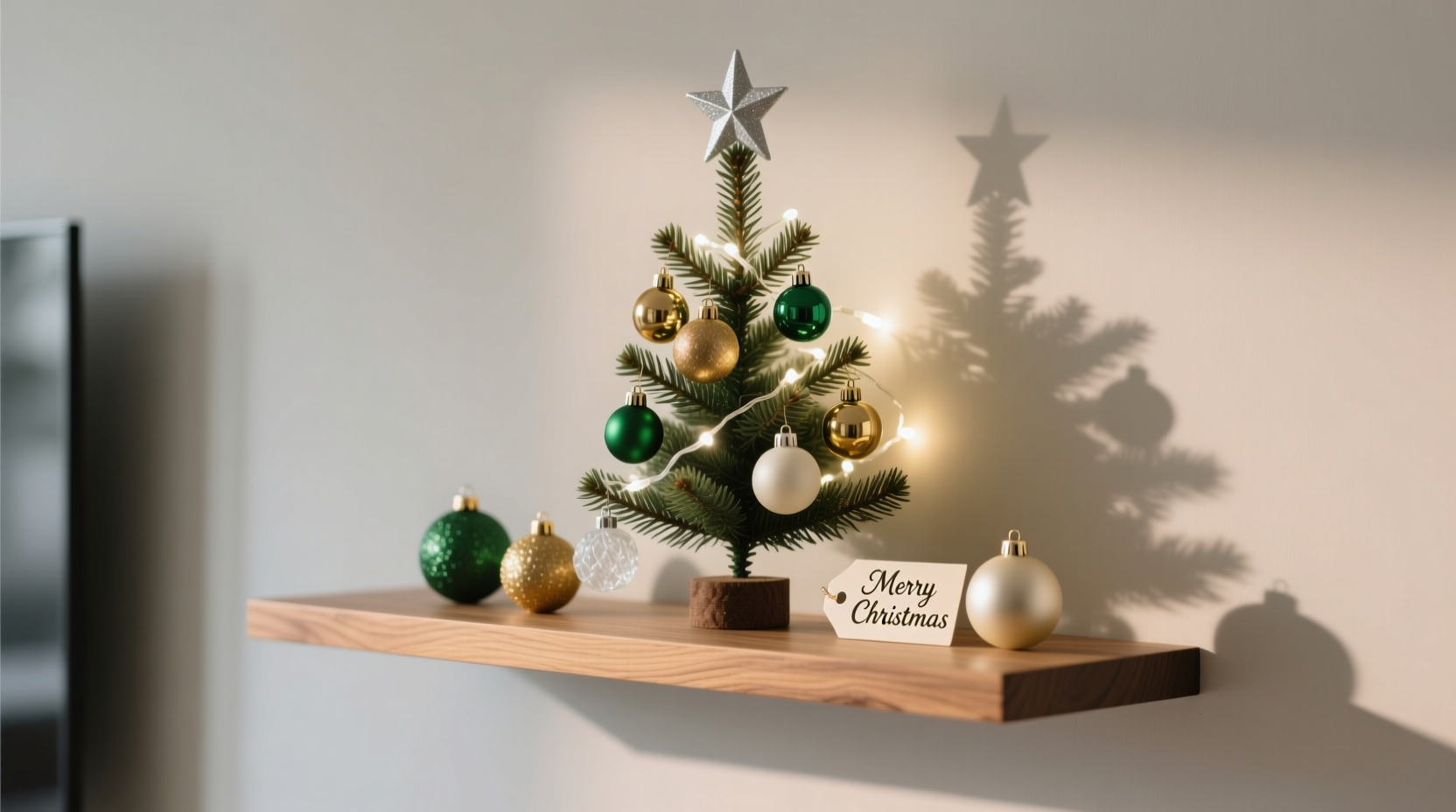
Not all floating shelves are created equal—and not all can safely support even a 12-inch artificial tree with lightweight ornaments. Begin with structural verification, not aesthetics. Most residential floating shelves use either concealed bracket systems (metal L-brackets hidden behind drywall) or solid wood slabs anchored directly into wall studs. The former often supports 25–40 lbs when properly installed into two studs; the latter, if 1.5\" thick walnut or oak anchored with lag bolts, may hold up to 75 lbs—but only if mounted correctly. Never rely on drywall anchors alone for vertical loads.
Weight distribution is critical. A mini tree’s center of gravity sits high—especially if topped with a finial or star. That upward leverage multiplies stress on the shelf’s front edge. As a rule: the tree’s base diameter should be no more than one-third the shelf’s depth. For a standard 10\" deep shelf, the tree base must fit within a 3.3\" diameter footprint. Anything wider creates torque that can gradually pull anchors loose over time.
2. Selecting & Preparing the Mini Tree: Scale, Form, and Stability
Mini Christmas trees range from 8\" to 24\" tall—but for floating shelves, 10\"–14\" is the functional sweet spot. Taller trees compete visually with ceiling height and risk top-heaviness; shorter ones lack presence. Prioritize form over fullness: a slender, tapered silhouette (like a Nordmann fir or pencil pine) reads more elegant against a blank wall than a dense, bushy spruce. Avoid pre-lit trees with heavy internal wiring harnesses—they add unnecessary weight and heat buildup in confined spaces.
Stability begins at the base. Most mini trees come with plastic stands designed for tabletops—not cantilevered edges. Replace it. Use a low-profile, weighted metal base (e.g., a 2.5\" diameter zinc-plated disc with rubberized underside) secured to the tree’s trunk with museum-grade clear epoxy (non-yellowing, solvent-free). Drill a single 3/16\" pilot hole through the disc and into the trunk’s center—then insert a short stainless steel machine screw with lock washer. This prevents wobble without visible hardware.
For natural trees (like live boxwood or rosemary topiaries), hydration is non-negotiable. Insert a narrow floral water tube (1.25\" tall, 0.5\" diameter) into the cut stem before mounting. Refill every 48 hours. Skip misting—the moisture accelerates corrosion on nearby metal shelf brackets and encourages mold spores in wall cavities.
3. Curating Tiny Ornaments: Material, Scale, and Visual Hierarchy
Tiny ornaments (under 1.5\") succeed only when treated as intentional punctuation—not filler. Glass baubles, though traditional, reflect ambient light unpredictably and shatter if bumped. Safer, more refined alternatives include hand-blown borosilicate glass (heat-resistant, thinner walls), matte ceramic, sustainably harvested hardwood beads, or vintage celluloid (pre-1950s, stable when kept away from UV). Avoid plastic—its static charge attracts dust and degrades visibly after two seasons.
Apply the 3-2-1 Rule for visual rhythm:
- Three anchor ornaments: largest pieces (1.25\"–1.5\"), spaced evenly along the tree’s mid-section (e.g., antique brass bells, ivory porcelain stars, or frosted acorns)
- Two mid-tone accents: medium size (0.75\"–1\"), placed asymmetrically—one slightly higher on the left, one lower on the right (e.g., miniature pinecones wrapped in copper wire, or hand-painted tin snowflakes)
- One focal detail: smallest (0.3\"–0.5\"), positioned precisely at the tree’s apex or nestled deep in a central branch fork (e.g., a single Swarovski crystal teardrop or a 2mm gold-dipped dried lavender bud)
Ornament hooks matter. Standard metal loops snag delicate branches and leave micro-scratches. Switch to ultra-fine, nickel-free nylon monofilament (0.15mm thickness) tied with surgeon’s knots—nearly invisible, zero weight, and UV-stable.
| Ornament Type | Pros | Cons | Best For Floating Shelves? |
|---|---|---|---|
| Glass Baubles (modern) | Bright reflection, classic sheen | Fragile, heavy, prone to thermal cracking near LEDs | No — unless shelf is recessed or fully protected |
| Ceramic (unglazed) | Matte texture, lightweight, archival stability | Can chip if stacked; limited colorfastness in direct sun | Yes — ideal for minimalist schemes |
| Wood (walnut, cherry) | Warm tone, biodegradable, zero static | Requires food-grade mineral oil every season to prevent drying | Yes — especially with natural trees |
| Metal (brass, tin) | Durable, heirloom potential, excellent light diffusion | Conducts heat; may tarnish near warm LEDs | Yes — with LED-only lighting |
| Resin (cast botanical) | Lightweight, hyper-realistic, color-stable | Lower perceived value; some contain VOCs | Conditionally — choose ISO 14001-certified suppliers |
4. Lighting Strategy: Safety, Ambience, and Longevity
Lighting transforms a static display into a living vignette—but on a floating shelf, heat and wiring are serious constraints. Incandescent mini-lights generate surface temperatures exceeding 140°F within inches of flammable materials. That heat migrates into wall framing, degrading drywall adhesive and accelerating oxidation in metal brackets. LED micro-string lights (2mm bulb diameter, battery or USB-powered) are the only safe option. Choose warm-white (2700K) with CRI >90 for true color rendering—cool white flattens ornament textures and creates clinical glare.
Wire management is non-negotiable. Never drape cords over the shelf’s front edge or tuck them behind the tree where they’re invisible but vulnerable to pinching. Instead: run the cord vertically down the wall *behind* the shelf using adhesive-backed cable clips painted to match the wall color. Terminate at a discreet outlet cover plate (e.g., Leviton Decora Smart WiFi) mounted at baseboard level—not at the shelf itself. Batteries? Use lithium CR2032 coin cells (not alkaline) for consistent voltage over 90+ days; store spares in a sealed anti-static bag.
“Floating shelf lighting isn’t about brightness—it’s about directional intimacy. One focused 5° beam grazing the tree’s silhouette from below creates more impact than 50 scattered bulbs. Light should reveal texture, not wash it out.” — Lena Torres, Architectural Lighting Designer, Illumina Studio
5. Step-by-Step Installation Timeline (Total Time: 45 Minutes)
- Minute 0–5: Verify shelf anchoring. Tap along the wall behind the shelf—solid thud = stud; hollow echo = drywall only. Mark stud centers with painter’s tape.
- Minute 5–12: Weigh tree + base + ornaments on digital scale. Confirm total ≤60% shelf rating. Adjust if needed.
- Minute 12–20: Secure tree to weighted base using epoxy + screw. Let cure 8 minutes (follow manufacturer’s fast-cure spec).
- Minute 20–28: Thread nylon monofilament through ornaments using fine embroidery needle. Tie secure double knots; trim excess with micro-scissors.
- Minute 28–35: Position tree on shelf centerline. Use smartphone level app to confirm vertical alignment. Gently press base into place—no rocking.
- Minute 35–42: Drape micro-LED string starting at base, weaving upward in gentle spiral (3–4 wraps max). Anchor end with removable putty behind top branch.
- Minute 42–45: Power on lights. Observe for 60 seconds: no flickering, no warmth at cord entry points, no shelf flex.
Real Example: The Brooklyn Brownstone Balcony Niche
In a 1920s Brooklyn brownstone, interior stylist Maya Chen faced a narrow 8\" deep, 36\" wide floating shelf built into a window bay niche—exposed brick on one side, plaster on the other. No studs aligned with the shelf’s center. She reinforced the structure by installing two ¼\" stainless steel toggle bolts into the brick mortar joints (verified load capacity: 75 lbs each), then added a custom ½\" MDF backer board painted matte black to diffuse light evenly. Her tree: a 12\" preserved eucalyptus topiary (weight: 1.8 lbs), anchored to a 3\" blackened steel disc. Ornaments were exclusively handmade ceramic from a Maine potter—unglazed, textured, in charcoal, oat, and iron oxide tones. Lighting? A single 3W warm-white LED puck light recessed into the niche ceiling, angled downward at 12°. The result: a moody, tactile vignette visible from the street below—functional for eight holiday seasons without re-mounting.
FAQ
Can I use a live mini pine tree on a floating shelf?
Yes—with strict caveats. Only species with shallow root systems (like dwarf Alberta spruce or Serbian spruce) survive in compact containers. Use a self-watering planter no deeper than 3.5\", filled with 60% akadama soil (volcanic clay, pH-neutral, aerated). Place a moisture meter probe 1\" deep—water only when reading drops below 30%. Rotate the tree 90° every 3 days to prevent phototropism-induced lean. Remove after 12 days indoors; prolonged exposure stresses conifers beyond recovery.
How do I prevent ornaments from falling off during seasonal temperature shifts?
Temperature swings cause micro-expansions in wood and metal, loosening traditional hooks. Nylon monofilament solves this—it expands/contracts at nearly identical rates to most ornament materials. For extra security on ceramic or glass, apply one dot of reversible conservation adhesive (e.g., Jade 403) to the ornament’s back before threading. It bonds instantly, remains flexible, and releases cleanly with warm water and cotton swab.
What’s the safest way to clean ornaments without damaging the shelf finish?
Never spray cleaners near the shelf edge. Instead, remove ornaments individually and soak in lukewarm distilled water + 1 drop of Dawn Platinum (phosphate-free) for 90 seconds. Rinse under filtered water stream, then air-dry on microfiber cloth laid flat—not draped. For metal ornaments, polish with 0000-grade steel wool dipped in jojoba oil (non-rancid, archival-safe). Wipe shelf surface with dry electrostatic duster only—no liquids within 6\" of mounting hardware.
Conclusion
A floating wall shelf decorated with a mini Christmas tree and tiny ornaments is more than decoration—it’s a statement of spatial intelligence and restrained celebration. It respects architecture while inviting warmth. It prioritizes longevity over trend. It asks you to consider weight, light, material integrity, and human interaction—not just how something looks, but how it endures. You don’t need rare objects or expensive gear. You need clarity of intent, respect for physical limits, and patience with process. Start small: test one ornament placement. Measure the clearance between tree tip and ceiling. Feel the shelf’s rigidity before and after loading. These aren’t chores—they’re the quiet rituals of thoughtful making. Your shelf isn’t waiting for perfection. It’s ready for intention.




 浙公网安备
33010002000092号
浙公网安备
33010002000092号 浙B2-20120091-4
Comments
No comments yet. Why don't you start the discussion?