
In a world increasingly drawn to simplicity and intentional living, the minimalist Christmas tree has emerged as a powerful expression of quiet elegance. Stripped of traditional tinsel, baubles, and themed ornaments, this approach relies solely on light and texture to create a serene, sophisticated centerpiece for the holidays. Far from being bare or underwhelming, a thoughtfully decorated minimalist tree can radiate warmth, depth, and timeless charm. The absence of clutter allows each element—every strand of light, every branch’s curve—to be seen and appreciated. This guide explores how to craft such a tree using only two essential components: lighting and tactile variation.
The Philosophy Behind Minimalist Holiday Design
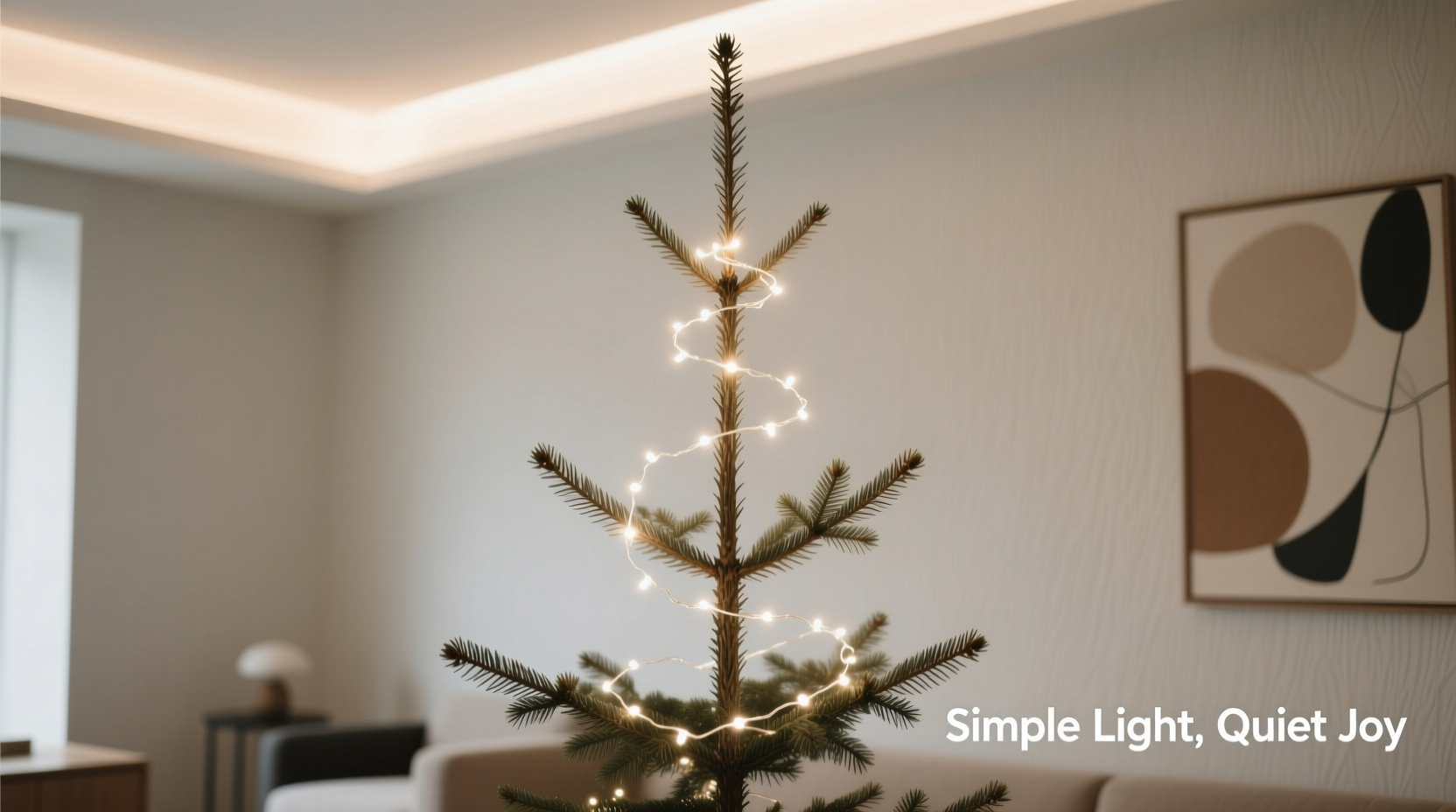
Minimalism in decor is not about deprivation but about refinement. It’s the deliberate choice to focus on quality over quantity, intention over impulse. When applied to Christmas trees, this philosophy invites a slower, more contemplative form of celebration—one where the ritual of decoration becomes meditative rather than frantic.
A minimalist tree emphasizes negative space, natural materials, and subtle contrast. By removing the visual noise of multiple colors and competing shapes, attention shifts to the interplay of shadow and glow, roughness and softness. This design approach aligns well with Scandinavian, Japandi, and modern farmhouse aesthetics, all of which value calm, harmony, and authenticity.
“Less ornamentation doesn’t mean less meaning. Sometimes, silence speaks louder than sound.” — Clara Nguyen, Interior Designer & Author of *Calm Spaces*
The minimalist tree also appeals to those seeking sustainability. Fewer purchased decorations mean reduced waste, lower consumption, and often a greater use of reusable or natural elements. It encourages creativity within constraints—a hallmark of true design mastery.
Selecting the Right Tree for a Textural Foundation
The success of a lights-and-texture-only tree begins with the tree itself. Since there will be no ornaments to distract or add volume, the shape, density, and surface quality of the branches become critical.
Natural fir, spruce, and pine trees offer excellent textural variety. Fraser firs, for example, have densely packed needles with a slight upward curve, creating natural layers that catch light beautifully. Balsam firs provide a rich green hue and strong fragrance, adding sensory depth even without visual embellishment. If opting for an artificial tree, choose one with realistic branch structure and varied needle lengths. Avoid overly uniform or glossy models, as they reflect light too evenly and lack dimension.
Consider color tone. A cooler blue-green spruce reflects light differently than a warm olive-toned Douglas fir. Match the tree’s undertones to your room’s lighting—warm white bulbs pair well with golden or amber-hued interiors, while daylight-white LEDs complement cooler, neutral spaces.
Mastering Light: Type, Placement, and Effect
Light is the heartbeat of a minimalist Christmas tree. Without it, the tree would fade into the background. With it, the tree becomes a living sculpture of luminosity.
Choose bulb type carefully. Incandescent mini lights emit a soft, warm glow with slight flicker, ideal for creating intimacy. LED string lights are energy-efficient and long-lasting, available in warm white, cool white, or dimmable varieties. For a minimalist aesthetic, avoid multicolored or flashing lights—they disrupt cohesion.
Warm white (2700K–3000K) is generally the best choice. It mimics candlelight, enhancing wood tones and fabric textures in the room. Cool white (4000K+) can feel clinical unless balanced with warm ambient lighting elsewhere.
Wiring Techniques for Maximum Impact
How you apply the lights matters as much as the lights themselves. The goal is even distribution with subtle rhythm—not perfect symmetry, but balanced progression.
- Start at the base: Begin wrapping from the bottom inner branches and work upward. This ensures lower sections aren’t neglected.
- Go deep, not just around: Insert lights inward toward the trunk, not just along the outer edges. This creates a glowing core effect.
- Vary spacing slightly: Instead of placing bulbs at rigid intervals, cluster some closer together and space others farther apart to mimic organic patterns.
- Use multiple strands: One string rarely provides enough coverage. Use several identical sets for fullness.
- Test as you go: Plug in periodically to check for dark zones or hotspots.
For added drama, consider incorporating fairy lights with copper wire—these can be hand-wrapped around select branches to highlight their form. Their delicate glow adds a second layer of illumination, like starlight caught in snow-laden limbs.
Enhancing Texture Through Natural and Tactile Elements
Texture is the silent partner to light. While light defines presence, texture gives character. In a minimalist tree, texture must do the work typically handled by ornaments—inviting touch, catching the eye, and changing with the light.
Introduce texture through natural additions that blend seamlessly:
- Dried citrus slices: Thin orange or grapefruit rounds, air-dried for 24–48 hours, add rustic warmth and a faint scent when warmed by lights.
- Cinnamon sticks: Bundled with twine and tucked into branches, they contribute coarse bark-like texture and a familiar holiday aroma.
- Unbleached cotton ribbons: Draped loosely or looped vertically, they soften the tree’s silhouette and absorb light gently.
- Linen or burlap strips: Cut into narrow bands and tied in simple knots, these add earthy tactility without visual weight.
- Pinecones (uncoated): Choose smaller, naturally shed cones. Their layered scales catch light and shadow, creating micro-movement as air circulates.
Avoid anything shiny, plastic, or overly processed. Matte finishes, raw edges, and irregular shapes enhance the organic feel.
Table: Do’s and Don’ts for Textural Additions
| Element | Do | Don’t |
|---|---|---|
| Dried Citrus | Use thin slices; place near lights to warm scent | Overcrowd; use moldy or moist pieces |
| Pinecones | Arrange in clusters of three; leave unvarnished | Spray with glitter or metallic paint |
| Fabric Strips | Use natural fibers; vary length slightly | Tie tight bows or use synthetic satin |
| Cinnamon Sticks | Bundle with jute; place near seating areas | Use broken or powdered pieces |
Step-by-Step Guide: Building Your Minimalist Tree
Follow this sequence to create a cohesive, impactful minimalist Christmas tree using only lights and texture.
- Choose and position your tree: Whether real or artificial, ensure it’s securely anchored and placed where it can be viewed from multiple angles. A corner location works well if lit from one side.
- Pre-light inspection: Test all light strings before installation. Replace any with dead bulbs or frayed wires.
- Begin wiring from the inside out: Starting at the trunk, weave the first string deeply into lower branches. Move upward in a spiral, ensuring inner layers receive light.
- Add secondary lighting layers: Use fairy lights or battery-operated twinkle wires to highlight specific branches or create vertical lines of light.
- Incorporate textured elements: Place dried citrus, pinecones, and fabric strips at varying heights. Focus on asymmetry—avoid mirroring left and right.
- Evaluate in darkness: Turn off room lights and assess the tree’s glow. Adjust light density or reposition textured items as needed.
- Final touch: ground layer: Place a neutral tree skirt—linen, wool, or undyed canvas—to extend the textural theme downward.
This process should take 1.5 to 2.5 hours, depending on tree size. Allow time for contemplation—step back frequently to observe how light interacts with form.
Real Example: A Brooklyn Apartment Transformation
In a 650-square-foot Brooklyn loft, designer Mira Chen replaced her family’s tradition of a heavily ornamented tree with a minimalist version after feeling overwhelmed by holiday chaos. She selected a seven-foot Fraser fir for its dense branching and rich color. Using 1,200 warm white LED bulbs, she hand-strung the tree over three evenings, focusing on inner illumination. She added only eight dried orange slices, six small pinecones, and three linen ribbons in oatmeal tone.
The result was transformative. “People kept asking if I had candles,” she said. “The tree didn’t shout—it hummed. It felt present without demanding attention.” Her young daughter still asked for one ornament, so they hung a single handmade clay star—low-gloss, unpainted—at child’s-eye level. Even this small addition followed the minimalist ethos: intentional, textural, and integrated.
Frequently Asked Questions
Can I use colored lights on a minimalist tree?
While possible, colored lights introduce visual complexity that can undermine minimalism. If used, opt for monochromatic schemes—such as all soft blue or pale gold—and ensure bulbs are uniformly shaded. Warm white remains the safest and most harmonious choice.
How many strings of lights do I need?
A general rule is 100 lights per foot of tree height. For a 6-foot tree, that’s 600 bulbs. However, due to the emphasis on depth and layering in minimalist design, consider using 1.5 times that amount—up to 900 bulbs—for a richer, more enveloping glow.
Is it okay to add a topper?
Yes, but keep it subtle. A simple fabric bow, knotted ribbon, or natural twig star maintains the aesthetic. Avoid large, glittery stars or angels. If topping feels necessary, let the highest lit branch serve as the peak—sometimes the light itself is the crown.
Checklist: Minimalist Tree Essentials
- ✔️ One high-quality tree with naturalistic branching
- ✔️ Multiple strands of warm white lights (LED or incandescent)
- ✔️ Battery-powered fairy lights (optional, for accent)
- ✔️ Dried citrus slices (prepared 1–2 days in advance)
- ✔️ Unvarnished pinecones or cinnamon sticks
- ✔️ Natural fiber ribbons or fabric strips (undyed preferred)
- ✔️ Neutral tree skirt (linen, wool, or canvas)
- ✔️ Scissors, floral wire, and twist ties for securing elements
- ✔️ Dark room for final evaluation
Conclusion: Embrace the Quiet Glow
A minimalist Christmas tree decorated with only lights and texture is more than a design choice—it’s a statement of presence. It asks us to slow down, to notice how light bends around a pine needle, how shadow pools beneath a dried orange slice, how warmth can be conveyed without noise. In a season often defined by excess, this approach offers clarity and calm.
You don’t need a warehouse of decorations to celebrate meaningfully. You need attention. Intention. And the courage to let simplicity speak.




 浙公网安备
33010002000092号
浙公网安备
33010002000092号 浙B2-20120091-4
Comments
No comments yet. Why don't you start the discussion?