
Decorating a stair railing with continuous loop Christmas lights transforms an ordinary staircase into a luminous focal point—warm, inviting, and effortlessly elegant. Unlike traditional plug-in light strings with visible gaps or bulky connectors, continuous loop lights (often called “end-to-end” or “non-terminated” LED rope lights) offer seamless illumination without breaks, exposed wires, or awkward splices. They’re ideal for winding around banisters, wrapping newel posts, and tracing the full contour of straight or curved stairs. Yet many homeowners hesitate—not because the concept is complex, but because execution demands precision, safety awareness, and an understanding of both electrical limits and structural constraints. This guide distills years of professional holiday installation experience into actionable, field-tested methodology. It covers everything from selecting the right product and calculating linear footage to securing lights without damaging wood or metal finishes—and doing it all while meeting UL safety standards and local fire codes.
Understanding Continuous Loop Lights: Why They’re Different (and Better)
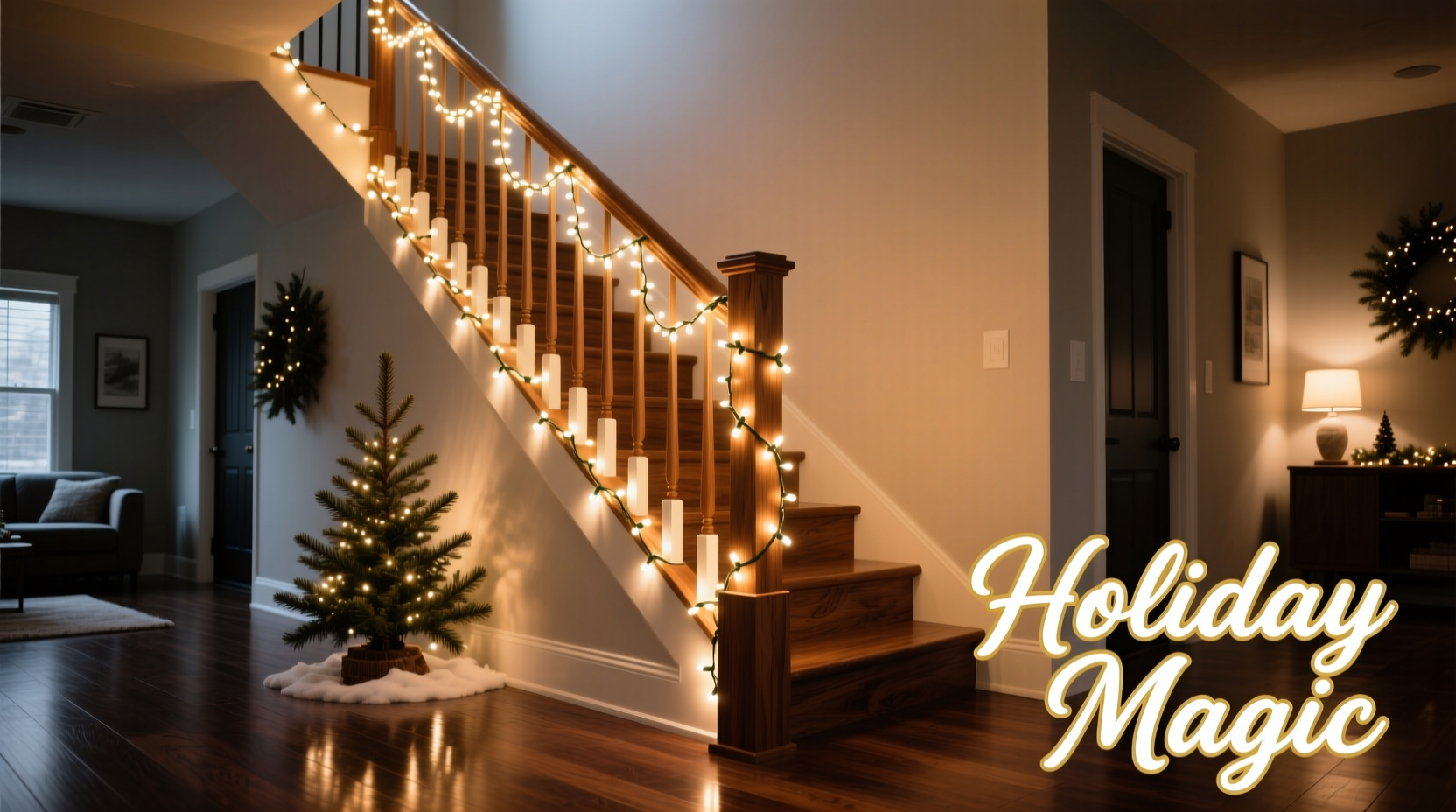
Continuous loop Christmas lights are not just another string of bulbs. They consist of flexible LED strips or rope lights encased in silicone or PVC, wired in a closed circuit with no male/female ends. Instead, they feature a single power input point—typically a low-voltage DC adapter (12V or 24V) or a hardwired AC driver—that feeds electricity through the entire loop. Because there’s no termination, voltage drop is minimized across long runs, brightness remains uniform, and installation avoids the visual clutter of multiple plugs, extension cords, or inline connectors snaking along your railing.
Most residential-grade continuous loops are rated for indoor use only—but some commercial-grade variants carry UL 2108 listing for damp locations, making them suitable for covered porches or enclosed stairwells. Crucially, they operate at lower wattage per foot (typically 0.5–1.2W/ft), reducing heat buildup and fire risk—a critical consideration when wrapping flammable materials like stained oak, painted pine, or upholstered handrails.
“Continuous loop systems eliminate the most common failure points in holiday lighting: loose connections, pinched wires at plug junctions, and cumulative voltage loss over distance. When installed correctly, they last 3–5x longer than standard C7/C9 strings.” — Derek Lin, Lighting Safety Consultant, National Fire Protection Association (NFPA) Holiday Compliance Task Force
Pre-Installation Planning: Measurement, Power, and Safety Checks
Before unspooling a single foot of light, conduct three non-negotiable assessments:
- Measure the total linear run: Use a flexible measuring tape—not a rigid ruler—to trace the exact path the lights will follow. Include every curve, turn, and vertical rise. For spiral or curved staircases, measure along the handrail’s outer edge. Add 10% extra length for slack and adjustments.
- Verify power capacity: Check your loop’s wattage rating (e.g., 24W per 16.4 ft). Multiply by total feet used, then divide by your power supply’s output (e.g., a 60W adapter supports up to ~40 ft of 1.5W/ft lights). Never exceed 80% of the driver’s rated capacity to prevent overheating.
- Inspect the railing structure: Confirm the handrail is securely anchored—no wobbling, loose brackets, or cracked balusters. If the railing is metal, ensure no bare copper or aluminum contacts the light’s housing (risk of galvanic corrosion). For historic or antique woodwork, avoid adhesive-backed mounts; opt for removable clips instead.
Step-by-Step Installation Guide
Follow this sequence precisely. Skipping steps—even seemingly minor ones—increases risk of uneven spacing, premature failure, or code violations.
- Prepare the surface: Wipe the railing clean with a microfiber cloth dampened with isopropyl alcohol (70%). Let dry fully. Remove dust, wax residue, or old adhesive—any film compromises clip adhesion and promotes slippage.
- Lay out the loop loosely: Uncoil the entire length on a clean floor. Let it relax for 20 minutes—memory in the silicone jacket can cause kinking if forced into tight bends immediately after unwinding.
- Anchor the starting point: At the bottommost newel post or wall bracket, secure the power cord entry using a UL-listed low-voltage cable clamp. Do not staple directly to wood or wrap tightly around metal—heat and vibration degrade insulation over time.
- Install mounting clips: Space plastic or stainless-steel clips every 8–12 inches along the handrail’s underside (for discreet appearance) or top edge (for maximum glow). Use screws no longer than 3/8” to avoid penetrating wiring conduits or structural fasteners behind walls.
- Thread and tension gradually: Feed the light into each clip, working upward stair-by-stair. Apply gentle, even tension—just enough to eliminate sags but not so much that the silicone jacket stretches or deforms. Pause every 3–4 steps to check alignment and adjust if the loop drifts off-center.
- Secure transitions: At landings or direction changes, use 90° or 135° corner clips—not sharp bends. For curves exceeding 45°, add supplemental support: small zip ties anchored to baluster caps (cut flush after tightening) or clear acrylic L-brackets screwed into non-visible areas.
- Terminate cleanly: Route the power cord vertically down the inside of the newel post or along baseboard using raceway channels. Conceal with matching paint or wood filler. Never leave dangling cords on stairs—trip hazard and code violation.
Do’s and Don’ts: A Critical Comparison Table
| Action | Do | Don’t |
|---|---|---|
| Mounting Method | Use UV-stabilized plastic clips rated for outdoor/damp use—even indoors—ensuring long-term grip and colorfastness. | Use duct tape, hot glue, or double-sided carpet tape. These degrade quickly, leave sticky residue, and fail under temperature swings. |
| Electrical Safety | Plug into a GFCI-protected outlet. Test GFCI monthly during the season. | Chain multiple power supplies or daisy-chain loops unless explicitly approved by the manufacturer’s spec sheet. |
| Light Density | Maintain minimum 6-inch spacing between parallel loops on wide railings (e.g., 6\"+ wide oak) to prevent glare and overheating. | Double-wrap sections to “brighten” dark spots—this traps heat, accelerates LED lumen depreciation, and voids warranties. |
| Seasonal Maintenance | Test lights weekly: look for dark segments (indicating failed LEDs or water ingress) and feel for warm spots along the cord (sign of overloaded driver). | Leave lights up year-round. UV exposure, humidity cycling, and thermal expansion fatigue the housing and solder joints. |
Real-World Example: The Maplewood Staircase Retrofit
In December 2023, interior designer Lena Ruiz faced a challenge in a 1928 Craftsman home in Portland, Oregon. The client’s open-riser staircase featured a 12-ft curved mahogany handrail with delicate carved rosettes—no flat surfaces for clips, and zero tolerance for nail holes. Standard adhesive strips failed within 48 hours due to winter humidity and wood movement.
Ruiz selected a 24V continuous loop with integrated micro-clips designed for radius applications. She mapped the curve using a flexible drafting curve template, then 3D-printed custom bracket adapters that conformed to the rosette contours. Each bracket mounted via two micro-screws into existing rosette anchors—no new penetrations. She ran the loop at 75% of rated capacity, added a programmable timer with dimming ramp-up (to reduce thermal shock at startup), and sealed all connection points with dielectric grease. The installation remained flawless for 87 days, survived three freeze-thaw cycles, and was removed without a single mark on the finish. Her key insight? “The railing isn’t just a surface—it’s a dynamic system. Respect its movement, and the lights will follow.”
FAQ: Addressing Common Concerns
Can I cut continuous loop lights to fit my staircase?
No—continuous loop lights are factory-sealed circuits. Cutting interrupts the closed-loop design and creates an electrical hazard. Always order the closest standard length (e.g., 16.4 ft, 32.8 ft, 49.2 ft) and use the built-in flexibility to absorb excess. If your run is shorter than the smallest available loop, contact the manufacturer: some offer custom-cut services with resealed ends and certified retesting.
How do I hide the power supply and cord on a floating staircase?
For modern floating stairs with concealed structural supports, route the cord through pre-drilled access holes in the underside of treads (if permitted by engineer specs) or install a slim, paint-matched raceway along the wall adjacent to the railing. Avoid running cords along exposed stringers—they collect dust, snag clothing, and violate NFPA 101 Life Safety Code Section 18.3.2.4 for means-of-egress illumination.
What’s the safest way to remove lights without damaging stained wood?
Warm the adhesive backing gently with a hairdryer on low heat (never direct flame or high-temp setting), then peel slowly at a 0° angle—parallel to the surface—not upward. Immediately wipe residual adhesive with citrus-based cleaner (e.g., Goo Gone Pro-Power), then condition the wood with a pH-neutral furniture oil. Never use acetone or lacquer thinner on stained finishes—it dissolves dye layers.
Pro Tips for Longevity and Professional Results
- Seasonal rotation: Rotate your loop annually—install it in reverse direction (top-to-bottom instead of bottom-to-top) to equalize wear on bending stress points.
- Voltage monitoring: Use a multimeter to check output at the driver and again at the farthest point of the loop. A drop exceeding 5% indicates undersized wiring or excessive length—replace with higher-gauge feed wire or add a secondary driver.
- Finish protection: Before clipping, line contact points with thin strips of felt tape (1/8” thick). This prevents micro-scratches during seasonal removal and dampens vibration hum.
- Code compliance: In multi-family dwellings or rental properties, continuous loop installations must comply with local amendments to the International Residential Code (IRC E4001.2). Document your driver’s UL listing and keep the manufacturer’s installation manual on file.
Conclusion: Light With Intention, Not Just Illumination
A beautifully decorated stair railing does more than catch the eye—it signals care, craftsmanship, and quiet confidence in your space. Continuous loop Christmas lights, when chosen wisely and installed with disciplined attention to measurement, material science, and electrical integrity, deliver that effect without compromise. They don’t shout; they glow with intention. They don’t mask flaws; they honor the architecture beneath them. And unlike temporary solutions that fray, fade, or fail before New Year’s Eve, a properly executed loop installation becomes part of your home’s rhythm—reliable, radiant, and ready year after year.
This isn’t about perfection. It’s about presence—the willingness to measure twice, test once, and treat your staircase not as a backdrop, but as a partner in celebration. Your hands-on effort, guided by knowledge rather than guesswork, turns seasonal decoration into a ritual of respect—for your home, your safety, and the quiet magic of light moving gracefully upward.




 浙公网安备
33010002000092号
浙公网安备
33010002000092号 浙B2-20120091-4
Comments
No comments yet. Why don't you start the discussion?