
Stair railings offer a natural vertical canvas for ambient lighting—enhancing evening safety, architectural detail, and seasonal charm. Yet unlike mantels or shelves, stairs demand unwavering attention to human movement, spatial awareness, and structural integrity. A single misplaced clip, protruding wire, or overly bright fixture can transform decorative intent into a liability. This guide distills field-tested practices from licensed electricians, certified home inspectors, and accessibility consultants. It focuses not on aesthetics alone, but on how light installations interact with gait, peripheral vision, tactile feedback, and building codes—so your staircase remains both beautiful and unambiguously safe.
Why Stair Lighting Safety Is Non-Negotiable
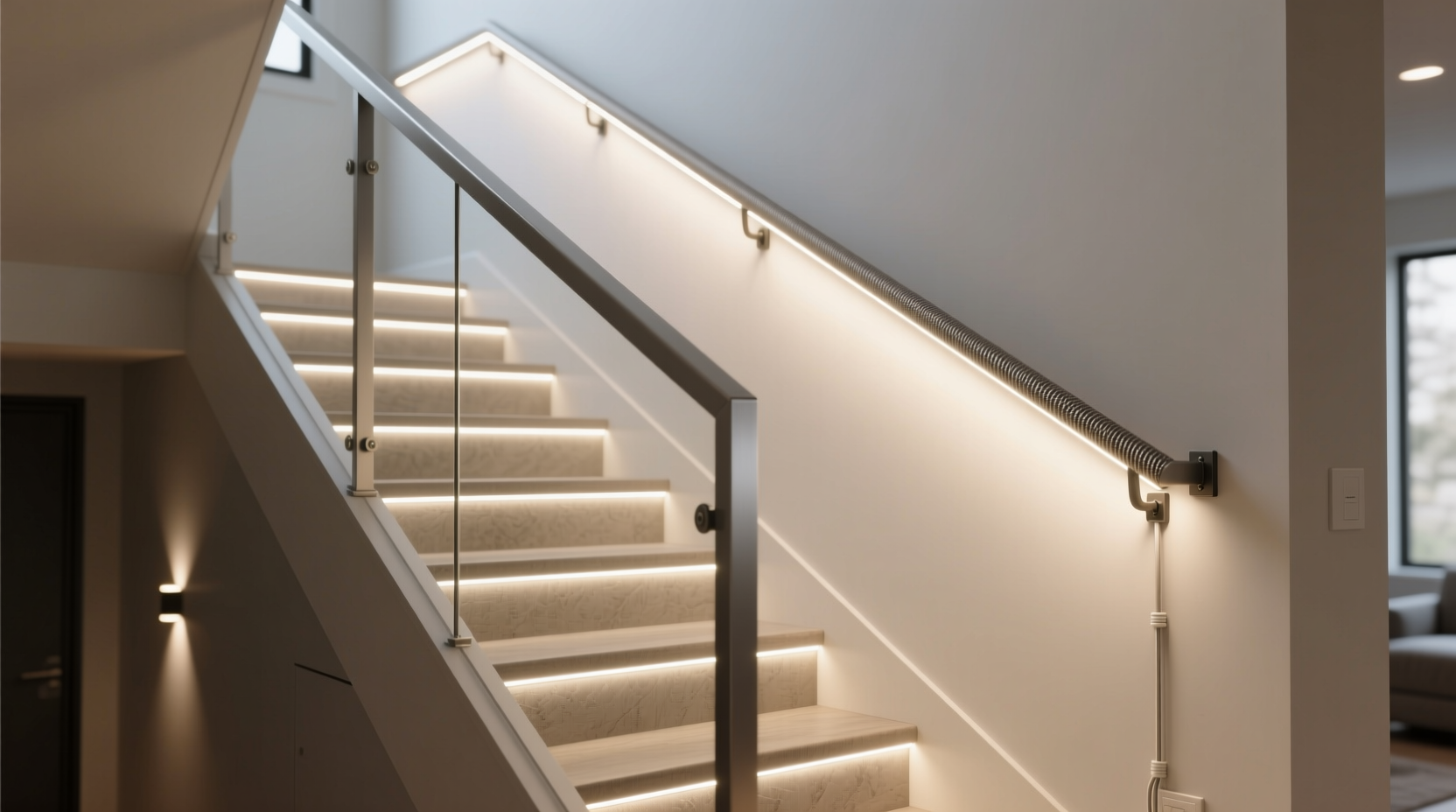
According to the U.S. Consumer Product Safety Commission, over 1.8 million stair-related injuries are treated in emergency departments annually—nearly 25% involving trips or missteps linked to poor visibility or environmental obstructions. The National Fire Protection Association (NFPA) 101 Life Safety Code mandates that all interior stairways maintain “unobstructed egress paths” with consistent visual cues. That means any added element—including lighting—must preserve three critical conditions: clear handrail graspability, uninterrupted tread depth (minimum 10 inches), and unbroken sightlines along the stair’s path of travel.
Unlike wall sconces or ceiling fixtures, stair railing lights sit at the precise height where hands naturally rest and eyes scan downward during descent. If wiring snags clothing, clips catch sleeves, or diffusers create glare on polished treads, the risk escalates—not just for adults, but especially for children, older adults, and those with low vision. Safety isn’t an afterthought in stair lighting; it’s the foundational design criterion.
Pre-Installation Safety Audit: 7 Must-Check Conditions
Before purchasing a single bulb or adhesive strip, conduct this on-site audit. Use a tape measure, flashlight, and notebook. Perform checks during both day and dusk to assess contrast and shadow behavior.
- Rail profile & grip surface: Run your hand along the full length. Is the rail smooth, rounded, and free of grooves, ridges, or sharp transitions? Avoid attaching anything to square-edged or textured wood unless mounting hardware is fully recessed.
- Minimum clearance: Measure horizontally from the outermost edge of the rail to the nearest wall, banister, or obstruction. NFPA requires ≥1.5 inches of unobstructed space for comfortable hand placement. Any light housing must fit within this envelope.
- Tread nosing visibility: Stand at the top and look down. Can you clearly see the front edge (nosing) of each step under ambient light? If installed lights cast shadows across nosings—or if their brightness washes out tread definition—you’ve compromised depth perception.
- Electrical access point: Locate the nearest GFCI-protected outlet or junction box. Extension cords are prohibited per NEC Article 400.17. Permanent installations require in-wall conduit or surface-mounted raceway rated for damp locations.
- Movement clearance: Have a person walk the stairs while holding the rail normally. Observe arm swing, elbow bend, and shoulder rotation. No light housing should interfere with natural biomechanics—even during fatigue or distraction.
- Light source temperature: Verify LED bulbs or strips are rated ≤3000K (warm white). Cool-white (>4000K) increases glare and reduces contrast sensitivity, particularly for users over age 60.
- Code alignment: Confirm local amendments to the International Residential Code (IRC R311.7.6) regarding handrail height (34–38 inches above stair nosing) and continuity. Lights must not alter measured height or introduce breaks in rail continuity.
Safe Installation Methods: What Works (and Why)
Not all lighting methods carry equal risk. Below is a comparative analysis of common approaches, ranked by safety performance, ease of inspection, and long-term reliability.
| Method | Safety Rating (1–5) | Key Risk Mitigators | Best For |
|---|---|---|---|
| Low-profile LED strip + aluminum channel | 5 | Channel fully encloses strip; mounting screws recessed below rail surface; diffuser lens eliminates hotspots; 12V DC power supply with UL listing | Wood or metal rails with flat or gently curved profiles |
| Surface-mount puck lights (recessed trim) | 4 | Fixture body mounted *behind* rail face; only lens protrudes ≤1/8 inch; no exposed wires; hardwired via junction box | Wider rails (≥3.5\" wide) with solid backing |
| Magnetic LED modules | 3 | Only on ferrous metal rails; magnets rated ≥12 lbs pull force; wiring routed through rail’s hollow core (if applicable); no adhesives | Steel or iron balustrades with uniform thickness |
| Adhesive-backed battery lights | 2 | Use only industrial-grade acrylic tape (e.g., 3M VHB); mount only on smooth, sealed surfaces; replace batteries quarterly; avoid near hand contact zones | Temporary use (e.g., holidays); non-ferrous rails with no alternative |
| String lights with clip hangers | 1 | Prohibited for permanent use. Clips create pinch points; wires sag and tangle; bulbs break easily; no electrical protection rating | None—use only for supervised, short-term events with constant supervision |
The aluminum channel method earns top marks because it transforms flexible LED strips into a rigid, shielded, and tactilely neutral system. When properly installed, the rail feels unchanged to the hand—no bumps, no edges, no vibration. The channel’s lip also prevents accidental upward finger contact with the light source, eliminating glare-induced reflexive withdrawal (a common cause of loss of balance).
Step-by-Step: Installing a Low-Profile LED Channel System
This sequence assumes a standard 36-inch-high wooden handrail with a 2.5-inch-wide top surface. All materials must be UL-listed and rated for indoor damp locations.
- Measure & map: Use a laser level to mark exact centerline of rail top. Measure total linear feet, then add 10% for cutting tolerance and wire slack. Note locations of newel posts, turns, and obstructions.
- Prepare surface: Lightly sand rail top where channel mounts. Wipe with isopropyl alcohol to remove dust and oils. Do not apply stain or finish after mounting—adhesion fails.
- Mount aluminum channel: Position channel centered on rail. Drill pilot holes every 12 inches using 1/16\" bit. Secure with #6 × 3/4\" stainless steel pan-head screws—countersunk so screw heads sit flush or slightly below rail surface. Verify no screw protrusion interferes with hand glide.
- Install LED strip: Peel backing and press strip firmly into channel groove. Ensure strip ends align precisely with channel ends—no overhang. Connect strip to 12V DC driver using pre-tinned wire nuts (no tape or twist-on connectors).
- Route & conceal wiring: Run low-voltage wire inside baseboard molding, behind drywall (via drilled holes), or within surface-mount raceway. Never staple wires to rail underside or run them across treads. Maintain minimum 6-inch separation from AC wiring.
- Install diffuser lens: Snap polycarbonate lens into channel. Test light output: stand at stair base and confirm even, shadow-free illumination across all treads. Adjust driver dimmer to 60–70% brightness—sufficient for navigation without pupil constriction.
- Final tactile test: Close eyes and run both hands along entire rail length. No hardware, lens edge, or thermal bump should be detectable. Open eyes and descend stairs slowly—verify no visual distraction or glare occurs.
Real-World Example: The Oakwood Condo Staircase Retrofit
In Portland, Oregon, the Oakwood Condo Association faced resident complaints about nighttime falls on their central oak staircase—a classic 1920s design with ornate turned balusters and a 3.25-inch-wide mahogany handrail. Previous attempts used double-sided tape and battery-powered fairy lights; residents reported “sticky spots,” “blinding flashes on dark steps,” and one incident where a child’s sweater caught on a loose clip.
Hiring a certified lighting technician specializing in accessible design, they replaced the system with a custom-fitted aluminum channel mounted using micro-recessed screws. The LED strip used 2700K color temperature with 120-degree beam spread. Wiring was routed through a discreet PVC raceway along the skirt board, terminating at a GFCI outlet in the adjacent hallway. Crucially, the team installed a motion-sensor dimmer: lights activate at 30% brightness upon approach, ramp to 70% when motion is sustained, and fade to off after 90 seconds of stillness.
Post-installation, fall reports dropped to zero over 18 months. Residents noted improved confidence descending at night—and several commented that the rail now “feels more secure, not less.” The solution succeeded not because it was brighter, but because it removed ambiguity: consistent light, zero tactile interference, and predictable activation eliminated cognitive load during movement.
“Stair lighting shouldn’t compete with the architecture—it should serve the physiology of the person using it. If your hand notices the light, the light has failed its primary function.” — Lena Torres, CPHD, Certified Professional in Healthcare Design & Accessibility Consultant
FAQ: Critical Questions Answered
Can I use solar-powered lights on an interior stair railing?
No. Solar panels require direct, sustained UV exposure to charge—impossible indoors. Indoor “solar” lights marketed for stairs rely on weak ambient light harvesting and deliver inconsistent, rapidly diminishing output. They fail the reliability standard required for life-safety pathways and violate NEC 725.121(A) for Class 2 power sources in egress areas.
How often should I inspect my stair lighting system?
Perform a tactile and visual check monthly: run hands along the rail, verify no screws loosened or lenses cracked, and confirm lights activate uniformly. Conduct a full electrical inspection—including voltage drop testing and ground-fault verification—every 12 months with a licensed electrician. Battery-operated units require quarterly battery replacement and biannual adhesive reassessment.
Do I need a permit for stair railing lighting?
Yes—if wiring is modified, extended, or hardwired. Most jurisdictions require permits for any new circuit, junction box, or permanent low-voltage installation exceeding 50 watts. Temporary plug-in systems under 25 watts may be exempt, but consult your local building department. Unpermitted work voids homeowner insurance coverage for injury claims related to the installation.
Conclusion: Light With Intention, Not Just Illumination
Decorating a stair railing with lights is never merely about adding sparkle—it’s an act of stewardship. Every choice you make reflects your commitment to the safety, dignity, and autonomy of everyone who uses that staircase. Whether it’s a grand Victorian entry or a modest basement stair, the principles remain constant: prioritize tactile neutrality over visual flair, ensure redundancy in power and control, and treat code compliance not as bureaucracy but as collective wisdom distilled from decades of incident data.
You don’t need expensive fixtures or complex programming to succeed. You need rigor in measurement, humility in testing, and respect for how human bodies move in three-dimensional space. Start small—audit one flight, install one channel section, validate with real use. Then expand with confidence, knowing each decision strengthens both beauty and safety.




 浙公网安备
33010002000092号
浙公网安备
33010002000092号 浙B2-20120091-4
Comments
No comments yet. Why don't you start the discussion?