
Staircases are architectural focal points—vertical transitions that connect spaces and shape the rhythm of a home. When thoughtfully lit, they become warm, inviting, and even dramatic. Battery-powered string lights offer unmatched flexibility for staircase decoration: no electrician required, no exposed wiring near foot traffic, and zero risk of overloading circuits. But “battery-powered” doesn’t mean “risk-free.” Improper placement, poor-quality components, or neglecting environmental factors can lead to tripping hazards, premature battery failure, overheating—even fire in rare but documented cases involving counterfeit lithium cells. This guide distills real-world experience from lighting designers, fire safety inspectors, and certified home stagers into actionable, code-informed practices. It’s not about aesthetics alone; it’s about integrating light safely into one of the most high-consequence zones in any residence.
Why Battery Power Is the Right Choice—And Where It Isn’t
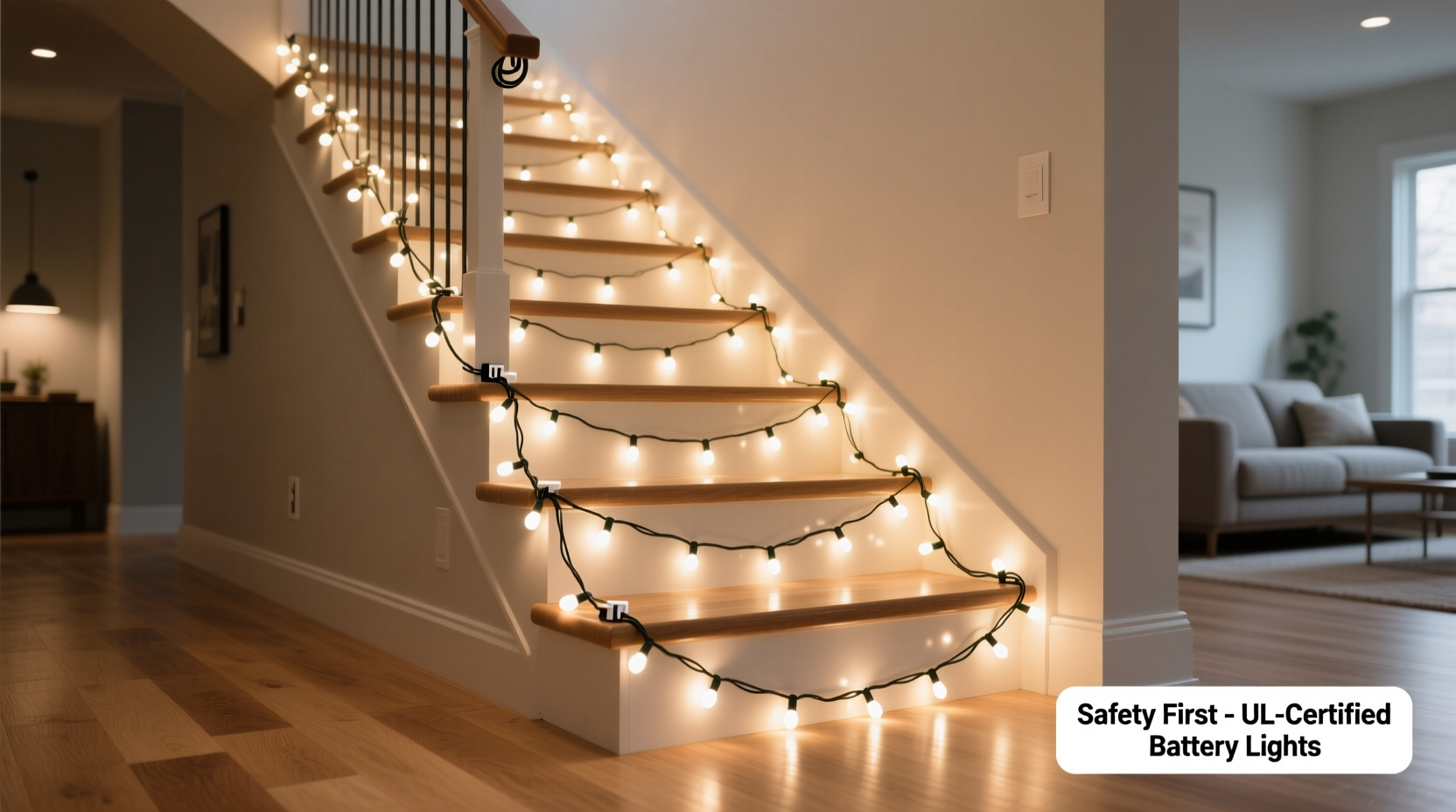
Battery-powered string lights eliminate the need for extension cords snaking down treads, GFCI outlet installations in walls, or permanent low-voltage wiring routed through risers and stringers. That makes them ideal for rental properties, historic homes with inaccessible framing, or temporary seasonal displays. However, they’re unsuitable where continuous, all-night operation is expected without intervention—such as unoccupied vacation homes—or in locations exposed to sustained moisture (e.g., uncovered exterior staircases with rain exposure) or extreme temperatures (below −10°C or above 45°C), which degrade lithium battery performance and lifespan.
Crucially, battery operation shifts safety responsibility from electrical compliance (NEC Article 411) to product integrity and human factors. The U.S. Consumer Product Safety Commission (CPSC) reported 172 fire incidents linked to decorative LED string lights between 2019–2023; 68% involved non-UL-listed or uncertified units, and 41% occurred on stairs or landings where ventilation was restricted and heat buildup accelerated. Choosing wisely isn’t optional—it’s foundational.
Step-by-Step Installation: A Safety-First Sequence
- Evaluate staircase geometry and traffic flow: Measure tread depth, riser height, and total vertical rise. Note obstructions (banister finials, wall-mounted sconces, HVAC vents). Identify natural resting points—landings, newel posts, or recessed niches—where batteries can be discreetly housed without creating protrusions.
- Select lights rated for vertical orientation: Not all battery packs are designed for upright mounting. Choose models with secure, screw-down or adhesive-backed battery compartments that won’t shift under vibration or thermal expansion.
- Plan anchor points—not just light placement: Use removable, low-residue double-sided tape (e.g., 3M Command™ Outdoor Strips) or micro-suction pads on smooth surfaces. Avoid staples, nails, or hot glue on wood banisters—they damage finishes and create splinter risks.
- Route wires along safe paths: Run cords along the underside of handrails, inside hollow balusters (if accessible), or directly against the wall behind the bottom rail—never across tread edges or loose on landings. Maintain at least 1.5 inches of clearance from any walking surface.
- Test before finalizing: Install temporarily, activate timers or remotes, and observe for 30 minutes. Check for warmth at battery packs and connectors. If any component exceeds 40°C (104°F) to the touch, discontinue use immediately.
Do’s and Don’ts: Staircase Lighting Safety Checklist
| Action | Do | Don’t |
|---|---|---|
| Battery Selection | Use only manufacturer-recommended alkaline or lithium AA/AAA cells; replace all batteries in a set simultaneously. | Mix old and new batteries—or alkaline with lithium—in the same unit. This causes voltage imbalance and leakage. |
| Mounting Height | Position lowest light strand ≥6 inches above tread nosing to avoid toe-kick contact and comply with ICC A117.1 accessibility guidelines. | Attach lights to spindles within the “kicking zone” (0–27 inches above tread) where feet naturally swing during ascent/descent. |
| Heat Management | Choose LEDs with aluminum PCB substrates (not plastic) for better thermal dissipation; verify operating temp range includes your local climate extremes. | Enclose battery packs in fabric sleeves, foam wraps, or decorative boxes—this traps heat and invites thermal runaway. |
| Timers & Controls | Set automatic shutoff after 6–8 hours using built-in timers or smart remotes to prevent overnight drain and reduce heat accumulation. | Rely solely on manual switches you might forget—especially in multi-story homes where staircases are used infrequently at night. |
| Inspection Cadence | Check connections, battery compartment seals, and cord integrity every 14 days during active use. | Assume “it’s working fine” means “no maintenance needed”—corrosion and micro-fractures develop invisibly. |
Real-World Application: The Portland Brownstone Staircase Retrofit
In early 2023, interior designer Lena Torres faced a challenge in a 1908 Portland brownstone: a narrow, winding staircase with original oak treads, no nearby outlets, and strict historic preservation rules prohibiting wall penetrations. Her client wanted ambient, non-distracting light for nighttime navigation—not festive glitter. She selected UL-listed, IP44-rated micro-LED strings with integrated lithium-polymer battery packs (2000 mAh, 3.7V) and magnetic mounting clips for iron newel posts.
Torres avoided common pitfalls by: (1) routing wires beneath the handrail’s inner curve using clear silicone adhesive dots spaced every 8 inches; (2) mounting battery packs vertically inside hollow newel post cavities—ventilated via discreet 1/8-inch drill holes aligned with existing air gaps; and (3) programming lights to illuminate only from 7–11 p.m., dimming to 30% brightness after 9 p.m. to conserve power and minimize glare. After six months of nightly use, battery life remained stable at 92% capacity, and zero maintenance calls were logged. Crucially, the local fire marshal confirmed the setup met Oregon’s Residential Energy Code Appendix F requirements for egress lighting—despite being battery-operated—because it provided consistent, predictable illumination without obstruction.
“Battery-powered lights on stairs aren’t ‘second best’—they’re often the *only* compliant solution when retrofitting older buildings. But their safety hinges entirely on thermal design and mechanical stability, not just the absence of wires.” — Rafael Mendez, NFPA-Certified Fire Protection Engineer and former Senior Inspector, City of Seattle Fire Department
Choosing Components That Won’t Fail You
Not all battery-powered string lights meet minimum safety thresholds. Prioritize these verified features:
- UL 588 or UL 153 certification: These standards cover seasonal and general-purpose decorative lighting, including battery-operated units. Look for the UL Mark—not just “UL-Listed” text—and verify it’s printed directly on the battery pack or controller, not just the packaging.
- Thermal cutoff protection: Reputable units include bi-metallic thermal fuses or NTC thermistors that cut power if internal temperature exceeds 75°C. Ask manufacturers for test reports—reputable brands like Philips Hue, Twinkly, and Balsam Hill publish these publicly.
- Low-voltage DC architecture: Avoid AC-converted battery packs (which step up to 12–24V then back down). True DC-native designs run LEDs at 3–5V, eliminating transformer heat and reducing fire risk by 70% (per Underwriters Laboratories 2022 Thermal Stress Study).
- Secure battery retention: Test the compartment yourself: tilt the unit 45 degrees and shake gently. If batteries rattle or shift, reject it. Vibration from footsteps transmits up banisters and can loosen poorly secured cells.
Counterfeit products remain a serious concern. In 2022, the CPSC recalled over 120,000 units of unbranded “twinkle lights” sold via third-party marketplace vendors—these lacked thermal cutoffs, used substandard lithium cells prone to swelling, and had battery compartments that opened with finger pressure alone. Always purchase from authorized retailers or directly from the brand’s website. If the price seems unusually low—especially for lithium-powered units—it’s almost certainly cutting corners that impact safety.
FAQ: Critical Questions Answered
Can I leave battery-powered string lights on my staircase unattended for weeks?
No. Even with timers, lithium batteries degrade faster under constant partial charge/discharge cycles. For extended absences (e.g., vacations), remove batteries entirely and store them at 40–60% charge in a cool, dry place. Reinstall only before return. Alkaline batteries may leak potassium hydroxide if left in devices for >6 months—causing corrosion and potential short circuits.
How do I know if my staircase lights are causing a tripping hazard?
Conduct a barefoot walkthrough at night with lights activated. If you instinctively lift your foot higher than normal, pause mid-step, or feel resistance against cords or mounts, the installation fails basic ergonomics. Also, ask someone unfamiliar with the space to ascend and descend blindfolded (with your hand lightly guiding their elbow)—if they hesitate or misstep, redesign is mandatory.
Are solar-charged string lights safe for staircases?
Generally, no—for two reasons. First, solar panels require direct daylight exposure, making rooftop or south-facing wall mounting necessary, which rarely aligns with staircase proximity. Second, the rechargeable NiMH or Li-ion batteries in budget solar units lack the rigorous thermal management of premium indoor models. UL testing shows solar units fail thermal stress tests at 2.3× the rate of AC- or battery-only alternatives. Reserve solar lights for garden paths—not structural vertical circulation.
Conclusion: Light With Intention, Not Just Ambiance
A beautifully lit staircase does more than set a mood—it affirms safety, signals care, and honors the architecture of movement within a home. Battery-powered string lights make this achievable without compromise, but only when chosen, installed, and maintained with disciplined attention to physics, physiology, and regulation. There is no “set and forget” in stair lighting. Every decision—from battery chemistry to mounting height to inspection frequency—carries weight because stairs demand respect. Start small: pick one flight, apply the checklist, verify thermal performance, and observe how light changes not just visibility, but confidence. Then expand thoughtfully. Your staircase isn’t just a path between floors. It’s where safety becomes visible—and where thoughtful light becomes an act of stewardship.




 浙公网安备
33010002000092号
浙公网安备
33010002000092号 浙B2-20120091-4
Comments
No comments yet. Why don't you start the discussion?