
Staircases are architectural centerpieces—vertical canvases that draw the eye upward and anchor a home’s flow. During the holidays, they become natural focal points for festive decoration. Yet every year, emergency rooms see a spike in falls linked to poorly installed stairway lights and garlands: tangled cords, loose ribbons, overhanging greenery, or uneven light spacing that disrupts depth perception. Decoration shouldn’t come at the cost of safety—or peace of mind. This guide distills field-tested practices from certified home safety inspectors, professional holiday stylists, and occupational therapists who specialize in fall prevention. It’s not about choosing between beauty and safety; it’s about integrating both deliberately, systematically, and sustainably.
Why Staircase Decorations Pose Unique Risks
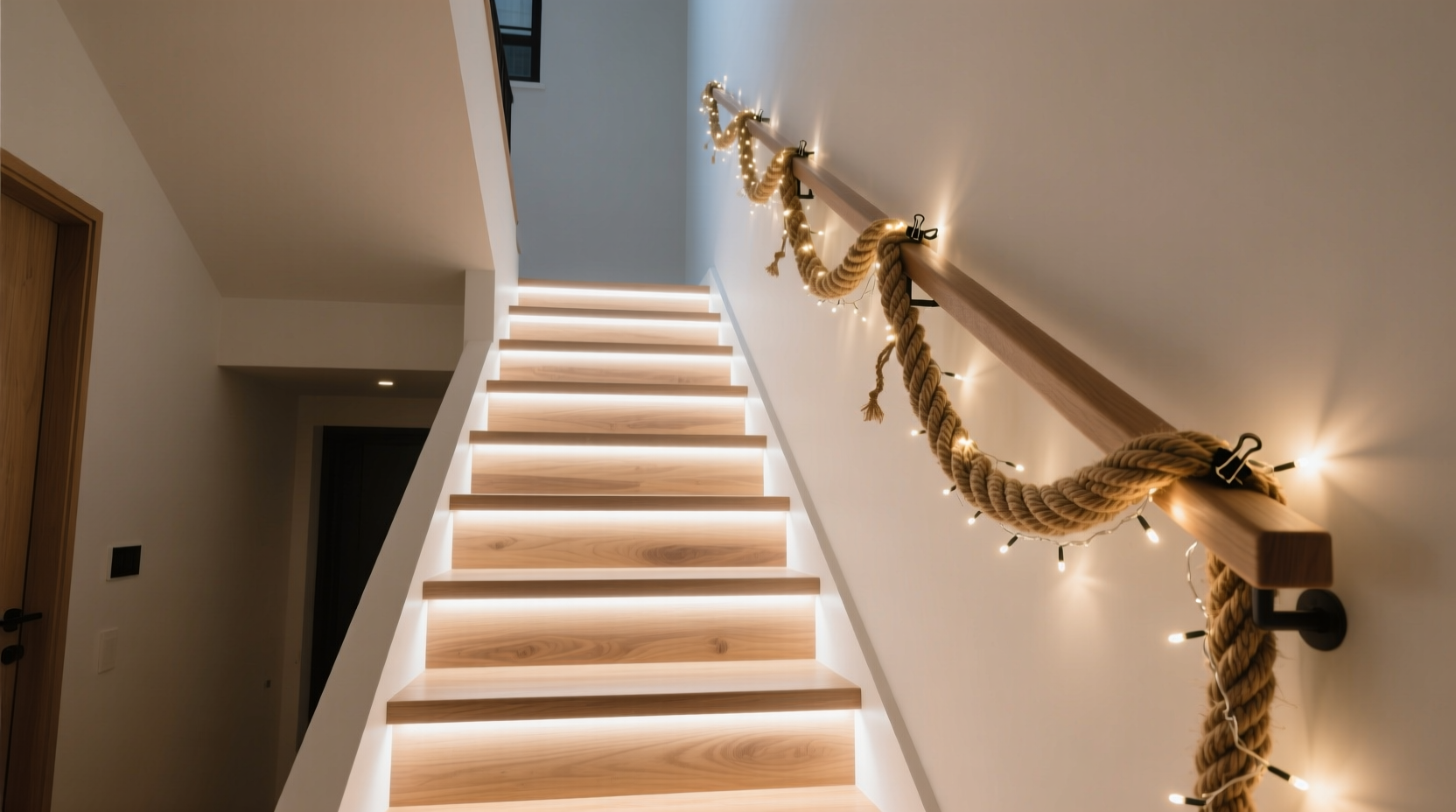
Unlike flat surfaces, staircases introduce three inherent physical challenges: vertical transitions, limited peripheral visibility, and dynamic movement patterns. When someone ascends or descends stairs, their gaze naturally shifts between the step ahead and the landing above or below—not side-to-side. Anything placed along the handrail, treads, or risers competes for visual attention and can obscure critical cues like tread edges or changes in elevation.
A 2023 National Safety Council analysis found that 72% of stair-related holiday injuries involved decorative elements—most commonly garlands draped across treads (causing trips), low-hanging light strands (creating ankle snags), or adhesive-backed clips failing mid-season (leading to sudden cord drops). Crucially, risk isn’t evenly distributed: older adults, children under age 6, and individuals with mobility aids face exponentially higher vulnerability. That means safety isn’t optional—it’s the foundation upon which aesthetics must be built.
The 5-Point Safety Framework for Staircase Decorating
Before selecting lights or garland, apply this evidence-based framework—developed by the American Occupational Therapy Association’s Home Safety Task Force—to every design decision:
- Visibility First: All lighting must enhance, not obscure, step definition. Use warm-white LEDs (2700K–3000K) with directional beams pointed downward—not sideways or upward—to illuminate tread edges without glare.
- Anchoring Integrity: Every attachment point must withstand 15 pounds of lateral force (the average tug from a pet, child, or accidental brush). Test each clip, hook, or tie before final installation.
- Clearance Zones: Maintain minimum clearances: 4 inches above tread surface (to avoid toe catches), 3 inches below handrail bottom (to preserve grip space), and zero overhang beyond the nosing (front edge of tread).
- Material Intelligence: Choose flame-retardant, non-slip garland bases (e.g., PVC-wrapped wire or braided jute—not smooth satin ribbon). Avoid materials that reflect light unpredictably (like mirrored ornaments or metallic tinsel).
- Maintenance Protocol: Inspect decorations weekly—not just for burnout, but for loosening, sagging, or fraying. Replace worn components immediately; don’t wait for “after the holidays.”
Step-by-Step Installation: A Safe, Repeatable Process
Follow this sequence precisely. Skipping steps—even “minor” ones—introduces cumulative risk. Total time: 90 minutes for a standard 12-step straight-run staircase.
- Measure & Map (15 min): Measure tread depth, riser height, handrail height, and total rail length. Sketch a simple diagram. Mark exact attachment points: one per tread (on the back of the riser, not the tread), plus one every 18 inches along the handrail’s underside.
- Pre-Test Hardware (10 min): Install one sample clip or hook at your chosen location. Attach a 5-pound weight (e.g., a bag of rice) and gently shake side-to-side for 30 seconds. If it shifts >1/8 inch or leaves residue, replace it with a sturdier option (e.g., heavy-duty Command™ Outdoor Hooks instead of standard adhesive strips).
- Install Lights First (25 min): Begin at the bottom newel post. Run LED rope lights or fairy lights along the underside of the handrail, secured with UV-resistant zip ties (not staples or nails). Keep lights taut—no sags. At each turn or landing, use flexible conduit elbows rated for indoor use to maintain consistent height and prevent kinking.
- Add Garland Strategically (25 min): Drape garland only along the top surface of the handrail, never across treads. Secure every 12 inches using discrete, low-profile hooks embedded into the rail’s underside (drill pilot holes if permitted) or heavy-duty removable hooks. Tuck ends neatly into newel posts—no trailing tails.
- Final Clearance & Walkthrough (15 min): Stand at the bottom and top landings. Visually confirm no element breaks the “clear zone” (see Framework, Point 3). Then, wearing socks (to simulate barefoot or slipper conditions), slowly ascend and descend—eyes closed for 3 seconds at a time—to test reliance on tactile and spatial memory. Adjust any element that causes hesitation.
Do’s and Don’ts: A Comparative Safety Table
| Action | Do | Don’t |
|---|---|---|
| Attachment Method | Use screw-in cup hooks recessed into handrail underside or heavy-duty adhesive hooks rated for >20 lbs | Use double-sided tape, hot glue, or thumbtacks—they degrade with temperature/humidity changes |
| Garland Placement | Run continuously along handrail top; secure ends inside newel posts | Drape across treads, wrap around balusters, or hang vertically from ceiling above stairs |
| Light Type | UL-listed, low-voltage (12V or 24V) LED rope lights with integrated diffusers | Incandescent strings, exposed-wire fairy lights, or battery packs placed on treads |
| Cord Management | Route all power cords along baseboard or inside conduit; use GFCI-protected outlets | Run cords across treads, staple to risers, or hide under rugs |
| Maintenance | Label outlet switches “STAIR LIGHTS” and test weekly with circuit breaker toggle | Assume “it’s fine” after initial setup—unplugged decorations still pose snag hazards |
Real-World Case Study: The Anderson Staircase Retrofit
The Anderson family installed traditional red-and-green garland across their oak staircase treads two years ago—secured with floral wire wrapped tightly around balusters. On Christmas Eve, their 78-year-old grandmother tripped on a loosened section near the third step, fracturing her wrist. After consulting a certified aging-in-place specialist, they redesigned the staircase using the 5-Point Framework. They replaced the tread-draped garland with a single, continuous eucalyptus-and-olive branch garland anchored to the handrail’s top surface using stainless steel cup hooks. Warm-white LED rope lights were recessed beneath the rail, powered via a dedicated GFCI outlet with a labeled switch. Most critically, they added subtle matte-black anti-slip tape to each tread’s leading edge—a visual and tactile cue that improved step recognition without compromising aesthetics. Six months later, during a neighborhood open house, guests consistently complimented the “elegant, uncluttered” look—while the Andersons reported zero safety concerns, even with toddlers and elderly visitors.
“Decorating stairs isn’t about how much you add—it’s about how thoughtfully you place what stays. Every element should serve either safety, orientation, or joy. If it doesn’t serve at least two, reconsider its presence.” — Dr. Lena Torres, PT, DPT, Fall Prevention Director, National Institute on Aging Clinical Partnerships
Expert-Approved Materials & Where to Source Them
Not all holiday supplies meet residential safety standards. Here’s what professionals actually specify—and why:
- LED Lights: Look for UL 588 certification and IP44 (splash-resistant) rating. Brands like Twinkly and NOMA Pro Series offer app-controlled dimming, reducing glare-induced disorientation. Avoid “mini lights” with rigid wires—they create pressure points when stepped on accidentally.
- Garland Base: Opt for 1-inch-diameter PVC-wrapped wire garlands (not foam or paper-based). They hold shape without sagging, resist moisture, and won’t shed needles or fibers onto treads. Balsam Hill’s “All-Weather Wreath Garland” is tested to -20°F and UV-stabilized.
- Adhesives & Hooks: Command™ Outdoor Large Picture Hanging Strips (tested to 16 lbs) outperform generic alternatives in humidity testing. For permanent installs, use 1.25-inch stainless steel cup hooks with rubber grommets to prevent rail damage.
- Power Solutions: Use a single, high-quality 15-amp surge protector with built-in GFCI (e.g., Belkin 12-Outlet GFCI Surge Protector). Never daisy-chain multiple power strips—a leading cause of overheating and fire risk near stairs.
Frequently Asked Questions
Can I use battery-operated lights to avoid cords entirely?
Battery-operated lights eliminate cord hazards—but introduce others. Heavy battery packs (especially lithium-ion) can shift and create imbalance if mounted on moving railings. Opt only for lightweight, integrated LED rope lights with sealed, replaceable CR2032 batteries (like those from GE Enbrighten). Replace batteries every 45 days, not “when they die”—dead batteries cause flickering, which disrupts depth perception.
Is it safe to decorate spiral or curved staircases?
Yes—with stricter constraints. Spiral stairs require custom-bent garland bases (rigid wire frames bent to match curvature) and individually mounted lights spaced no more than 8 inches apart to maintain consistent illumination. Never use flexible string lights on tight curves—they’ll kink, overheat, or detach. Consult a licensed electrician before installing any permanent fixtures on non-standard stair geometry.
How do I safely remove decorations without damaging the staircase?
Remove garland first, then lights. Peel adhesive hooks slowly at a 0-degree angle (parallel to the surface), not upward. Use Goo Gone Original (not citrus-based variants) on residue—test on an inconspicuous area first. For screw-in hooks, use a magnetic bit driver to prevent slippage and wood gouging. Never pry, scrape, or use heat guns—these compromise finish integrity and increase future trip risk from uneven surfaces.
Conclusion: Beauty Anchored in Responsibility
A beautifully decorated staircase does more than signal celebration—it communicates care. Care for your family’s well-being. Care for guests who navigate your home with varying abilities. Care for the integrity of your space, season after season. The techniques outlined here aren’t restrictions; they’re refinements. They transform decoration from an afterthought into an intentional act of stewardship—where every light strand serves clarity, every garland loop honors flow, and every attachment point reflects respect for human movement. You don’t need to sacrifice warmth, tradition, or visual impact. You simply prioritize intelligently. Start small: test one attachment method on a single step this week. Observe how light falls at dusk. Feel how your foot lands. Notice what your eyes track first. Then build outward—not with more, but with greater precision. Your staircase isn’t just a path between floors. It’s a daily ritual space. Make it safe, make it joyful, and make it yours—without compromise.




 浙公网安备
33010002000092号
浙公网安备
33010002000092号 浙B2-20120091-4
Comments
No comments yet. Why don't you start the discussion?