
Minimalism during the holidays isn’t about stripping away joy—it’s about distilling it. A minimalist Christmas tree doesn’t mean sacrificing spirit; it means choosing meaning over mass, intention over impulse, and calm over chaos. In a season saturated with sensory overload—blinking lights, layered ornaments, competing scents, and relentless commercial cues—a thoughtfully pared-down tree becomes an anchor: a quiet celebration of light, form, and presence. This approach resonates deeply with people who value mindful living, small-space aesthetics, neurodivergent-friendly environments, or simply the relief of less visual noise without losing warmth. The goal isn’t austerity—it’s resonance. Every element on the tree should earn its place through emotional weight, textural harmony, or quiet symbolism.
The Philosophy Behind Minimalist Holiday Design
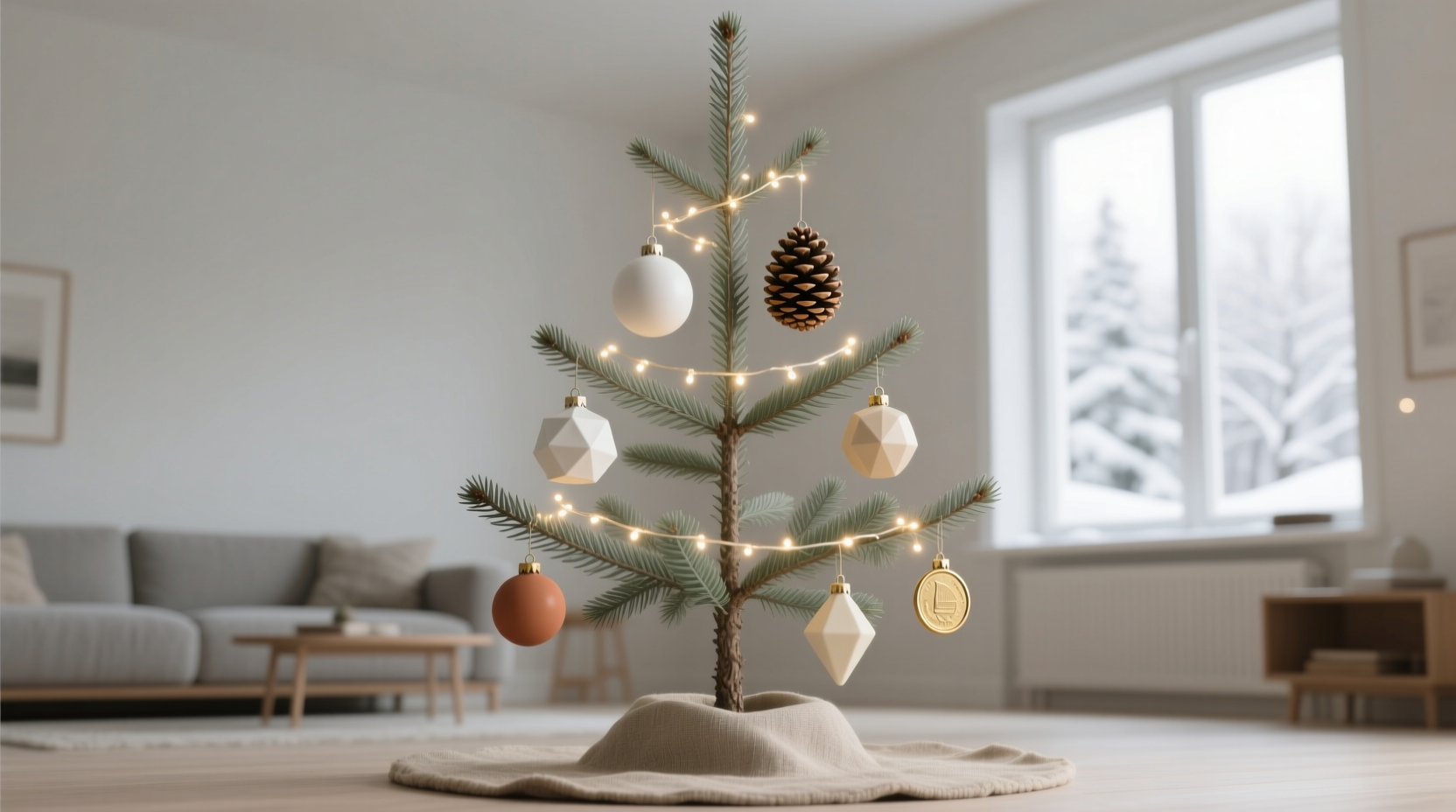
Minimalist tree design begins not with decor, but with mindset. It rejects the “more is merrier” narrative in favor of what designer and author Charlotte Hodes calls “generous restraint”—a practice where limitation becomes a catalyst for deeper attention. When ornament choices are reduced, the eye lingers longer on each piece: the curve of a hand-thrown ceramic bauble, the soft glow of warm-white LEDs, the subtle grain of a dried orange slice. This shift invites participation rather than passive consumption. You’re not decorating *at* the tree—you’re conversing *with* it.
This philosophy also aligns with growing cultural values: sustainability (fewer mass-produced items), mental wellness (reduced decision fatigue and visual clutter), and intergenerational appeal (children notice texture and light more readily than intricate detailing). A minimalist tree often feels more inclusive—its quiet elegance doesn’t require shared cultural fluency with traditional motifs to feel meaningful. Its power lies in universality: light against dark, symmetry balanced by asymmetry, natural materials honoring seasonal cycles.
Selecting Your Foundation: Tree, Shape, and Scale
The tree itself is the first and most consequential design decision. A minimalist aesthetic demands structural integrity and clean lines. Real firs—especially Nordmann or Fraser—offer dense, uniform branching with deep green needles that provide rich contrast for sparse ornamentation. Their natural symmetry reduces the need for corrective styling. For artificial options, prioritize trees with slender, tapered profiles (avoid “full bushy” styles) and matte, non-reflective PVC tips that mimic organic texture. Height matters: in standard living rooms (8–9 ft ceilings), a 6.5–7 ft tree creates ideal proportion—leaving breathing room above and below without dwarfing furniture.
Shape is equally vital. A classic conical silhouette reads as timeless and grounded. Avoid overly narrow pencil trees (they lack visual weight) or wide, squat forms (they invite clutter). For smaller spaces, consider a single-stemmed “feather tree” or a curated tabletop version using a birch branch or foraged evergreen bough arranged vertically in a weighted ceramic vessel—this transforms the tree from centerpiece to intentional object.
| Tree Type | Best For | Why It Works Minimally | Avoid If… |
|---|---|---|---|
| Nordmann Fir (real) | Living rooms, open-plan spaces | Dense, upward-facing branches create natural negative space; deep green acts as a rich “canvas” | You have pets that chew or high-traffic areas where needles may scatter |
| Matte-Finish Slim Artificial | Small apartments, rentals, allergy-sensitive homes | No maintenance, consistent shape year after year, zero needle drop | You prefer the scent and ritual of a real tree |
| Single-Stem Birch or Willow | Studio apartments, bedrooms, modern lofts | Radical reduction—celebrates line, shadow, and material honesty; easily styled with one or two hanging elements | You want traditional “tree” symbolism or family photo backdrops |
The Three-Layer Ornament System
Instead of layering dozens of ornaments, minimalist trees thrive on a disciplined three-layer system—each layer serving a distinct visual and emotional function. This structure ensures balance, rhythm, and intentionality without rigidity.
- Anchor Layer (3–5 pieces): These are your heaviest, most tactile ornaments—ceramic spheres, cast brass stars, or hand-dipped beeswax candles. Placed at key structural points (base corners, mid-level center, top third), they ground the composition. Size varies intentionally: largest at base (2.5–3 inches), smallest near top (1–1.5 inches).
- Rhythm Layer (7–12 pieces): Uniform in material but varied subtly in finish or orientation—e.g., ten matte white porcelain balls, three hung straight, four tilted slightly, three with faint gold interior glaze visible only when light catches them at certain angles. Distributed along central vertical axis, spaced 8–10 inches apart. This layer creates gentle repetition—not monotony.
- Whisper Layer (1–3 pieces): One-of-a-kind elements that tell a personal story: a child’s clay star from kindergarten, a vintage Czech glass bead collected on travels, a pressed sprig of rosemary tied with undyed linen thread. These aren’t “decor”—they’re heirlooms-in-waiting. They go exactly where they feel right, never forced.
This system prevents haphazard clustering and honors the tree’s natural architecture. It also makes annual setup efficient: you’re not hunting for “just one more” ornament—you’re placing meaning.
Lighting with Intention: Warmth Over Wow
Lighting is where many minimalist trees falter—either too sparse (feeling unfinished) or too bright (undermining serenity). The solution lies in temperature, placement, and purpose. Use only warm-white LEDs (2200K–2700K color temperature)—never cool white or multicolor. This mimics candlelight and enhances wood tones, ceramics, and natural fibers while softening shadows rather than casting harsh highlights.
String lights should follow the tree’s central spine, not wrap every branch. Start at the trunk base, spiral upward with 6–8 inch vertical spacing between loops, ending just below the tip. Hide the plug cord inside the stand or behind a lower branch. For a 7-ft tree, 100–150 bulbs are ample; more dilutes impact. Battery-operated puck lights nestled deep in inner branches add dimension without wires—place three: one low, one mid, one high—aimed inward to illuminate the tree’s core, not its surface.
“Light in minimalism isn’t illumination—it’s revelation. It should reveal texture, not erase shadow. A well-lit minimalist tree feels like it’s breathing light from within.” — Lena Vogel, Lighting Designer & Author of Quiet Light
Real-World Example: The Urban Studio Tree
Maria, a graphic designer living in a 550-square-foot Toronto loft, struggled with holiday overwhelm for years. Her previous trees—dense with glitter, tinsel, and mismatched ornaments—felt alien in her otherwise serene, neutral-toned space. Last December, she committed to a minimalist approach guided by three constraints: no plastic, no red/green, nothing store-bought that wasn’t handmade.
She selected a 6.5-ft Nordmann fir delivered locally. For anchors, she used three wheel-thrown stoneware orbs (matte charcoal, oatmeal, and iron oxide red—deep, earthy, not candy-like) made by a nearby potter. Her rhythm layer consisted of eleven hand-blown glass baubles in varying thicknesses but identical smoky-gray hue—each catching light differently. Her whisper element was a single brass pinecone forged by her grandfather in the 1950s, hung at eye level on the left side.
She strung 120 warm-white micro-LEDs along the trunk’s spine and added two battery-powered amber pucks deep in the lower canopy. She skipped a tree skirt entirely, letting the fir’s natural base rest on her pale oak floor. The result? A tree that felt like a continuation of her home—not an intrusion. Visitors consistently remarked on its “calm energy,” and Maria reported feeling lighter, not deprived, throughout December. “It didn’t feel like less,” she said. “It felt like *enough*, finally.”
Step-by-Step Setup Timeline
Adopting minimalism requires planning—not perfection. Follow this 90-minute timeline for stress-free execution:
- Day Before (10 min): Unbox and fluff tree (if artificial) or secure real tree in stand with fresh water. Let it acclimate in its final location.
- Setup Day – Hour 1 (30 min): String lights precisely along the trunk spine. Test functionality. Tuck excess cord.
- Setup Day – Hour 2 (25 min): Place anchor ornaments first—use painter’s tape to mark ideal spots before hanging. Step back. Adjust spacing until visually balanced.
- Setup Day – Hour 3 (15 min): Add rhythm layer, counting placements to maintain even vertical intervals. Rotate each ornament slightly for organic variation.
- Final Touch (10 min): Hang whisper piece. Stand back for 2 full minutes—no adjustments. Then add one final element: a single sprig of eucalyptus tucked into the topmost branch, facing outward. Its silvery-green hue and subtle aroma complete the sensory experience without visual competition.
Do’s and Don’ts: Common Pitfalls and Fixes
| Do | Don’t | Why It Matters |
|---|---|---|
| Use odd numbers of ornaments per layer (3, 5, 7) | Arrange in symmetrical pairs or grids | Odd numbers create natural visual flow; symmetry feels static and decorative rather than alive |
| Choose ornaments with inherent texture (ribbed ceramic, hammered metal, raw-edged wood) | Select perfectly smooth, glossy finishes | Texture adds depth and interest without visual noise—gloss reflects light unpredictably, breaking calm |
| Let negative space dominate—aim for 65% tree, 25% ornament, 10% light | Fill all visible branch tips | Empty space is active, not empty—it allows the eye to rest and the tree’s form to read clearly |
| Rotate ornaments annually: swap one anchor, refresh rhythm layer with new handmade batch | Keep the same ornaments every year without editing | Minimalism evolves—it’s not a frozen aesthetic but a living practice of discernment |
FAQ
Can I use a colored tree—like white or black—for minimalism?
Yes—but with nuance. A naturally white-barked birch stem or a blackened ash branch works beautifully as a sculptural base, especially with monochrome ornaments. Avoid painted or dyed artificial trees, which often read as gimmicky rather than intentional. Authenticity of material matters more than literal color.
What if my family expects “more” decoration?
Invite collaboration around meaning, not volume. Ask each person to bring one personal item that represents their favorite memory of the season—then integrate those into the whisper layer. This shifts focus from accumulation to storytelling, honoring tradition while honoring simplicity.
How do I store minimalist ornaments so they last decades?
Wrap each piece individually in acid-free tissue paper, nestle into rigid cardboard boxes lined with wool felt, and store in a cool, dry closet away from sunlight. Label boxes by layer (“Anchor: Charcoal Sphere,” “Rhythm: Gray Glass x11”)—not by year. This preserves both physical integrity and conceptual clarity for future setups.
Conclusion
A minimalist Christmas tree is not a compromise—it’s a commitment. A commitment to noticing the way light pools in the curve of a ceramic sphere at dusk. To feeling the weight of a brass pinecone warmed by ambient heat. To hearing the quiet rustle of fir needles as you pass by, unburdened by visual static. It asks you to trade the exhaustion of excess for the vitality of attention. And in doing so, it restores something essential: the ability to feel festive not because of what’s piled on, but because of what’s truly present.
Your tree doesn’t need to shout to be seen. It doesn’t need to dazzle to be loved. It simply needs to be yours—thoughtfully chosen, gently placed, quietly held. So this year, resist the urge to fill. Instead, pause. Breathe. Choose one thing that feels true. Then another. Then stop. Let the space between speak, too. That’s where the magic lives—not in the abundance, but in the resonance.




 浙公网安备
33010002000092号
浙公网安备
33010002000092号 浙B2-20120091-4
Comments
No comments yet. Why don't you start the discussion?