
The P0461 trouble code in Audi vehicles indicates a malfunction in the fuel level sensor circuit—specifically, an inaccurate fuel gauge reading due to a discrepancy between the expected and actual signal from the fuel level sensor. Left unresolved, this issue can lead to unreliable fuel readings, unexpected stalling, or even engine start problems. More importantly, it may mask deeper electrical or mechanical faults within the fuel system. Addressing the P0461 code promptly ensures accurate fuel monitoring, enhances driving safety, and prevents unnecessary repair costs down the line.
Understanding the P0461 Code: What It Means
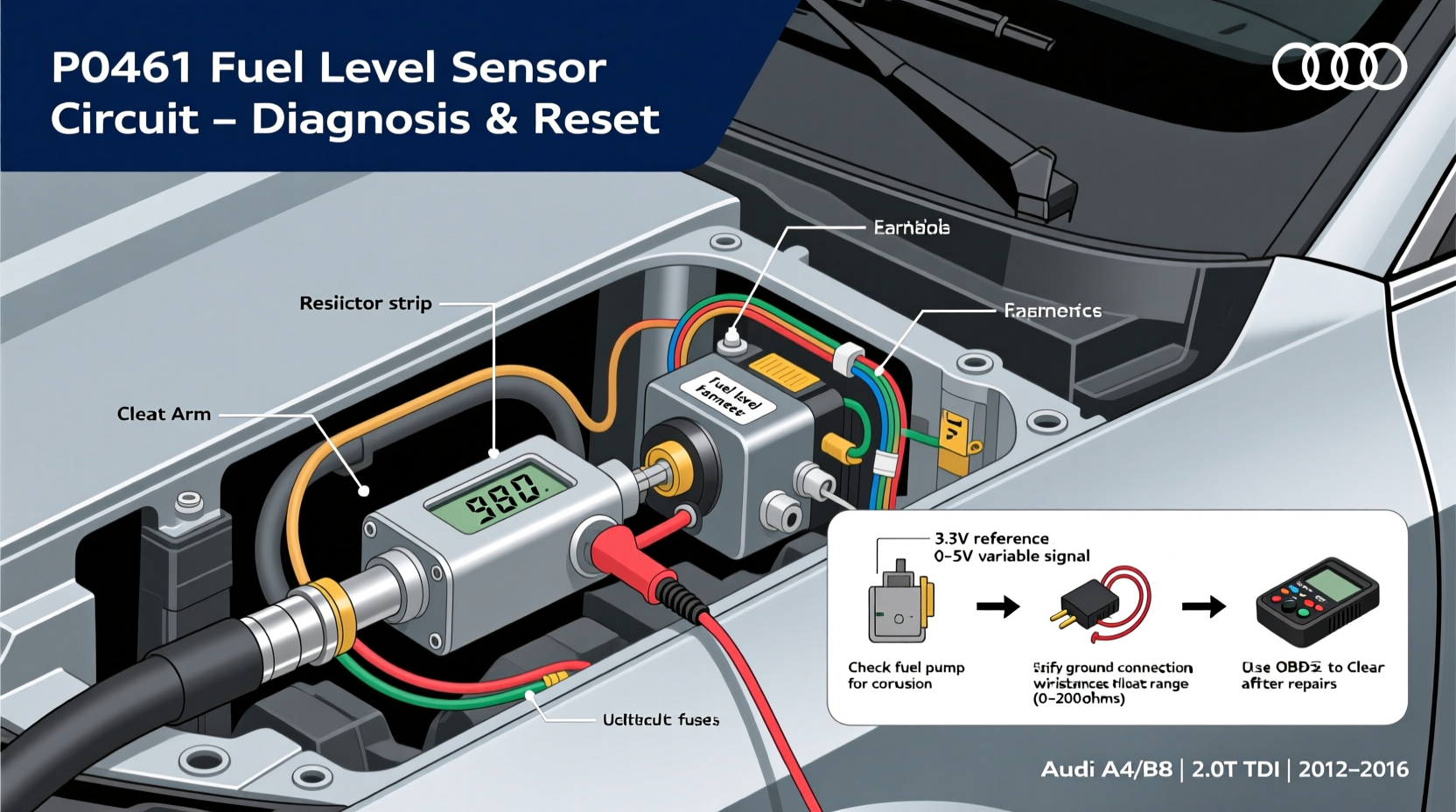
The OBD-II code P0461 stands for “Fuel Level Sensor ‘A’ Range/Performance.” This diagnostic trouble code is triggered when the Engine Control Module (ECM) detects that the voltage signal from the fuel level sensor does not align with expected parameters during vehicle operation. The sensor, located inside the fuel tank as part of the fuel pump assembly, measures fuel volume using a float arm connected to a variable resistor. As fuel levels change, so does the resistance, which translates into a voltage signal sent to the ECM.
When the ECM receives inconsistent, erratic, or out-of-range signals—such as sudden drops in fuel level without corresponding driving distance—it logs the P0461 code. While the most common symptom is an inaccurate fuel gauge (stuck on empty or full), other signs include illuminated warning lights, false low-fuel alerts, or failure to pass emissions testing due to incomplete readiness monitors.
“Modern fuel systems rely on precise sensor feedback. A faulty fuel level sensor doesn’t just mislead the driver—it disrupts onboard diagnostics and evaporative emission control functions.” — Daniel Meier, ASE-Certified Master Technician
Step-by-Step Diagnosis Process
Diagnosing the root cause of P0461 requires methodical inspection rather than immediate part replacement. Follow this sequence to identify whether the issue lies in the sensor, wiring, connector, or ECM communication.
- Scan for Additional Codes: Use a professional-grade OBD-II scanner to check for related codes such as P0451 (fuel tank pressure sensor), P0463 (high input), or P0460 (low fuel level). These may point to broader fuel system issues.
- Inspect the Fuel Gauge Behavior: Observe if the gauge fluctuates erratically, reads empty when full, or remains static regardless of actual fuel level.
- Check Connector and Wiring at the Fuel Pump Module: Locate the access panel under the rear seat or trunk floor (model-dependent). Disconnect the harness and inspect for corrosion, bent pins, or loose connections.
- Test Reference Voltage and Ground: With the ignition on, use a multimeter to verify the sensor’s reference voltage (typically 5V) and solid ground connection at the connector.
- Measure Sensor Resistance: Remove the fuel level sensor and measure resistance across its terminals at different float positions. Compare values to factory specifications (usually available in repair manuals).
- Monitor Live Data: Reconnect the system and use scan tool live data to observe real-time fuel level percentage while manually moving the float arm. Look for smooth transitions without jumps or dead zones.
Common Causes and Repair Options
The P0461 code can stem from several sources. Identifying the exact culprit avoids wasted time and money.
| Cause | Symptoms | Solution |
|---|---|---|
| Faulty Fuel Level Sensor | Inaccurate gauge, intermittent readings | Replace sensor or full fuel pump module |
| Corroded or Loose Connector | No signal, intermittent dropout | Clean contacts, secure harness, apply dielectric grease |
| Wiring Damage (Open/Short) | No reference voltage, grounded signal | Repair damaged wires along chassis or through firewall |
| Sticking Float Arm | Gauge stuck at one level | Lubricate pivot point or replace sender unit |
| ECM Communication Fault | Misfires, multiple sensor errors | Professional diagnosis; possible reprogramming or ECM replacement |
On many Audi models—including A4, A6, and Q5—the fuel level sensor is integrated into the fuel pump module, meaning replacement often involves swapping the entire unit. Aftermarket sensors are available, but OEM parts from Bosch or VDO offer better long-term reliability.
Resetting the P0461 Code and Verifying Repair
After completing repairs, resetting the code and confirming the fix is essential. Simply clearing the code without verification may result in recurrence.
- Reconnect all components and ensure tight electrical connections.
- Reconnect the battery and turn the ignition to “ON” (do not start the engine).
- Use your OBD-II scanner to clear the stored DTCs (Diagnostic Trouble Codes).
- Start the engine and let it idle for 2–3 minutes.
- Drive the vehicle through a variety of conditions: idle, acceleration, cruising, and deceleration.
- After 10–15 minutes of mixed driving, rescan the system to confirm the code has not returned.
- Verify that the fuel gauge responds accurately to changes in fuel level over the next few fill-ups.
Mini Case Study: Resolving Persistent P0461 in a 2012 Audi A4
A 2012 Audi A4 2.0T owner reported recurring P0461 codes despite replacing the fuel pump module six months prior. Initial diagnostics showed normal resistance and voltage at the connector, yet the fuel gauge would drop to zero after refueling.
Further investigation revealed that the replacement module used a non-OEM float arm with slightly different buoyancy characteristics. When combined with a minor software calibration mismatch, the ECM interpreted the signal as out of range. The solution involved installing a genuine Audi fuel pump module and performing a module adaptation via VCDS (VAG-COM) software to re-synchronize the fuel level reading with the ECM.
This case highlights the importance of using compatible parts and leveraging advanced diagnostic tools beyond basic code readers.
Essential Checklist for DIY Diagnosis and Reset
- ✅ Retrieve all stored trouble codes using a capable scan tool
- ✅ Visually inspect fuel pump module connector for damage or moisture
- ✅ Test reference voltage (should be ~5V) and ground continuity
- ✅ Measure sensor resistance at multiple float positions
- ✅ Check for physical obstructions or binding in the float arm
- ✅ Replace sensor or module if readings fall outside spec
- ✅ Clear codes only after confirming repair
- ✅ Complete a drive cycle to validate system stability
Frequently Asked Questions
Can I drive my Audi with a P0461 code?
Yes, but with caution. The engine will run normally, but you risk running out of fuel unexpectedly due to inaccurate gauge readings. It’s best to address the issue promptly.
Is the fuel level sensor separate from the fuel pump?
In most modern Audis, the sensor is integrated into the fuel pump assembly. While some aftermarket kits offer standalone sensors, full module replacement is standard practice.
Why does the P0461 code return after clearing?
If the underlying issue—such as a failing sensor, poor connection, or wiring fault—isn’t resolved, the ECM will detect the same anomaly and re-trigger the code. Ensure thorough diagnosis before assuming the repair is complete.
Conclusion: Maintain Accuracy for Long-Term Reliability
Accurate fuel monitoring is more than a convenience—it's critical for efficient engine management and emissions control. Diagnosing and resetting the Audi P0461 code properly protects your vehicle’s performance and prevents misleading warnings that could compromise safety. Whether you're tackling the repair yourself or preparing to speak knowledgeably with a technician, understanding the sensor’s role, testing procedures, and reset protocol empowers informed decisions.




 浙公网安备
33010002000092号
浙公网安备
33010002000092号 浙B2-20120091-4
Comments
No comments yet. Why don't you start the discussion?