
Artificial Christmas trees offer convenience, longevity, and flame resistance—but even high-end models can develop thinning branches over time. Wear from storage, repeated fluffing, or suboptimal assembly often leaves awkward voids: bare wire stems near the trunk, gaps between tiers, or sparse outer tips that undermine the illusion of abundance. Rather than replacing the tree (an expensive, environmentally taxing choice), savvy decorators turn to nature-inspired solutions: real botanical elements, layered textures, and light-based illusions that mimic how evergreens grow in the wild. This approach doesn’t just mask imperfections—it enhances realism. Botanists confirm that mature firs and spruces aren’t uniformly dense; they feature subtle variations in foliage density, layered depth, and organic asymmetry. The goal isn’t perfection—it’s authenticity.
Why “Natural” Disguising Works Better Than Artificial Fixes
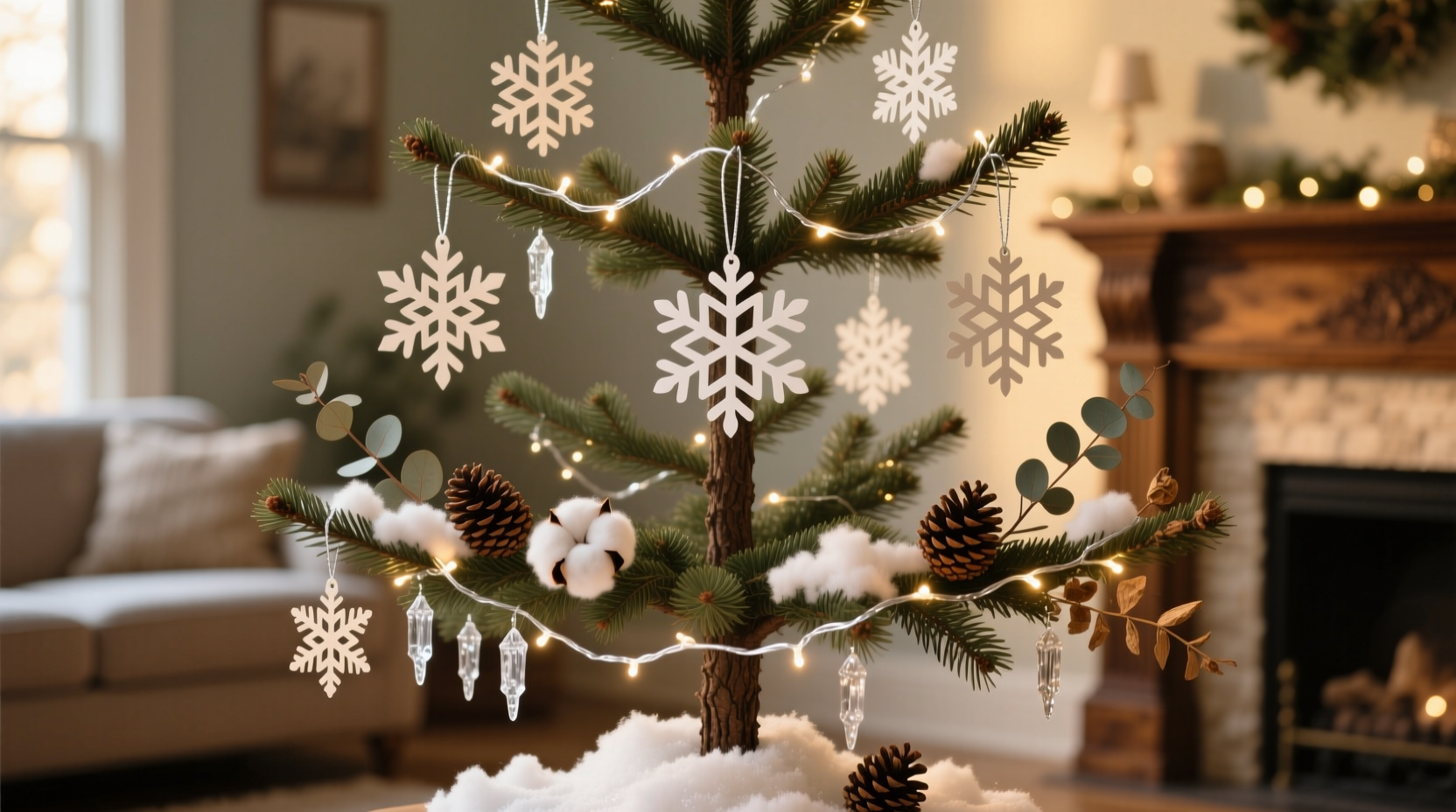
Most quick fixes—like stuffing plastic garlands into gaps or taping on mismatched branch tips—backfire under close inspection. They create visual noise, reflect light unnaturally, or introduce jarring color shifts (e.g., overly bright green plastic against muted faux-pine). In contrast, natural materials share key optical properties with real conifers: matte surface texture, variable needle length, subtle chlorophyll gradients, and gentle flexibility that responds to air movement. When integrated thoughtfully, dried eucalyptus, preserved cedar, or even responsibly foraged pine boughs don’t look “added”—they look like extensions of the tree’s own growth pattern. As landscape designer and holiday styling consultant Lena Torres explains:
“An artificial tree’s greatest strength is its structure—not its surface. Use that framework to support real botanicals. A few well-placed sprigs of rosemary beside a gap read as ‘new growth,’ not ‘cover-up.’ That psychological shift is what makes the difference between ‘I see the flaw’ and ‘I feel the forest.’” — Lena Torres, Founder of Evergreen Studio & Author of Seasonal Design Beyond the Tinsel
This principle anchors every technique below: work *with* the tree’s architecture, not against it.
Five Natural, Low-Cost Materials That Blend Seamlessly
Not all botanicals are equal for this purpose. Success depends on compatibility with artificial tree color temperature, scale, and texture. Below is a curated comparison of proven performers:
| Material | Best For | Key Advantage | Caution |
|---|---|---|---|
| Dried Eucalyptus (silver dollar or baby) | Mid-canopy gaps, upper-tier softening | Matte silver-green hue matches most faux-pine tones; flexible stems grip wire easily | Avoid if household has birds or small children—eucalyptus oil is toxic if ingested |
| Preserved Cedar Boughs | Trunk-base voids, lower-tier density | Deep green, feathery texture mirrors Fraser fir; retains shape for 3–4 seasons | Must be purchased pre-preserved—fresh cedar dries brittle and drops needles rapidly |
| Rosemary Sprigs (dried or fresh) | Tiny tip gaps, inner branch clusters | Narrow, linear profile mimics young pine shoots; aromatic scent adds sensory authenticity | Fresh rosemary wilts in dry indoor heat within 7–10 days; use dried for longevity |
| White Pine Cones (unscented, unpainted) | Concealing wire junctions, trunk intersections | Natural brown tones break up metallic glare; irregular shapes distract the eye from symmetry flaws | Avoid painted or glitter-coated cones—they scream “artificial addition” |
| Wheat Stems (dried, bleached or natural) | Horizontal layering across sparse zones | Soft golden-brown adds warmth and vertical rhythm; lightweight and easy to tuck | Do not use near open flames or hot lights—highly flammable when fully desiccated |
Source materials locally when possible. Farmers’ markets, floral wholesalers, or even your own yard (if pruning conifers) yield fresher, more color-matched results than mass-produced craft store bundles.
Step-by-Step: The “Layer & Light” Method for Seamless Integration
This 6-step process prioritizes visual hierarchy—guiding the eye *away* from gaps and *toward* intentional focal points. It takes 45–75 minutes, depending on tree size, and requires no specialized tools.
- Assess & Map Gaps at Eye Level: Stand 6 feet back and note where emptiness is most visible (not where it feels worst to you). Mark these zones lightly with removable painter’s tape. Focus only on areas visible from primary living spaces—not the back or floor-level periphery.
- Fluff Strategically, Not Uniformly: Gently bend outward any stiff, inward-facing branch tips near gaps. Don’t force them—bend only to 15–20 degrees. This creates “negative space pockets” where botanicals will nestle without looking inserted.
- Add Depth with Layered Foliage: Start with longest material (cedar boughs) at the *back* of each gap zone, securing stems deep into the trunk’s central wire. Then layer medium-length eucalyptus in front, angled slightly upward. Finish with short rosemary sprigs at the very front tip. This replicates how real trees grow: older wood behind, new growth forward.
- Break Up Linear Sightlines: Place 2–3 unscented white pine cones where branch wires intersect. Their organic irregularity disrupts the “grid effect” of artificial construction, making structural flaws recede.
- Deploy Warm-Tone Lighting: Replace cool-white mini-lights with warm-white (2700K) LEDs. Hang them *behind* and *within* gaps—not just on outer tips. The gentle glow diffuses through eucalyptus and cedar, creating soft halos that visually “fill” space without adding physical bulk.
- Final Texture Pass: Lightly mist dried wheat stems with a fine water spray (1–2 pumps), then tuck vertically into sparse horizontal zones. As moisture evaporates, stems soften and curl naturally, mimicking wind-swept pine fronds.
Real-World Application: The Maple Street Living Room Case Study
In December 2023, Sarah M., a graphic designer in Portland, OR, faced a common dilemma: her 12-year-old 7.5-foot Noble Fir artificial tree had developed pronounced gaps in its middle third after three moves and attic storage. “It looked like a ladder with green rungs,” she recalls. She tried traditional fixes—adding extra garlands, re-fluffing for hours—but the hollows remained glaring under her living room’s recessed ceiling lights. Following the Layer & Light Method, she sourced cedar boughs from a local arborist (who pruned diseased limbs) and dried eucalyptus from her garden. She skipped rosemary (her cat was curious) and used unbleached wheat stems instead. Most crucially, she replaced her old cool-white lights with warm-white LEDs and intentionally hung 30% of them *inside* the canopy, threading them through gaps before adding foliage. The result? Guests consistently asked, “Is that a real tree?” not because it looked perfectly full, but because its shadows, textures, and light diffusion felt ecologically coherent. “The gaps didn’t vanish,” Sarah notes. “But they stopped being the thing people noticed first.”
What NOT to Do: The Five Common Pitfalls
- Overloading one area: Adding excessive botanicals to a single gap creates a “lump” that draws more attention than the void itself. Distribute volume across 2–3 adjacent zones.
- Mismatching scale: Large magnolia leaves or oversized pinecones overwhelm delicate artificial needles. Stick to elements no wider than 2 inches and no longer than 8 inches.
- Ignoring scent migration: Strong-smelling herbs (lavender, mint) clash with traditional pine fragrance and can trigger headaches. Rosemary is safe; avoid anything with volatile oils unless well-ventilated.
- Using fresh cuttings indoors without hydration: Fresh holly or fir boughs dehydrate in 3–5 days, turning brown and brittle. Only use fresh material if placed in water-filled floral tubes (hidden in the stand) or opt for professionally preserved alternatives.
- Forgetting fire safety: Dried botanicals are combustible. Keep all natural elements at least 3 feet from candles, fireplaces, or space heaters—even if labeled “flame-retardant.”
FAQ: Addressing Practical Concerns
Can I reuse the botanicals next year?
Yes—with care. Store dried eucalyptus, cedar, and wheat in breathable cotton bags (not plastic) in a cool, dark closet. Avoid humidity and direct light. Inspect for dust or brittleness before reusing; discard any material that crumbles or smells musty. Properly stored, they retain integrity for 2–3 seasons.
Will pets or kids be tempted to chew on the natural additions?
Supervision is essential during setup. While dried eucalyptus and cedar are low-toxicity when intact, ingestion can cause mild GI upset. Rosemary is pet-safe in small amounts. For homes with toddlers or chewing-prone pets, prioritize wheat stems and pine cones—both are unpalatable and pose minimal risk if accidentally ingested.
How do I clean the tree *after* adding botanicals?
Never use water or cleaners on botanicals—they’ll warp or discolor. Instead, use a hairdryer on cool, low setting, held 12 inches away, to blow dust off surfaces. For the artificial tree itself, vacuum gently with a brush attachment *before* removing botanicals. Store botanicals separately to prevent resin transfer onto plastic branches.
Conclusion: Embrace Imperfection as Authenticity
A truly convincing Christmas tree doesn’t need to be flawless—it needs to feel alive. The slight asymmetry of a cedar bough bending under its own weight, the way eucalyptus catches light differently than plastic needles, the quiet rustle of wheat stems shifting in a draft—these aren’t compromises. They’re evidence of intentionality, of choosing resonance over rigidity. Disguising sparse spots naturally isn’t about hiding flaws; it’s about honoring the tree’s role as a scaffold for meaning, memory, and seasonal ritual. Your hands-on involvement—the careful layering, the thoughtful lighting, the personal selection of botanicals—transforms a manufactured object into something deeply human. It becomes less “a tree we bought” and more “the tree we tended.” That shift changes everything. So this season, skip the replacement impulse. Gather a few sprigs, adjust your lights, and invite the quiet magic of natural variation back into your home. Your tree won’t just look fuller. It will feel like it belongs.




 浙公网安备
33010002000092号
浙公网安备
33010002000092号 浙B2-20120091-4
Comments
No comments yet. Why don't you start the discussion?