
Jewelry is more than an accessory—it's a language. Nowhere is this more evident than in the subtle yet distinct differences between Japanese and Korean earring styles. While both cultures value elegance and craftsmanship, their approaches to design, symbolism, and wearability diverge in ways that reflect deeper aesthetic philosophies. For fashion enthusiasts, collectors, or those navigating K-fashion and J-fashion, understanding these nuances allows for more intentional styling and appreciation of each tradition.
The Cultural Foundations of Earring Design
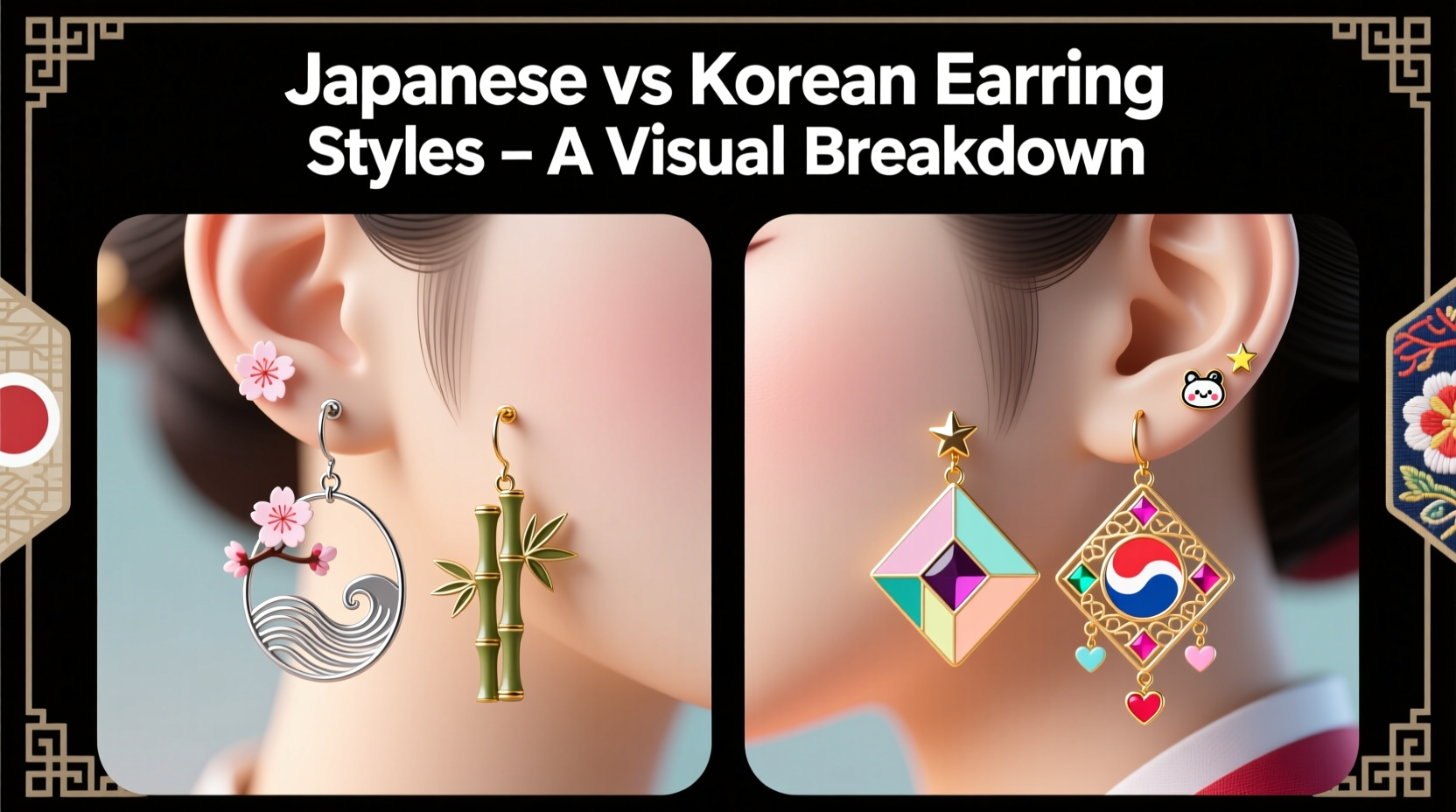
To understand the visual language of earrings in Japan and Korea, one must first consider the cultural roots that shape them. Japanese aesthetics are deeply influenced by concepts such as *wabi-sabi* (the beauty of imperfection), *ma* (negative space), and *shibui* (subtle elegance). These principles translate into jewelry that values minimalism, asymmetry, and natural materials like wood, bamboo, and oxidized silver.
In contrast, Korean earring design is shaped by *hanbok* heritage, Confucian ideals of harmony, and modern pop culture. The rise of K-pop and Korean dramas has amplified a trend toward bold, expressive accessories that balance tradition with innovation. Korean designs often emphasize symmetry, intricate detailing, and a polished finish—reflecting a broader cultural emphasis on presentation and refinement.
“Japanese earrings whisper; Korean earrings speak. One invites contemplation, the other commands attention.” — Yuki Tanaka, Tokyo-based jewelry curator
Design Philosophy: Minimalism vs. Maximalism
The most immediate way to distinguish between Japanese and Korean earring styles lies in their design philosophy. Japanese pieces lean toward understated sophistication, often featuring:
- Organic shapes inspired by nature (leaves, petals, stones)
- Asymmetrical arrangements
- Muted color palettes (black, white, gray, earth tones)
- Handcrafted textures and visible artisan marks
Korean earrings, particularly in contemporary fashion, embrace a bolder approach:
- Symmetrical, balanced compositions
- Vibrant enamel work or gemstone accents
- Geometric precision and high-polish finishes
- Statement sizes, especially in dangle or hoop styles
Materials and Craftsmanship Comparison
The choice of materials further highlights the divergence between the two styles. Japanese artisans frequently use traditional techniques such as *mokume-gane* (wood-grain metal) or *shippo* (cloisonné enamel), favoring metals like titanium, shibuichi (a copper-silver alloy), or blackened silver. Natural elements—such as silk cords, ceramic beads, or even lacquered paper—are not uncommon.
Korean designers, while also skilled in metalwork, tend to prioritize accessibility and versatility. Stainless steel, rhodium plating, and cubic zirconia are common in mass-market pieces, allowing for durability and shine at affordable price points. Handmade Korean jewelry may incorporate hanji (traditional paper) or mother-of-pearl inlays, but these are typically finished with a glossy, modern seal.
| Aspect | Japanese Style | Korean Style |
|---|---|---|
| Primary Aesthetic | Minimalist, organic | Balanced, polished |
| Common Materials | Oxidized silver, titanium, wood, silk | Stainless steel, rhodium, CZ, enamel |
| Color Palette | Neutral, monochrome, muted | Pastel, metallic, jewel-toned |
| Shape Preference | Asymmetrical, flowing | Symmetrical, geometric |
| Wearability Focus | Daily subtlety | Statement versatility |
Real-World Styling Scenarios: A Mini Case Study
Consider Mina, a stylist based in Seoul, who curated two separate looks for a cross-cultural fashion editorial. For the \"Tokyo Tranquility\" segment, she selected hand-forged silver earrings with irregular teardrop shapes suspended from silk threads. Paired with a neutral linen kimono-style top, the look emphasized calm and introspection. The earrings were barely noticeable at first glance but drew admiration upon closer inspection—a hallmark of Japanese design.
In contrast, her \"Seoul Glamour\" look featured oversized gold hoops with embedded pearl clusters and delicate chain tassels. Worn with a satin blazer and sleek bun, the earrings framed the face dramatically, enhancing the model’s features under studio lighting. This deliberate showmanship reflects the Korean preference for accessories that elevate and accentuate.
The difference wasn’t just in the jewelry—it was in the intention. One invited intimacy; the other celebrated visibility.
How to Identify Authentic Styles: A Practical Checklist
When shopping online or browsing collections, use this checklist to determine the likely origin of earring designs:
- Observe symmetry: Is the design perfectly mirrored? If yes, it leans Korean. Asymmetry suggests Japanese influence.
- Check the finish: High-gloss, mirror-like surfaces are typical of Korean mass production. Matte, brushed, or intentionally imperfect finishes point to Japanese artisanship.
- Evaluate size and weight: Japanese earrings are often lightweight and small-scale. Korean statement pieces may be larger but still well-balanced for all-day wear.
- Look for symbolism: Cherry blossoms or cranes may appear in both, but Japanese versions are stylized and abstract; Korean renditions are often literal and decorative.
- Read the brand ethos: Japanese brands emphasize craft, seasonality, and silence. Korean brands highlight trends, coordination with outfits, and celebrity endorsements.
Frequently Asked Questions
Can Japanese and Korean earring styles be mixed?
Absolutely. Many modern stylists blend both aesthetics—for example, pairing minimalist Japanese studs with Korean-style layered necklaces. The key is balancing dominance: let one style lead while the other supports.
Are there unisex earring trends in either culture?
Yes. In Japan, unisex designs are common, especially in avant-garde or streetwear circles, where genderless fashion (*genderless-kei*) is prominent. Korean unisex styles are emerging, particularly in minimalist silver hoops or ear cuffs popular among male idols.
Do traditional motifs still influence modern designs?
They do. Japanese designers reinterpret symbols like *maneki-neko* (beckoning cat) or *seigaiha* (wave patterns) in abstract forms. Korean creators integrate *dancheong* (temple colors) or *norigae* (tassel charms) into contemporary silhouettes, preserving cultural identity through modern expression.
Final Thoughts: Wear With Intention
Distinguishing between Japanese and Korean earring styles isn’t about rigid categorization—it’s about recognizing intention. Japanese designs invite mindfulness, encouraging the wearer to appreciate quiet beauty and tactile detail. Korean styles celebrate self-expression, offering tools to amplify personality and presence.
Whether you're drawn to the whisper of a handcrafted silver leaf or the gleam of a pearl-embellished hoop, your choice of earrings becomes a form of cultural dialogue. By understanding the stories behind the styles, you don’t just accessorize—you communicate.




 浙公网安备
33010002000092号
浙公网安备
33010002000092号 浙B2-20120091-4
Comments
No comments yet. Why don't you start the discussion?