
Conducting a background check doesn’t require hiring a private investigator or paying for expensive services. With the right approach, you can gather accurate, publicly available information about someone for free—whether it’s for personal safety, vetting a potential tenant, or reconnecting with an old acquaintance. The key is knowing where to look, how to verify what you find, and doing so within legal and ethical boundaries.
This guide walks you through a systematic process using legitimate sources and tools that are accessible to anyone with an internet connection. While no free method guarantees 100% completeness, combining multiple sources significantly improves reliability.
Step 1: Gather Basic Identifying Information
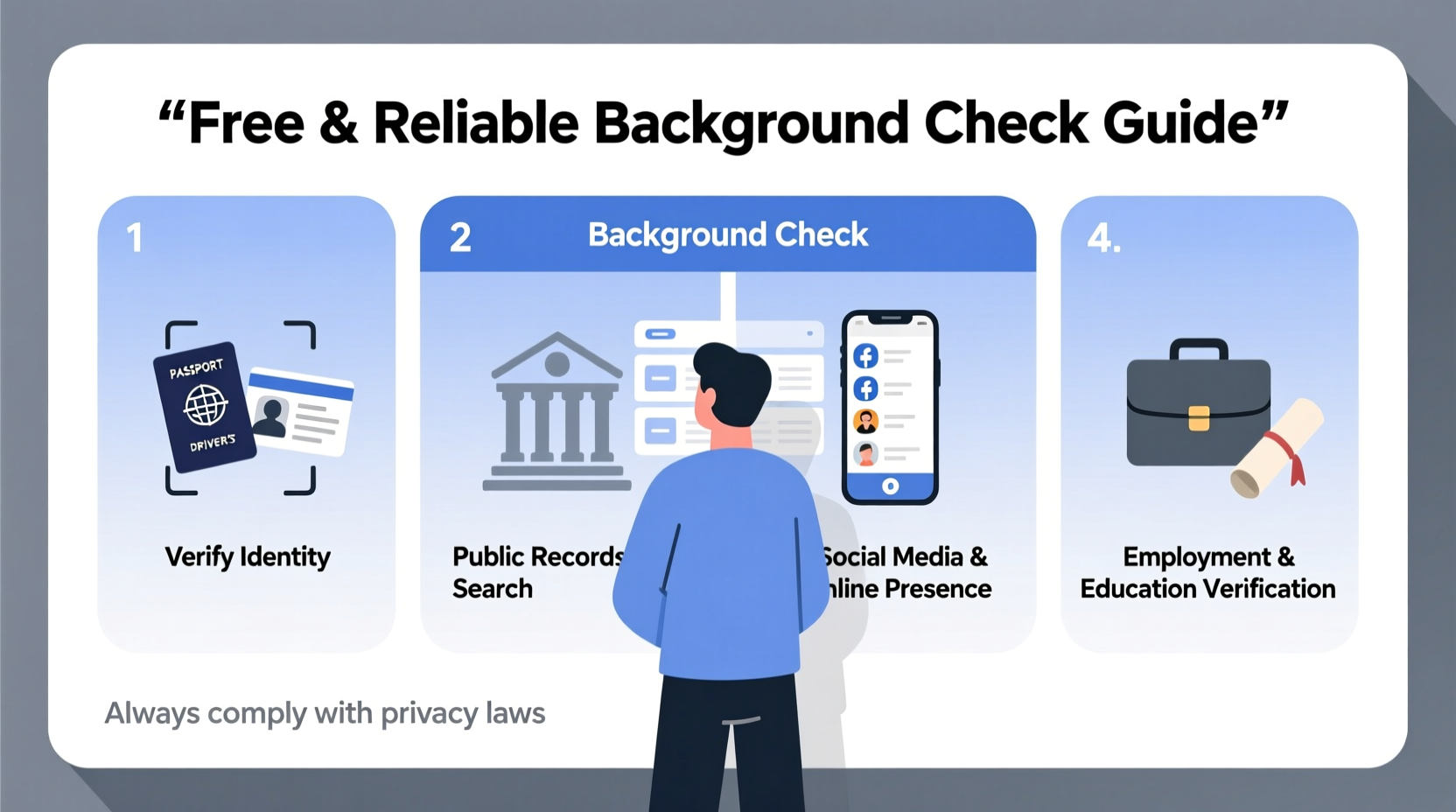
Before searching, collect as much accurate identifying data as possible. The more details you have, the easier it is to distinguish your subject from others with similar names.
- Full name (including middle name or initial)
- Past and current addresses
- Date of birth (if known)
- Phone number or email address
- Known aliases or variations of the name
- City or state of residence
Start with what you already know—social media profiles, mutual contacts, or previous correspondence. Avoid guessing; inaccurate input leads to false results.
Step 2: Search Public Records Databases
Many government agencies maintain searchable online records. These include criminal history, property ownership, marriage licenses, and business filings. Most are free to access, though some may charge for certified copies.
Criminal and Court Records
Each U.S. state operates its own court system with online access to case records. For example:
- California: public.courts.ca.gov
- Texas: www.txcourts.gov
- New York: Unified Court System
Search by name and filter by county if possible. Look for civil judgments, restraining orders, bankruptcies, or criminal cases. Note that not all jurisdictions offer full online access—some require in-person visits or mailed requests.
Property and Deeds
County assessor and recorder offices list real estate ownership. Visit the official website of the county where the person lives or has lived. Search terms like “[County Name] property records” will lead you to the correct portal.
These records often include purchase dates, property value, and co-owners—useful for verifying residency and financial standing.
Business Filings
If the individual owns a business, state Secretary of State websites list registered entities. Search “[State] Secretary of State business search” to find owners, registration dates, and filing status.
“Public records are powerful, but they only reflect what has been officially documented. Gaps don’t imply innocence—they reflect reporting limits.” — Sarah Lin, Investigative Journalist & Data Privacy Advocate
Step 3: Use Advanced Search Techniques
Google and other search engines can uncover valuable information when used strategically. Instead of basic name searches, apply these methods:
Boolean Search Operators
Combine keywords with operators to refine results:
\"John Smith\" + \"Houston\" + \"teacher\"– Finds exact matchessite:linkedin.com \"Jane Doe\" \"Chicago\"– Limits to LinkedIn\"Robert Lee\" intitle:resume OR cv– Finds resumes online\"Maria Garcia\" -\"Texas\" +\"Oregon\"– Excludes Texas, includes Oregon
Check social media platforms directly. Facebook, LinkedIn, and Twitter often reveal employment history, education, associations, and photos tied to locations.
Step 4: Check Sex Offender Registries and National Databases
The National Sex Offender Public Website (NSOPW) allows free, cross-jurisdictional searches: www.nsopw.gov. Enter the person’s name and location to see if they are registered.
This database pulls from all 50 states, U.S. territories, and tribal registries. It’s one of the most reliable free resources for safety-related screening.
Additionally, the U.S. Department of Justice maintains other federal databases, such as:
- Federal Bureau of Prisons inmate records (for releases since 1982)
- Executive Office for Immigration Review (EOIR) for immigration court cases
Note: These only cover federal offenses, not state-level crimes.
Step 5: Verify and Cross-Reference Information
One source is never enough. Misidentifications happen frequently due to common names or outdated records. Always corroborate findings across multiple platforms.
| Data Point | Source 1 | Source 2 | Confirmed? |
|---|---|---|---|
| Residence: 123 Oak St, Denver | County Property Records | Google Maps Street View (photo tag) | Yes |
| Employed at XYZ Corp | LinkedIn Profile | Company Staff Directory (archived) | Yes |
| Arrest Record: DUI 2019 | State Court Portal | Local News Archive | Pending |
Discrepancies should prompt deeper investigation. If a criminal record appears in one place but not another, check the date of the record and whether expungement may have occurred.
Mini Case Study: Vetting a Prospective Roommate
Alice needed to screen a potential roommate, Mark Thompson. She started with his Facebook profile, which listed his hometown and college. Using Google, she found a yearbook scan confirming his photo and graduation year.
She searched the Colorado Judicial Branch site and found a dismissed misdemeanor from 2017. No active warrants or recent charges appeared. She checked NSOPW—no listings. A property search showed he previously rented in Boulder, verified via a utility notice in a public PDF document.
By triangulating social media, court data, and public documents, Alice gained confidence in her decision without spending a dollar.
What You Should Avoid
While gathering public data is legal, certain actions cross ethical or legal lines:
- Using deception to obtain private information (e.g., pretending to be someone else).
- Accessing sealed or confidential records (such as juvenile files or medical history).
- Stalking or harassment through repeated monitoring.
- Selling or redistributing personal data obtained from public sources.
The Fair Credit Reporting Act (FCRA) prohibits using background information for employment, housing, or credit decisions unless obtained through a compliant third-party service. Personal use is generally permitted, but commercial use is restricted.
Free Background Check Checklist
Follow this checklist to conduct a thorough and responsible search:
- ✅ Collect full name, known addresses, and DOB
- ✅ Search state and county court records
- ✅ Check the National Sex Offender Registry
- ✅ Use Boolean Google searches for social media and news
- ✅ Review property and business filings
- ✅ Cross-reference at least two sources for each key fact
- ✅ Respect privacy and avoid illegal methods
Frequently Asked Questions
Can I run a completely free background check with full accuracy?
No single free method provides complete accuracy. However, combining public records, court data, and open-source intelligence significantly increases reliability. For comprehensive reports (especially for hiring), paid FCRA-compliant services are recommended.
Is it legal to look up someone’s criminal history online?
Yes, if the records are public and accessed through official channels. Criminal records maintained by courts are part of the public domain. However, using that information to discriminate in housing, employment, or lending may violate laws unless done under regulated conditions.
How far back do free background checks go?
It depends on the jurisdiction. Some states limit online access to 7–10 years. Others maintain historical archives. Older records may require formal requests or in-person visits to courthouses.
Final Thoughts
Performing a free and reliable background check is entirely possible with patience, attention to detail, and respect for legal boundaries. The internet has democratized access to public records, empowering individuals to make informed decisions about personal relationships, rentals, and safety.
Remember: transparency does not override privacy. Use the information responsibly, verify everything, and never assume guilt based on incomplete data. Knowledge is powerful—handle it with care.




 浙公网安备
33010002000092号
浙公网安备
33010002000092号 浙B2-20120091-4
Comments
No comments yet. Why don't you start the discussion?