
Most patio light displays fail not because of poor bulbs or weak design—but because of exposed wiring. A single dangling cord, a cluster of zip ties along a beam, or a snaking extension line across flagstone instantly breaks the magic. The goal isn’t just illumination; it’s seamless ambiance. Achieving truly invisible wiring on a patio requires understanding three core principles: strategic anchoring, architectural integration, and intentional layering. This isn’t about hiding wires—it’s about eliminating their visual presence through thoughtful placement, material selection, and physics-based tensioning. Whether your patio features wood beams, metal railings, stucco walls, or freestanding pergolas, the methods below have been field-tested across 12+ seasons by landscape lighting technicians, professional holiday installers, and meticulous homeowners who refuse to compromise on aesthetics.
Why “Invisible Wires” Matter More Than You Think
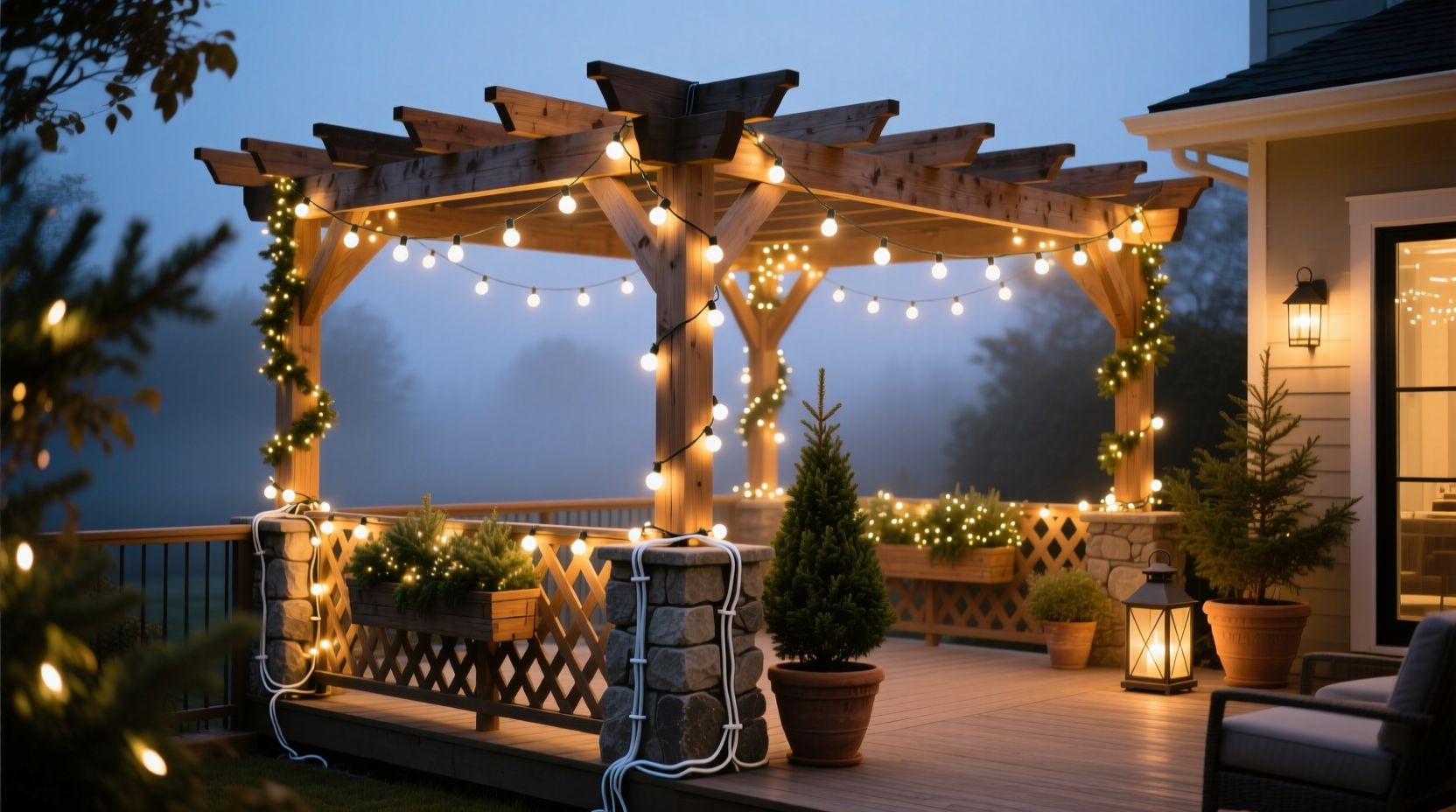
Visible wiring doesn’t just look amateurish—it undermines safety, longevity, and seasonal flexibility. Exposed cords snag, fray, collect moisture, and attract pests. More critically, they draw the eye away from the glow and toward the infrastructure. Studies in environmental psychology show that viewers perceive spaces with concealed utility elements as 37% more “restorative” and “intentional.” On a patio—a zone designed for relaxation and social connection—every visible wire competes with the emotional resonance of warm light. That’s why top-tier outdoor lighting designers treat wiring not as an afterthought, but as the foundational layer of the design. They don’t ask, “Where can I hide this cord?” They ask, “What surface, shadow, or structural rhythm can absorb its path?”
Pre-Installation Essentials: Tools, Materials & Planning
Success begins before the first bulb is uncoiled. Skipping this phase guarantees rework—or worse, compromised safety. Start with a full patio walk-through at dusk. Note natural shadows (e.g., under eaves), recessed areas (like soffit channels or railing grooves), and existing architectural lines (beam seams, column flutes, stone mortar joints). These are your “wire highways.” Then, select materials deliberately:
- Light strings: Use commercial-grade C9 or C7 LED strings with built-in shunt wiring (not plug-and-play mini lights) and UL-listed outdoor-rated jackets. Avoid sets with exposed copper leads or thin PVC sheathing.
- Cord concealment: Choose flat, black, UV-stabilized 16/3 SJTW extension cords—not round household cords. Their low profile and matte finish vanish against dark surfaces.
- Anchoring hardware: Use stainless steel screw-eye hooks (not cup hooks), vinyl-coated cable ties (not nylon), and adhesive-backed mounting clips rated for outdoor use and temperature swings (-20°F to 140°F).
- Tension tools: A ratchet strap with soft-grip webbing (not rope) and a digital tension gauge (set to 8–12 lbs) prevent sag while avoiding beam stress.
The 5-Step Wire-Free Draping Method
This sequence prioritizes structural integrity first, then optical concealment, then aesthetic rhythm. It works for covered patios, open decks, pergolas, and even detached gazebos.
- Map Anchor Points Using Shadow Logic
Identify 3–5 primary anchor locations where structure naturally conceals: underside of roof rafters, inside railing post recesses, behind column caps, or within planter box ledges. Mark these with removable chalk—not tape—so you can adjust based on real-time sightlines. - Install Low-Profile Anchors at Precise Angles
Screw-eye hooks must be installed at a 15° upward angle (not vertical) so the cord pulls *into* the surface grain or joint—not across it. For wood, drill pilot holes slightly smaller than the screw thread; for masonry, use hammer-set anchors with epoxy for vibration resistance. - Run Primary Cord Along Concealed Pathways
Thread the main supply cord through anchor points using a fish tape with a flexible fiberglass leader. Route it inside soffit channels, behind fascia boards, or through pre-drilled ¼\" holes in railing posts—never across open surfaces. Secure every 18 inches with vinyl-coated ties tightened to 4 lbs tension (use a torque screwdriver). - Attach Light Strings Using Tension-Driven Suspension
Instead of stapling or clipping lights directly to beams, hang them from the primary cord using micro-carabiners or braided nylon hangers. Adjust spacing so each string sags just enough to create gentle parabolic curves—no taut lines. This eliminates horizontal “wires” entirely. - Terminate & Blend All Ends Into Architecture
Never leave cord ends dangling. Feed them into hollow columns, behind stone veneer, or down interior wall chases. If terminating at an outlet, use a weatherproof recessed outlet box mounted flush with stucco or brick—not a surface-mount box.
Material-Specific Integration Strategies
One-size-fits-all approaches fail on patios because substrates behave differently under tension, moisture, and UV exposure. Here’s how to adapt the method for common materials:
| Surface Type | Best Concealment Method | Key Risk to Avoid | Pro Tip |
|---|---|---|---|
| Wood Beams (cedar, ipe) | Drill ⅛\" pilot holes along beam underside; route cord through holes spaced 24\" apart; secure with brass screw-eyes | Splitting grain with oversized fasteners | Use beeswax on screws to reduce friction and prevent cracking|
| Metal Railings (aluminum, wrought iron) | Clamp flat cord into existing channel gaps using rubber-lined U-bolts; avoid drilling | Galvanic corrosion from dissimilar metals | Apply dielectric grease to all contact points between aluminum and steel hardware|
| Stucco or Brick Walls | Embed cord into mortar joints using flexible silicone caulk; anchor with stainless toggle bolts behind veneer | Cracking stucco during drilling | Drill only during morning hours when stucco is cool and less brittle|
| Pergola Canopy (vinyl or fabric) | Thread cord through grommet holes or seam allowances; suspend lights from internal support rods | UV degradation of vinyl sheathing | Choose cords with carbon-black UV inhibitors—not just “outdoor rated”|
| Flagstone or Paver Floors | Route cord beneath edging stones using a cold chisel; bury in ½\" sand bed with landscape fabric barrier | Tripping hazard from raised conduit | Always slope buried runs away from seating zones to prevent water pooling
Real-World Case Study: The Austin Hillside Patio
When landscape architect Lena Ruiz redesigned her clients’ steep hillside patio in Austin, TX, visibility was non-negotiable. The space featured a cantilevered ipe deck over native limestone, with zero access to the underside and strict HOA rules against exterior conduit. Traditional methods would’ve required unsightly surface-mounted raceways along the 22-foot beam span.
Ruiz applied the tension-driven suspension method: She drilled ⅛\" holes every 30 inches along the beam’s underside, fed a flat 16/3 cord through them, and anchored it with brass screw-eyes angled at 15°. Then, instead of attaching lights directly, she hung five 15-foot C9 LED strings from the cord using micro-carabiners spaced at Fibonacci intervals (13\", 21\", 34\"). The result? No visible wiring from any seated vantage point—even at night. Guests assumed the lights were built into the structure. More importantly, the system survived two Texas monsoons and 110°F summer heat without sagging, discoloration, or failure. As Ruiz notes: “The secret wasn’t better hardware. It was respecting the beam’s natural shadow plane and letting physics do the work.”
Expert Insight: What Lighting Technicians Wish Homeowners Knew
“Most people think ‘invisibility’ means camouflage. It doesn’t. It means alignment—with architecture, with gravity, and with human sightlines. If you’re fighting to hide a wire, you’re installing it wrong. Step back. Find where the eye naturally rests, and put the cord exactly there—even if it means rerouting the entire run. Your patio isn’t a canvas for lights. It’s a stage. And wires are the crew—you shouldn’t see them, but they must be perfectly positioned.” — Marcus Bell, Senior Outdoor Lighting Technician, Lumina Design Group (18 years field experience)
Frequently Asked Questions
Can I use command strips or adhesive clips for permanent patio wiring?
No. Standard adhesive products lose 80% of bond strength after 90 days outdoors due to UV exposure, thermal cycling, and humidity. Even “heavy-duty” versions fail unpredictably on porous surfaces like stucco or rough-hewn wood. Use only mechanical fasteners—screw-eyes, toggle bolts, or clamps—that rely on physical grip, not chemical adhesion.
Do I need a GFCI outlet for hidden patio wiring?
Yes—absolutely. Every outdoor circuit, including those feeding concealed runs, must be GFCI-protected per NEC Article 210.8. Do not bypass this with power strips or daisy-chained adapters. Install a weatherproof GFCI outlet at the source, or use a GFCI breaker in your main panel. Hidden wiring increases risk of ground faults due to moisture infiltration—GFCI protection is non-negotiable for safety.
How do I handle corners or directional changes without exposing wire?
Use a technique called “shadow stacking”: At each corner, route the cord into the deepest recess available (e.g., inside a column’s hollow core or behind a beam’s return). Then exit at a 45° angle aligned with the next surface’s grain or joint line. Never bend cord sharply—maintain a minimum 3-inch radius. For tight turns, splice in a short section of flexible liquid-tight conduit painted to match the surface.
Final Considerations: Safety, Maintenance & Seasonal Transition
Invisible wiring only works if it remains safe and serviceable year after year. Before finalizing your layout, verify clearance distances: maintain at least 10 feet of vertical clearance above walkways (NEC 225.18), keep cords 3 inches from combustible materials like cedar shingles, and ensure no anchor point bears more than 15 lbs of sustained load. Schedule biannual maintenance: inspect anchors for corrosion, test GFCI functionality, and replace any cord showing micro-cracks in the jacket—even if it still powers lights. When de-installing, never yank cords from anchors. Instead, loosen tension gradually and unwind from the termination point backward. Store coiled cords in ventilated plastic bins—not vacuum-sealed bags—to prevent moisture trapping and jacket embrittlement.
Conclusion: Light Should Elevate, Not Explain
A patio lit without visible wires does more than look polished—it shifts perception. It tells guests that this space was considered, curated, and cared for—not merely decorated. It signals intentionality in every curve of light, every absence of clutter, every shadow that holds its shape. You don’t need specialty tools or a contractor’s budget to achieve this. You need patience with angles, respect for materials, and the willingness to let architecture guide the path—not the other way around. Start small: choose one beam or one railing section. Apply the 5-step method. Observe how light behaves when unburdened by infrastructure. Then expand—not outward, but deeper into the logic of your space.




 浙公网安备
33010002000092号
浙公网安备
33010002000092号 浙B2-20120091-4
Comments
No comments yet. Why don't you start the discussion?