
Calculating the number of hours between two times—like 8:30 AM and 5:30 PM—is a routine task in work scheduling, payroll processing, project planning, and personal time management. While it may seem straightforward, confusion often arises from format interpretation (e.g., 24-hour vs. 12-hour), lunch breaks, or miscalculations due to skipped steps. Getting this right ensures accurate time tracking, fair compensation, and better productivity planning.
This guide breaks down the process into simple, reliable methods so you can determine the duration between 8:30 and 5:30 quickly and confidently—whether you're managing your own schedule or overseeing team hours.
Understanding the Time Format
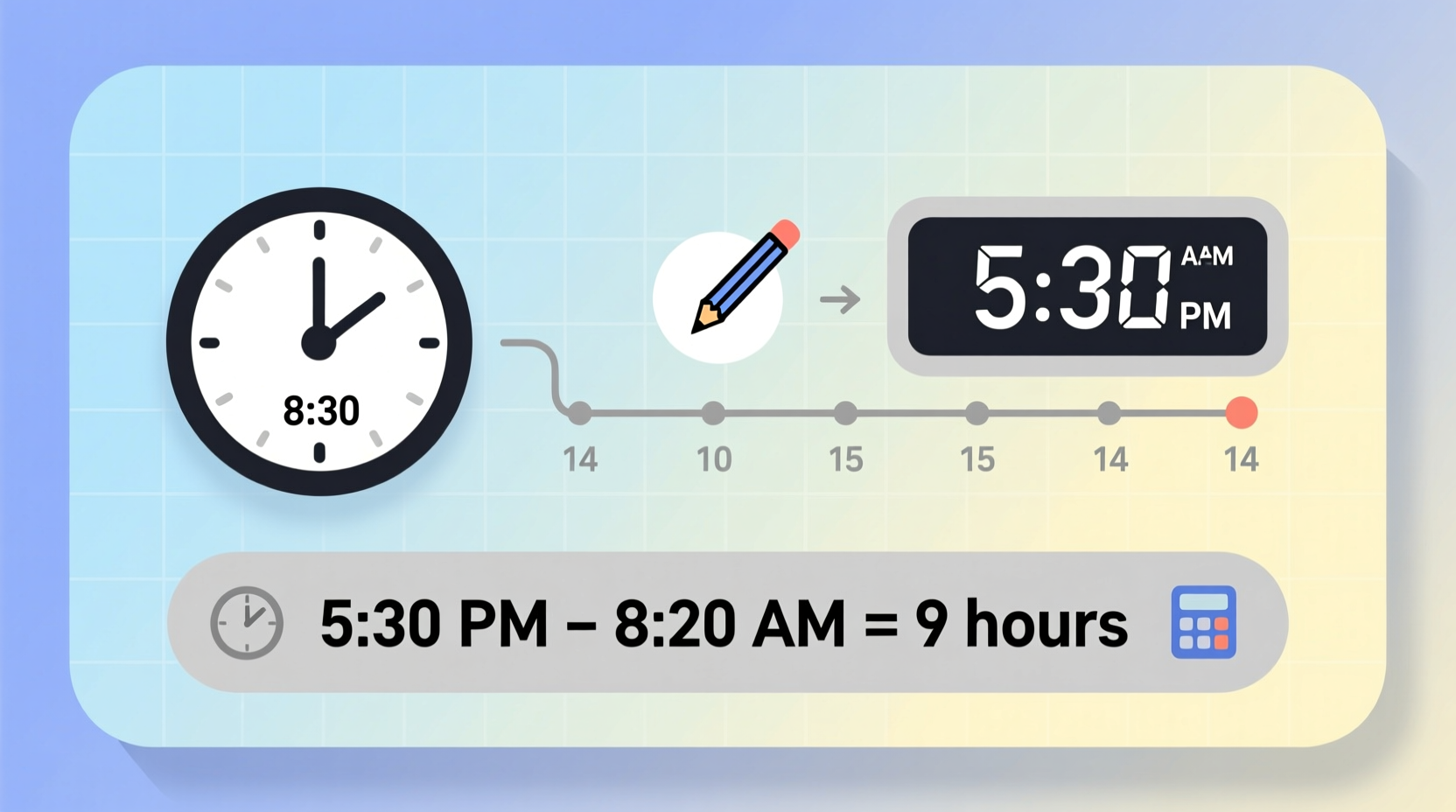
The first step in calculating elapsed time is clarifying the format of the given times. In most workday contexts, “830” refers to 8:30 AM and “530” means 5:30 PM. These are standard start and end times for a full-day shift. However, if not specified, these could technically be interpreted as 8:30 PM and 5:30 AM, which would yield a different result.
To avoid confusion:
- Treat “830” and “530” as shorthand for 8:30 AM and 5:30 PM unless otherwise noted.
- Always confirm whether times are in AM/PM (12-hour clock) or 24-hour format.
- Convert all times to a consistent system before calculating.
Step-by-Step Guide to Calculate Total Hours
Follow this logical sequence to accurately compute the time difference between 8:30 AM and 5:30 PM.
- Convert both times to minutes past midnight.
- 8:30 AM = (8 × 60) + 30 = 480 + 30 = 510 minutes
- 5:30 PM = (17 × 60) + 30 = 1020 + 30 = 1050 minutes (since 5:30 PM is 17:30 in 24-hour time)
- Subtract the start time from the end time.
- 1050 – 510 = 540 minutes
- Convert minutes back to hours and minutes.
- 540 ÷ 60 = 9 hours exactly
The total time between 8:30 AM and 5:30 PM is **9 hours**.
Alternative Method: Break It Into Segments
If mental math is preferred, break the interval into manageable chunks:
- From 8:30 AM to 9:30 AM → 1 hour
- 9:30 AM to 12:30 PM → 3 hours
- 12:30 PM to 5:30 PM → 5 hours
Total: 1 + 3 + 5 = 9 hours
This method works well when visualizing shifts or teaching others how to track time.
Accounting for Lunch Breaks
In many workplaces, a full day from 8:30 AM to 5:30 PM includes a meal break—typically 30 to 60 minutes. If you're calculating *paid* or *working* hours, subtract any unpaid break time.
| Lunch Duration | Total Elapsed Time | Working Hours |
|---|---|---|
| 30 minutes | 9 hours | 8.5 hours |
| 60 minutes | 9 hours | 8 hours |
| No break | 9 hours | 9 hours |
For example, if an employee clocks in at 8:30 AM, takes a 30-minute lunch, and clocks out at 5:30 PM, their actual working time is 8.5 hours.
Common Mistakes and How to Avoid Them
Even simple time math can go wrong without attention to detail. Here are frequent errors and how to correct them:
- Mistaking PM for AM: Assuming 5:30 is 5:30 AM instead of PM leads to a negative or incorrect duration.
- Ignoring the 24-hour conversion: Failing to convert PM times to 24-hour format causes subtraction errors.
- Forgetting partial hours: 8:30 has 30 extra minutes beyond 8:00—don’t round down unless appropriate.
- Double-counting breaks: Including lunch in working hours inflates productivity metrics.
Using digital tools like time calculators or spreadsheets reduces human error, but understanding the manual method builds confidence and accuracy.
Real-World Example: Office Work Schedule
Consider Maria, an administrative assistant who starts her shift at 8:30 AM. She logs her lunch break from 12:30 PM to 1:00 PM and finishes work at 5:30 PM. Her supervisor needs to verify her daily hours for payroll.
Calculation:
- Start: 8:30 AM (510 minutes)
- Lunch Start: 12:30 PM = (12 × 60) + 30 = 750 minutes
- Lunch End: 1:00 PM = (13 × 60) = 780 minutes
- End: 5:30 PM = 1050 minutes
Breakdown:
- Before lunch: 750 – 510 = 240 minutes (4 hours)
- After lunch: 1050 – 780 = 270 minutes (4.5 hours)
- Total working time: 4 + 4.5 = 8.5 hours
This matches company expectations and ensures accurate pay. Without accounting for the 30-minute break, she’d appear to have worked 9 hours—leading to overpayment or confusion.
“Accurate time calculation isn’t just about math—it’s about fairness, compliance, and trust in workplace systems.” — David Lin, Payroll Compliance Officer
Quick Checklist for Accurate Time Calculation
Use this checklist whenever computing hours between two times:
- Confirm whether times are AM or PM.
- Convert all times to 24-hour format for consistency.
- Convert hours and minutes into total minutes since midnight.
- Subtract start time from end time.
- Convert result back to hours and minutes.
- Deduct any unpaid breaks.
- Verify with a second method or tool if possible.
Frequently Asked Questions
Is 8:30 to 5:30 a 9-hour day?
Yes, from 8:30 AM to 5:30 PM is exactly 9 hours of elapsed time. However, if a 30-minute unpaid lunch break is included, the actual working time is 8.5 hours.
How do I calculate hours in Excel between 830 and 530?
In Excel, enter the times in separate cells using proper time format (e.g., 8:30 AM and 5:30 PM). Then subtract the start from the end: =B1-A1. Format the result cell as [h]:mm to display total hours correctly. For example, this will show 9:00 for a 9-hour span.
Can I use military time to make this easier?
Absolutely. Converting to 24-hour format eliminates AM/PM confusion. 8:30 AM becomes 08:30, and 5:30 PM becomes 17:30. The calculation remains the same: 17:30 – 8:30 = 9 hours.
Conclusion: Master Time Calculations with Confidence
Knowing how to calculate the total hours between 8:30 and 5:30 is more than a basic arithmetic skill—it's essential for payroll accuracy, time management, and professional accountability. Whether you're an employee tracking your own hours, a manager scheduling shifts, or an HR professional processing timesheets, mastering this process ensures reliability and transparency.
By applying the step-by-step methods, avoiding common pitfalls, and using checklists or tools when needed, you can perform these calculations effortlessly. Understanding the role of breaks and time formats adds depth to your accuracy. With practice, this becomes second nature.




 浙公网安备
33010002000092号
浙公网安备
33010002000092号 浙B2-20120091-4
Comments
No comments yet. Why don't you start the discussion?