
Every holiday season, thousands of homes experience flickering lights, warm outlets, or sudden blackouts—not from faulty bulbs, but from a single, overlooked mistake: daisy-chaining too many light strands on one circuit. Overloading isn’t just inconvenient; it’s a leading cause of seasonal electrical fires. According to the U.S. Fire Administration, decorative lighting accounts for an estimated 770 home fires annually—and nearly 40% involve extension cords or improper strand connections. The good news? You don’t need an electrician’s license to solve this. With clear voltage awareness, smart planning, and a few precise calculations, you can illuminate your home safely, brilliantly, and reliably—no guesswork required.
Why Circuit Overload Happens (and Why It’s Not Obvious)
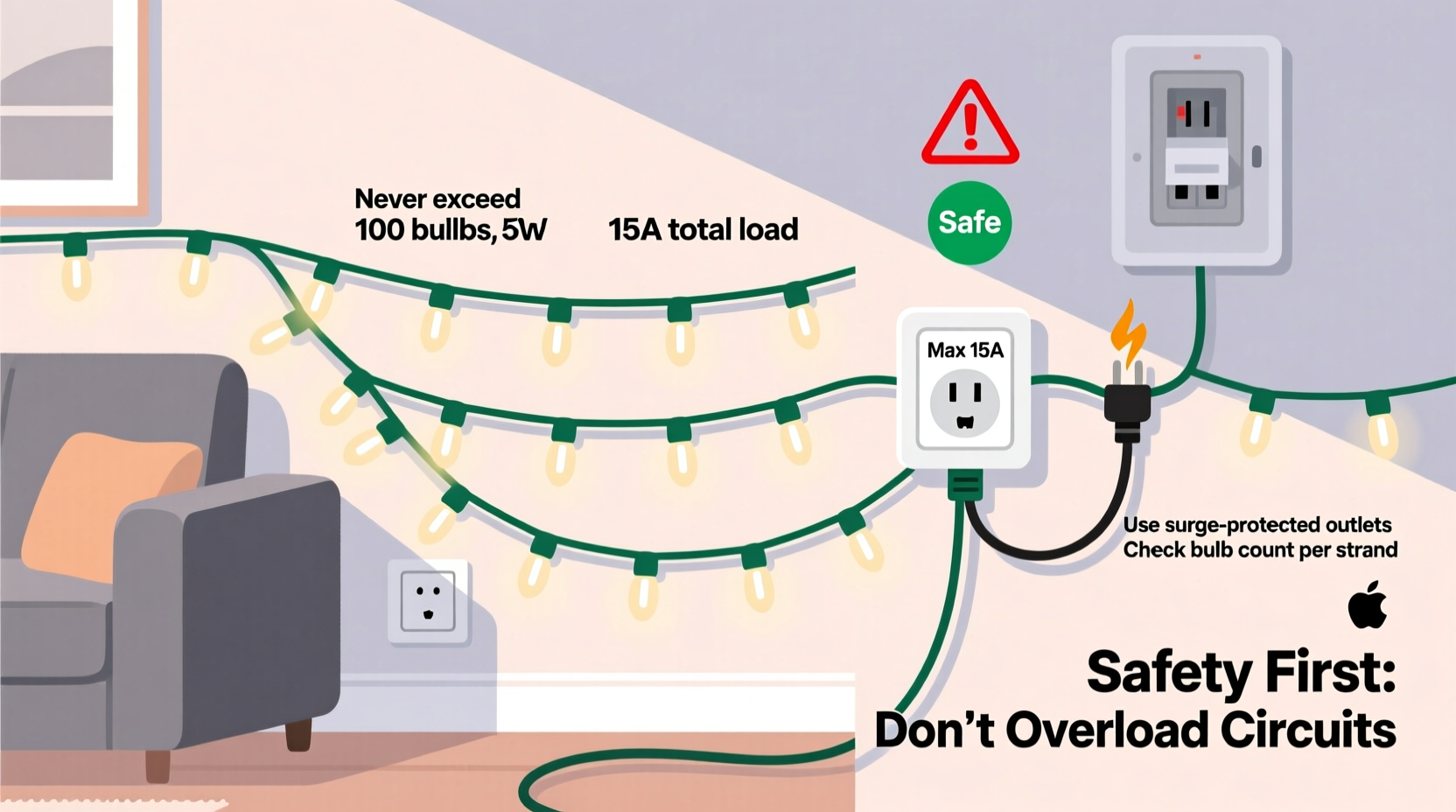
Most people assume “if the plug fits, it’s fine.” But household circuits operate on strict limits—typically 15 or 20 amps at 120 volts in North America. That translates to a maximum safe load of 1,800 watts (15A × 120V) or 2,400 watts (20A × 120V). Yet a single 50-light incandescent strand can draw 20–40 watts, while LED versions use just 2–5 watts. The danger arises when users chain 10, 15, or even 20 strands together—especially across multiple outlets fed by the same circuit breaker. Because outlets in adjacent rooms, hallways, or even the garage often share one breaker, the cumulative draw may exceed capacity long before any outlet feels warm.
Worse, manufacturers’ “maximum connectable” labels—like “connect up to 210 strands”—apply only to *identical, UL-listed LED sets* under *ideal lab conditions*. Real-world variables—aging wiring, shared loads (refrigerators, space heaters), voltage drop over long extension runs, and ambient temperature—shrink that safe margin significantly. As licensed master electrician Rafael Mendoza explains:
“Those ‘connect up to X’ numbers are marketing thresholds—not safety thresholds. In my 28 years inspecting holiday installations, I’ve seen more overloaded circuits caused by trusting that label than by using cheap cords. Always calculate based on your actual circuit rating and measured load—not the box.” — Rafael Mendoza, NECA Certified Electrical Inspector & Holiday Lighting Safety Advisor
Your Step-by-Step Connection Plan (No Guesswork)
Follow this verified sequence—designed for homeowners with no electrical training—to ensure every connection stays within safe thermal and amperage limits.
- Identify your circuit’s capacity: Locate your home’s breaker panel. Find the breaker labeled “Living Room,” “Front Porch,” or “Garage.” Note its amperage rating (15A or 20A). Multiply by 120V to get total wattage capacity (e.g., 15A × 120V = 1,800W).
- Deduct existing loads: Unplug or turn off all non-essential devices on that circuit—lamps, TVs, chargers, coffee makers. Use a plug-in energy monitor (under $25) to measure baseline consumption. Subtract that number from your total capacity.
- Calculate per-strand draw: Check the UL label on each light set. If it lists amps (e.g., “0.03A”), multiply by 120V. If it lists watts (e.g., “4.8W”), use that directly. For unmarked sets, assume 4.5W per 50-light LED strand or 25W per 50-light incandescent strand.
- Determine safe strand count: Divide your remaining wattage by the per-strand wattage. Round down—never up. Example: 1,600W available ÷ 4.8W/strand = 333 strands. But limit to 250 strands for safety margin and voltage stability.
- Map physical routing: Use a sketch or app to trace which outlets feed into the same breaker. Never exceed 3 strands per outlet, and avoid plugging more than one light-heavy extension cord into a single power strip—even if it has surge protection.
Do’s and Don’ts: A Clear Comparison
| Action | Do | Don’t |
|---|---|---|
| Cord Selection | Use outdoor-rated, 16-gauge (or thicker) extension cords for runs over 25 feet. Look for “UL Listed for Outdoor Use” and “W-A” rating. | Use indoor extension cords, coiled cords during operation, or 18-gauge cords for anything beyond 10 feet. |
| Strand Linking | Connect only strands with identical voltage, wattage, and manufacturer-recommended linking specs. Use polarized plugs and check for tight, undamaged connections. | Mix incandescent and LED strands on the same run—or link third-party “compatible” connectors not tested with your brand. |
| Outlet Management | Distribute loads across multiple circuits: e.g., front yard on Circuit A, porch on Circuit B, tree on Circuit C. Use a circuit map app like “Breaker Finder” (iOS/Android). | Plug three 100-light LED strands + a projector + fog machine into one 6-outlet power strip on a single 15A circuit. |
| Monitoring & Maintenance | Check cords and plugs for warmth every 2 hours during initial use. Use GFCI-protected outlets outdoors and in garages. | Leave lights on unattended overnight or while sleeping—especially older incandescent sets or near flammable materials like dry trees or straw decorations. |
A Real-World Case Study: The Anderson Family Porch Project
The Andersons in Portland, Oregon, wanted a full-wrap display for their two-story colonial: roofline, columns, railing, and 12-foot spruce tree. They bought 120 meters of premium warm-white LED net lights, 80 meters of icicle lights, and 60 meters of rope lights—all marketed as “connectable up to 500 strands.” Excited, they plugged everything into three outlets along the front porch—all fed by a single 15A breaker.
On night two, the lights dimmed noticeably after 45 minutes. By hour three, the main porch outlet grew warm to the touch. At midnight, the breaker tripped—taking out their refrigerator, security system, and Wi-Fi. An electrician visit revealed the issue wasn’t faulty lights: their combined draw was 1,740 watts—just 60 watts below the 1,800W ceiling. But voltage drop across 40 feet of undersized extension cord raised resistance, increasing heat at the outlet. Worse, their old 1970s aluminum wiring couldn’t sustain the load without significant thermal expansion.
The fix? They installed a dedicated 20A GFCI circuit for exterior lighting (cost: $420), switched to 14-gauge outdoor cords, and redistributed strands: 45% on the new circuit, 30% on the kitchen circuit (with fridge unplugged during display hours), and 25% on the garage circuit. They also added a $22 smart plug timer to cycle lights in 3-hour blocks—reducing average load by 40%. Result: zero trips, consistent brightness, and lower December electricity usage than the previous year.
Essential Tools & What to Keep On Hand
You don’t need a toolbox full of gear—but these four items prevent 90% of overload incidents:
- Digital multimeter ($15–$35): Verify actual voltage at outlets (should be 114–126V) and measure current draw on suspect circuits.
- Plug-in energy monitor ($20–$28): Models like the Kill A Watt EZ or Belkin Conserve Insight show real-time watts, volts, and cumulative kWh—critical for load verification.
- UL-listed outdoor power distribution box ($45–$85): Replaces daisy-chained power strips. Provides 4–6 individually fused, GFCI-protected outlets with built-in circuit breakers.
- Label maker or colored tape: Mark each outlet and cord with its assigned circuit (e.g., “Circuit 4 – Max 1,400W”) to prevent accidental overloading next year.
Crucially: never substitute “heavy-duty” for “rated.” A cord labeled “heavy duty” means nothing unless it carries UL/ETL certification, gauge size (e.g., “14 AWG”), and temperature rating (e.g., “-20°C to 60°C”).
FAQ: Quick Answers to Critical Questions
Can I use a regular indoor power strip for outdoor lights?
No. Indoor power strips lack weatherproofing, GFCI protection, and thermal cutoffs needed for outdoor use. Moisture ingress can cause short circuits or electrocution—even if the strip itself is under a covered porch. Only use power distribution units explicitly rated for outdoor, wet-location use and certified by UL (look for “Type 3R” or “Type 4X” enclosures).
My LED lights say “up to 43 strands”—but the manual warns “do not exceed 2100 watts.” Which do I follow?
Always follow the wattage limit. The strand count assumes perfect conditions: new wiring, 120V exactly, zero voltage drop, and identical sets. Your home likely has 114–117V at the outlet, especially during peak grid demand. At 115V, a 4.8W strand draws ~4.2W—but voltage drop over 50 feet of 16-gauge cord adds resistance, increasing effective wattage per strand. Stick to the hard number: 2100W is your absolute ceiling. For safety, cap at 1,600W.
How do I know if my home wiring is outdated and can’t handle modern light displays?
Warning signs include: breakers tripping frequently with modest loads; outlets or faceplates warm to the touch; flickering lights when appliances cycle on; aluminum wiring (common in homes built 1965–1973); or knob-and-tube wiring (pre-1940s). If you see any of these—or if your home is over 40 years old—hire a licensed electrician for a load evaluation before installing more than 500 feet of lights. They’ll test ground integrity, neutral bonding, and panel busbar temperature under load.
Conclusion: Light Up with Confidence, Not Compromise
Safety shouldn’t dim your holiday spirit—it should amplify it. Connecting multiple strands of Christmas lights isn’t about restriction; it’s about intentionality. When you understand your circuit’s true capacity, respect voltage realities, and choose hardware designed for the job, you transform a potential hazard into a reliable, joyful ritual. You gain peace of mind knowing your children’s laughter echoes beneath steady, bright lights—not the buzz of an overloaded outlet. You preserve your home’s electrical integrity so future seasons shine just as brightly. And you model responsible stewardship—of your home, your family’s well-being, and the quiet magic of light itself.
This year, skip the last-minute panic of a tripped breaker at dusk. Skip the burnt-plug smell and the scramble for spare fuses. Instead, take 20 focused minutes to map your circuits, measure your loads, and plan your connections. Your future self—standing under a flawless, flicker-free canopy of lights on Christmas Eve—will thank you.




 浙公网安备
33010002000092号
浙公网安备
33010002000092号 浙B2-20120091-4
Comments
No comments yet. Why don't you start the discussion?