
Understanding temperature is essential whether you're traveling, cooking, checking the weather, or working in science or healthcare. But when different countries use different scales—Celsius in most of the world and Fahrenheit primarily in the United States—converting between them becomes a daily necessity. While the formulas may look intimidating at first, converting Celsius to Fahrenheit can be quick and easy once you know the right methods and shortcuts.
This guide breaks down the process into simple steps, shares mental math tricks, and offers practical tools so you’ll never struggle with temperature conversion again.
The Science Behind the Scales
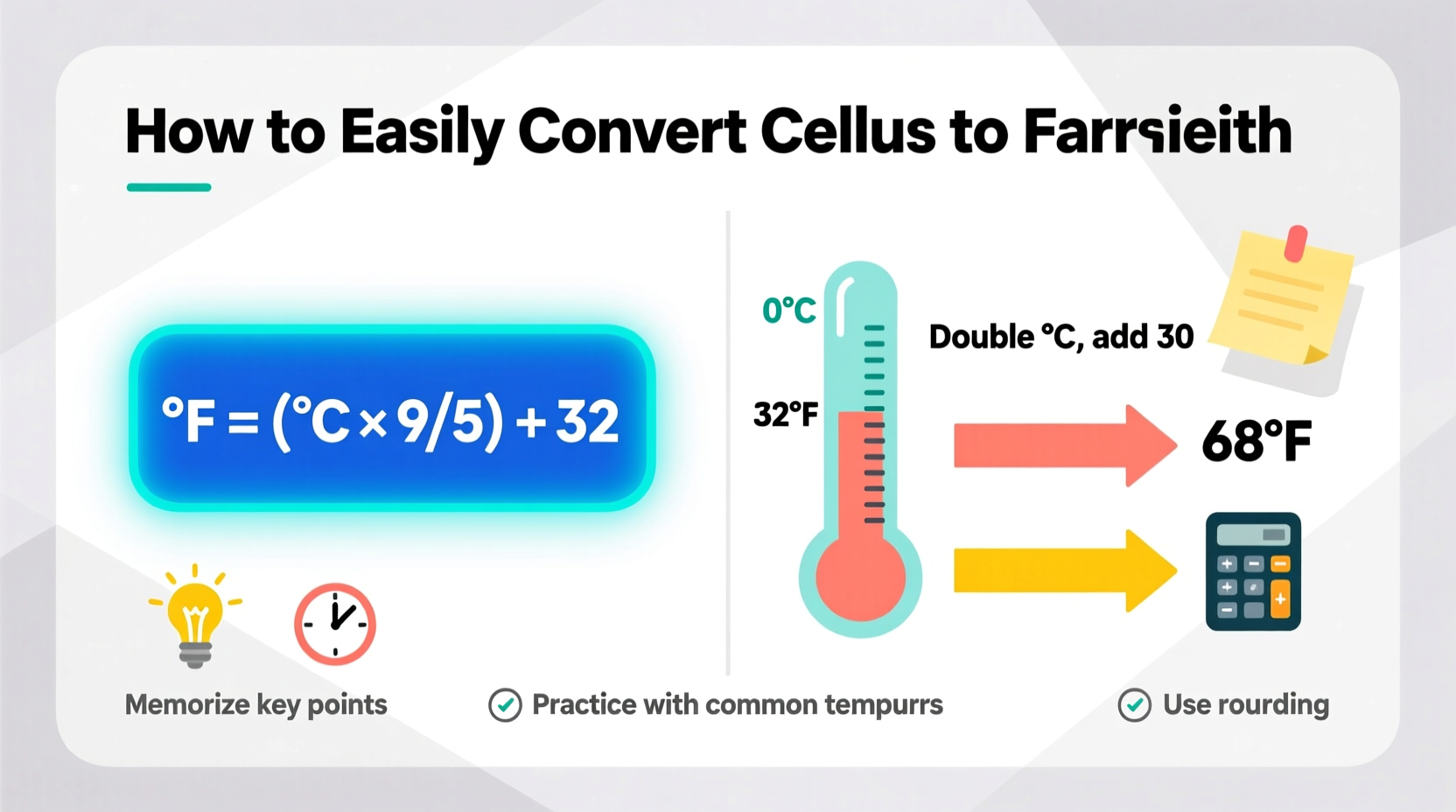
Celsius and Fahrenheit are two different ways of measuring temperature, each based on distinct reference points. The Celsius scale, part of the metric system, sets the freezing point of water at 0°C and the boiling point at 100°C under standard atmospheric conditions. It was developed by Swedish astronomer Anders Celsius in 1742.
Fahrenheit, created by German physicist Daniel Gabriel Fahrenheit in 1724, sets water’s freezing point at 32°F and its boiling point at 212°F. This means the interval between freezing and boiling is 180 degrees in Fahrenheit versus 100 degrees in Celsius—making Fahrenheit more granular but less intuitive for scientific calculations.
“Temperature affects everything from human comfort to chemical reactions. Knowing how to interpret and convert it accurately is a foundational skill.” — Dr. Lena Torres, Climate Research Scientist
Step-by-Step Guide to Convert Celsius to Fahrenheit
The standard formula to convert Celsius (°C) to Fahrenheit (°F) is:
°F = (°C × 9/5) + 32
Let’s walk through this step by step using an example: converting 20°C to Fahrenheit.
- Multiply the Celsius temperature by 9/5 (or 1.8):
20 × 1.8 = 36 - Add 32 to the result:
36 + 32 = 68 - So, 20°C equals 68°F.
This method works every time and is perfect for precise conversions. Whether you're calculating body temperature, oven settings, or weather forecasts, following these steps ensures accuracy.
Quick Mental Math Tricks for Everyday Use
You don’t always need a calculator or paper to convert temperatures. With a few estimation techniques, you can get close enough for practical purposes—especially useful when traveling or reading international weather reports.
- Double and Add 30 Rule: A rough but fast shortcut is to double the Celsius temperature and add 30. For 20°C: (20×2)+30 = 70°F. The actual value is 68°F—close enough for casual use.
- Memorize Key Benchmarks: Know a few common temperatures to estimate others:
- 0°C = 32°F (freezing point)
- 10°C = 50°F
- 20°C = 68°F (room temperature)
- 30°C = 86°F (warm day)
- 37°C = 98.6°F (body temperature)
- 100°C = 212°F (boiling point)
- Use Increments: Since 5°C equals 9°F, each degree Celsius is about 1.8°F. So, going up 1°C means increasing by roughly 2°F.
These tricks aren’t meant for lab work, but they’re excellent for making quick decisions—like what to wear or whether your child has a fever.
Common Conversion Table for Quick Reference
Here's a table of frequently encountered temperatures to help you quickly find equivalents without calculation:
| Celsius (°C) | Fahrenheit (°F) | Common Context |
|---|---|---|
| -40°C | -40°F | Extremely cold (the point where both scales meet) |
| 0°C | 32°F | Water freezes / Cold winter day |
| 10°C | 50°F | Cool autumn morning |
| 20°C | 68°F | Room temperature / Pleasant spring day |
| 25°C | 77°F | Warm indoor setting |
| 30°C | 86°F | Hot summer day |
| 37°C | 98.6°F | Average human body temperature |
| 40°C | 104°F | High fever / Extreme heatwave |
| 100°C | 212°F | Water boils / Oven baking temperature |
Real-Life Example: Cooking Across Borders
Sophie, a home baker from London, decided to try her hand at a classic American pie recipe. The instructions said to preheat the oven to 350°F. Not familiar with Fahrenheit, she initially guessed 175°C—but that felt too low. Instead of guessing, she applied the conversion formula:
°F = (°C × 9/5) + 32 → Rearranged to solve for °C: °C = (°F – 32) × 5/9
(350 – 32) = 318
318 × 5/9 ≈ 176.7°C
She set her oven to 177°C and baked the pie perfectly. Later, she created a small chart of common baking temperatures and stuck it inside her oven door. Now, she converts effortlessly—and her desserts have never been better.
This example shows how a little knowledge can prevent kitchen disasters and boost confidence when using foreign measurements.
Do’s and Don’ts When Converting Temperatures
To avoid mistakes, follow this simple checklist:
| Do’s | Don’ts |
|---|---|
| ✅ Double-check critical conversions (e.g., medical or scientific use) | ❌ Don’t rely solely on memory for precise tasks |
| ✅ Use the exact formula when accuracy matters | ❌ Don’t forget to add 32 after multiplying by 1.8 |
| ✅ Memorize key benchmarks like 0°C, 20°C, and 37°C | ❌ Don’t assume doubling and adding 30 is always accurate |
| ✅ Use apps or voice assistants for quick checks | ❌ Don’t mix up Celsius and Fahrenheit when reporting symptoms |
Frequently Asked Questions
Why is the conversion formula (°C × 9/5) + 32?
The 9/5 ratio comes from the fact that a 100-degree range in Celsius (from freezing to boiling) equals a 180-degree range in Fahrenheit (32 to 212). Since 180/100 = 9/5, that becomes the scaling factor. The +32 accounts for the offset in starting points—water freezes at 0°C but 32°F.
Is there a temperature where Celsius and Fahrenheit are the same?
Yes. At -40 degrees, both scales read the same value. You can verify this: (-40 × 9/5) + 32 = -72 + 32 = -40. So, -40°C = -40°F—a rare but scientifically interesting convergence.
Can I use my smartphone to convert temperatures automatically?
Absolutely. Most smartphones have built-in unit converters in their calculator apps. Simply rotate your phone to landscape mode, enter the temperature, and select the conversion. Alternatively, say “Hey Siri” or “OK Google, what is 25 degrees Celsius in Fahrenheit?” for instant results.
Final Tips for Mastering Temperature Conversion
- Practice converting five common temperatures each week until it becomes second nature.
- Label your thermostat or oven with both scales if you frequently switch between them.
- Teach children the basics using fun comparisons: “When it’s 30°C outside, it’s like bathwater—hot!”
- Keep a sticky note with the formula in your kitchen, travel journal, or workspace.
Conclusion
Converting Celsius to Fahrenheit doesn’t require advanced math or special tools. With the correct formula, a few mental shortcuts, and some practice, anyone can do it quickly and confidently. Whether you're interpreting a weather forecast, adjusting a recipe, or monitoring health, understanding temperature across scales empowers you to make informed decisions.




 浙公网安备
33010002000092号
浙公网安备
33010002000092号 浙B2-20120091-4
Comments
No comments yet. Why don't you start the discussion?