
Picture messaging, or MMS (Multimedia Messaging Service), allows users to send photos, videos, audio clips, and longer text messages beyond the limitations of traditional SMS. Despite being a standard feature on smartphones, many users encounter issues when trying to send or receive media via text. Often, the problem isn’t with the device itself but with incorrect settings, network restrictions, or carrier configurations. This guide walks through everything you need to know to successfully enable MMS and ensure reliable multimedia messaging across Android and iOS devices.
Understanding MMS vs. SMS
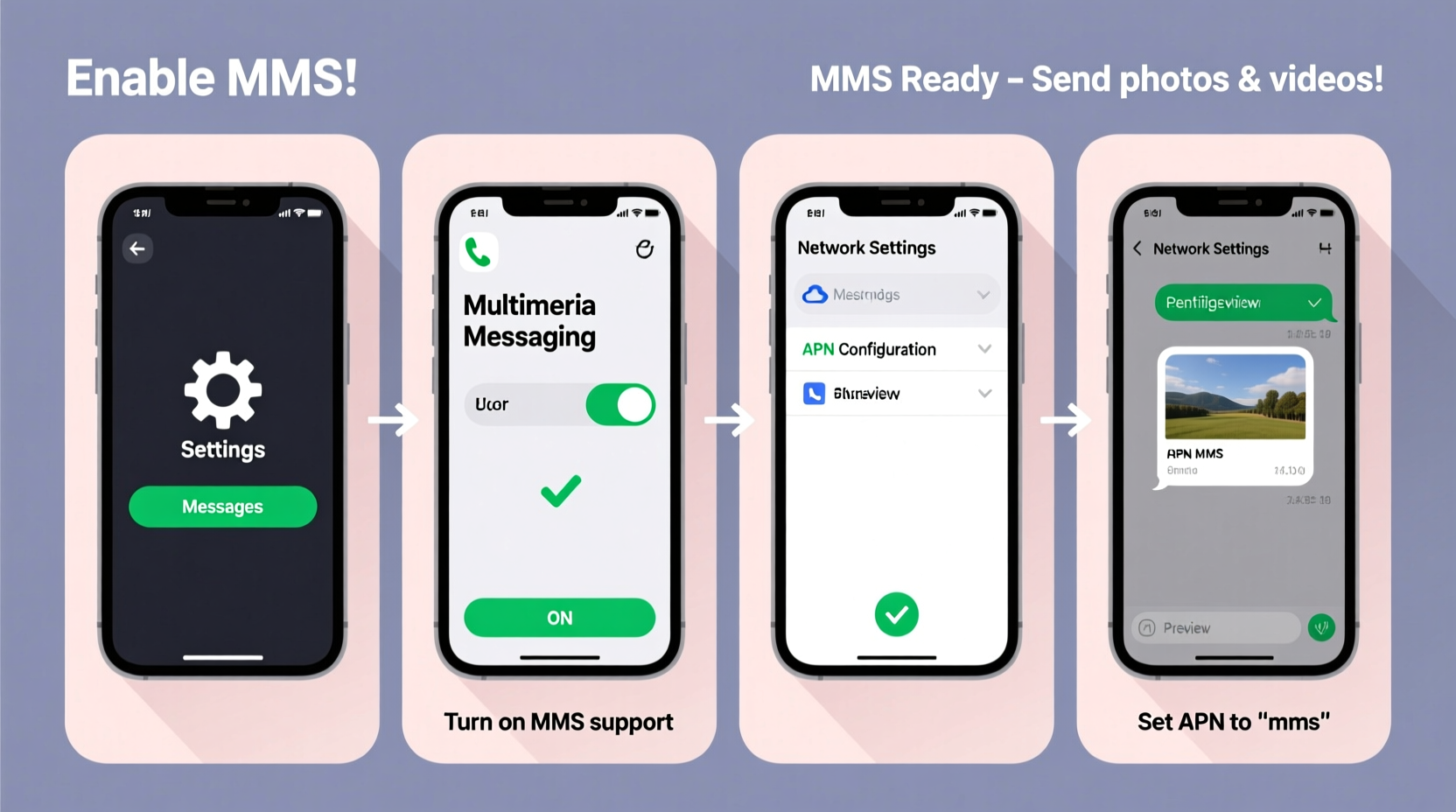
SMS (Short Message Service) supports only plain text up to 160 characters. When you attach a photo, video, or even a long message that exceeds this limit, your phone automatically attempts to send it as an MMS. Unlike SMS, MMS requires mobile data connectivity and proper APN (Access Point Name) settings to function.
Without correct configuration, your device may fail to send pictures, display error messages like “Message failed” or “Cannot download message,” or fall back to sending links instead of embedded media—especially common in group chats.
“MMS relies on both cellular data and carrier-specific settings. If either is misconfigured, media messages won’t go through.” — David Lin, Mobile Network Engineer at T-Mobile
Step-by-Step Guide to Enable MMS on Android
Android devices vary by manufacturer and carrier, so settings menus can differ slightly between Samsung, Google Pixel, OnePlus, and others. However, the core steps remain consistent.
- Ensure Mobile Data Is Enabled: Open Settings > Network & Internet > Mobile Network and toggle on “Mobile Data.” MMS cannot work over Wi-Fi alone unless your carrier supports Wi-Fi calling with MMS enabled.
- Verify APN Settings: Go to Settings > Network & Internet > Mobile Network > Advanced > Access Point Names. Tap your current APN (usually labeled “default” or your carrier’s name).
- Check Key MMS Fields: Confirm these values are correctly set (example shown for generic U.S. carriers):
- Name: Internet
- APN: fast.tmobile.com (T-Mobile), vzwinternet (Verizon), epc.tmobile.com (AT&T)
- MMS Proxy: Leave blank or use proxy.mobile.att.net (for AT&T)
- MMS Port: 80 or 8080
- MCC: 310 (U.S.)
- MNC: Varies by carrier (e.g., 410 for T-Mobile)
- Authentication Type: None or PAP
- APN Protocol: IPv4
- APN Roaming Protocol: IPv4
- Bearer: Unspecified
- Save and Restart: After verifying or updating the APN, save changes and restart your phone.
- Set MMS as Default: In your default messaging app (e.g., Messages), go to Settings > Advanced > Multimedia Messages and ensure auto-retrieve and send/receive are enabled.
Enabling MMS on iPhone (iOS)
iOS handles MMS differently than Android, often blending iMessage with traditional MMS. Misconfiguration here leads to green message bubbles (SMS/MMS) not supporting media.
- Turn On Cellular Data: Navigate to Settings > Cellular and confirm that Cellular Data is active. Also, ensure “Messages” has cellular access allowed.
- Enable MMS Messaging: Go to Settings > Messages and toggle ON “MMS Messaging.” If this option is grayed out, your carrier may not support MMS over SMS, or there's a provisioning issue.
- Disable iMessage Temporarily (if needed): If photos fail to send, turn off iMessage (Settings > Messages > iMessage) and retry sending as MMS. Re-enable afterward.
- Check Group Messaging: In the same menu, enable “Group Messaging” to allow multiple recipients via MMS.
- Reset Network Settings (Last Resort): If MMS remains broken, go to Settings > General > Transfer or Reset iPhone > Reset > Reset Network Settings. Note: This erases saved Wi-Fi passwords.
“iPhones require explicit permission to fall back to MMS when iMessage fails. Users often miss this setting, leading to undelivered photos.” — Sarah Kim, Apple Support Specialist
Common Issues and Troubleshooting Checklist
Even after following setup steps, some users still face problems. Use this checklist to diagnose and fix recurring MMS issues.
- ✅ Mobile data is turned on
- ✅ Airplane mode is off
- ✅ Correct APN settings applied (Android)
- ✅ “MMS Messaging” enabled (iPhone)
- ✅ Carrier supports MMS (contact customer service if unsure)
- ✅ SIM card properly inserted and activated
- ✅ No data cap reached or plan restriction
- ✅ Messaging app is updated to latest version
- ✅ Date and time settings are automatic
Carrier-Specific APN Reference Table
| Carrier | APN | MMS Proxy | MMS Port | MMSC |
|---|---|---|---|---|
| Verizon | vzwinternet | proxy.vzw.com | 80 | http://mms.vtext.com/servlets/mms |
| AT&T | epc.tmobile.com | proxy.mobile.att.net | 80 | http://mmsc.mobile.att.net |
| T-Mobile | fast.tmobile.com | Not required | 80 | http://mms.msg.eng.t-mobile.com/mms/wapenc |
| Sprint (Now T-Mobile) | cin.mnc012.mcc310.jltev.doa.sprintpcs.com | 166.130.159.251 | 80 | http://mmss.sprintpcs.com |
Real-World Example: Fixing MMS After Switching Carriers
Jamal switched from AT&T to Mint Mobile, a MVNO using T-Mobile’s network. After activation, he could make calls and browse the web, but every time he tried to send a photo to his family group chat, he received a “Failed to Send” error.
He checked his mobile data—it was on. He restarted his phone—no change. Then he remembered reading about APN settings. He went to Settings > Connections > Mobile Networks > Access Point Names and noticed the APN was still set to AT&T’s configuration.
He created a new APN with Mint Mobile’s recommended settings:
APN: tmobile
MMSC: http://mms.msg.eng.t-mobile.com/mms/wapenc
MMS Proxy: (blank)
MMS Port: 80
After saving and rebooting, he tested a photo message. It sent instantly. His group chat came back to life with shared memories.
Frequently Asked Questions
Why does my phone say “Downloading…” but never loads the picture?
This usually means MMS retrieval is blocked. Check if auto-retrieve is enabled in your messaging app. Also verify that mobile data is active and your APN settings include the correct MMSC URL. Some carriers block MMS on unlimited plans unless explicitly enabled.
Can I send MMS over Wi-Fi?
Generally, no—MMS requires a cellular data connection. However, carriers that support Wi-Fi Calling with MMS (like T-Mobile and Verizon) allow media messaging over Wi-Fi when enabled in settings. Look for “Send MMS over Wi-Fi” under Messages settings.
What happens if I exceed my data limit?
If your plan has a data cap and you’ve exceeded it, MMS may stop working until your billing cycle resets or you purchase additional data. Some carriers throttle or disable MMS when data limits are reached to prevent overages.
Final Steps for Seamless MMS Experience
Once MMS is enabled, maintain its functionality by keeping your software updated, monitoring carrier notifications, and periodically reviewing APN settings—especially after OS updates or SIM changes. Avoid third-party apps that override default messaging behaviors unless necessary.
For families, small businesses, or anyone relying on quick visual communication, a working MMS setup ensures smooth coordination without needing internet-based apps like WhatsApp or Telegram. It remains one of the most universally compatible ways to share moments directly through your phone number.




 浙公网安备
33010002000092号
浙公网安备
33010002000092号 浙B2-20120091-4
Comments
No comments yet. Why don't you start the discussion?