
Purchasing a cross pendant is more than a fashion choice—it can be a deeply personal symbol of faith, heritage, or identity. With rising demand for elegant yet affordable jewelry, many retailers now offer pieces that look strikingly similar at first glance. Among the most commonly confused are zircon and diamond cross pendants. While both can sparkle beautifully, their value, durability, and optical properties differ significantly. Understanding these differences is essential for making an informed, confident purchase.
This guide breaks down the key distinctions between zircon and diamond in cross pendants using practical inspection techniques, scientific principles, and real-world buying insights. Whether you're shopping for yourself, a gift, or as an investment, mastering these differentiators will protect your budget and ensure authenticity.
Understanding the Materials: Zircon vs. Diamond
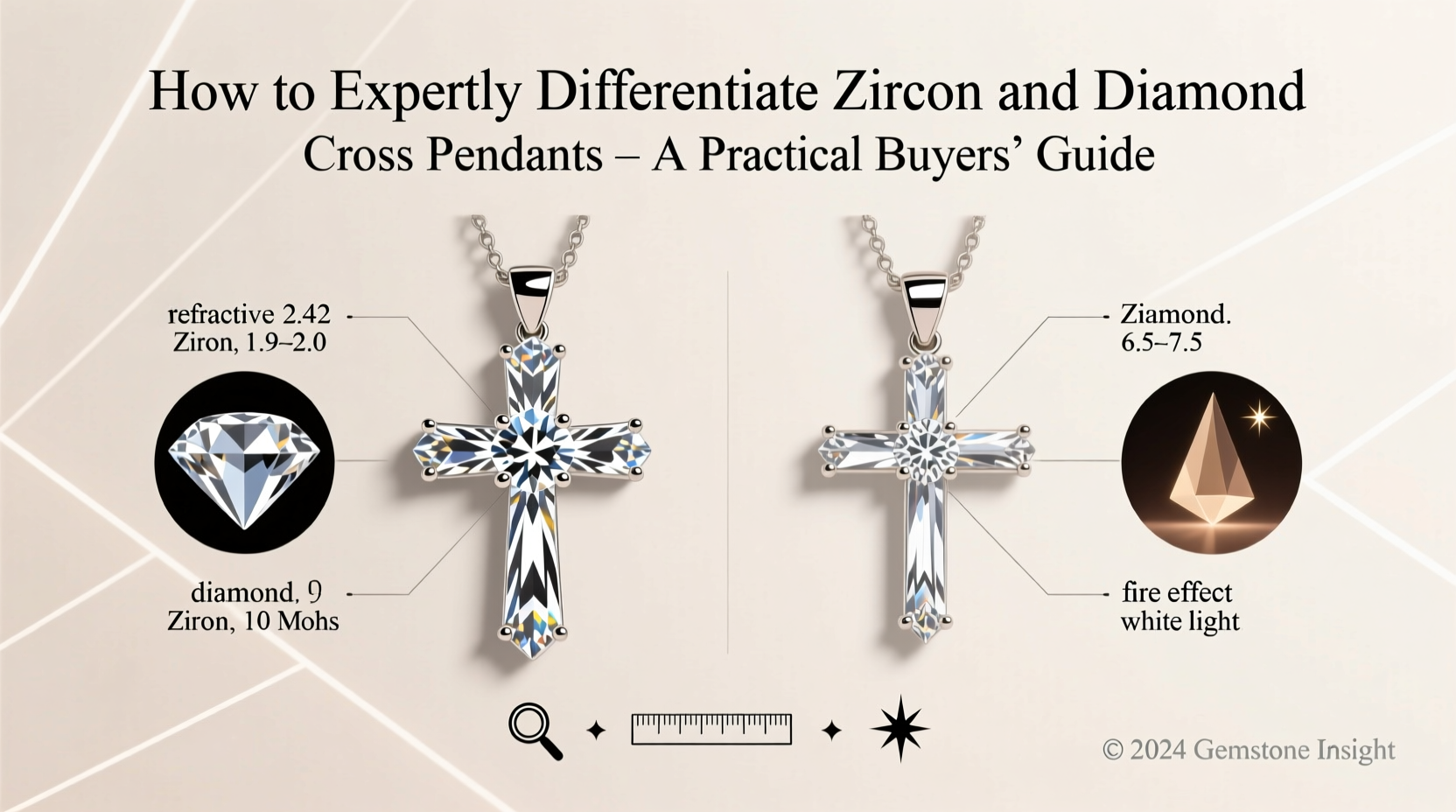
Before evaluating appearance or price, it’s crucial to understand what zircon and diamond actually are. Despite the similarity in names, they are entirely different materials—one natural gemstone, the other often mistaken for synthetic cubic zirconia.
Zircon (zirconium silicate) is a naturally occurring mineral found in various colors, including colorless when used in fine jewelry. It has been used for centuries and was historically mistaken for diamonds due to its brilliance. High-quality zircons exhibit strong fire (dispersion of light into spectral colors) and good hardness (6.5–7.5 on the Mohs scale), but they are still softer than diamonds.
Diamond, composed of pure carbon, ranks 10 on the Mohs hardness scale—the hardest known natural material. Its exceptional refractive index gives it unmatched brilliance and scintillation. Natural diamonds used in cross pendants are typically small melee stones (under 0.20 carats), set in gold or platinum settings.
Visual Inspection: Clues in Brilliance and Fire
The way a stone interacts with light provides immediate clues. Hold the pendant under natural daylight or a bright LED source and observe carefully.
- Diamonds reflect white light intensely (brilliance) with subtle flashes of color (fire). Their sparkle is sharp, crisp, and consistent from all angles.
- Zircons display excessive fire—rainbow-colored flashes that dominate over white light. This over-the-top dispersion is a red flag for non-diamond gems.
Another visual test involves reading text through the stone. Place the pendant face-down over printed text. A diamond’s high refractive index will distort or block the text completely. A zircon may allow some letters to remain visible due to lower refraction and double refraction (a property causing doubling of facet edges).
“Excessive fire is nature’s hint—when a stone looks like a disco ball, it’s likely not a diamond.” — Dr. Lena Torres, Gemologist, GIA Alumni
Physical Tests You Can Perform at Home
While professional grading is ideal, several simple tests can help rule out imitations without damaging the piece.
- Fog Test: Breathe on the stone to fog it. A real diamond disperses heat instantly, so the fog disappears in under two seconds. Zircon retains the fog slightly longer (3–5 seconds).
- Weight Comparison: If comparing side-by-side, zircon is about 40% heavier than a diamond of the same size. A noticeably heavier pendant may indicate zircon.
- Scratch Resistance: Never attempt to scratch the stone directly. However, if there are tiny nicks or scratches visible under magnification, the stone is likely softer than diamond—zircon can show wear over time.
Note: These tests are supportive, not definitive. Some treated or coated stones may mimic diamond behavior.
Expert Evaluation Tools and What to Look For
For serious buyers, investing in a few inexpensive tools can dramatically improve accuracy.
| Tool | Diamond Reaction | Zircon Reaction | Cost Range |
|---|---|---|---|
| Jeweler’s Loupe (10x) | Sharp, single-refracted facets | Doubled facet edges (birefringence) | $20–$50 |
| Thermal Conductivity Tester | Positive (beeps/lights) | No response (unless CZ-coated) | $80–$150 |
| UV Light (365nm) | Sometimes blue fluorescence | Common green or yellow glow | $25–$40 |
Using a 10x loupe, examine the girdle and crown. Zircon’s birefringence causes facet lines to appear doubled—a telltale sign absent in diamonds. Thermal testers measure how quickly the stone conducts heat; diamonds excel here, while zircons do not.
Real-World Buying Scenario: A Cautionary Tale
Sophia was drawn to a beautiful white gold cross pendant advertised as “diamond accent” at a local boutique. Priced at $395, it seemed like a steal. The salesperson emphasized the “sparkle” and “certified quality,” but no grading report was provided. At home, Sophia noticed rainbow flashes under sunlight—more intense than her sister’s engagement ring. She used a jeweler’s loupe borrowed from a friend and saw doubled facet lines. A visit to an independent appraiser confirmed: all stones were natural zircon, not diamond. The actual value? Around $120.
This case highlights the importance of skepticism when pricing seems too good to be true and underscores the need for verification beyond marketing terms.
Checklist: How to Verify Your Pendant Before Purchase
Use this checklist before finalizing any cross pendant purchase:
- ✅ Ask for a certificate from GIA, IGI, or AGS for any claimed diamond stones
- ✅ Inspect under natural light for excessive fire (rainbow flashes)
- ✅ Use a loupe to check for doubled facet edges (indicates zircon)
- ✅ Confirm the metal stamp (e.g., 14K, 585, PT950) matches the setting description
- ✅ Request a written appraisal from a certified gemologist
- ✅ Avoid vague terms like “diamond-like” or “gemstone accent” without specifics
Frequently Asked Questions
Can zircon be mistaken for diamond by professionals?
Not typically. Trained gemologists use refractometers and spectroscopy to distinguish them easily. However, untrained sales staff or online sellers may mislabel zircon as diamond, intentionally or not.
Is zircon a bad choice for a cross pendant?
No. Natural zircon is a legitimate gemstone with historical significance and beauty. It’s just important to pay a fair price—usually far below diamond. If you love the look and understand the material, it can be a meaningful, ethical choice.
Does a higher price always mean real diamonds?
Not necessarily. Some retailers markup zircon pendants heavily by using premium metals or branding. Always verify the stone type independently, regardless of price or packaging.
Final Advice: Shop Smart, Stay Informed
The emotional significance of a cross pendant makes authenticity especially important. Whether passed down, gifted, or self-purchased, knowing what you own adds lasting value beyond carats and clarity. Diamonds offer unmatched durability and prestige; zircons provide affordability and charm. Neither is inherently superior—it’s about accurate representation and informed consent.
Never hesitate to ask detailed questions, request documentation, or walk away if something feels off. Reputable jewelers welcome scrutiny and provide transparency. Remember: knowledge is your best authentication tool.




 浙公网安备
33010002000092号
浙公网安备
33010002000092号 浙B2-20120091-4
Comments
No comments yet. Why don't you start the discussion?