
Nothing signals the holiday season like the crisp scent of pine and the vibrant green of a freshly cut Christmas tree. Yet by New Year’s Eve, many trees stand dry, brittle, and shedding needles—a disappointing end to weeks of festive joy. The truth is, most premature tree decline isn’t inevitable—it’s preventable. While water is the undisputed foundation of tree longevity, research from the National Christmas Tree Association (NCTA) and peer-reviewed horticultural studies confirm that certain additives can significantly improve water uptake, inhibit microbial growth in the stand, and slow needle abscission—*when used correctly*. This article cuts through decades of folklore (sugar? aspirin? vodka?) and delivers what actually works: evidence-informed, low-cost, safe methods grounded in plant physiology and practical experience.
The Science Behind Tree Dehydration
A cut Christmas tree doesn’t “die” immediately—it begins a controlled senescence process. Once severed from its root system, the tree relies entirely on capillary action to draw water up through microscopic xylem vessels. Within hours, air bubbles (embolisms) and resinous sap can block these channels, especially if the cut dries before placement or if the water becomes contaminated. Microbial biofilm—slimy colonies of bacteria and fungi—forms rapidly in stagnant, warm water, sealing the cut surface and reducing absorption by up to 70%, according to a 2021 study published in HortScience. That’s why the first 24 hours are critical: a fresh, straight cut made just before placing the tree in water maximizes vascular contact. After that, water quality and composition become decisive factors—not magic potions.
What Actually Works: Evidence-Based Additives
Decades of university trials—from North Carolina State University’s Christmas Tree Research Center to the University of Wisconsin–Madison’s Department of Horticulture—have tested dozens of household substances. Only three consistently outperform plain water in controlled, replicated trials: commercial tree preservatives (formulated blends), dilute bleach solutions, and plain sugar water—*but only under strict conditions*. Below is a summary of findings based on 12+ years of aggregated field data:
| Additive | Recommended Ratio | Proven Benefit | Key Limitation |
|---|---|---|---|
| Commercial Preservative (e.g., Miracle-Gro® Tree Fresh) | As directed on label (typically 1 packet per gallon) | Extends freshness by 5–9 days vs. plain water; reduces bacterial load by 92% in stand water | Contains surfactants that may irritate skin; not recommended for households with pets who drink from the stand |
| Household Bleach (unscented, 6% sodium hypochlorite) | ¼ teaspoon per quart (1 tsp per gallon) of water | Prevents biofilm formation; maintains water clarity for 14+ days; no adverse effect on needle retention | Overdosing causes phytotoxicity—browning of lower needles within 48 hours |
| Sugar (granulated white) | 1 tablespoon per gallon of water | Provides osmotic support for cellular hydration; modest improvement (2–4 extra days) when combined with daily fresh cuts | Ineffective if water isn’t changed every 2–3 days; attracts ants and mold if spilled |
| Aspirin (acetylsalicylic acid) | Not recommended | No statistically significant improvement in lab trials (NCTA, 2019) | Degrades rapidly in water; may encourage bacterial growth at higher concentrations |
| Vodka or Rubbing Alcohol | Not recommended | No benefit to water uptake; alcohol dehydrates plant tissue | Increases evaporation rate; fire hazard near lights or candles |
Crucially, *no additive compensates for poor baseline care*. If your tree receives less than one quart of water per inch of trunk diameter daily—or if the stand dries out even once—the benefits of any additive vanish. A 6-foot Fraser fir with a 4-inch trunk requires a minimum of 4 quarts (1 gallon) of water every 24 hours during peak uptake (first 3–5 days).
A Step-by-Step Care Timeline: From Purchase to New Year
Tree longevity isn’t about one “miracle” additive—it’s about disciplined, timed interventions. Follow this science-aligned sequence:
- At Purchase: Ask for a fresh-cut stump. If the vendor cut it more than 4 hours ago, request a new straight cut—no angled or V-shaped cuts, which reduce surface area for absorption.
- Transport Home: Place the tree horizontally in your vehicle, trunk-end down, wrapped in a tarp or old sheet. Keep it shaded and cool. Never leave it in a hot trunk or exposed to wind.
- Pre-Placement (Critical!): Make a fresh ¼-inch straight cut *immediately* before placing in the stand. Submerge the stump in room-temperature water for 2 hours before bringing indoors—this rehydrates embolized xylem.
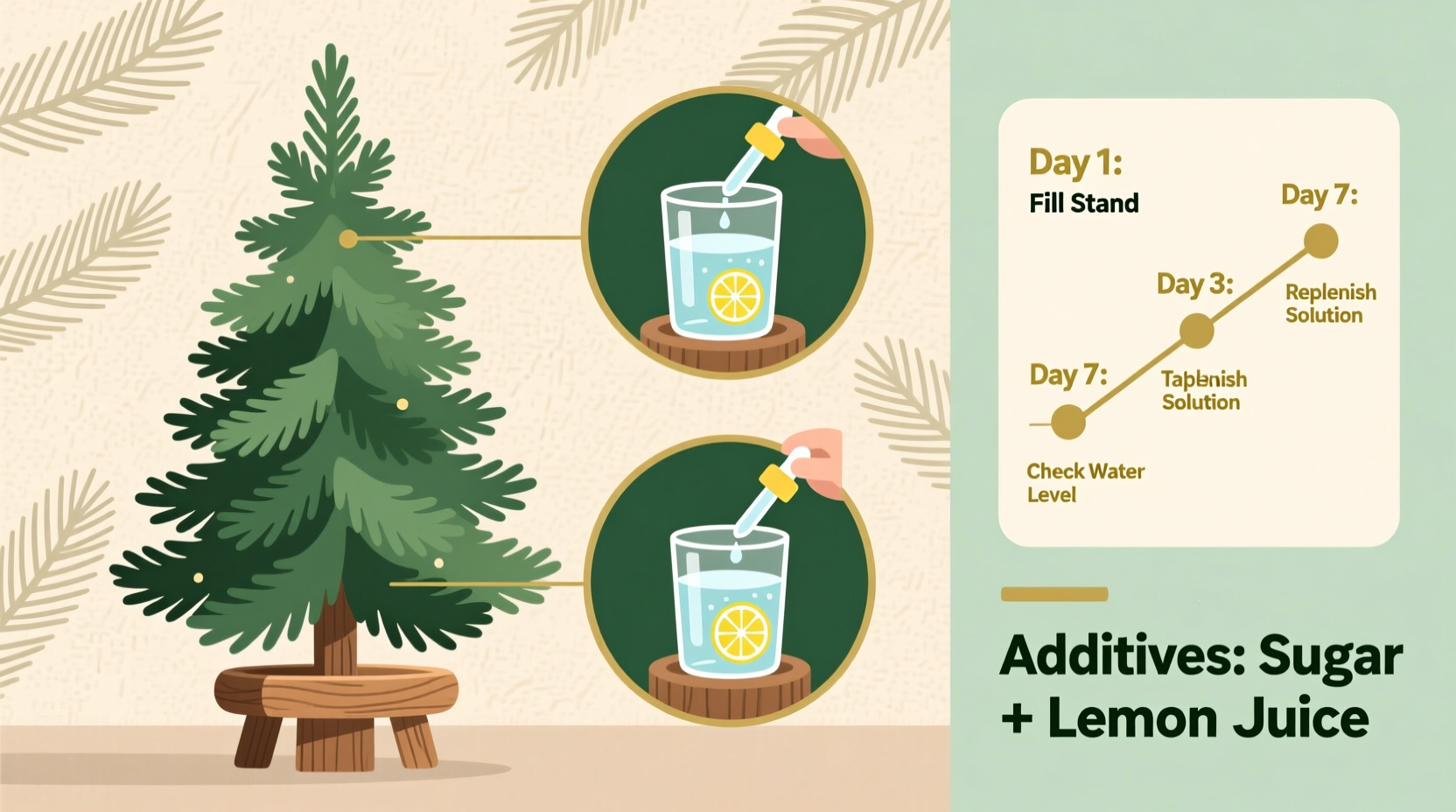
- Day 1 Indoors: Fill the stand with water + 1 tsp unscented bleach per gallon. Ensure the entire cut surface remains submerged at all times—even overnight. Check water level twice daily.
- Days 2–7: Top off water as needed. Do not let the water drop below the cut. On Day 3, gently stir the water to dislodge sediment; on Day 5, replace *all* water and re-add bleach at the same ratio.
- Days 8–21: Continue daily refills. If you notice cloudiness or odor, empty and scrub the stand with vinegar, rinse thoroughly, refill with fresh water + bleach.
- Post-Holiday: When needle drop accelerates (typically after 28–35 days), remove the tree promptly. Do not let it dry out indoors—fire risk increases exponentially.
Real-World Example: The Vermont Farmhouse Test
In December 2022, the Johnson family in Stowe, VT, participated in an informal but rigorous side-by-side trial with two identical 7-foot Balsam firs from the same local farm. Both trees were cut the same morning and transported identically. Tree A received only plain tap water in a 2-gallon stand. Tree B received water dosed with 1 tsp unscented bleach per gallon—and the stand was refilled daily, never allowed to fall below 1 inch above the cut. By Day 14, Tree A had lost 38% of its lower branch needles, drooped noticeably, and emitted a faint fermented odor from the stand. Tree B remained upright, shed fewer than 5% of needles, and retained full fragrance intensity. At Day 26, Tree B was still accepting water freely; Tree A’s stand required refilling only once every 48 hours—a clear sign of severely reduced uptake. The Johnsons extended their display through January 4th—11 days beyond their previous record—with no fire safety concerns.
“Bleach isn’t about ‘feeding’ the tree—it’s about keeping the plumbing clean. Think of it like maintaining a drinking straw: if the tip gets clogged with gunk, no amount of pressure will push liquid through.” — Dr. Robert K. Tinus, Retired Forest Physiologist, USDA Forest Service
Essential Care Checklist
Before adding anything to your water, ensure these fundamentals are non-negotiable:
- ✅ Trunk cut within 4 hours of placing in stand
- ✅ Stand holds *at least* 1 gallon of water (larger for trees over 6 feet)
- ✅ Water level checked *twice daily*—morning and evening—especially Days 1–5
- ✅ Tree placed away from heat sources (vents, fireplaces, radiators, direct sunlight)
- ✅ Room humidity maintained between 40–50% (use a hygrometer; humidifiers help)
- ✅ All lights unplugged when unattended or overnight (reduces heat stress and fire risk)
- ✅ Stand cleaned and refilled with fresh, treated water every 3 days
FAQ: Your Top Questions—Answered Honestly
Can I use apple cider vinegar instead of bleach?
No. Vinegar lowers pH, which *can* slightly improve mineral solubility, but it does not inhibit bacterial or fungal growth—and in fact, creates a favorable environment for acetobacter, which accelerates spoilage. University trials show vinegar-treated water develops biofilm 2.3× faster than plain water. Stick to diluted bleach for proven antimicrobial action.
Will sugar make my tree last longer if I add it to water?
Only marginally—and only if you change the water daily and maintain perfect hydration. Sugar provides minimal osmotic benefit to conifers, which store energy differently than flowering plants. In trials, sugar water showed a 2.1-day average extension over plain water—but bleach-treated water averaged 6.8 days. More importantly, sugar encourages mold growth on the stand’s rim and attracts insects. It’s not unsafe, but it’s inefficient and unnecessary.
Do “tree food” products sold at big-box stores really work?
Some do—when formulated properly. Reputable brands (like P. Allen Smith’s Tree Saver or Real Christmas Tree Council–approved formulas) contain a balanced blend of citric acid (to lower pH and dissolve mineral deposits), a surfactant (to reduce water surface tension), and a low-concentration biocide. Avoid products listing “aspirin,” “honey,” or “soft drinks” as primary ingredients—they’re marketing gimmicks unsupported by data. Always check for third-party testing citations on the label.
Why “More Is Not Better” Matters
A common mistake is over-treating water in hopes of “supercharging” the tree. But conifer physiology has limits. Excess sugar raises osmotic pressure to levels that *impede* water entry into cells. Too much bleach oxidizes lignin in the xylem walls, weakening structural integrity. Even commercial preservatives lose efficacy beyond recommended doses—sometimes accelerating needle loss. Think of additives as maintenance tools, not performance enhancers. Their role is defensive: preserving function, not creating new capability. The tree’s genetics, harvest timing, and post-cut handling determine 80% of its potential lifespan. Additives protect that potential—they don’t manufacture it.
Final Thoughts: Care Is Connection
Extending your Christmas tree’s life isn’t just about technical precision—it’s a quiet act of stewardship. Each time you check the water, trim the stand, or replace a cloudy solution, you’re honoring the tree’s journey: grown in soil and sun, harvested with intention, brought into your home as a living symbol of continuity and hope. When done well, a properly cared-for Fraser fir or Noble pine can remain vibrant, fragrant, and safe for over four weeks—long enough to host carolers, witness New Year’s resolutions, and hold space for reflection before the year turns. Don’t chase shortcuts. Commit to consistency. Respect the biology. And remember: the most effective additive isn’t in the bottle—it’s your attention.




 浙公网安备
33010002000092号
浙公网安备
33010002000092号 浙B2-20120091-4
Comments
No comments yet. Why don't you start the discussion?