
Losing your Android phone is more than just inconvenient—it can mean losing access to personal data, banking apps, photos, and communication channels. The challenge intensifies when the device is turned off, out of battery, or in silent mode with no network connection. Unlike online tracking, locating a phone that’s offline requires foresight, preparation, and knowledge of both Google’s ecosystem and alternative recovery methods. Fortunately, even without an active internet connection, there are still viable ways to increase your chances of recovering your device—some of which rely on recent location history, Bluetooth signals, or pre-configured settings.
This guide walks through practical, real-world techniques to locate a lost Android phone when it's not connected to Wi-Fi or cellular data and isn’t making any sound. Whether you misplaced it under couch cushions or left it behind in a public place, these strategies combine technology, timing, and proactive habits to help you regain control.
Understanding the Limitations of Offline Tracking
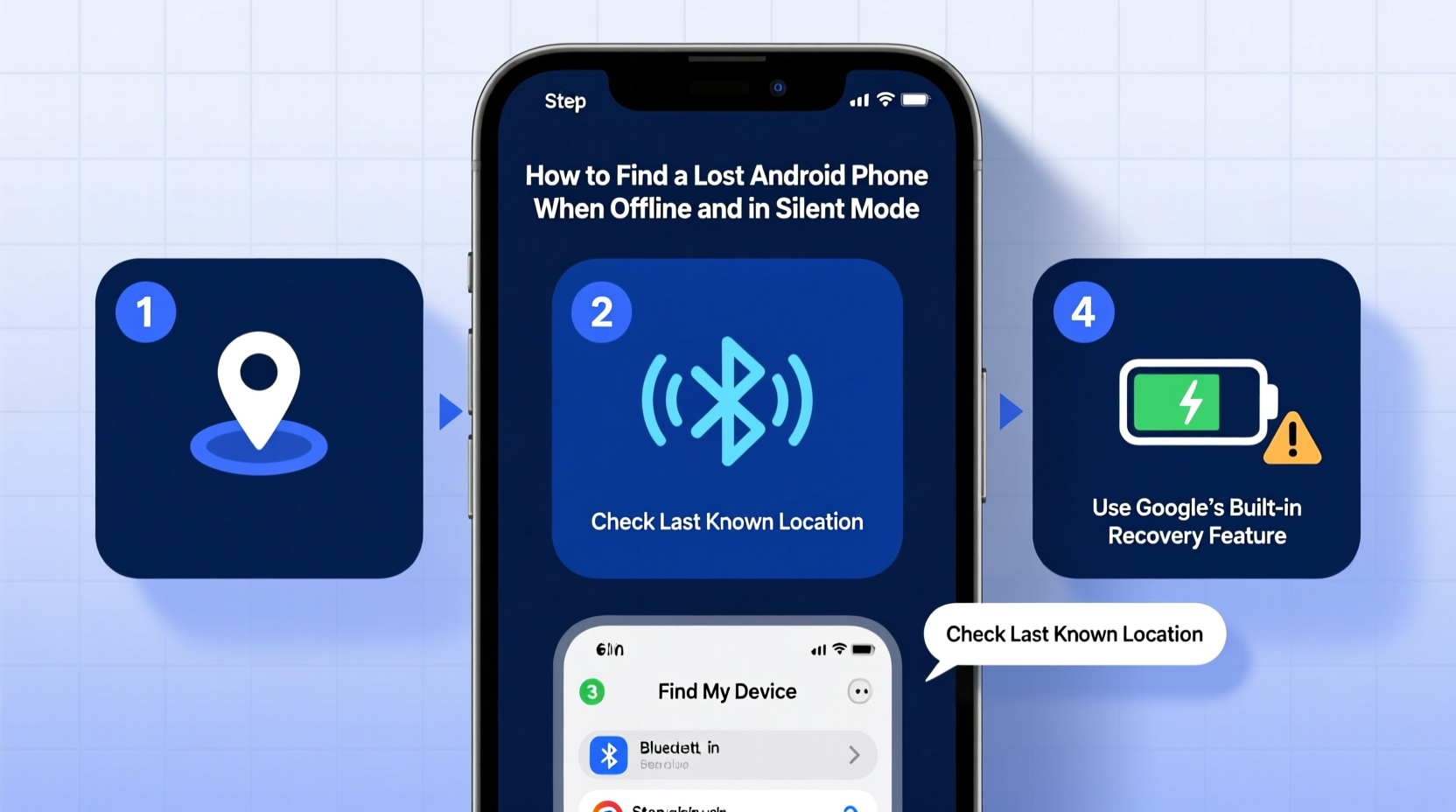
When a phone is powered off or disconnected from the internet, traditional GPS-based tracking stops working because location services depend on continuous data transmission. Google’s Find My Device service, for example, relies on the phone being online to report its current position. Once the device goes offline, only the last known location is available.
However, “offline” doesn’t always mean “untraceable.” Recent advancements in Bluetooth-based detection and background scanning allow certain features to passively gather information even when the screen is off or the phone is silenced. The key lies in what was enabled *before* the phone went missing.
“Most people don’t realize their phone can leave digital breadcrumbs even when it appears dead. It’s not magic—it’s preparation.” — Dr. Lena Torres, Mobile Security Researcher at CyberShield Labs
Without prior setup—like enabling location history, remote access, or third-party tracking apps—the odds of recovery drop significantly. That said, even after the fact, there are still steps you can take to improve your chances.
Step-by-Step Guide to Locating a Lost Android Phone
The following sequence outlines the most effective actions to take immediately after realizing your phone is missing. Speed matters: the sooner you act, the more accurate the data will be.
- Stay Calm and Retrace Your Steps
Before diving into digital tools, mentally walk through your last few hours. Did you use the phone at a café? Leave it in a taxi? Check common hiding spots like pockets, bags, or between car seats. - Use Google Find My Device (While It’s Still Active)
Go to findmydevice.google.com from another device. If your phone was online recently, you’ll see its last known location on a map. Even if it’s now offline, this snapshot may pinpoint where it was last active. - Check Location History (If Enabled)
If you have Location History turned on via your Google Account, visit Google Timeline. This feature logs movement over time and might reveal the exact building or street where the phone stopped transmitting. - Ring the Device (Even in Silent Mode)
In Find My Device, select “Play Sound.” If the phone is nearby—even if set to silent or Do Not Disturb—it will ring at maximum volume for five minutes. This override function works as long as the device has power and isn’t in airplane mode. - Lock or Secure the Device Remotely
Select “Secure Device” to lock it with a PIN and display a custom message (e.g., “Reward if found – Call 555-1234”). This protects your data and increases the chance of honest return. - Enable Offline Finding Features
Newer Android devices support “Nearby Devices” detection. If someone else with an Android phone passes near your lost device, their phone can detect its Bluetooth signal and anonymously report its location back to you—provided this feature was enabled beforehand.
Alternative Methods When Standard Tools Fail
Sometimes, standard solutions aren’t enough—especially if the thief disables location services or removes the SIM card. In such cases, consider these supplementary approaches:
- Third-Party Tracking Apps: Apps like Cerberus, Prey Anti-Theft, or Where’s My Droid offer advanced features such as stealth拍照 (remote camera activation), SMS-triggered commands, and multi-device monitoring. These often work even when the phone is offline, provided they were installed and configured ahead of time.
- Bluetooth Beacon Detection: If you suspect the phone is somewhere in your home or office, use a Bluetooth scanner app on another device to search for undetectable signals. Some phones continue broadcasting low-energy Bluetooth pings even in sleep mode.
- Wi-Fi Network Reconnection Alerts: If you know which Wi-Fi networks your phone automatically connects to (home, work, favorite coffee shop), ask contacts or staff to watch for unfamiliar devices joining the network. You can also log into your router admin panel to check connected clients.
- IMSI Catcher Detection (Advanced): While not consumer-grade, some security professionals use RF detectors to identify active mobile signals. This is rarely practical for average users but highlights how determined efforts can sometimes recover devices based on residual emissions.
Real Example: Recovering a Phone Left in a Taxi
Sophia, a marketing consultant in Chicago, realized her Pixel 6 was missing after a late-night ride-share. She immediately opened Find My Device on her tablet. The phone showed as offline but had last been active near O’Hare Airport. However, Google Timeline revealed a more precise path: the phone moved along I-90 for 20 minutes before stopping at a gas station exit.
She called the ride-share company and provided the timestamp and location. Within two hours, the driver confirmed finding the phone in the back seat. Because she acted quickly and used historical data, she recovered it before the next passenger could take it.
This case illustrates the value of persistent location logging—even when real-time tracking fails.
Do’s and Don’ts When Your Phone Is Lost
| Do’s | Don’ts |
|---|---|
| Enable Find My Device and Location History in advance | Wait more than an hour before taking action |
| Use Google Timeline to view past movements | Assume the phone is gone forever just because it’s offline |
| Set up a lock screen message with contact info | Publicly post about the loss on social media (could aid thieves) |
| Install a trusted anti-theft app with offline triggers | Give remote access permissions to unverified apps |
| Contact carriers or authorities if theft is suspected | Keep using the same password across accounts after loss |
Prevention Checklist: Secure Your Phone Before It’s Lost
Recovery is difficult without preparation. Use this checklist to ensure your device is ready for emergencies:
- ✅ Enable Find My Device in Settings > Google > Find My Device
- ✅ Turn on Location Services and Location History
- ✅ Set up a strong lock screen PIN, pattern, or biometric authentication
- ✅ Install a reputable anti-theft app (e.g., Cerberus, Prey)
- ✅ Add a recovery contact and emergency info in Settings
- ✅ Regularly back up data to Google Drive or external storage
- ✅ Label your phone with a non-obvious identifier (e.g., “Property of Alex T.”)
- ✅ Test the “Play Sound” feature monthly to confirm functionality
Frequently Asked Questions
Can I track my Android phone if it’s completely powered off?
No real-time tracking is possible when a phone is off. However, Google stores the last known location before shutdown. On select Samsung and Google devices, ultra-wideband (UWB) chips and Bluetooth LE may allow limited proximity detection by other devices, even when powered down—but this requires specific hardware and pre-activation.
Does Airplane Mode disable Find My Device?
Yes. When Airplane Mode is on, all wireless signals—including Wi-Fi, cellular, and Bluetooth—are disabled, preventing location updates. However, if the phone was online moments before entering Airplane Mode, the last recorded location remains accessible via Find My Device.
What should I do if someone turns off my phone and removes the SIM?
Removing the SIM prevents calls and cellular data, but Wi-Fi-based location can still function if the device reconnects to a known network. Continue monitoring Find My Device. If the thief enables Wi-Fi later (even briefly), the phone may reappear online. Also, file a report with your carrier to blacklist the IMEI number, rendering the device unusable on most networks.
Conclusion: Preparedness Beats Panic
Finding a lost Android phone when it’s offline and silent isn’t guaranteed, but it’s far from hopeless. Success hinges on what you did *before* the moment of loss. Enabling location services, syncing with Google, and installing reliable tracking tools create a safety net that can pay off when disaster strikes.
Technology alone isn’t enough—timely action, logical thinking, and persistence matter just as much. By combining digital tools with human insight, many lost phones are recovered every day. Don’t wait until it’s too late. Take five minutes now to verify your settings, install a backup tracker, and test your recovery plan. That small effort could save you stress, cost, and data loss down the road.




 浙公网安备
33010002000092号
浙公网安备
33010002000092号 浙B2-20120091-4
Comments
No comments yet. Why don't you start the discussion?