
In an age of information overload, the ability to extract what matters—fast—is not just a skill, it's a necessity. Whether you're researching a medical diagnosis, verifying a news story, or preparing for a business meeting, sifting through noise to uncover accurate, relevant data separates informed decisions from guesswork. This guide delivers actionable methods to help you locate critical information efficiently, using structured approaches, trusted tools, and cognitive discipline.
1. Define Your Objective with Precision
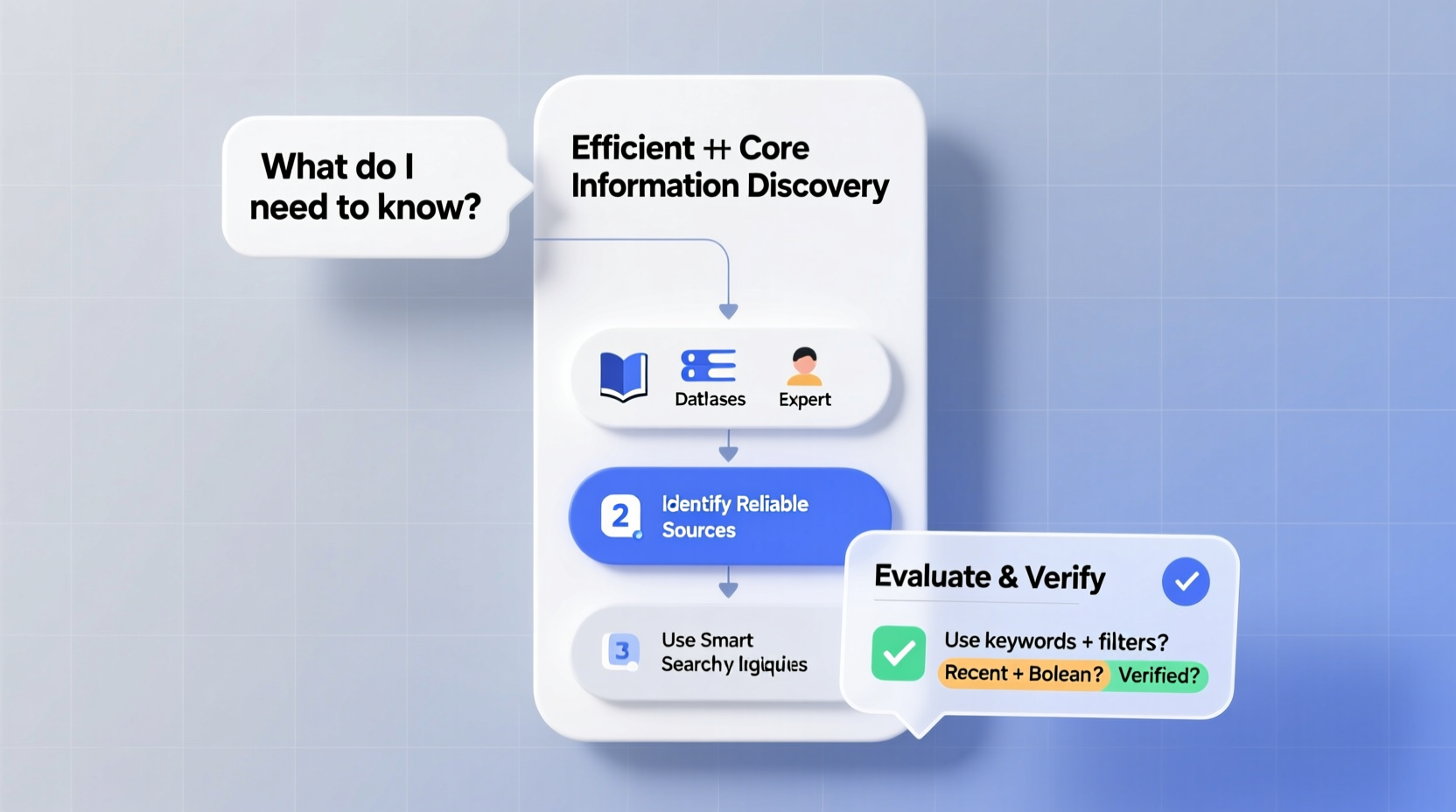
The first step in effective information gathering is clarity. Vague questions yield vague answers. Instead of asking, “Tell me about climate change,” refine your inquiry: “What are the top three causes of accelerated glacial melt since 2010?” Specificity reduces search volume and increases relevance.
Use the SMART framework to shape your query:
- Specific: What exactly do you need?
- Measurable: Can you quantify the outcome?
- Achievable: Is the information realistically accessible?
- Relevant: Does it align with your goal?
- Time-bound: By when do you need it?
2. Use Advanced Search Techniques
Most people use basic keyword searches and miss powerful filtering options. Mastering advanced search syntax can cut research time by up to 70%. These techniques work across major search engines like Google, Bing, and academic databases.
| Technique | Syntax | Example |
|---|---|---|
| Exact phrase | \" \" | \"remote work productivity study\" |
| Exclude terms | - | AI ethics -military |
| Site-specific search | site: | inflation forecast site:.gov |
| File type filter | filetype: | mental health statistics filetype:pdf |
| Time-limited results | Tools → Any time | Set to \"Past year\" or \"Past month\" |
For example, searching cybersecurity threats site:ncsc.gov.uk after:2023-01-01 returns only results from the UK’s National Cyber Security Centre published in 2023 or later.
3. Prioritize Reliable Sources
Speed means nothing without accuracy. Not all sources carry equal weight. Develop a hierarchy of trust based on authority, transparency, and peer validation.
“Information is only as valuable as its source. In high-stakes decisions, prioritize primary data over summaries.” — Dr. Lena Patel, Research Methodologist, University of Edinburgh
Rank sources by credibility:
- Primary sources: Original research, government reports, court documents.
- Secondary sources: Reputable news outlets (e.g., BBC, Reuters), academic journals, expert analyses.
- Tertiary sources: Summaries, encyclopedias, forums—useful for context but verify claims.
Avoid social media posts or unverified blogs unless they cite verifiable evidence. When in doubt, cross-check facts across at least two independent, authoritative sources.
4. Apply the 5-Step Rapid Research Framework
When time is limited, follow this repeatable process to extract key insights fast:
- Scan headlines and abstracts – Skim titles, executive summaries, and conclusions first.
- Identify key sections – Look for methodology, data, dates, and author credentials.
- Extract core facts – Note names, numbers, dates, and conclusions in bullet points.
- Verify contradictions – If two sources disagree, trace their references to find the origin.
- Summarize in one paragraph – Force yourself to condense findings. If you can’t, you don’t understand them.
Mini Case Study: Responding to a Sudden Job Market Shift
Maya, a mid-career marketing professional, learned her industry was facing AI-driven layoffs. She needed to assess viable career pivots within 48 hours for a strategic planning session.
She applied the rapid research method:
- Defined her goal: “Which adjacent roles have low automation risk and high growth in 2024?”
- Used
site:bureauoflaborstats.gov \"occupational outlook\" automation riskto find official projections. - Scanned LinkedIn job trends and Coursera enrollment data for emerging skills.
- Cross-referenced findings with a McKinsey report on future-proof careers.
Within six hours, she identified UX research and compliance analytics as strong options, complete with required certifications and average salaries. Her concise summary impressed her manager and shaped her upskilling plan.
5. Organize and Retain What You Learn
Gathering information is only half the battle. Without organization, insights vanish. Build a personal knowledge system that allows quick retrieval.
Choose a tool that suits your workflow:
- Notion – Ideal for structured databases with tags and links.
- Obsidian – Great for connecting ideas via backlinks.
- Google Keep or Apple Notes – Simple for quick captures.
Adopt the PARA method (Projects, Areas, Resources, Archives) to categorize information meaningfully. Tag entries with keywords like “health,” “finance,” or “urgent” for instant filtering.
“Your brain isn’t for storing information—it’s for processing it. Offload details to a trusted system so you can think clearly.” — Tiago Forte, productivity expert and creator of PARA
Checklist: Rapid Information Retrieval Workflow
- ☑ Define a specific, answerable question
- ☑ Use advanced search operators (quotes, site:, filetype:)
- ☑ Filter results by date and domain authority
- ☑ Extract key facts using bullet points
- ☑ Cross-verify critical claims with multiple sources
- ☑ Summarize findings in under 100 words
- ☑ Save and tag the information in your knowledge system
Frequently Asked Questions
How do I verify if a website is trustworthy?
Look for clear authorship, citations, contact information, and a transparent “About” page. Government (.gov), educational (.edu), and established nonprofit (.org) domains are generally more reliable. Check if the site corrects errors publicly—a sign of accountability.
Can I rely on AI chatbots for factual information?
Proceed with caution. While tools like ChatGPT can summarize concepts quickly, they sometimes generate plausible-sounding falsehoods (“hallucinations”). Always verify AI-generated responses against primary sources before acting on them.
What’s the fastest way to get up to speed on a new topic?
Start with a recent review paper or Wikipedia overview (for structure), then dive into cited sources. Watch expert interviews or conference summaries on platforms like YouTube or TED for conceptual clarity. Avoid deep dives until you grasp the big picture.
Conclusion: Turn Information Into Action
Finding important information quickly isn’t about skimming faster—it’s about thinking smarter. With precise questions, disciplined sourcing, and efficient systems, you can transform confusion into clarity in minutes, not days. The modern world rewards those who can separate signal from noise under pressure. Start applying these strategies today: refine your next search, verify one claim you assumed was true, or organize a pile of scattered notes. Small habits compound into powerful advantages.




 浙公网安备
33010002000092号
浙公网安备
33010002000092号 浙B2-20120091-4
Comments
No comments yet. Why don't you start the discussion?