
Speed is one of the most fundamental concepts in both physics and everyday life. Whether you're calculating how fast a car travels down a highway, determining the velocity of a thrown ball, or estimating your average walking pace, knowing how to accurately find speed is essential. Unlike velocity, which includes direction, speed is a scalar quantity—it only measures how fast something moves. This guide breaks down the process into clear, actionable steps, explains common pitfalls, and provides real-world examples to help you master speed calculations with confidence.
Understanding the Basics: What Is Speed?
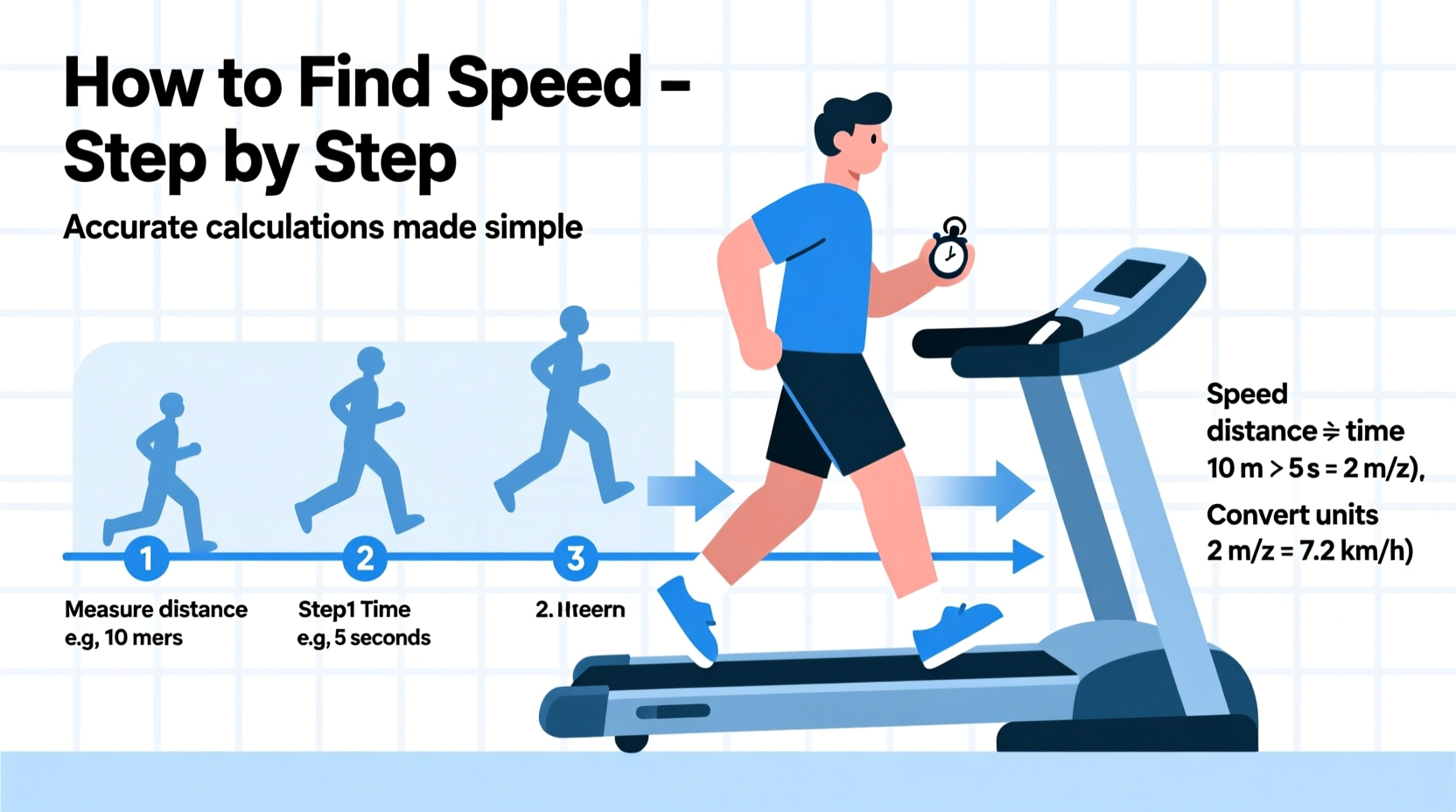
At its core, speed is defined as the distance traveled per unit of time. The standard formula used across disciplines is:
Speed = Distance ÷ Time
This formula applies whether you're measuring a sprinter’s dash or a spacecraft's journey. The units vary depending on context—common ones include meters per second (m/s), kilometers per hour (km/h), and miles per hour (mph). To calculate speed accurately, you must ensure that your units are consistent. For example, if distance is in kilometers and time is in minutes, convert time to hours before dividing.
“Speed isn’t just about motion; it’s about precision in measurement and understanding the relationship between space and time.” — Dr. Alan Reyes, Physics Educator
Step-by-Step Guide to Calculating Speed
Follow this structured approach to compute speed reliably every time.
- Determine the total distance traveled. Use tools like rulers, odometers, GPS devices, or maps to measure how far an object has moved. Ensure the measurement is in a standard unit such as meters, kilometers, or miles.
- Measure the time taken to cover that distance. Use stopwatches, clocks, or digital timers. Record time in seconds, minutes, or hours, depending on the scenario.
- Convert units if necessary. Align distance and time units. For instance, if distance is in kilometers and time is in minutes, divide minutes by 60 to convert to hours for km/h output.
- Apply the formula: Speed = Distance ÷ Time. Perform the division using a calculator or manually, depending on complexity.
- Round and report your result appropriately. Depending on context, round to a reasonable number of decimal places and include correct units (e.g., 65.4 km/h).
Types of Speed: Average vs. Instantaneous
Not all speed is measured the same way. Two primary types are commonly used:
- Average Speed: Total distance divided by total time. This gives an overall picture of movement over a period.
- Instantaneous Speed: The speed at a specific moment, often measured using sensors or radar guns. Think of a car’s speedometer showing current speed.
For example, a cyclist may have an average speed of 15 km/h over a 30-minute ride, but their instantaneous speed could spike to 25 km/h during a downhill stretch.
When to Use Each Type
| Type of Speed | Best Used For | Example |
|---|---|---|
| Average Speed | Journeys with varying pace, fitness tracking, fuel efficiency | Calculating your average running speed over a 5K race |
| Instantaneous Speed | Traffic enforcement, sports performance analysis, engineering | Police radar measuring a vehicle’s speed at a checkpoint |
Common Mistakes and How to Avoid Them
Even simple calculations can go wrong without attention to detail. Here are frequent errors and how to prevent them:
- Mixing incompatible units: Using miles with seconds without converting leads to incorrect results.
- Ignoring rest periods: Including breaks in travel time inflates duration and reduces calculated average speed incorrectly.
- Confusing speed with velocity: Remember, speed doesn’t consider direction—velocity does.
- Rounding too early: Premature rounding introduces inaccuracies. Wait until the final step.
Real-World Example: Planning a Road Trip
Sarah plans a 240-kilometer road trip and wants to estimate her average speed. She leaves at 8:00 AM and arrives at 11:30 AM, including a 30-minute lunch break. Her driving time is actually 3 hours (3.5 hours total minus 0.5-hour break).
Using the formula:
Speed = 240 km ÷ 3 h = 80 km/h
This calculation helps Sarah understand her effective travel rate and plan future trips more accurately. Without subtracting the break, she’d get 240 ÷ 3.5 ≈ 68.6 km/h—a misleading figure that underestimates her actual driving speed.
Practical Tips for Accurate Measurements
Whether you’re a student, athlete, or driver, these strategies improve accuracy:
- ✅ Measure distance with calibrated tools (ruler, GPS, app)
- ✅ Use precise timing devices (digital stopwatch, smartphone timer)
- ✅ Exclude stops when calculating average moving speed
- ✅ Convert all units to match (e.g., km and hours, not km and minutes)
- ✅ Repeat measurements for consistency, especially in experiments
Frequently Asked Questions
Can speed be negative?
No. Speed is a scalar quantity and always non-negative. While velocity can be negative (indicating direction), speed only reflects magnitude. If an object returns to its starting point, its average velocity may be zero, but its average speed will still be positive because distance traveled is never zero unless there’s no movement.
How do I calculate speed if acceleration is involved?
If an object accelerates uniformly, you can use the formula: Final Speed = Initial Speed + (Acceleration × Time). For average speed under constant acceleration: (Initial Speed + Final Speed) ÷ 2. These are useful in physics problems involving vehicles speeding up or slowing down.
Is there a difference between 'rate' and 'speed'?
In many contexts, they’re used interchangeably. However, “rate” is broader—it can refer to any change over time (e.g., heart rate, data transfer rate). “Speed” specifically refers to the rate of motion through space.
Conclusion: Mastering Speed for Everyday Success
Understanding how to find speed accurately empowers better decision-making in academics, transportation, fitness, and technology. From planning efficient commutes to analyzing athletic performance, the ability to calculate speed correctly enhances both practical and analytical skills. By following the step-by-step method, avoiding common errors, and applying real-world checks, anyone can perform these calculations with confidence.




 浙公网安备
33010002000092号
浙公网安备
33010002000092号 浙B2-20120091-4
Comments
No comments yet. Why don't you start the discussion?